Coating Additives Insights & Technical Guides
Industry insights, technical articles and practical formulation guides from ASTRA experts

Latest insights
Technical articles and company news
TSCA Compliance for Additives: A Formulator's Guide
TSCA Compliance for Additives: A Formulator's Guide ! Formulator reviewing an additive compliance file TSCA compliance for an additive comes down to one determination made before the first kilogram is manufactured or imported: whether the chemical substance is on the TSCA Chemical Substance Inventor…

Additive Supplier Collaboration: 2–3 Partners, Faster Formulation
Additive Supplier Collaboration: 2–3 Partners, Faster Formulation ! Formulation scientists reviewing an additive trial sample Collaborating with additive suppliers moves procurement from transactional buying to joint formulation and faster product improvements.
Custom Additive Formulation: Vet Four Chemistry Classes Before Scale Up
Custom Additive Formulation: Vet Four Chemistry Classes Before Scale Up ! Small-batch coating samples on a lab bench A custom additive formulation delivers targeted dispersion, foam control, or rheology performance that off-the-shelf chemistries cannot match, backed by supplier documentation that sa…

Gloss Haze in Coatings: 5 Causes, From Polish to Formulation
Gloss Haze in Coatings: 5 Causes, From Polish to Formulation ! Hazy band across a glossy black coating Reflection haze is a milky scattering of light near the specular highlight on an otherwise glossy film, and when it appears right after polishing or application, an isopropyl alcohol wipe followed…

Millbase Viscosity Control: Replace One Target with Shear Windows
Millbase Viscosity Control: Replace One Target with Shear Windows ! Disperser mixing pigmented millbase in vessel Stable millbase viscosity comes from defining a shear-specific rheological profile, selecting dispersant and rheology modifier chemistry suited to the pigment and equipment, and controll…
Formulators: Tune Thixotropy to Reach 90% Recovery in Under 1 Minute
Thixotropy control means managing two linked phenomena: structural breakdown under shear and recovery once shear stops, and we tune both through formulation chemistry and process parameters rather than one alone. The primary levers are rheology modifiers, dispersants, and polycarboxylate ether dosing, paired with measurement targets such as recovery ratio and recovery time from a [3-interval thixotropy test](https://wiki.anton-paar.com/us-en/basics-of-thixotropy/). When done correctly, this delivers anti-sag performance, reliable pumpability, and controlled leveling in the same formulation.

Avoid Six Week Recoat Failures with Astra R&D Defoamers for Formulators
When recoatability is the binding constraint, non-silicone defoamers or very low-dose, engineered polysiloxanes outperform conventional silicone chemistries because they minimize surface migration and intercoat contamination. The second lever is process control: incorporation shear, droplet or particle loading, and the add point (millbase versus let-down) determine whether a chemically sound defoamer behaves well in production. We recommend validating both choices with ISO-style recoat testing before scale-up.

Coating Additives: Avoid Prop 65 60 Day Notices, Test Powder Exposure
Proposition 65 applies to coating additives when their handling, processing, or end use creates exposure above OEHHA Safe Harbor levels, not merely because a listed substance appears somewhere in the formulation. Formulators should treat exposure assessment, not chemical presence alone, as the operative test. The first practical step is to check the raw material against the current OEHHA list and map how the additive is likely to be encountered by workers or end users, prioritizing inhalation pathways before anything else.

No New Chemistry Needed: Pilot Scale Additive Testing for Formulators
Pilot-scale additive testing is the controlled, intermediate production stage that verifies additive performance and critical process parameters before commercial scale-up. It confirms formulation stability under realistic operating conditions, [identifies the process variables](https://www.callaghaninnovation.govt.nz/products/solve/capabilities/pilot-scale-processing/) that govern outcomes at production volume, and reduces the risk of costly surprises during full deployment. This article outlines the test sequence, measurement priorities, and a practitioner checklist formulation teams can apply directly.

Formulators & Procurement: 3 Plant Ready Fixes for Air Release in Epoxy
Air release in epoxy resin is the formulation and processing property that determines whether entrapped air escapes during mixing and cure or becomes a permanent void. Three levers correct poor air release: controlling the viscosity and cure profile so bubbles have time to rise, incorporating a compatible internal air-release additive, and tightening process and mix controls to limit air entrainment in the first place. Additive suppliers typically develop and qualify additive systems for exactly this problem, and formulators evaluating a fix are welcome to request samples for trial.

Screen 120 Additives in One DIA Run: Additive Screening for Formulators
For broad discovery work, LC/GC-HRMS non-targeted workflows identify the widest range of unknown or suspect additives in a single run. When regulatory compliance or trace-level quantitation is the goal, targeted LC-MS/MS or GC-MS methods in MRM mode deliver the sensitivity that non-targeted screening cannot match. Direct-analysis techniques and high-throughput or Bayesian optimization approaches serve triage and formulation-selection tasks where speed outweighs comprehensive sensitivity, provided every workflow is validated against matrix-matched standards with documented limits of detection, limits of quantitation, and recovery data.

Stop Recoat Failures: Astra's 4 Step Defoamer Compatibility Protocol
Stop Recoat Failures: Astra's 4 Step Defoamer Compatibility Protocol ! Isometric four-step compatibility testing illustration The right defoamer is the least incompatible chemistry that clears foam at the lowest effective dose, confirmed by a ladder study and correct incorporation.

Fix Defoamer Cratering Without Reformulating: Triage for Formulators
Fix Defoamer Cratering Without Reformulating: Triage for Formulators ! Isometric illustration of coating crater triage Most cratering blamed on a defoamer is a dispersion or contamination problem in disguise, not a formulation failure.
Stop Costly Resprays: 3 Lab Checks to Fix Gloss Loss in Paint
Gloss loss, often called dieback, is the dulling or hazing of a paint film after it appeared to cure normally, and it almost always traces back to solvents still trapped beneath the surface or a curing reaction gone wrong. The immediate action is simple: stop applying additional coats, give the film uninterrupted cure time in stable conditions, and check tack before deciding whether the problem is application error or something deeper in the formulation.

Formulators: 5 Lab Checks to Choose Silicone or Non Silicone Defoamers
Formulators: 5 Lab Checks to Choose Silicone or Non Silicone Defoamers ! Abstract comparison of defoamer chemistry Use silicone (PDMS) emulsions when the process tolerates trace siloxane and needs low-dose, broad-range knockdown across temperature and pH.
Map Failure Modes First to Cut Scale Up Risk in Additive Selection
Start by matching the dominant formulation failure mode to the additive family responsible for it, then run a short lab feasibility trial alongside a supplier capability check before committing to a line item. Selection decisions should be judged on compatibility, cost-in-use, compliance exposure, and scale-up risk, not unit price alone. The immediate next step is a targeted screening: one additive family, one failure mode, one qualified supplier willing to document the result.

Procurement First: Scale Additive Production Without Supply Delays
Scaling up specialty additive production is a re-engineering exercise, not a bigger version of the lab batch. Success depends on three non-negotiable pillars: engineered heat, mixing, and residence-time control; validated pilot evidence before capital is committed; and a qualified, redundant supply chain. Technical teams often support this work directly, offering procurement tests and formulation guidance that catch failure modes before they reach the plant floor.
Prevent Pigment Flocculation for Formulators: Astra's 4 Step Playbook
Pigment flocculation stops when three controls work together: proper wetting to displace air and open agglomerates, a dispersant chemistry anchored strongly enough to hold particles apart, and a rheological network that keeps them suspended once separated. If a batch shows early signs of flocculation, run a wetting check first, then a quick shear and redispersion test, then a short accelerated stability check before you touch dosage.

Stop Scale Up Failures: Five Procurement Tests for Formulation Support
The best formulation support pairs a technical additive partner with documented lab-to-pilot validation, not a data sheet and a sales call. It means the supplier evaluates candidates against performance, compatibility, compliance, process stability, and cost-in-use before anything reaches your plant. Procurement teams should require this evidence up front. Custom formulation guidance can be structured around this framework.
5 Lab to Plant Tests to Choose an Antifoam for PSA Adhesives
5 Lab to Plant Tests to Choose an Antifoam for PSA Adhesives ! PSA adhesive antifoam testing title card Start defoamer trials with an organo-modified silicone and a compatible polyether-based non-silicone chemistry, run side by side.

Formulators: 3 QC Metrics to Qualify a Coating Additive Producer
Formulators: 3 QC Metrics to Qualify a Coating Additive Producer ! Coating additive quality control title card A coating additive producer is a manufacturer that formulates, tests, and supplies dispersants, defoamers, rheology modifiers, and related performance chemicals, backed by technical support…
Measure Thixotropy in Adhesives With Step Shear and 3iTT to Stop Sag
Measure Thixotropy in Adhesives With Step Shear and 3iTT to Stop Sag ! Illustrated thixotropy measurement title card Thixotropy in adhesives is a time-dependent, reversible drop in viscosity under shear that recovers gradually once shear stops, not instantly like simple shear-thinning.
Four Lab Checks Formulators Use to Fix Haze in Clearcoats, from R&D
Four Lab Checks Formulators Use to Fix Haze in Clearcoats, from R&D ! Clearcoat haze troubleshooting title card Haze in clearcoats almost always traces back to one of five sources: particle scattering, refractive-index mismatch, poor millbase dispersion, additive migration, or moisture entrapment du…
Knock Foam Down in One Shift: Plant R D Playbook for Polymer Emulsions
Knock Foam Down in One Shift: Plant R D Playbook for Polymer Emulsions ! Polymer emulsion foam title card illustration The fastest, most reliable way to control foam in emulsion polymerization is a compatibly tuned silicone-polyether defoamer, or a screened mineral or molecular alternative, dosed at…
Formulators' Lab to Plant Playbook for Pigment Dispersion plus DLS
Formulators' Lab to Plant Playbook for Pigment Dispersion plus DLS ! Pigment dispersion laboratory title card illustration Most pigment dispersion issues trace back to one of four culprits: poor wetting, a dispersant mismatch or dosage error, letdown solvent stripping the dispersant off the pigment…

Coating Chemists: 4-Step Lab Diagnosis for Flooding and Floating
Coating Chemists: 4-Step Lab Diagnosis for Flooding and Floating ! Coating defect diagnosis title card illustration Flooding is a uniform surface color shift caused by vertical pigment migration during film formation, while floating produces streaks or mottled patches from horizontal pigment separat…

Formulators: Process First Foam Control for Mixing (Save up to 8%)
Formulators: Process First Foam Control for Mixing (Save up to 8%) ! Foam control mixing process title card Foam during mixing is typically controllable when process fixes come first and chemistry comes second: reduce vortexing, switch to under-surface powder induction or inline recirculation, and r…
Reduce Milling Time 20–60% for Formulators With Production Tested Tactics
Reduce Milling Time 20–60% for Formulators With Production Tested Tactics ! Decorative milling efficiency title card illustration To reduce milling time most reliably, prioritize media selection (smaller, higher-density beads), raise controlled tip speed and flow rate for multiple-pass grinding, and…
5 Variables Formulators Must Screen Before Custom Defoamer Formulation
5 Variables Formulators Must Screen Before Custom Defoamer Formulation ! Decorative custom defoamer formulation title card A custom defoamer formulation is justified once an off-the-shelf product fails repeatedly under real process conditions, whether from extreme pH, high surfactant load, elevated…
Formulators: Inkjet Pigment Dispersion Specs to Prevent Nozzle Failures
Formulators: Inkjet Pigment Dispersion Specs to Prevent Nozzle Failures ! Inkjet pigment dispersion technical title card An inkjet pigment dispersion is a concentrated suspension of milled pigment particles stabilized in a liquid carrier, engineered to jet cleanly through a printhead without settlin…
Reproduce Paint Yield Stress for Formulators & Labs with ASTM D7836
Reproduce Paint Yield Stress for Formulators & Labs with ASTM D7836 ! Paint yield stress ASTM title card Yield stress is the minimum shear stress required to make a paint flow, and it governs the trade-off between resisting sag and settling while still leveling smoothly after application.
How to Achieve Uniform Effect Pigment Dispersion Without Losing Optical Effect
How to Achieve Uniform Effect Pigment Dispersion Without Losing Optical Effect ! Decorative title card with pigment and dispersant illustrations The best-practice route to stable effect pigment dispersion is controlled pre-wetting followed by measured mechanical energy, not brute-force milling.

What Causes Color Strength Loss in Coatings and Inks
What Causes Color Strength Loss in Coatings and Inks ! Decorative title card illustration for chemical coatings article Color strength loss is the measurable reduction in a pigment's tinting power, whether the culprit is poor dispersion, flocculation, a shift in pigment crystal phase, or damage from…
Wetting vs Dispersing: What Actually Separates the Two
Wetting vs Dispersing: What Actually Separates the Two ! Decorative title card illustration Wetting agents lower liquid surface tension so a resin or solvent can spread across a pigment surface; dispersing agents adsorb onto that wetted surface and keep particles apart once the mill has broken them…
Additive Lead Times: What to Expect and How to Shorten Them
Additive Lead Times: What to Expect and How to Shorten Them ! Decorative title card illustration Specialty formulation additives, including dispersants, defoamers, and rheology modifiers, typically move from purchase order to delivery in 10 to 30 days, according to chemical industry supply-chain dat…
How to Qualify Additive Suppliers Before the First Order
How to Qualify Additive Suppliers Before the First Order ! Decorative title card illustrating supplier qualification theme The minimum evidence required to approve a new additive supplier for a trial order is a Certificate of Analysis (CoA), a Safety Data Sheet (SDS), a Technical Data Sheet (TDS), a…
Achieving Stable Pigment Dispersion in Coatings and Inks
Achieving Stable Pigment Dispersion in Coatings and Inks ! Decorative title card illustration Achieving a stable pigment dispersion requires three sequential steps: wetting, deagglomeration, and stabilization.

Dispersant Pricing: A Procurement Buyer's Cost Guide
Dispersant Pricing: A Procurement Buyer's Cost Guide ! Decorative chemical industry title card illustration Standard-grade anionic and nonionic dispersants trade at $2.
Adhesive Pigment Dispersion Selection for Formulation Chemists
Adhesive Pigment Dispersion Selection for Formulation Chemists ! Decorative title card with chemical and pigment dispersion icons An adhesive pigment dispersion is a pre-dispersed pigment paste or suspension engineered to deliver stable, reproducible color and opacity when let down into an adhesive…
Dispersant Dosage Calculation: A Surface-Area Method
Dispersant Dosage Calculation: A Surface-Area Method ! Decorative title card illustration for dispersant dosage article Start with pigment surface area, not a percentage from a spec sheet.
Pseudoplastic vs Thixotropy: The Real Difference Explained
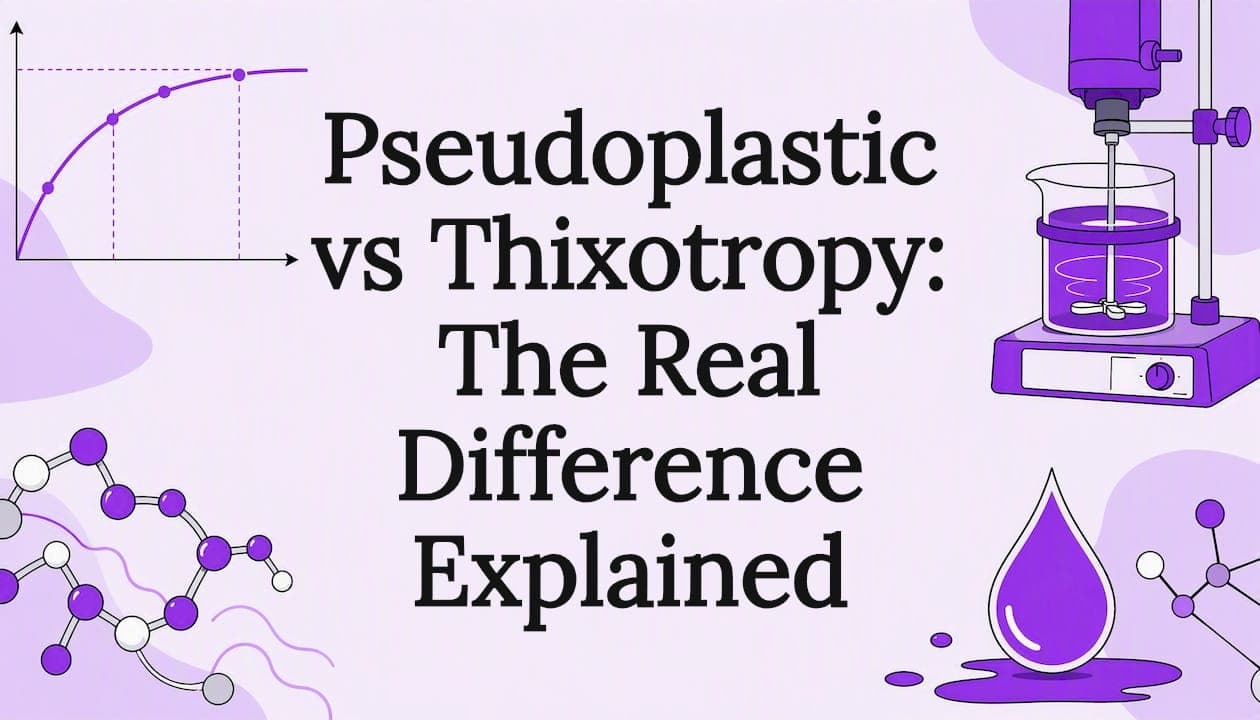
Pseudoplastic vs Thixotropy: The Real Difference Explained ! Decorative title card with rheology and chemical themes A material is pseudoplastic when its viscosity drops as shear rate increases, and that drop happens instantaneously, with no time lag.

Flow vs. Leveling in Coatings: A Formulator's Guide
Flow vs. Leveling in Coatings: A Formulator's Guide !

Zeta Potential in Dispersions: A Formulator's Guide
Zeta Potential in Dispersions: A Formulator's Guide ! Decorative graphical title card illustrating dispersion and zeta potential concepts Zeta potential is the electrokinetic potential at the slipping plane, the boundary between the tightly bound ion layer surrounding a particle and the bulk dispers…
Titanium Dioxide Dispersion: High-Solid, Low-Viscosity Guide
Titanium Dioxide Dispersion: High-Solid, Low-Viscosity Guide ! Decorative title card illustration for titanium dioxide dispersion article A low-molecular-weight sodium polyacrylate (PAAS) dispersant strategy, combined with a controlled order-of-addition and wet milling sequence, is the most reliable…

Carbon Black Dispersion: Practical Methods for Formulators
Carbon Black Dispersion: Practical Methods for Formulators ! Recommended Image Reliable carbon black dispersion requires three sequential actions: complete wetting of aggregate surfaces, controlled mechanical breakup of agglomerates, and chemical stabilization against re-agglomeration.
Fisheyes in Paint: Causes, Prevention, and Repair
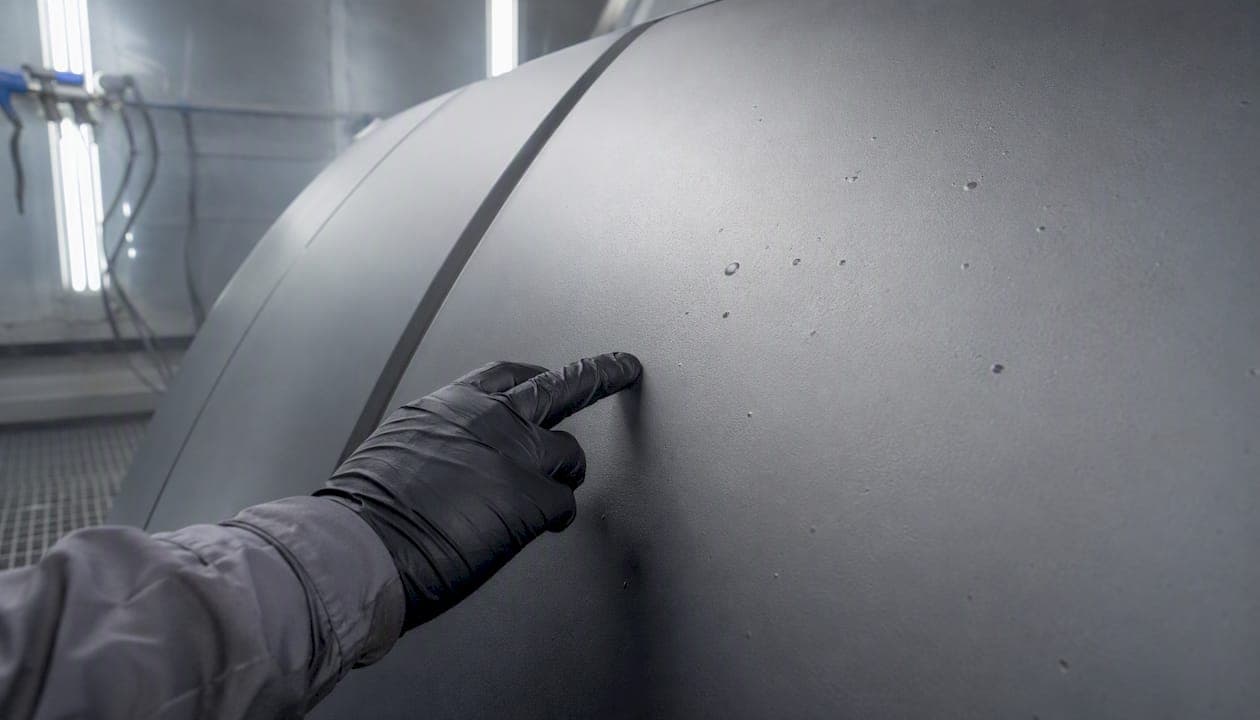
Fisheyes in Paint: Causes, Prevention, and Repair ! Close-up of fisheye paint defects on metal panel Fisheyes in paint are small, circular craters that form in a wet film immediately after spraying, where surface contamination or a surface-tension imbalance has repelled the coating from the substrat…
Additives for Epoxy Systems: A Complete Selection Guide
Why epoxy coatings and flooring systems fail without a purpose-built additive set, how defoamers, dispersants, leveling agents, adhesion promoters, reactive silicone modifiers, antistatic additives and thixotropes are matched to epoxy chemistry, and which formulation errors create craters, amine blush or poor adhesion on concrete.
Additives for Polyurethane Coatings: A Complete Selection Guide
Why 2K PU chemistry is ruled by the isocyanate, how reactive silicone modifiers bond into the PU network, and how to choose adhesion promoters, dispersants, defoamers, slip additives and rheology modifiers for solvent-borne 2K PU, waterborne PU and PU flooring systems.
Rheology Modifiers for Coatings: A Practical Selection Guide
Why rheology is the most underestimated property in paint formulations, how Newtonian, pseudoplastic and thixotropic behaviour differ, how associative acrylic, alkali-swellable, polyurethane and wax thickeners work in waterborne systems, and how to select and dose them without sagging or settling.
Defoamers for Coatings: Silicone vs Silicone-Free Selection Guide
How foam forms and survives, why the crater trade-off is physics rather than a product flaw, the two-stage addition rule, and the defoamer-wetting agent antagonism every formulator has to manage.

The Complete Guide to Coating Additives: Selection, Chemistry, and Formulation
A senior formulator's reference to the ten functional additive families that determine whether a coating works in the lab, on the line, and in the field.
Dispersants for Coatings: Selection, Chemistry and Dosage Optimisation
How dispersants work, how to match anchor chemistry to pigment type, how to find the optimal dosage with a three-point test, and the seven mistakes that quietly cost colour strength, gloss and shelf life.
Switching Coating Additive Suppliers: A Practical Migration Guide
How to audit your additive portfolio, match alternatives by function and chemistry instead of brand, run laboratory screening, production trials and customer qualification with minimal risk, and measure the real savings of a supplier switch.
Reactive Diluents and Functional Additives: The Complete Guide
Why reactive diluents cut viscosity without VOC and become part of the film, how terminal groups — OH, epoxy, amino, acrylate — determine compatibility, and how catalysts, siccatives, coalescents and pH buffers shape the cured film.
7 Critical Mistakes in Water-Based Coating Formulation
The seven formulation errors behind most water-based coating failures: why each happens, what it costs, and the specific additive and process changes that fix it.
Adhesion Promoters for Coatings: The Complete Guide
Why coatings delaminate on metals, plastics and repainted surfaces, how coupling agents build a chemical bridge between film and substrate, which chemistry matches which surface, and how to formulate and test adhesion reliably.
Levelling Agents: The Complete Guide to a Perfect Coating Finish
Why surface defects are a surface tension problem, how silicone and silicone-free chemistries differ, the recoatability trade-off that decides most selections, and how to use levelling additives for slip, soft-touch, hammer finish and anti-graffiti effects.
Wetting Agents for Coatings: The Complete Selection Guide
Why coatings crawl, crater and fish-eye, the difference between substrate wetting and pigment wetting, how static and dynamic surface tension decide which product to use, and how to select a wetting agent for waterborne, solvent-borne and UV systems.