Reproduce Paint Yield Stress for Formulators & Labs with ASTM D7836
Reproduce Paint Yield Stress for Formulators & Labs with ASTM D7836 ! Paint yield stress ASTM title card Yield stress is the minimum shear stress required to make a paint flow, and it governs the trade-off between resisting sag and settling while still leveling smoothly after application.
Yield stress is the minimum shear stress required to make a paint flow, and it governs the trade-off between resisting sag and settling while still leveling smoothly after application. The practical target for water-based thin-film coatings is straightforward: aim above 1 Pa at rest for storage stability, and below 0.25 Pa after high-shear application for leveling. ASTM D7836 is the standard formulators should test against.
TL;DR:
- Yield stress should be kept above 1 Pa at rest to prevent pigment settling and achieve storage stability, but below 0.25 Pa after shear to ensure proper leveling.
- Testing methods such as rotational rheometers and vane geometries can produce different yield stress results depending on sample structure and slip tendencies, highlighting the need for standardized procedures.
- Variations between labs in reported yield stress values are mostly due to measurement protocol differences, making consistent testing conditions essential for reproducibility.
- Additives like rheology modifiers increase yield stress by building internal networks, while dispersants lower it by stabilizing particles, requiring careful formulation adjustments.
- Proper sample conditioning, pre-shear, and rest times are critical steps in testing to obtain reliable, comparable yield stress data for formulation decisions.
Rheological yield stress is the stress threshold at which a paint's internal network of particles, polymer chains, and associative bonds breaks down and the material transitions from solid-like to liquid-like flow. Below that threshold, the coating behaves like an elastic gel: it resists gravity, holds pigment in suspension, and won't slump on a vertical surface. Above it, the network collapses and the material flows like a viscous liquid. This is not a fixed material property in the way tensile strength is for a cured film. It shifts with shear history, rest time, and temperature.
Formulators need to track two distinct values:
- Static yield stress — the stress needed to initiate flow from a fully rested, undisturbed state. This governs sag resistance on a vertical wall and pigment settling in a closed can.
- Dynamic yield stress — the stress at which flow stops once the material is already moving, typically lower than static yield because the network hasn't had time to rebuild. This governs leveling and brush-mark flow-out immediately after application.
One distinction trips up newcomers to the field constantly: rheological yield stress has nothing to do with mechanical yield strength, the point at which a cured, solid film permanently deforms under mechanical load. They share terminology by historical accident, not by physics. Likewise, thermochromic "stress paints" used in structural testing to visualize mechanical strain are an entirely separate product category from the rheology being discussed here.
How Yield Stress Predicts Sag, Leveling, and Suspension
A paint's measured yield stress correlates almost linearly with sag resistance on vertical or overhead surfaces. Push the value too low, and a thick coat slides before it sets. Push it too high, and the same coating won't level after application, leaving visible brush marks, roller stipple, or orange peel that never relaxes out. This tension is the central formulation problem in yield stress material design: the same property that keeps the paint hanging on a wall is the property that fights against a smooth finish.
The numbers that matter: technical guidance puts the storage-stability threshold at yield stress greater than 1 Pa at rest with low-shear viscosity above 50 Pa·s at 0.1 s⁻¹. After the high shear of brush or spray application, yield stress needs to drop below roughly 0.25 Pa to allow proper flow-out.
Yield stress also controls pigment and extender suspension over shelf life. A network with sufficient static yield stress prevents dense particles from settling into a hard cake at the bottom of the can, which is why pigment loading and rheology modifier selection have to be evaluated together rather than in isolation. In metallic and pearlescent systems, yield stress additionally governs flake orientation during drying. Too little structure and flakes tumble randomly as solvent or water leaves the film, killing the flop effect; too much and they never orient at all. Modeling work on drying paint films confirms this isn't a smooth continuum. There are critical yield stress values that mark distinct leveling regimes, where crossing a threshold can suppress leveling almost entirely rather than degrading it gradually.
Measuring Yield Stress: ASTM D7836 Methods Compared
ASTM D7836 is the reference standard for measuring yield stress in paints, inks, and related liquid materials, and it lays out several distinct approaches rather than one universal method. Choosing among them depends on the material's structure and how prone it is to wall slip.
- Rotational geometries (coaxial cylinder, cone/plate, plate/plate) on a controlled-stress rheometer, using a stress ramp to find the point where flow initiates.
- Vane spindle geometry, which shears the sample from within its own bulk and avoids the wall-slip problems that smooth rotational geometries can introduce in strongly structured dispersions.
- Falling needle viscometer (FNV), a non-rotational alternative useful for quick screening when a full rheometer setup isn't practical.
- Oscillatory amplitude sweep, tracking the elastic stress component (σ′) to infer the yield point from where the solid-like response breaks down, an approach SpecialChem's rheology guidance outlines as complementary to a direct stress ramp.
| Method | Best suited for | Main limitation |
|---|---|---|
| Rotational (cone/plate, plate/plate) | Well-dispersed, low-slip formulations | Prone to wall slip on structured systems |
| Vane spindle | Strongly structured, slip-prone dispersions | Requires specific geometry hardware |
| Falling needle (FNV) | Fast screening, QC environments | Less precise than rheometer methods |
| Oscillatory amplitude sweep | Cross-checking stress-ramp results | Requires interpretation of σ′ crossover |
A stress ramp is generally preferred when the goal is a single, reportable yield value for spec comparison. The oscillatory approach earns its place as a cross-check, particularly when a rheometer's stress ramp gives an ambiguous inflection point.
Why Yield Stress Results Vary Between Labs
Two labs testing the same batch of paint can report meaningfully different yield stress values, and the gap is almost always methodological rather than chemical. Geometry choice, gap setting, temperature control, and shear history before the measurement all shift the "apparent" yield stress reported. A sample sheared hard during transfer into the test cup and measured immediately will read differently than one given a defined rest period to rebuild its network, which is exactly why documenting protocol details is the single highest-leverage practice for reproducible reporting across formulation teams.
Every test report should include:
- Geometry type and gap size used.
- Pre-shear conditions (rate and duration) applied before the measurement.
- Rest time allowed after pre-shear and before the stress ramp.
- Test temperature, held constant across comparisons.
- Ramp rate, since faster ramps tend to overestimate yield stress.
Pro Tip: Standardize a fixed rest time (commonly 60 to 300 seconds) after pre-shear before every stress ramp in your lab's SOP. Comparing results across a formulation series is meaningless if one sample rested 30 seconds and another rested five minutes.
Additives That Raise or Lower Yield Stress
Yield stress is a network property, so anything that changes how particles and polymer chains interact in the can will shift it. Rheology modifiers and associative thickeners build structure by bridging particles or forming secondary networks, which raises both static and dynamic yield stress. Dispersants do close to the opposite: they coat particle surfaces, improve steric or electrostatic stabilization, and reduce the attractive forces that build yield stress in the first place, which is why dispersant selection is often the fastest lever for pulling an overstructured formulation back into a workable application window.
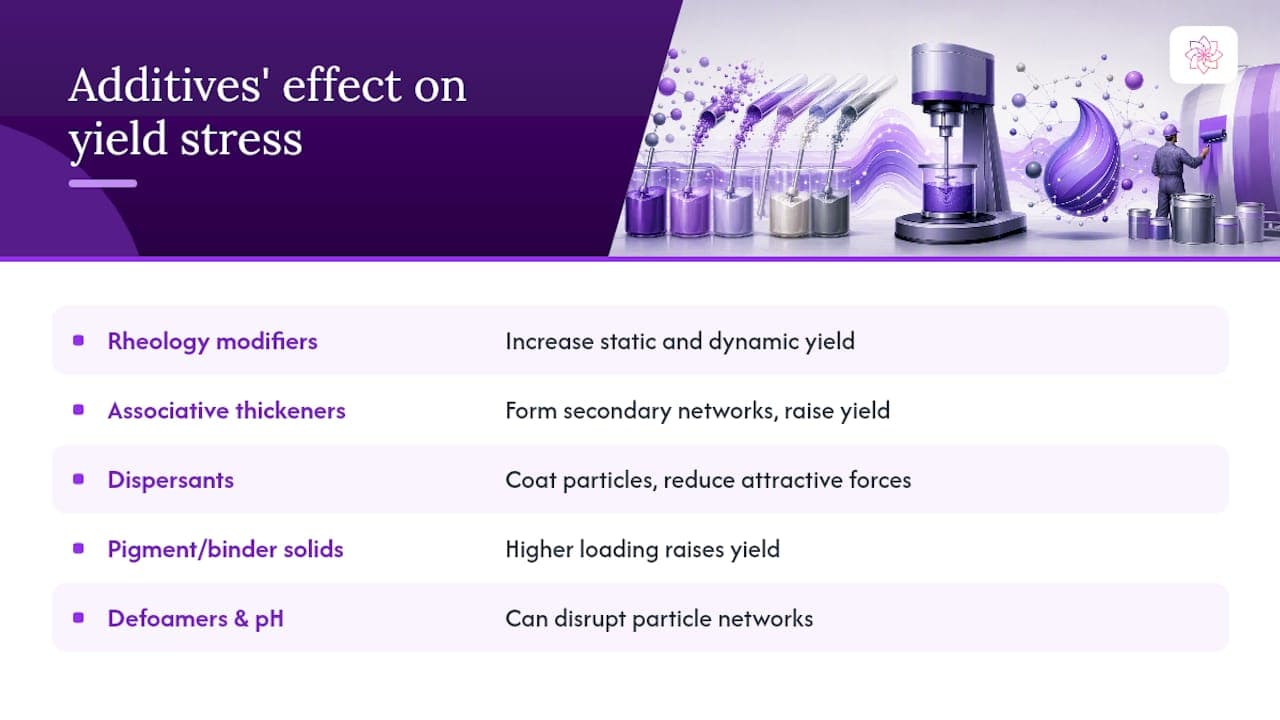
Particle loading and binder solids content matter just as much as any single additive. Higher pigment volume concentration generally raises yield stress independent of any rheology package, which is why reformulating a high-PVC coating often means adjusting dispersant dosage before reaching for a thickener at all.
Watch for cross-effects: defoamers can disrupt the same particle networks that give a formulation its structure, and shifts in pH or electrolyte concentration can collapse electrostatic stabilization unexpectedly. This is where rheology modifier selection benefits from close collaboration with an additive supplier who can flag known incompatibilities before a full batch trial.
Pro Tip: If a batch shows unexpectedly low yield stress after switching defoamer chemistry, check the defoamer's compatibility with your dispersant system first. It's a more common culprit than the rheology modifier dose.
A Step-by-Step Protocol for Reproducible Testing
A consistent protocol turns yield stress from a number you distrust into a number you can formulate against.
- Condition the sample at a controlled temperature (typically 25°C) for at least 30 minutes before testing.
- Apply a defined pre-shear (rate and duration fixed in your SOP) to erase loading history.
- Allow a fixed rest period to let the network rebuild before measurement.
- Select geometry based on structure: vane for slip-prone dispersions, cone/plate for well-dispersed systems.
- Run the stress ramp and record static yield, dynamic yield, low-shear viscosity at a defined rate, and tan δ where available.
- Compare against your target profile: if static yield falls below 1 Pa, suspect suspension stability issues; if dynamic yield stays above 0.25 Pa post-shear, expect leveling defects.
- Decide whether the fix is a formulation change (additive dose or type) or a process change (application shear rate, film thickness) before altering the base formula.
Astra R&D Perspective: Closing the Gap Between Data and Formulation
Yield stress numbers only matter once they change a formulation decision. Astra R&D Team's view is that supplier collaboration shortens that loop: sharing raw stress-ramp data with an additive partner lets dispersant dosage and rheology modifier selection get tuned in parallel rather than through blind trial and error. Request technical support to work through your specific profile.
— Astra R&D Team
Get Formulation Support for Your Yield Stress Targets
Hitting both storage stability and post-application leveling in the same formulation usually comes down to additive selection, not a full reformulation from scratch. Astra-chemical manufactures the dispersants and rheology additives that let you decouple those two requirements instead of compromising on one to protect the other. ASTRA DISP® is built to improve pigment wetting and reduce the particle interactions that push yield stress too high for good flow-out, while defoamer selection from the broader additive portfolio addresses the network disruptions that show up as inconsistent lab results. If your last stress-ramp data set didn't match your spec sheet, request a technical consultation and sample set to work through the profile with our formulation team.
Sources
- Rheology (SpecialChem) — Yield stress guidance
- D7836 Standard Test Methods for Measurement of Yield Stress of Paints, Inks and Related Liquid Materials (ASTM)
- Rheological characterization of paints and coatings (AZoM article)
- Leveling of a model paint film with a yield stress (Journal of Coatings Technology and Research)
FAQ
What is the difference between 0.2% proof stress and yield stress?
0.2% proof stress is a mechanical metric used for metals and cured solid materials that don't show a clear yield point on a stress-strain curve; it marks the stress producing 0.2% permanent strain. Rheological yield stress, the subject of this article, describes the stress needed to initiate flow in a liquid or paste, an entirely different physical phenomenon.
How do I calculate yield stress for a paint?
Yield stress isn't calculated from a formula. It's measured directly using a controlled-stress rheometer running a stress ramp, a vane spindle test, or an oscillatory amplitude sweep, per the methods in ASTM D7836.
Is there a paint that gives a wood effect?
Wood-effect finishes are achieved through specialty pigments, translucent glazes, and application technique rather than through yield stress tuning alone, though controlling flow behavior helps preserve the graining pattern during drying.
What is yield stress versus yield strength?
Yield stress describes the rheological threshold at which a liquid coating begins to flow, while yield strength describes the mechanical threshold at which a cured, solid film permanently deforms under load. The two terms share a name but describe unrelated properties measured with entirely different instruments.
What yield stress range should I target for a water-based coating?
Aim for greater than 1 Pa at rest for storage stability and below roughly 0.25 Pa after high-shear application for acceptable leveling. Values outside that range typically show up as either settling in the can or visible application defects.
Recommended
Testing additives for this application?
Send us your current formulation challenge and our technical team will recommend an ASTRA product package for lab screening.