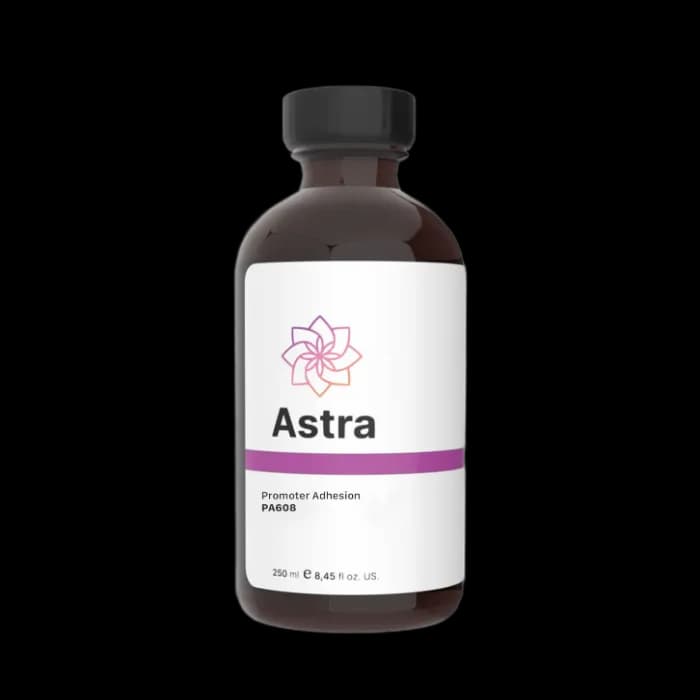
ASTRA PA®
Adhesion Promoters
Specialized additives to enhance adhesion strength between surfaces (metals, plastics, glass, composites). Modify surface, improve wettability and chemical compatibility.
Why use adhesion promoters?
Adhesion promoters enhance the bond between coatings and difficult substrates: plastics, metals, glass, composites. They modify surface energy and create chemical bridges for lasting adhesion.
Key Benefits
- Stronger bond to difficult substrates
- Works on plastics, metals, glass, composites
- Improved water and humidity resistance
- Better salt spray performance
- Reduced delamination risk
- Available for solvent and waterborne systems
Impact on Coating Performance
ASTRA PA adhesion promoters solve the most challenging substrate adhesion problems. Essential for coatings on polypropylene, stainless steel, glass and other low-energy surfaces.
P – organosoluble, WB – water-based, RC – radiation-curable
Product Catalog
Download TDS| Active % | Feature | TDS | Samples | |||
|---|---|---|---|---|---|---|
| ASTRA PA-1008 | DC-6030 | Radiation-curable | 100% | Contains unsaturated double bonds, suitable for radiation-curing systems. Reacts with resin and inorganic substrate. Improves adhesion, moisture resistance, heat resistance, resistance to salt fog. | ||
| ASTRA PA-108 | DC-6030 | Solvent-based / Radiation-curable | 100% | Contains unsaturated double bonds, can react with resin and substrates. Can participate in crosslinking of UV-curable systems. Improves paint durability. Used for surface treatment of fillers. | ||
| ASTRA PA-1108 | PM-2 | Radiation-curable | 100% | Contains unsaturated double bonds, suitable for radiation-curing systems. Can react with resin and inorganic substrate. Improves moisture resistance, heat resistance, resistance to salt fog. | ||
| ASTRA PA-1208 | Elementis-ADP | Solvent-based / Water-based | 75% | Good compatibility with thermosetting systems. Can participate in crosslinking of paintwork. Promotes adhesion to non-ferrous metals, improves impact resistance and elasticity. | ||
| ASTRA PA-1308 | Lubrizol-2063 | Solvent-based / Water-based | 60% | Good compatibility with resins, can react with melamine resins, NCO groups. Significantly improves adhesion to metals, moisture resistance, resistance to salt fog. | ||
| ASTRA PA-1408 | TEGO LTW | Solvent-based | 60% | Good compatibility with resins, improves paint adhesion, moisture resistance, and resistance to salt-mutuman. | ||
| ASTRA PA-1508 | — | Solvent-based / Water-based | 60% | Good compatibility with thermosetting systems. Can participate in crosslinking of paint and varnish coatings. Promotes adhesion to metal substrates, improves impact resistance. | ||
| ASTRA PA-1608 | DUPONT AA-75 | Solvent-based | 50% | The organotitanium compound becomes reactive at 60 degrees Celsius. Reacts with -COOH and -OH groups of the substrate and resin. Improves adhesion and heat resistance of paintwork. | ||
| ASTRA PA-1708 | PP adhesion promoter | Solvent-based / Radiation-curable | 20% | Modified chlorinated polyolefin significantly improves adhesion to polyolefin-based substrates, improves moisture resistance and salt fog resistance. | ||
| ASTRA PA-1808 | Water-born ASTRA-PA1708 | Water-based | 30% | Chlorinated polyolefin significantly increases the adhesion of paintwork to substrates based on polyolefins (especially polypropylene). Increases moisture resistance, resistance to salt fog. |
Articles about ASTRA PA®
Custom Additive Formulation: Vet Four Chemistry Classes Before Scale Up
Custom Additive Formulation: Vet Four Chemistry Classes Before Scale Up ! Small-batch coating samples on a lab bench A custom additive formulation delivers targeted dispersion, foam control, or rheology performance that off-the-shelf chemistries cannot match, backed by supplier documentation that sa…
Read
Coating Additives: Avoid Prop 65 60 Day Notices, Test Powder Exposure
Proposition 65 applies to coating additives when their handling, processing, or end use creates exposure above OEHHA Safe Harbor levels, not merely because a listed substance appears somewhere in the formulation. Formulators should treat exposure assessment, not chemical presence alone, as the operative test. The first practical step is to check the raw material against the current OEHHA list and map how the additive is likely to be encountered by workers or end users, prioritizing inhalation pathways before anything else.
Read
Formulators: 3 QC Metrics to Qualify a Coating Additive Producer
Formulators: 3 QC Metrics to Qualify a Coating Additive Producer ! Coating additive quality control title card A coating additive producer is a manufacturer that formulates, tests, and supplies dispersants, defoamers, rheology modifiers, and related performance chemicals, backed by technical support…
ReadNeed technical assistance?
Our team can help you select the right additive for your formulation.
Contact Technical Support