Coating Additives: Avoid Prop 65 60 Day Notices, Test Powder Exposure
Coating Additives: Avoid Prop 65 60 Day Notices, Test Powder Exposure ! Abstract Prop 65 exposure title card Proposition 65 applies to coating additives when their handling, processing, or end use creates exposure above OEHHA Safe Harbor levels, not merely because a listed substance appears somewher…

Proposition 65 applies to coating additives when their handling, processing, or end use creates exposure above OEHHA Safe Harbor levels, not merely because a listed substance appears somewhere in the formulation. Formulators should treat exposure assessment, not chemical presence alone, as the operative test. The first practical step is to check the raw material against the current OEHHA list and map how the additive is likely to be encountered by workers or end users, prioritizing inhalation pathways before anything else.
TL;DR:
- Exposure assessment for coating additives must focus on inhalation pathways during handling, transfer, and application, rather than solely relying on chemical presence.
- Safe Harbor levels are only available for some substances, requiring proactive testing or modeling to determine if warnings are necessary.
- Powders, spray application, and sanding generate different exposure risks, with unbound powders at highest risk and cured films generally posing low inhalation hazards.
- Compliance requires regular list checks, exposure pathway mapping, documented testing, and appropriate control measures or warnings based on exposure likelihood.
- Reformulation with lower-dust or encapsulated additives can significantly reduce Prop 65 exposure risk upstream, avoiding the need for consumer warnings.
The Office of Environmental Health Hazard Assessment maintains the official Proposition 65 list, updated periodically as new substances are evaluated for carcinogenicity or reproductive toxicity. Each listing entry identifies the chemical, its CAS number, the basis for listing, and, where one has been adopted, a Safe Harbor level. These figures come in two forms: the No Significant Risk Level for carcinogens and the Maximum Allowable Dose Level for reproductive toxicants. Exposure below these thresholds does not trigger a warning obligation; exposure above them generally does.
Many listed substances have no adopted Safe Harbor level. In that circumstance, the manufacturer carries the burden of estimating exposure through modeling or testing and deciding independently whether a warning is warranted. OEHHA does not make that determination for individual businesses.
- Download the current list in PDF, Excel, or CSV format directly from OEHHA and cross-reference every raw material by CAS number.
- Re-check the list at each formulation change, and at minimum annually, since new chemicals are added on an ongoing basis.
- Treat the absence of a Safe Harbor level as a flag for further exposure work, not as evidence of safety.
Common Prop 65 chemicals in coatings and additives
Coating additive formulations draw from several chemical classes that recur on the Proposition 65 list. Recognizing where each typically enters a formulation speeds up the raw material review process considerably.
- Phthalates, used as plasticizers in some resin and additive systems, appear frequently in older or lower-cost formulations.
- Heavy metals, including lead, cadmium, and nickel compounds, turn up in pigments, driers, and certain catalyst systems.
- Bisphenol A and related bisphenol variants occur in some epoxy resin chemistries and can migrate into coating additives during synthesis.
- Aromatic amines and select solvents, some used as curing agents or process solvents, carry listing status depending on specific substitution patterns.
- Polycyclic aromatic hydrocarbons, often riding along with carbon black or combustion-derived fillers, are a common contaminant class rather than an intentional additive.
- Flame-retardant classes and certain PFAS-related substances appear in specialty coatings requiring fire performance or surface repellence.
- Titanium dioxide and carbon black, both common pigments, carry inhalation-hazard status specifically in respirable particulate form.
Titanium dioxide and carbon black illustrate a listing quirk formulators must internalize: the cured-film exception means these pigments trigger inhalation concern as loose powder but generally not once locked into an intact, cured coating. The distinction between a raw material's hazard classification and its actual exposure potential in the finished product is the single most consequential judgment call in this entire compliance process.
Why exposure pathway matters for coatings: powder, spray, sanding, and cured-film scenarios
A chemical's presence on the OEHHA list says nothing about whether a given product needs a warning. Exposure pathway does that work, and coatings present a wider range of pathways than most product categories because the same formulation can exist as a dry powder, an aerosolized spray, a wet film, and a fully cured solid within a single production and use cycle.
- Powder coating manufacture and transfer generate the highest inhalation risk in the entire lifecycle, since operators handle unbound particulate directly.
- Spray application introduces both inhalation and dermal exposure routes, particularly in confined booth environments without adequate ventilation.
- Sanding or abrading a cured film can regenerate respirable dust from pigments and fillers that were otherwise bound into the matrix.
- Intact, cured films typically present low inhalation risk to the end consumer, since the cured-film exception documented in practitioner analysis of powder coatings recognizes that binding into a solid matrix removes the respirable-particle pathway.
- Food-contact coatings require a separate migration assessment, since 21 CFR Part 175 governs the safe use of coating materials in indirect food-contact applications and imposes its own compliance recordkeeping independent of Prop 65.
Pro Tip: Assess exposure at the point of maximum handling risk first, typically raw powder transfer or spray booth operation, since these scenarios almost always exceed any exposure generated by the finished, cured product.
Testing, exposure modeling, and records: practical methods for formulators
Once a plausible exposure pathway is identified, the next question is how to quantify it defensibly. Formulators generally choose between material-content testing, exposure or emission testing, and modeling, often using more than one in combination.
- Material-content testing identifies what is actually present and at what concentration: ICP-MS for metals such as lead, cadmium, and nickel; GC-MS for organic additives, residual solvents, and process byproducts; targeted methods for PAHs and PFAS-related compounds.
- Exposure and emission testing measures what workers or consumers actually encounter: air sampling during spray application, dust sampling during powder transfer and packaging, and migration testing for food-contact coating systems under the applicable eCFR framework.
- Exposure modeling fills the gap when sampling is impractical, using conservative, worst-case assumptions about handling frequency, room volume, and ventilation rates rather than optimistic averages.
- Documentation retention ties the whole assessment together: supplier declarations, chain-of-custody records for any samples sent to an outside lab, full laboratory reports, the exposure calculations themselves, and a change-control log showing when formulations shifted and why.
When empirical sampling is not feasible, conservative exposure modeling paired with confirmatory testing later is a recognized path to a defensible decision, an approach reflected in how the EPA's aerosol coatings rulemaking treats reactivity factors and reporting when direct measurement is impractical at scale.
Pro Tip: Retain supplier certificates of analysis alongside your own confirmatory test results rather than one or the other; regulators and 60-day-notice plaintiffs' attorneys both scrutinize the paper trail as closely as the chemistry.
Making the warning decision and alternative controls
An exposure assessment that shows a likely exceedance of a Safe Harbor level does not leave a manufacturer with only one option. Three distinct paths exist, and the right one depends on the product's use context and the manufacturer's timeline for reformulation.
- Issue a consumer warning using OEHHA's Safe Harbor warning language, sized and placed according to the product category rules, when reformulation is not immediately feasible and consumer exposure is plausible.
- Implement engineering or administrative controls such as local exhaust ventilation, closed powder transfer systems, or respiratory protection when the exposure occurs in an occupational rather than consumer setting.
- Route occupational exposures through SDS updates and employee training rather than a consumer-facing warning, since OSHA-style workplace communication is the appropriate channel when the exposed population is the workforce, not the buyer of the finished product.
- Reformulate away from the listed substance where a viable substitute exists, which resolves the underlying question rather than managing around it.
Business-size exemptions exist under Proposition 65 for companies with fewer than a stated number of employees, though most mid-size and larger additive manufacturers and their industrial customers fall outside that exemption and should assume standard obligations apply. A 60-day notice of violation should trigger an immediate internal exposure review rather than an immediate settlement discussion, since many notices target formulations where a defensible below-threshold showing is achievable with existing test data.
Step-by-step compliance checklist for coating-additive formulators
A structured, repeatable process reduces both regulatory exposure and the internal friction of handling Prop 65 questions on an ad hoc basis.
- Search every raw material's CAS number against the current OEHHA list and record the result in the formulation file.
- Map the exposure pathway for each formulation, prioritizing inhalation scenarios during powder handling or spray application over cured-film consumer contact.
- Collect supplier declarations for listed substances and order confirmatory testing when supplier data is incomplete or dated.
- Choose a resolution path: engineering controls, reformulation, or prepared Safe Harbor warning language and placement.
- Set review triggers so the process repeats automatically rather than depending on memory: any formulation change, any new OEHHA listing, or any customer compliance request.
| Checklist step | Primary owner | Trigger for repeat |
|---|---|---|
| CAS number screening | Regulatory affairs | New raw material or OEHHA update |
| Exposure pathway mapping | Formulation chemist | Change in handling or end use |
| Supplier declaration and testing | Quality assurance | Supplier change or data gap |
| Warning or control decision | Regulatory affairs and R&D | Exposure assessment result |
Recent updates or changes to Prop 65 relevant to coating additives
Proposition 65 obligations shift on two fronts that matter to coating additive manufacturers: the OEHHA list itself, which is amended as new substances complete the listing process, and adjacent federal rulemaking that changes what formulation data manufacturers must already have on hand. The EPA's finalized aerosol coatings rule, issued in January 2025, updates volatile organic compound reactivity factors and reporting requirements for aerosol coating products. While this rule operates under a separate federal statute rather than Proposition 65 itself, the formulation-level VOC and reactivity data it requires overlaps substantially with the exposure inputs a manufacturer needs for a Prop 65 assessment of a spray-applied product.
The practical effect for coating additive suppliers is that a single data-gathering exercise, VOC content, reactivity factor, application method, and particulate generation during application, now serves two compliance obligations rather than one. Manufacturers updating aerosol formulations to meet the EPA's revised reactivity tables should run the same updated formulation through an OEHHA list check at the same time, rather than treating the two reviews as sequential and unrelated projects.
OEHHA's list additions continue on their own periodic schedule, independent of federal rulemaking, which is why a formulation that cleared review two years ago cannot be assumed current without a fresh check.
Case studies or examples of Prop 65 compliance in coating additives
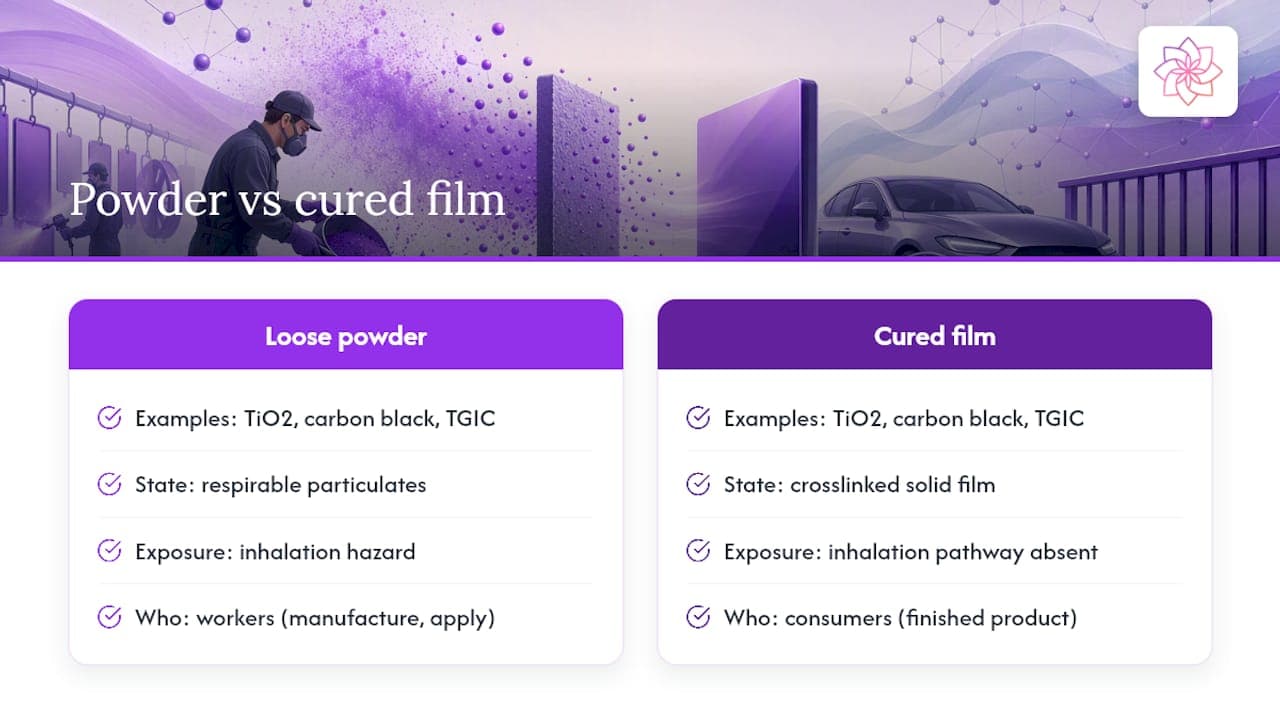
The clearest illustration of how exposure pathway determines outcome comes from powder coatings containing titanium dioxide, carbon black, or triglycidyl isocyanurate. All three appear on lists of inhalation hazards in their respirable particulate form. Practitioner guidance on powder coating compliance concludes that once these substances are cured into a solid, crosslinked coating film, they generally do not require a consumer Prop 65 warning, because the exposure pathway that made them hazardous, inhaling loose particulate, no longer exists once the film has cured.
The same analysis draws a firm line at the manufacturing facility door. During powder transfer, sieving, and electrostatic application, workers face the unbound particulate directly, and that stage of the lifecycle is where engineering controls and occupational communication carry the compliance burden rather than a consumer-facing label. A manufacturer supplying powder coating additives therefore typically manages two separate compliance obligations for the same chemical: occupational exposure controls at the point of manufacture and application, and a consumer warning determination for the finished, cured product that in many documented cases resolves in the manufacturer's favor.

This split treatment, one substance, two different exposure conclusions depending on physical state, is the pattern coating additive formulators encounter most often and the one most likely to be misapplied if the powder-versus-cured-film distinction is skipped.
Potential legal and financial consequences of non-compliance
Proposition 65 is enforced substantially through private citizen suits, and coating and additive manufacturers are frequent targets because the same raw material commonly appears across dozens of downstream formulations sold under different brand names. A 60-day notice of violation names the specific product and alleged chemical exposure, and it starts a clock during which the manufacturer or the retailer named alongside it must assess the claim or negotiate a resolution.
The financial exposure runs on two tracks. Statutory penalties accrue on a per-violation, per-day basis for confirmed non-compliance, and settlements in citizen-suit litigation commonly include both a monetary payment and a court-ordered reformulation or warning-label commitment going forward. Beyond the direct penalty, a coating additive supplier named in litigation over a raw material often faces indemnification demands from downstream customers who formulated the substance into their own finished products, multiplying the financial and reputational exposure well beyond the original notice.
The practical lesson for additive manufacturers is that the exposure assessment described earlier in this article is not simply a compliance formality. It is the primary defense against a citizen suit, since a documented, science-based showing that exposure falls below the relevant Safe Harbor level is the strongest available response to a 60-day notice. Manufacturers who cannot produce that documentation on request are negotiating from a materially weaker position regardless of the underlying chemistry.
Supplier collaboration and additive selection to reduce exposure
Reducing Prop 65 exposure risk in a coating formulation often starts upstream, at the additive selection stage, rather than downstream at the warning-label stage. Technical support functions often help formulators evaluate dosage and delivery form during formulation review, since the physical form of an additive frequently determines its exposure profile as much as its chemistry does.
Liquid pigment dispersions and encapsulated additive forms reduce respirable dust generation compared with dry powder equivalents, a formulation-level change that can shift a raw material from a high-inhalation-risk handling scenario to a substantially lower one without altering the finished coating's performance. Formulators evaluating a reformulation path as an alternative to a consumer warning should request sample quantities and technical data alongside any Prop 65 screening, so the exposure question and the performance question get answered together.
— Astra R&D Team
How Astra Chemical can help with Prop 65 exposure risk
Reformulating away from a Prop 65 exposure concern is easier when the replacement additive has already been qualified for performance, not just for compliance. Certain suppliers provide dispersants, defoamers, and functional coating additives designed for batch consistency and dosage efficiency, often with technical documentation available to support regulatory files.

- Request technical data sheets and safety data sheets for any ASTRA DISP® dispersant under review as a lower-dust alternative.
- Ask for application samples of ASTRA DF NS® or ASTRA DF® defoamers when a formulation change affects processing exposure.
- Contact technical service for a formulation review before finalizing a reformulation timeline.
Browse the full product catalog or start a conversation with Astra Chemical's technical team about your next formulation review.
Key regulatory and primary sources
- The official OEHHA Proposition 65 list is not the download source itself but should be used together with 21 CFR Part 175 for food-contact coating obligations.
- The EPA's aerosol coatings final rule covers VOC reactivity factors relevant to spray formulation reporting.
- Practitioner analysis of the cured-film exception in powder coatings explains inhalation-only hazard treatment.
- For hazardous material shipping and labeling logistics, see this step-by-step compliance guide.
Sources
- eCFR :: 21 CFR Part 175 -- Indirect Food Additives: Adhesives and Components of Coatings
- Final Rule: Aerosol Coatings National Volatile Organic Compound Emission Standards
- Are Prop 65 labels required after powder paint cures? | PCI Magazine
FAQ
What products require a Prop 65 warning?
A Prop 65 warning is required when a product exposes a Californian to a listed chemical above its Safe Harbor level, not simply because a listed substance is present in the formulation. Coating additive manufacturers determine this through exposure testing or conservative modeling, since the cured-film exception often removes the inhalation pathway once a coating is fully cured.
What chemicals are included in the California Proposition 65 chemical list for 2026?
The Proposition 65 list is maintained and updated by OEHHA on an ongoing basis, and coating-relevant entries commonly include phthalates, certain heavy metals, bisphenol variants, select aromatic amines, and PAHs associated with carbon black. Formulators should check the current OEHHA list directly by CAS number rather than relying on a static summary, since new substances are added periodically.
Is Prop 65 in all states?
No, Proposition 65 is a California state law and its warning requirements apply to products sold or exposures occurring within California. Manufacturers who distribute nationally, including coating additive suppliers outside California, still need to assess Prop 65 exposure if their products reach California consumers or workers.
Should I worry if a product has a P65 warning?
A Prop 65 warning indicates a manufacturer's exposure assessment found a listed chemical present above its Safe Harbor level, or that the manufacturer chose to warn without a definitive threshold determination. It does not by itself indicate an acute safety emergency, since many warnings apply to substances that pose risk only under specific handling conditions, such as inhaling unbound powder rather than contact with a cured film.
Recommended
Testing additives for this application?
Send us your current formulation challenge and our technical team will recommend an ASTRA product package for lab screening.