Custom Additive Formulation: Vet Four Chemistry Classes Before Scale Up
Custom Additive Formulation: Vet Four Chemistry Classes Before Scale Up ! Small-batch coating samples on a lab bench A custom additive formulation delivers targeted dispersion, foam control, or rheology performance that off-the-shelf chemistries cannot match, backed by supplier documentation that sa…
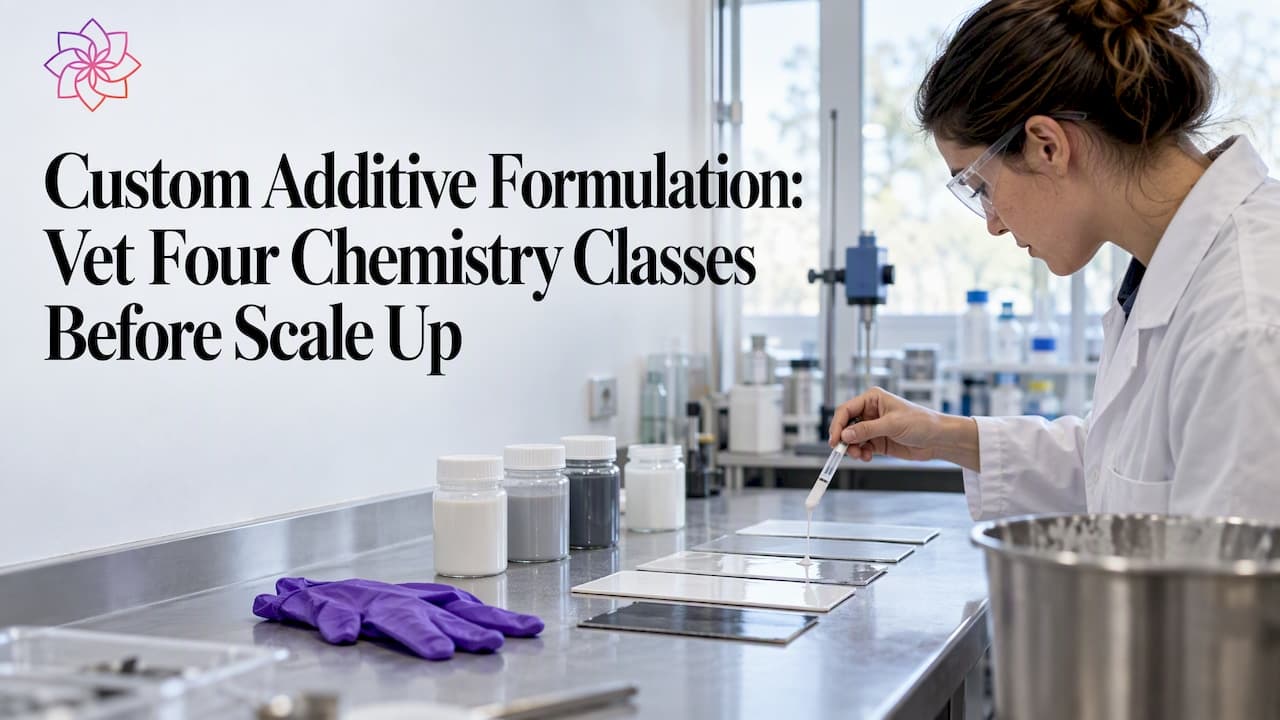
A custom additive formulation delivers targeted dispersion, foam control, or rheology performance that off-the-shelf chemistries cannot match, backed by supplier documentation that satisfies regulatory review. Formulation chemists at Astra Chemical typically recommend pursuing one when a production line shows persistent QC drift, when a coating or ink fails to meet VOC or reactivity targets under rules like those EPA finalizes for aerosol coatings, or when cost-in-use calculations point to savings from dose reduction.
TL;DR:
- Recurring cratering, orange peel, poor pigment wetting, adhesion loss, or foam that survives standard defoamer treatment point to specific formulation gaps worth testing.
- Choose defoamers by defect risk and compatibility: silicone types may work at lower doses but can cause cratering, while alternatives without silicone suit sensitive films.
- Require ingredient and CAS disclosures, a safety data sheet with GHS hazard classification, batch certificates, shelf stability reports, and application test data before regulatory review.
- Agree on ASTM methods, acceptance limits, and a signed protocol before sampling; use D562 for KU viscosity and D7394 to assess rheology across shear rates.
- Development moves from requirements and lab formulation through samples, pilot validation, and production release; regulatory work, compatibility trials, and stability checks extend timelines and costs.
Custom development becomes worth the investment when a formulation problem resists standard fixes or when a business goal cannot be reached with catalog chemistries. Technical failures are the clearest signal: persistent dispersion failures, foam that survives defoamer addition, film defects such as cratering or orange peel, adhesion loss on a new substrate, or poor pigment wetting during letdown.
Production data often points to the same conclusion before a technician does. Batch-to-batch viscosity drift, a new substrate or coating line, or a throughput increase that stresses existing rheology control all suggest the current additive package has reached its limit.
Procurement and sustainability goals add a third category of trigger:
- A target reduction in cost-in-use through lower dosage or fewer reworked batches
- A regulatory shift that restricts an ingredient currently in the formulation
- A corporate sustainability commitment that requires reformulating toward lower-VOC or bio-based chemistries
When several of these triggers appear together, a tailored formulation project may be worth comparing with repeated troubleshooting of an existing blend.
Core chemistry options and selection criteria
Four additive classes account for most custom formulation requests, and each has its own selection metrics.
Dispersants control pigment wetting and particle separation during milling. A well-matched dispersant reduces grind time and improves color strength, so we ask suppliers for particle size distribution data, optical density readings, and dispersion energy figures rather than taking a generic claim of "fine dispersion" at face value.
Defoamers fall into silicone and non-silicone chemistries. Silicone defoamers tend to control foam at lower dosage but carry higher risk of surface defects like cratering in some coating systems; non-silicone alternatives trade some efficiency for compatibility in sensitive films. The right choice depends on the specific film defect profile a production line is fighting.
Rheology modifiers split into associative (HEUR) and non-associative thickener chemistries. Associative polymers are generally less sensitive to pH and ionic strength than non-associative thickeners, which makes them a common choice for complex industrial formulations where other ingredients shift the system's chemistry. Typical dosage ranges vary by polymer architecture, so suppliers should provide a dosage curve rather than a single number.
Functional and reactive additives, including coupling agents and cure-modifying chemistries, address adhesion and process-specific performance that standard additives do not touch.
When comparing supplier proposals, request these metrics as a baseline:
- Shear-thinning curve across low, mid, and high shear rates
- Mid-shear viscosity (MSV) and KU conversions
- Stability time under accelerated storage
- Pigment settling results after extended shelf storage
Pro Tip: Ask for raw test data, not just pass/fail summaries, so your own lab can verify a supplier's qualification claims against your acceptance criteria.
Documentation and regulatory must-haves
A technically sound additive is only useful if it ships with documentation that survives regulatory review. VOC compliance is often calculated on a weighted-average basis, so formulation records need to support daily or rolling-average calculations and flag any exceedance before it reaches a regulator's desk. Background guidance from state-level programs shows that recordkeeping requirements can apply to coating operations, so producers should keep defensible records rather than rely on estimates.
Supplier responsibilities extend beyond the technical data sheet. Manufacturers need full ingredient lists and CAS numbers to classify hazards correctly under GHS, and OSHA's hazard classification guidance outlines the documentation burden this places on both supplier and buyer.
A documentation checklist worth insisting on includes:
- Safety data sheet (SDS) with complete GHS hazard classification
- Full ingredient declaration suitable for regulatory filings
- Impurity thresholds and batch certificates of analysis
- Stability reports covering the intended shelf life
- Test reports tied to the application's performance requirements
Federal rules on reactivity limits for aerosol coatings and state implementation plans can both change which ingredients remain acceptable, so a formulation that passes today's review should be re-checked against updated reactivity factors when rules change.
Testing and validation: what to specify in lab and pilot trials
A test matrix agreed before trials begin prevents disputes later and shortens qualification time. We recommend structuring agreements around published methods rather than informal benchmarks.
- Specify ASTM D562 for Krebs Unit (KU) viscosity to establish a consistent, comparable measure of paint consistency across batches.
- Use the ASTM D7394 practice for bench viscometers to survey rheology across a broad shear range and capture mid-shear viscosity (MSV) as a predictor of thickener efficiency.
- Run stability checks for settling and syneresis alongside foam measurement and dispersion quality assessment.
- Add adhesion and cure testing specific to the final application, drawing on industrial coating test protocols such as ASTM D6577 or D4712 where substrate and environmental conditions demand it.
- Document acceptance criteria in a signed protocol shared between supplier and manufacturer before pilot-scale work begins.
Pre-agreed methods remove ambiguity when a batch lands close to a specification boundary, which is often where qualification timelines stall.
Development workflow, lead times, and cost drivers
A custom additive project typically moves through a sequence of phases: requirements definition, lab-scale formulation, sample trials, pilot-scale validation, and scale-up to production release. Early phases move faster than later ones, since pilot and scale-up work must confirm that lab performance holds at production volumes.
Several factors commonly extend timelines beyond initial estimates:
- Extensive regulatory testing required for a new chemistry or restricted ingredient
- Multi-component formulations that need sequential compatibility testing
- Long-term stability trials that cannot be compressed without risking shelf-life failures
Cost drivers follow a similar pattern. R&D hours, specialty raw material sourcing, small-batch production costs, and documentation or testing fees all add up before a formulation reaches commercial volume. Qualification support, including on-site troubleshooting, is often priced separately from the additive itself.
Structuring the engagement around milestone sign-offs tied to sample delivery and test acceptance keeps costs predictable and gives both sides a clear point to pause or adjust scope before committing to the next phase.
How to work with a supplier on sample programs and scale-up
A productive supplier relationship depends on documentation and process discipline as much as chemistry. Before committing to a project, confirm these deliverables are part of the agreement.
- Request the SDS, full formulation disclosure needed for regulatory filings, batch certificates, dosage guidance, and stability data up front.
- Negotiate test protocols and acceptance criteria before sampling begins, referencing agreed ASTM methods or a mutually defined alternative.
- Confirm the supplier will provide technical collaboration during qualification, including troubleshooting support and on-site trial assistance where needed.
- Include documentation delivery timelines, batch consistency guarantees, and confidentiality or IP terms in the contract before pilot work starts.
Pro Tip: Build acceptance criteria into the purchase agreement itself, not just the technical brief, so a failed batch has a contractual remedy rather than an informal renegotiation.
Case studies illustrating custom additive formulations across industries
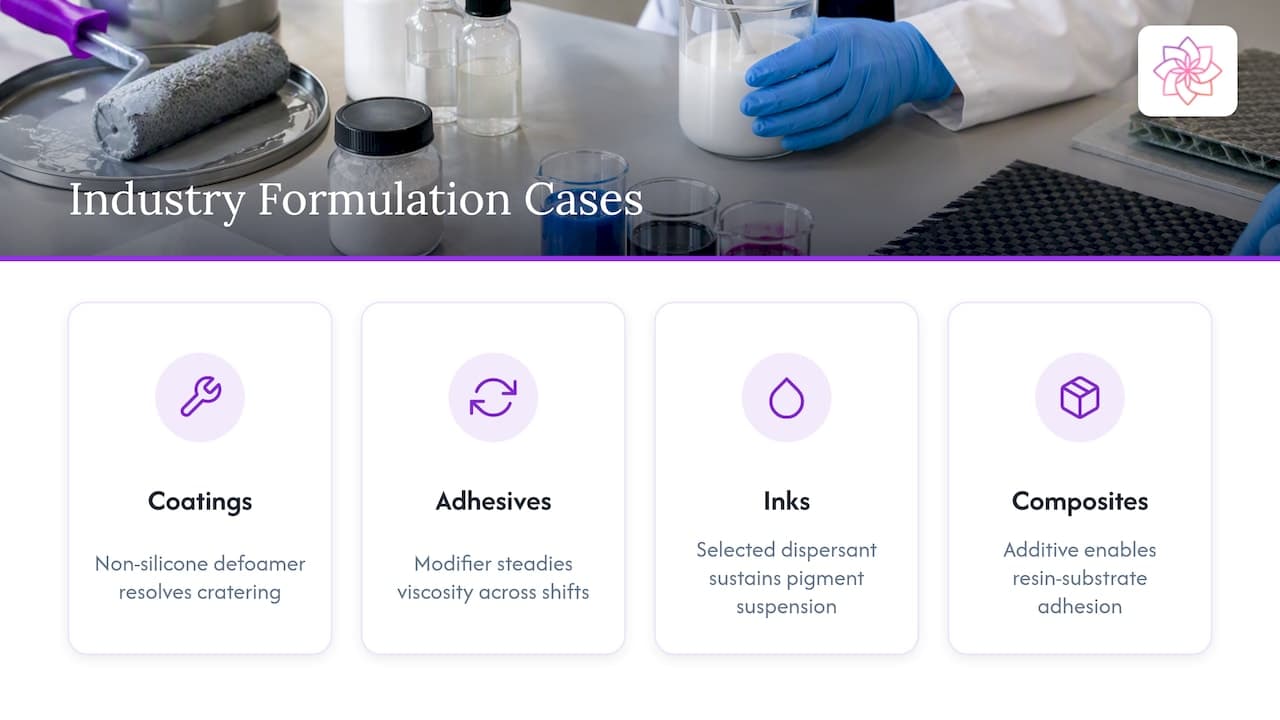
Industrial coatings, adhesives, inks, and composites each present different reasons to commission a tailored additive package. A coatings manufacturer facing recurring cratering defects on a metal substrate, for instance, typically traces the issue to a mismatch between defoamer chemistry and the coating's surface tension profile. Moving from a silicone to a non-silicone defoamer, with dosage optimized against the specific resin system, often resolves the defect without reformulating the entire coating.
An adhesives producer scaling into a higher-throughput line may find that a thickener suited to lab-batch viscosity behaves differently under continuous mixing, where shear history changes over time. An associative rheology modifier selected for its reduced sensitivity to pH and ionic strength can hold viscosity targets more consistently across that shift in process conditions.
Ink formulators working with fine pigments frequently run into dispersion stability problems during storage, where settling or flocculation shows up weeks after production. A dispersant selected using particle size distribution and dispersion energy data, rather than a generic product claim, tends to hold pigment suspension through the full shelf life.
Composite manufacturers introducing a new reinforcement material often need a functional or coupling additive to achieve adhesion between resin and substrate that a standard formulation was never designed to deliver. In each case, the common thread is a formulation gap that only becomes visible under real production conditions, which is exactly where a tailored additive earns its cost.
Common challenges in custom additive formulation and how to address them
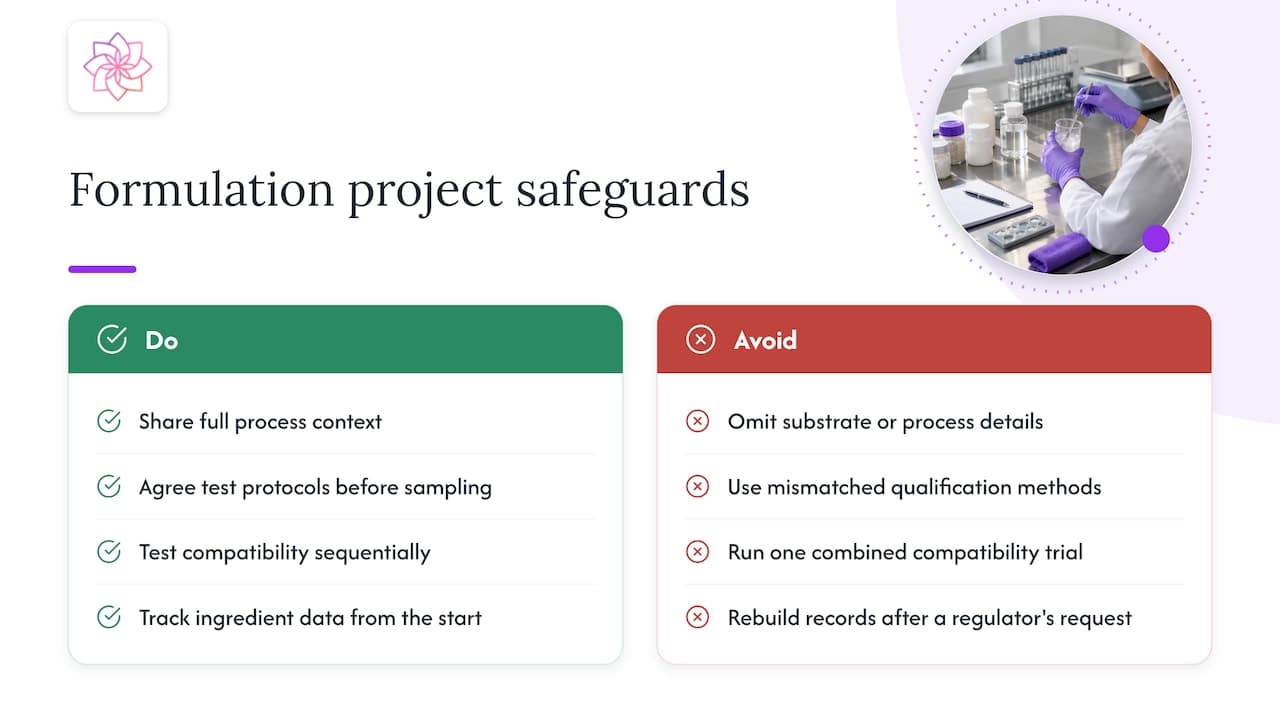
Formulation projects rarely fail because the chemistry is wrong. They fail because of gaps in communication, documentation, or timeline expectations. A recurring challenge is incomplete technical briefs: when a manufacturer specifies a desired outcome without sharing substrate details, process conditions, or existing formulation constraints, a supplier ends up guessing at variables that matter. Sharing full process context, including shear conditions, cure schedule, and existing ingredient restrictions, shortens the number of trial iterations needed.
Another common obstacle is testing misalignment, where a supplier's internal qualification methods do not match the manufacturer's acceptance criteria. Agreeing on ASTM-based or mutually defined test protocols before sampling begins, as outlined earlier, removes this friction before it costs a trial cycle.
Multi-component compatibility is a third persistent challenge, particularly when a new additive must coexist with several legacy ingredients in a mature formulation. Sequential compatibility testing, rather than a single combined trial, isolates which component is responsible when a batch underperforms.
Finally, regulatory uncertainty complicates projects that span multiple jurisdictions, since VOC and reactivity rules differ by state and by product category. Building a documentation package that tracks ingredient-level data from the start, rather than reconstructing it after a regulator's request, keeps a formulation compliant as rules evolve.
Emerging trends in additive technologies
Rheology modifier chemistry continues to advance past simple thickening toward engineered network behavior. Research on hydrophobically modified ethoxylated urethanes describes how molecular weight, hydrophobe type, and concentration can be tuned to control shear-thinning behavior and overall physicochemical properties, giving formulators more precise control than earlier generations of associative thickeners allowed.
Coating stratification is another area drawing fresh technical attention. Applied research on rheology modifiers and self-stratification shows that different rheology modifier classes, including xanthan gum, Carbopol, and HEUR chemistries, produce distinct film-formation outcomes depending on how they interact with latex particles. That research points toward formulations that self-organize into functional layers, which could reduce the number of separate coats needed in some industrial applications.
On the regulatory side, reactivity-based compliance frameworks are replacing simple VOC mass limits in some product categories, which pushes additive selection toward lower-reactivity solvents and coupling agents that maintain performance under tighter chemical constraints. Formulation teams that build flexibility into their additive packages now will have an easier time adapting when reactivity factors shift again.
Astra R&D perspective: what we focus on when developing custom additives
We prioritize lab-backed qualification over marketing claims because a defect that resurfaces in the field can be costlier than additional stability testing. We also push for early agreement on test protocols and acceptance criteria, since misaligned methods are the most common reason qualification timelines stretch. Customers working with us typically report fewer production defects, tighter batch consistency, and more efficient dosage, outcomes we track directly through the same test data we share during qualification.
— Astra R&D Team
How Astra Chemical can help with your next formulation project
We develop custom dispersants, defoamers, and rheology modifiers for coatings, adhesives, inks, plastics, and composites, supported by dosage optimization. Our product lines, including ASTRA DISP®, ASTRA REO®, and ASTRA DF®, are built to match the performance of premium chemistries at a lower total cost-in-use, with laboratory-backed qualification data and full technical support behind every batch.
When you reach out, come prepared with a technical brief covering your substrate, process conditions, and performance targets. We work with you to set up a sample program, document agreed acceptance criteria, and assemble the regulatory package your team needs for internal sign-off.
- Request a technical brief review and sample program
- Review dosage optimization data alongside your existing formulation
- Confirm documented acceptance criteria before pilot-scale trials begin
Visit our product catalog to review the full additive range, or reach out through our company page to start a technical conversation with our team.
FAQ
What is a custom additive formulation?
A custom additive formulation is a chemistry such as a dispersant, defoamer, or rheology modifier engineered to meet specific performance, regulatory, or cost targets that standard catalog products cannot satisfy. It typically includes supplier-backed documentation such as an SDS and test data to support qualification in coatings, adhesives, inks, plastics, or composites.
How long does custom additive development usually take?
Timelines vary with chemistry complexity, but projects generally move through requirements definition, lab formulation, sample trials, pilot validation, and scale-up in sequence. Multi-component formulations or extensive regulatory testing tend to extend pilot and scale-up phases the most.
What documentation should a supplier provide with a custom additive?
At minimum, expect a complete SDS with GHS hazard classification, a full ingredient declaration suitable for regulatory filings, batch certificates of analysis, and stability reports covering your intended shelf life. These documents are what let your regulatory team classify hazards correctly and defend VOC calculations if an exceedance is ever questioned.
Does Astra Chemical support dosage optimization during qualification?
Yes, our technical team works with you to optimize dosage against your specific formulation and process conditions during qualification. Our product lines are documented with laboratory-backed data to support that optimization throughout qualification.
Sources
Testing additives for this application?
Send us your current formulation challenge and our technical team will recommend an ASTRA product package for lab screening.