Gloss Haze in Coatings: 5 Causes, From Polish to Formulation
Gloss Haze in Coatings: 5 Causes, From Polish to Formulation ! Hazy band across a glossy black coating Reflection haze is a milky scattering of light near the specular highlight on an otherwise glossy film, and when it appears right after polishing or application, an isopropyl alcohol wipe followed…
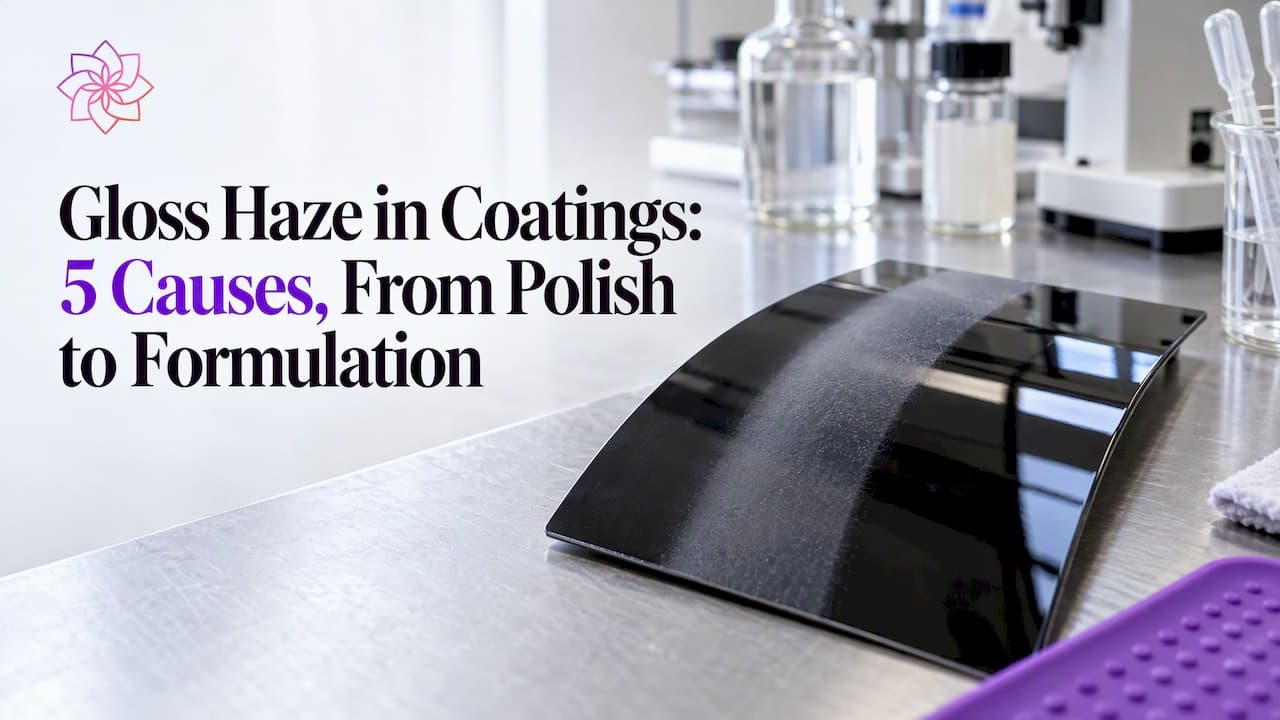
Reflection haze is a milky scattering of light near the specular highlight on an otherwise glossy film, and when it appears right after polishing or application, an isopropyl alcohol wipe followed by a finishing polish on a soft pad resolves it in most cases. When haze persists after correction, we are usually looking at crystalline bloom, phase separation, or a formulation fault that calls for supplier or lab involvement.
TL;DR:
- Haze that appears immediately usually points to residue or application conditions, while haze emerging hours or days later suggests recrystallization within the film.
- For high gloss finishes, specify reflection haze testing at 20°; 60° serves general gloss comparisons, while 85° is used for low gloss and matte surfaces.
- Test a soft pad and finishing polish on an inconspicuous area first; thin, aged, or previously polished clear coats have less margin for correction.
- If haze returns or resists polishing, stop before thinning the clear coat and send 20° haze readings, cure details, and photos to the coating supplier.
Gloss haze rarely has a single origin, and identifying which mechanism is at work determines whether a surface fix will hold or whether the film itself needs attention. We find the cause generally falls into one of five categories, each leaving a slightly different visual signature.
Surface-level haze from polishing residue, waxes, or trapped dust scatters light without affecting the film underneath, and it typically wipes or polishes away cleanly. Overheating during machine polishing can burn the surface, leaving a dull or hazy band that follows the pad's travel path. Contamination from oils, silicone transfer, or airborne salts, along with incomplete solvent flash before cure, traps diffusing material at the surface and under it.
Formulation-driven haze is harder to correct because it originates inside the film: crystalline components, phase separation between resin and additive, or raw material incompatibilities scatter light from within the cured matrix rather than on top of it.
Application and cure conditions compound these risks:
- Film thickness applied outside the specified range changes how solvents and reactive components escape during cure.
- Low temperature or high humidity during application or early cure slows solvent release and favors recrystallization.
- Rapid cooling after a UV or thermal cure step can trigger delayed haze days after the part looked clear.
- Inconsistent film build across a part creates uneven haze that reads as patchiness rather than uniform cloudiness.
Haze that shows up immediately points to surface or application causes; haze that develops over hours or days points toward recrystallization inside the film.
2. How haze is measured and what standards say
Gloss tells you how much light reflects at the specular angle; haze tells you how much of that light scatters into the area just beside it; distinctness of image (DOI) tells you how sharply a reflected image holds its edges. All three answer different questions, and a surface can read high on gloss while still looking cloudy because of poor DOI or elevated haze.
Measurement geometry matters because coatings behave differently depending on viewing angle:
- 20° geometry is standard for high-gloss finishes and is the angle specified for reflection haze testing.
- 60° is the general-purpose angle used for most gloss comparisons across coating types.
- 85° picks up sheen differences on low-gloss and matte surfaces where 60° readings cluster too closely together.
ISO 13803 defines reflection haze measurement at 20° and quantifies the light scattering adjacent to the specular reflection, which is what separates a hazy high-gloss film from a genuinely matte one. ASTM D4039 takes a related approach, deriving a haze index from two specular gloss readings taken with different receptor apertures.
A haze meter reading taken at 20° correlates with what the eye perceives as cloudiness near the highlight, which makes it the geometry worth specifying when a customer complaint and a gloss reading do not agree. Field checks under diffused light catch gross haze, but documented haze index numbers are what a supplier needs to troubleshoot a recurring defect rather than guess at it.
3. Step-by-step removal and repair techniques for hazy finishes
Most surface haze responds to a short, conservative correction sequence, and the goal is to use the least aggressive method that clears the defect. Start by inspecting the part under diffused light rather than direct sun, which exaggerates haze and hides whether it is uniform or patchy. An isopropyl alcohol wipe on a clean microfiber cloth removes residue-based haze on contact; if the haze disappears, the cause was surface contamination, not the film itself. Photograph the surface before any correction so you have a baseline if the defect returns.
For haze that survives the IPA wipe, work through this sequence:
- Wash the surface to remove loose grit and dust that would otherwise scratch the film during polishing.
- Decontaminate with an iron or tar remover if embedded particulate is suspected, rinsing fully afterward.
- Wipe with isopropyl alcohol to strip remaining residue and confirm the haze is still present.
- Apply a finishing polish with a soft foam or microfiber finishing pad at low machine speed, working small sections.
- Inspect under diffused light and only repeat the polish step if the clear coat thickness supports another light pass.
Pro Tip: Test any polish and pad combination on a small, inconspicuous area first, since clear coats that are thin, aged, or previously polished have less margin before you cut through to the base coat.
When the haze returns after a successful correction, or when it never responded to polishing at all, the cause is likely recrystallization or a formulation incompatibility rather than surface contamination. At that point, further polishing risks thinning the clear coat without fixing anything. The appropriate next step is lab haze testing against ISO 13803 or ASTM D4039 methods, a conversation with the coating supplier about the batch, or, for severe cases, a strip-and-recoat.
4. Prevention: formulation and application controls to avoid haze
Preventing haze is less expensive than correcting it, and most of the leverage sits in formulation and process control rather than in polishing after the fact. Dispersants improve how pigments and fillers distribute through the resin, reducing the agglomerates that scatter light and read as haze once the film is cured. Recrystallization inhibitors address a related but distinct mechanism, interfering with crystalline components reassembling into light-scattering structures as the film cools, an approach described in formulations for UV-curable powder coatings.
Process controls matter just as much as the formulation itself:
- Apply film thickness within the specified range; both under-build and over-build change solvent release and cure behavior.
- Avoid premature cooling before cure is complete, since rapid temperature drops favor recrystallization.
- Hold a consistent cure schedule rather than varying time or temperature batch to batch.
- Filter incoming resin and pigment dispersions to remove particulates before they reach the application line.
Application temperature and humidity deserve their own attention: cold substrates slow solvent flash and trap volatiles near the surface, while high humidity can interfere with cure chemistry in ways that show up later as haze rather than immediately. Routine gloss and haze checks on production samples, logged against a baseline, catch drift before it becomes a customer-facing defect and give a supplier real numbers to work from instead of a verbal description.
5. Astra R&D perspective: additives and services that address haze
We work with formulators whose haze problems trace back to dispersion quality, foam-related surface defects, or flow and leveling during film formation rather than to field contamination. Dispersants improve pigment and filler distribution through the resin system, which reduces the agglomerates that scatter light at the surface. Defoamers address microbubbles that can telegraph through a film and read as localized haze or pinholing. Rheology modifiers influence how the film flows and levels before cure, which affects uniformity of gloss across a part.
Our typical engagement starts with a lab sample submission, moves into dosage optimization against the customer's existing formulation, and continues with a technical consultation to review results.
Before reaching out to any additive supplier, it helps to have on hand:
- Photos of the hazy surface under diffused light, plus photos of a good reference panel.
- The cure profile, including temperature, time, and any post-cure or cooling steps.
- Gloss and haze meter readings, if available, from the defective and acceptable panels.
— Astra R&D Team
Impact of gloss haze on final product performance and customer perception
Gloss haze is rarely just a cosmetic footnote. On high-value finishes such as automotive clear coats, furniture lacquers, or packaging coatings, haze changes how a product photographs, how it reads under showroom lighting, and how a buyer judges quality at a glance, often before any functional testing happens. A hazy finish next to a clear, high-DOI reference panel reads as a defect even when the underlying film performs identically in adhesion and hardness testing.
The perception problem compounds the cost problem. Haze that triggers a customer reject after the part has already shipped carries far more cost than haze caught at the QC bench, because it involves returns, rework, and in some cases loss of the account entirely. For coatings sold on appearance alone, such as high-gloss architectural paints or premium plastic components, haze can be the single factor that separates a passing batch from a rejected one, regardless of how well the coating performs on every other metric.
This is why objective measurement matters more than a visual pass or fail. A haze index tracked against a documented baseline gives a manufacturer an early warning before the defect becomes visible enough for a customer to flag it, which turns a reactive quality problem into a controllable process variable.
Differentiation between gloss haze and other surface defects such as bloom or bloom haze
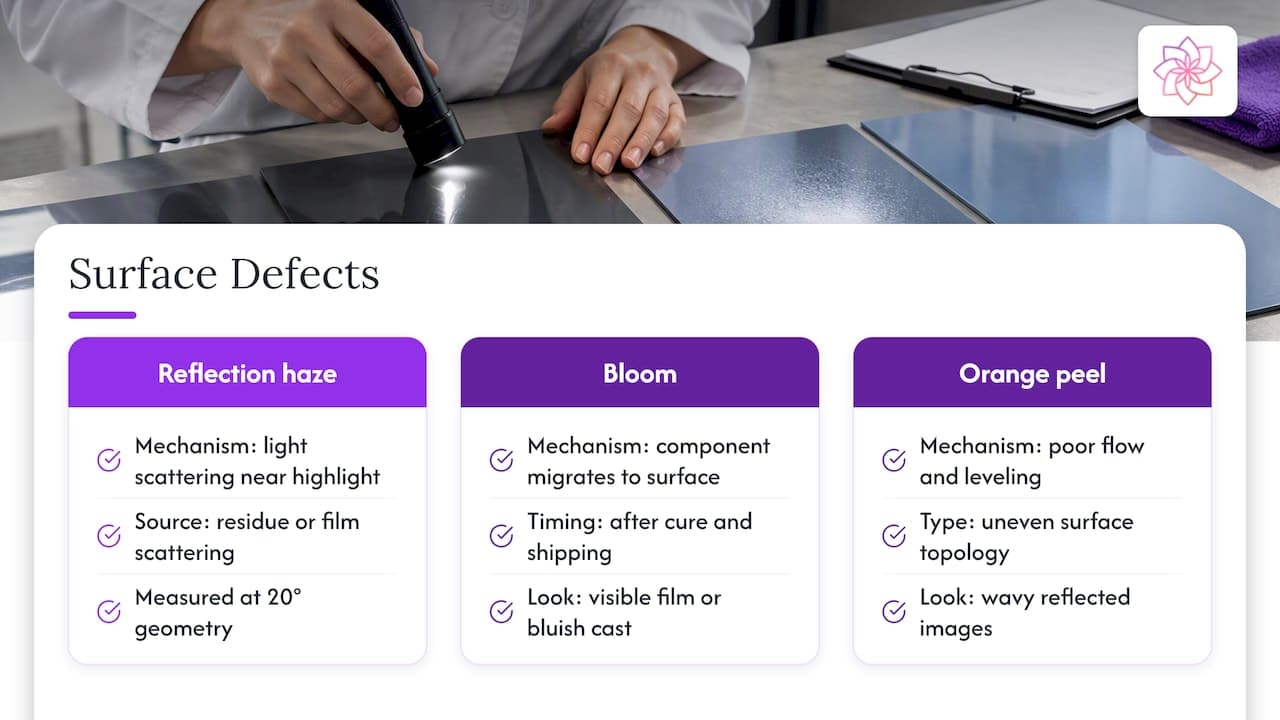
Gloss haze, bloom, and orange peel often get lumped together because they all reduce perceived clarity, but they come from different mechanisms and need different fixes. Reflection haze is light scattering near the specular angle, measured at a specific geometry such as 20°, and it usually traces back to surface residue, contamination, or fine-scale scattering within the film.
Bloom, sometimes called bloom haze, is a related but distinct phenomenon in which a component, often a wax, plasticizer, or unreacted crystalline material, migrates to the surface over time and forms a visible film or bluish cast. Bloom tends to appear well after the part has cured and shipped, which is why it is sometimes confused with delayed haze from recrystallization, though the underlying chemistry differs: bloom is migration to the surface, while recrystallization haze forms within the bulk film as crystalline domains reorganize during cooling.
Orange peel is a texture defect, an uneven surface topology from poor flow and leveling, and it is visually distinct from haze because it distorts reflected images in a wavy pattern rather than diffusing light uniformly near the highlight. A part can have orange peel without haze, haze without orange peel, or both at once, which is why relying on a single visual impression leads to the wrong corrective action. Distinguishing these defects correctly, using measurement tools alongside visual inspection, determines whether the fix is a surface wipe, a formulation change, or an application adjustment.
Advanced analytical techniques for diagnosing gloss haze at microscopic or chemical levels
When polishing and basic haze readings do not explain a recurring defect, the next step is to look inside the film rather than at its surface. Microscopy, including scanning electron microscopy, can reveal whether haze-causing structures are crystalline domains, filler agglomerates, or microvoids, each of which points to a different corrective path in the formulation.
Fourier-transform infrared spectroscopy (FTIR) helps identify whether a surface bloom or internal haze is chemically distinct from the bulk resin, which matters when distinguishing migrated additive from a resin-level incompatibility. Differential scanning calorimetry (DSC) can detect crystalline melting or recrystallization behavior in the resin system itself, which is directly relevant when haze develops after cure rather than during application.
Alongside these chemical techniques, objective optical measurement, gloss meters, haze meters, and DOI meters, remains the fastest way to quantify how severe a defect is and whether a process change actually reduced it. Pairing optical data with microscopy or spectroscopy turns a vague complaint into a specific, addressable mechanism, which is usually what a reformulation effort needs before any additive change can be justified with confidence.
Decide fast: DIY fix, repair shop, or supplier/formulator intervention
A quick decision framework saves time once you know what you are looking at:
- If haze wipes away with isopropyl alcohol or responds to a single finishing polish pass, it is a surface issue you can likely correct yourself in under an hour.
- If haze returns after correction or appears days after application, suspect recrystallization or a formulation fault and involve the coating supplier.
- If haze is uniform across an entire production run rather than isolated to a few parts, treat it as a process or formulation problem, not a one-off surface defect.
Before contacting a supplier or formulator, gather gloss and haze readings, the cure profile, and clear photos; this turns a vague complaint into a diagnosable one.
How Astra Chemical can help (product pages and next steps)
Recurring haze that resists surface correction usually comes down to dispersion quality, foam-related defects, or flow and leveling during film formation, and that is where our additive lines come in. 
We offer:
| Product family | Primary role in haze control |
|---|---|
| ASTRA DISP® | Improves pigment and filler dispersion, reducing agglomerates that scatter light |
| ASTRA DF® | Reduces foam-related surface defects that can read as localized haze |
| ASTRA REO® | Adjusts flow and leveling to support uniform film formation and gloss |
We offer qualification and dosage optimization support, so a persistent haze complaint does not have to end in guesswork. If your team is troubleshooting a recurring gloss or clarity defect, visit our product catalog to identify the additive family that matches your resin system, or reach out through our company page to start a lab sample review.
FAQ
Does clear coat make it look glossy?
Clear coat is what produces the high-gloss, reflective finish on most painted surfaces, but gloss and clarity are not the same thing. A clear coat can be glossy and still look hazy if it scatters light near the specular reflection, which is why gloss meter readings alone do not fully describe appearance.
How to get rid of haze on car paint?
Most surface haze on car paint responds to an isopropyl alcohol wipe followed by a finishing polish applied with a soft foam or microfiber pad at low speed. Work a small section at a time and inspect under diffused light between passes, since thin or previously polished clear coats have limited margin for repeated correction.
Why is my ceramic coating hazy?
Ceramic coating haze is most often leftover residue from an uncured or improperly leveled layer rather than a defect in the underlying paint. A gentle IPA wipe or a dedicated ceramic coating panel wipe typically clears residue haze; haze that persists after that step may point to an application error during cure.
Why is my clear coat turning white?
A clear coat turning white, rather than simply hazy, often signals moisture intrusion during application or cure, or in some cases bloom from a migrating component reaching the surface. This is different from reflection haze and generally needs more than surface polishing, since the whitening can involve the film's internal structure rather than just surface contamination.
Sources
- ISO 13803:2014 - Paints and varnishes - Determination of haze on paint films at 20° (preview)
- D4039 Standard Test Method for Reflection Haze of High-Gloss Surfaces
- Gloss, haze, and the hidden variables: A guide to understanding surface appearance — Quality Magazine
- Non-hazing UV curable powder coatings containing crystalline resins (US Patent 6136882)
Key standards and industry resources
For teams that need test method detail or want to share documentation with a lab or supplier, ISO 13803 defines reflection haze measurement at 20°, ASTM D4039 describes the two-aperture haze index method for high-gloss surfaces, and the Quality Magazine guide to gloss and haze explains how these appearance metrics interact in production settings. Readers wanting broader background on surface finishing options may also find this surface finishes guide useful for engineering context.
Testing additives for this application?
Send us your current formulation challenge and our technical team will recommend an ASTRA product package for lab screening.