Pseudoplastic vs Thixotropy: The Real Difference Explained
Pseudoplastic vs Thixotropy: The Real Difference Explained ! Decorative title card with rheology and chemical themes A material is pseudoplastic when its viscosity drops as shear rate increases, and that drop happens instantaneously, with no time lag.

A material is pseudoplastic when its viscosity drops as shear rate increases, and that drop happens instantaneously, with no time lag. A material is thixotropic when its viscosity drops under sustained shear and then climbs back up over time once shear stops, a structural recovery process. Ketchup and many polymer melts are largely pseudoplastic; latex paints and certain gelled drilling fluids are classic thixotropic systems. A single formulation can be pseudoplastic only, thixotropic only, both at once, or neither, and confusing the two is one of the most common errors in rheology reports across the coatings and personal care industries.
Key Takeaways
Pseudoplasticity is an instantaneous, shear-rate-dependent thinning effect, while thixotropy is a time-dependent thinning-and-recovery cycle, and only a hysteresis or recovery test can confirm which one a material actually exhibits.
| Point | Details |
|---|---|
| Core distinction | Pseudoplastic viscosity depends only on shear rate; thixotropic viscosity depends on shear rate and elapsed time. |
| Hysteresis is the tell | A gap between up-ramp and down-ramp sweeps confirms time-dependent structure; overlapping curves confirm pseudoplasticity alone. |
| Recovery testing is mandatory | A shear-thinning ratio alone can't prove thixotropy; only a step-shear-then-recovery test confirms structural rebuild. |
| Both can coexist | Many gels and pastes show shear-rate alignment and time-dependent network rebuild simultaneously. |
| Astra-chemical supports diagnosis | Astra-chemical's rheology modifiers and technical team help formulators match additive choice to whichever behavior their rheogram reveals. |
Pseudoplasticity describes shear-thinning behavior where apparent viscosity is a function of shear rate alone: η = f(γ̇). Apply a given shear rate and the viscosity reading settles immediately; there's no dependency on how long you've been shearing the sample. Polymer solutions, molten thermoplastics, and many surfactant systems behave this way because their internal structure responds to shear rate, not shear duration.
Thixotropy adds a second variable to the equation: time. A thixotropic fluid's viscosity depends on both shear rate and shear history, η = f(γ̇, t), and its defining feature is structural recovery after shear removal. According to Anton Paar's technical guidance, true thixotropy requires two things to be demonstrated together: measurable breakdown under shear and measurable, finite-time recovery at rest. A fluid that thins with shear but never rebuilds its structure isn't thixotropic by the strict definition, no matter how dramatic the thinning looks on a flow curve.
These two behaviors sit inside a broader taxonomy of non-Newtonian response:
- Newtonian fluids: viscosity is constant regardless of shear rate or time (water, mineral oil).
- Time-independent non-Newtonian fluids: viscosity depends on shear rate only, including shear-thinning (pseudoplastic) and shear-thickening (dilatant) behavior.
- Time-dependent non-Newtonian fluids: viscosity depends on shear history, including thixotropy (time-dependent thinning) and its mirror opposite, rheopecty.
A rheogram makes the distinction visible. A pseudoplastic fluid's up-ramp and down-ramp shear-rate sweep trace the same curve, because viscosity only cares about instantaneous shear rate. A thixotropic fluid's up-ramp and down-ramp diverge, tracing a hysteresis loop, because the down-ramp measures a structure that hasn't had time to rebuild yet. That loop is the single clearest fingerprint separating the two behaviors on paper.
What Actually Breaks Down Inside the Fluid?
Rheological behavior traces back to what's happening at the microstructural level, and pseudoplasticity and thixotropy arise from genuinely different physical events, even though they often coexist in the same formulation.
Pseudoplastic mechanisms are shear-rate driven and reversible almost instantly:
- Polymer chains disentangle and align with the flow direction as shear rate rises, reducing the resistance they present to flow.
- Anisotropic particles (rods, platelets, fibers) rotate into alignment with streamlines, lowering the effective hydrodynamic drag.
- Weakly associating polymer networks stretch and slip past junction points without permanent bond rupture.
Thixotropic mechanisms are kinetics driven and depend on elapsed time, not just shear rate:
- Flocculated particle networks, built from weak attractive forces (van der Waals, electrostatic bridging, or associative polymer junctions), break apart under shear and reform through Brownian collision and diffusion once shear stops.
- Gel networks built from entangled or crosslinked domains lose connectivity progressively under sustained shear, and rebuild on a timescale set by diffusion and junction kinetics rather than shear rate.
- Weak hydrogen-bonded or hydrophobic association networks in associative thickeners cycle between broken and reformed states depending on rest time.
Plenty of real formulations show both mechanisms simultaneously: a particle network that both aligns with shear rate (instantaneous) and takes measurable seconds to minutes to rebuild after shear stops (time-dependent). Picture it as a four-stage cycle: a resting network at full structural strength, shear-induced breakdown as force exceeds junction strength, a depleted, low-viscosity structure during sustained shear, and gradual rebuild once shear is removed. Several variables push a material toward one behavior, the other, or both together: particle size and distribution, the strength of interparticle attractive forces, polymer molecular architecture (linear vs branched vs associative), solids concentration, and temperature, which accelerates both breakdown kinetics and diffusion-driven rebuild.
Viscoelastic effects complicate the picture further. Broadband spectroscopy work shows that recovery and damping behavior shift with frequency and temperature, so a rheometer test window that's too short or too narrow can misrepresent how a fluid actually behaves under application conditions.
How Do You Measure and Identify Each Behavior?
Distinguishing pseudoplasticity from thixotropy in the lab comes down to whether your protocol tests shear-rate dependence, time dependence, or both. Four test types cover nearly every practical need:
- Steady shear-rate sweep: a single up-ramp flow curve, no hold time, reveals shear-rate dependence (pseudoplasticity) but says nothing about time dependence.
- Up/down shear-rate sweep: the same ramp run up and then back down; any gap between the two curves is a hysteresis loop and a direct signature of time-dependent structure.
- Step-shear (constant shear-rate hold): apply a fixed high shear rate and record viscosity as a function of time; a decaying curve indicates breakdown kinetics.
- Shear recovery test: after a high-shear step, drop to a low shear rate (or zero) and monitor viscosity climbing back, which quantifies recovery kinetics directly.
A practical rheometer protocol for a coatings or ink sample typically runs as follows:
- Equilibrate the sample at the target temperature (usually 25°C, controlled with a Peltier plate) for at least two minutes before any measurement starts.
- Load the sample into a cone-and-plate or parallel-plate geometry, set an appropriate gap (typically a small gap appropriate for pastes), and trim excess material to avoid edge effects.
- Run a pre-shear step at a moderate rate for a short interval, then rest for a fixed interval to standardize the sample's starting structural state.
- Perform an up-ramp from low to high shear rate over an appropriate range in logarithmic steps, followed immediately by a down-ramp covering the same range.
- Follow with a step-shear hold at a high, application-relevant shear rate for several minutes, capturing viscosity versus time.
- Drop to a low shear rate or zero shear and record the recovery curve for a sufficient period until viscosity plateaus.
- Compare up-ramp and down-ramp curves for hysteresis loop area, and compare pre-shear and post-recovery viscosity to quantify structural recovery.
Hysteresis loop area is the most widely cited quantitative signature. According to Pharmacy180's rheology reference, the loop's presence and area depend directly on shear history and hold times, which is why thixotropy testing is inherently reproducibility sensitive. A wider loop generally signals stronger time dependence, though loop area alone can't distinguish a fluid with fast, complete recovery from one with slow, partial recovery. That distinction requires the separate recovery-hold step. Anton Paar's guidance is blunt on this point: simple shear-thinning ratios, sometimes labeled a "thixotropic index," are not sufficient to prove thixotropy without a dedicated recovery test, because a purely pseudoplastic fluid can post a high TI ratio with zero time dependence at all.
Pro Tip: Run your recovery hold at least three times longer than you think you need. Formulators routinely underestimate rebuild time, mistaking a slow-recovering thixotropic gel for a permanently degraded one just because the hold ended too early.
Watch for three common measurement pitfalls: insufficient hold times that cut off the recovery curve before it plateaus, instrument inertia artifacts at very high shear rates that mimic false thinning, and wall slip in low-viscosity or highly shear-thinned samples, which produces an apparent viscosity drop that has nothing to do with the material's actual rheology. A serrated or knurled plate geometry often reduces slip artifacts in suspensions prone to this issue.
Which Models Describe Each Behavior Mathematically?
Once you have flow curve and hysteresis data, model selection depends on whether time dependence showed up in the sweep.
For purely shear-rate-dependent (pseudoplastic) systems, three model families cover most practical fits:
- Power-law (Ostwald–de Waele): τ = Kγ̇ⁿ, with n < 1 for shear-thinning. Simple, two-parameter, but inaccurate at very low or very high shear rates.
- Cross model: describes a smooth transition between a zero-shear plateau viscosity and an infinite-shear plateau, useful for polymer solutions with clear Newtonian regions at both ends.
- Carreau model: similar to Cross but with a different transition shape, often preferred for concentrated polymer melts and solutions.
For time-dependent (thixotropic) systems, structural-kinetic models add a variable, often called λ, representing the fraction of intact structure at any moment: η = η(λ, γ̇), with a companion kinetic equation dλ/dt = f(λ, γ̇) describing how structure breaks down under shear and rebuilds at rest. Classic frameworks in this family include the Moore model and the Houska model, both of which pair a viscosity function with a first-order structural rate equation.
The practical selection rule: start simple. Fit a power-law or Cross model to your steady-state flow curve first. If the up/down sweep shows no hysteresis and the step-shear hold shows flat viscosity over time, you're done, the material is pseudoplastic without meaningful time dependence, and a time-independent model is sufficient. If hysteresis or recovery kinetics show up, only then move to a structural-kinetic model. That escalation matters because thixotropic model fitting demands far more from your dataset. Reliable parameter identifiability requires time-resolved data across multiple protocols (sweep, hold, and recovery) rather than a single flow curve; trying to fit a structural-kinetic model to one static sweep will produce parameters that look plausible but aren't uniquely determined by the data.
Where Does This Distinction Actually Matter?
The pseudoplastic vs thixotropy distinction isn't academic. It determines whether a product pumps, sprays, levels, or stays suspended correctly, and getting it backward leads directly to failed batches.
- Ketchup and many sauces: primarily pseudoplastic. Viscosity drops sharply the moment you squeeze the bottle and recovers essentially instantly once flow stops, which is why it pours under pressure but sits stably on the plate.
- Yogurt: shows both pseudoplastic thinning under stirring and mild thixotropic structure loss, which is why over-stirring during processing can permanently thin a batch that never fully rebuilds its original set.
- Architectural and industrial paints: strongly thixotropic by design. High viscosity at rest resists sagging on a vertical wall, low viscosity under brush or roller shear allows easy application, and moderate-speed recovery after application lets brush marks level out before the coating sets.
- Printing inks: usually pseudoplastic, sometimes mildly thixotropic, tuned so ink transfers cleanly at press speed but doesn't run or feather on the substrate afterward.
- Drilling muds: deliberately engineered as thixotropic gels, building enough structure at rest to suspend cuttings when circulation stops, then thinning rapidly once pumping resumes.
- Cosmetic and pharmaceutical gels: often both, combining shear-rate-dependent spreadability with time-dependent structure rebuild that restores a stable, non-migrating gel after application.
The practical consequences split cleanly by behavior type. Pseudoplasticity governs pumpability and dispensing ease at a given flow rate. Thixotropy governs sag resistance, suspension stability during storage, and leveling quality after application, because those all depend on how fast structure returns once shear stops. It's worth noting the opposite of thixotropy exists too: rheopecty, or antithixotropy, where viscosity increases with sustained shear and structure builds rather than breaks. Rheopectic systems are rare in commercial formulations, but they show up occasionally in certain concentrated suspensions and some clay systems.
The most common confusion in industry conversation is calling any shear-thinning material "thixotropic" as a catch-all descriptor. A fluid that thins with shear rate but shows no hysteresis and no time-dependent recovery is pseudoplastic, full stop, and mislabeling it wastes formulation effort chasing recovery kinetics that were never the actual problem.
Comparing Pseudoplastic and Thixotropic Behavior Side by Side
A formulator troubleshooting sag, poor pumpability, or unstable suspension can usually diagnose the issue with three tests, run in this order: a steady shear-rate sweep to establish the flow curve, an up/down sweep to check for hysteresis, and a step-shear hold followed by a low-shear recovery segment to quantify time-dependent rebuild. If the up and down curves overlay and viscosity during the hold stays flat, you're looking at pseudoplasticity alone. If the curves diverge and viscosity climbs measurably during the recovery segment, time dependence, and likely thixotropy, is present.
| Dimension | Pseudoplastic | Thixotropic |
|---|---|---|
| Dependence | Instantaneous shear-rate dependence | Time-dependent, requires shear history |
| Measurement method | Single steady-shear flow curve | Up/down hysteresis loop, step-shear hold, recovery test |
| Typical examples | Polymer melts, many printing inks, ketchup | Architectural paints, drilling muds, gelled suspensions |
| Rheogram signature | Up and down ramps overlay exactly | Up and down ramps diverge, forming a hysteresis loop |
| Formulation implication | Controls pumping and dispensing ease | Controls sag resistance, leveling, and suspension stability |
Picture the rheogram itself: on a plot of viscosity against shear rate, a purely pseudoplastic material traces one continuous downward curve no matter which direction you scan. A thixotropic material traces a loop, the down-ramp sitting below the up-ramp because the structure hasn't rebuilt yet at each measured point, and the enclosed area of that loop scales roughly with how much time-dependent structure the fluid holds.
For troubleshooting, two symptoms point in different directions. If a coating sags on a vertical surface minutes after application, suspect weak or slow thixotropic recovery, meaning the modifier isn't rebuilding structure fast enough after brush or spray shear. If a product is difficult to pump or dispense at low flow rates despite thinning fine at high shear, suspect an excessively high low-shear viscosity plateau, a pseudoplastic characteristic that needs a different fix, typically a lower zero-shear viscosity target rather than faster recovery kinetics.
Choosing Rheology Modifiers Based on What You Measure
Once a rheogram tells you whether you're dealing with a pseudoplastic problem, a thixotropic one, or both, additive selection follows directly from the rheological target.
- Pumpability and low-shear ease: target a lower zero-shear viscosity plateau, typically addressed with associative thickeners that shear-thin cleanly without building excessive structure at rest.
- Sag resistance on vertical surfaces: target strong low-shear viscosity at rest combined with rapid rebuild after application shear, typically addressed with particulate rheology modifiers (clays, fumed silica, cellulosics) that form a physical network.
- Leveling and finish quality: target moderate recovery speed, fast enough to prevent sag but slow enough to let brush or spray marks flow out before the structure locks back in.
- Pigment and filler compatibility: dispersants control particle wetting and prevent flocculation that would otherwise create unintended thixotropic behavior; poor dispersion can masquerade as a rheology modifier problem when it's actually a wetting failure.
Interactions matter as much as the primary modifier choice. Solvent polarity, pigment surface chemistry, and dispersant selection all shift how an associative or particulate thickener performs, and a modifier that builds beautiful structure in a lab draw-down can behave differently once combined with a specific pigment package. A rheology modifier selection guide that walks through these interactions by additive class is a useful starting reference before running plant-scale trials.
A representative paint formulation workflow illustrates the trade-offs: measure the baseline rheogram on the unmodified base, add a candidate modifier in small dosage increments (commonly 0.1 to 0.5% by weight steps), and rerun the up/down sweep plus step-shear recovery test after each addition. Watch for the point where sag resistance reaches target without over-thickening the low-shear pumping viscosity, since those two goals often pull in opposite directions. Dispersant interactions can also shift measured recovery kinetics; a dispersant selection and dosage guide is worth consulting alongside modifier trials rather than treating the two additive classes independently. Recovery kinetics tuning is rarely a one-shot exercise, and collaborating directly with a technical support team, rather than iterating blindly through dosage trials, generally shortens the path to a stable formulation considerably.
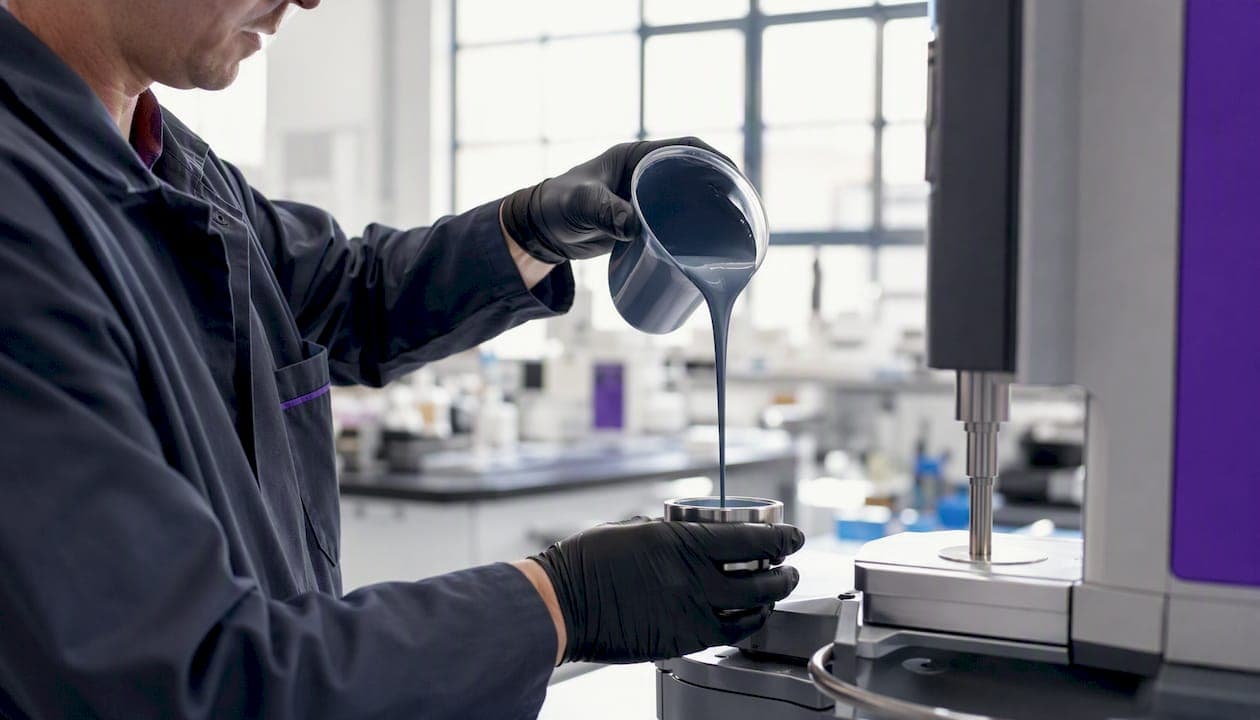
What a Formulator Learns From Doing This Work Every Day
The single biggest gap between textbook rheology and real formulation work is shear history mismatch. A rheometer test protocol can be perfectly executed and still mislead if the shear rates and hold times don't resemble what the product actually experiences in a pump, spray gun, or brush stroke. Reproducible lab tests matter, but they only matter if the shear history in the test matches the shear history in the application.
Pro Tip: Before reformulating from scratch to fix weak recovery, try blending a small amount of an associative thickener into an existing particulate rheology modifier system. The associative component often accelerates early-stage network rebuild without displacing the particulate network's overall structure, tuning recovery speed with a fraction of the reformulation effort.
Always validate final performance under the actual application condition, whether that's a plant-scale pump, a production spray line, or hand brushing, since bench rheometer data predicts behavior but doesn't replace an application trial.
Get Lab-Backed Support for Sag, Suspension, and Pumping Issues
Diagnosing whether a formulation problem traces back to pseudoplastic viscosity or thixotropic recovery is only half the job. Astra-chemical supplies the additive classes that solve both, backed by technical support that reads your rheogram alongside you instead of leaving you to guess at dosage.

Astra-chemical manufactures rheology modifiers, dispersants, and both silicone and non-silicone defoamers built for coatings, inks, adhesives, and composite formulations where sag control, suspension stability, and application rheology all have to work together. The ASTRA REO® rheology modifier line targets structural recovery kinetics directly, while the ASTRA DISP® dispersant range addresses pigment wetting issues that can otherwise masquerade as rheology failures. Formulators wrestling with foam generated during high-shear letdown can also review practical foam testing methods to isolate whether an air-entrainment issue is compounding a rheology problem. Request a technical consultation or a sample of a rheology modifier suited to your target sag resistance and recovery speed through Astra-chemical's product catalog to start narrowing down the right additive for your next formulation trial.
Sources
For measurement protocols, start with the primary industry technical references before consulting theoretical texts:
- Basics of thixotropy | Anton Paar Wiki
- Thixotropy - Rheology | Pharmaceutical
- Thixotropy - Wikipedia
- Viscoelasticity resources, Lakes Lab
For constitutive model theory, the Cambridge Core reference and the Anton Paar structural-kinetics discussion pair well together; for lab protocol design, the Anton Paar and Pharmacy180 pages cover the practical steps in the most direct detail.
FAQ
What Is the Difference Between Thixotropic and Pseudoplastic?
Pseudoplastic viscosity depends only on shear rate and changes instantly; thixotropic viscosity depends on shear rate and time, thinning under sustained shear and rebuilding gradually after shear stops.
What Is Thixotropy in Simple Terms?
Thixotropy is a fluid getting thinner the longer you shear it and thickening back up again once you leave it alone, with the rebuild taking measurable time rather than happening instantly.
What Is the Key Difference Between Plastic Flow and Pseudoplastic Flow?
Plastic flow (Bingham-type behavior) requires a minimum yield stress before any flow starts at all, while pseudoplastic flow thins progressively with increasing shear rate from the very start, with no true yield point.
What Is the Opposite of Thixotropy?
The opposite is rheopecty, also called antithixotropy, where viscosity increases with sustained shear rather than decreasing, a behavior seen occasionally in certain concentrated suspensions.
Can Astra-chemical Help Identify Which Behavior My Formulation Has?
Astra-chemical's technical team supports formulators running rheogram-based diagnostics and can recommend rheology modifier classes suited to whichever behavior, pseudoplastic, thixotropic, or both, the testing reveals.
Recommended
Testing additives for this application?
Send us your current formulation challenge and our technical team will recommend an ASTRA product package for lab screening.