TSCA Compliance for Additives: A Formulator's Guide
TSCA Compliance for Additives: A Formulator's Guide ! Formulator reviewing an additive compliance file TSCA compliance for an additive comes down to one determination made before the first kilogram is manufactured or imported: whether the chemical substance is on the TSCA Chemical Substance Inventor…
TSCA compliance for an additive comes down to one determination made before the first kilogram is manufactured or imported: whether the chemical substance is on the TSCA Chemical Substance Inventory, and if it is not, which notice or exemption applies. Under the Toxic Substances Control Act, the EPA has broad authority to require reporting, testing and controls on chemical substances and mixtures, and dispersants, defoamers, rheology modifiers and other functional additives fall within that scope when they are used in industrial coatings, adhesives, inks, plastics and composites. This guide sets out how the determination works, where formulators most often go wrong, and which documents a procurement or technical team should obtain from an additive supplier.
TL;DR
- Every additive component must be checked individually against the TSCA Inventory; a compliant finished coating does not make each ingredient compliant.
- A substance not on the Inventory requires a Pre-manufacture Notice (PMN) at least 90 days before manufacture or import, unless an exemption such as the Low Volume Exemption (LVE) or the polymer exemption is granted or applies.
- Importers must make a positive or negative TSCA certification to U.S. Customs and Border Protection for each shipment, which places responsibility on the importer of record, not only on the foreign supplier.
- Confidential Business Information (CBI) claims require upfront substantiation; missing it can cost the protection.
- Ask any additive supplier for written Inventory status, CAS number or confidential accession details, and regulatory documentation before qualification.
TSCA operates at the level of the chemical substance, not the trade-name product. A defoamer sold as a single product may be a mixture of a polysiloxane, a carrier oil and a hydrophobic particle, and each component is a separate substance with its own Inventory status. The Inventory, described on the EPA TSCA Inventory page, lists existing chemical substances manufactured, processed or imported in the United States that do not qualify for an exemption or exclusion. It contains over 70,000 existing chemical substances, some of which appear only under a generic name because the identity is claimed as confidential.
The practical consequence for additives is that three questions must be answered for each constituent:
- Is the substance on the public or confidential Inventory, and is it active?
- If listed, are there restrictions attached, such as a significant new use rule (SNUR) that limits certain uses or volumes?
- If not listed, who is the manufacturer or importer of record, and which notice or exemption covers that party?
The answers can differ between a domestic manufacturer and an importer, because the obligation attaches to the party that manufactures (including imports) the substance for a non-exempt commercial purpose.
Checking the Inventory Before Qualifying an Additive
The Inventory check is the cheapest step and the one most often skipped when a new additive is qualified on performance data alone. A workable sequence is:
- Obtain the full composition, at least by CAS number or by generic chemical name for confidential components, from the supplier's safety data sheet and regulatory statement.
- Search each CAS number against the public Inventory and note the active or inactive flag.
- For components with no public match, request the supplier's written statement that the substance is on the confidential Inventory, with the supporting accession or notice reference where the supplier is able to share it.
- Where a component is claimed to be on the confidential list, a formulator who intends to manufacture or import it may use the bona fide procedure. The EPA's Inventory reporting instructions describe how a company can confirm confidential listings on the basis of a genuine intent to manufacture or import, so a substance missing from the public list should not be assumed unavailable.
- Record the outcome in the qualification file, with the date, because Inventory status and SNUR coverage change over time.
This record is the document an auditor or a customer's supplier-quality team will ask for first.
When a New Additive Requires a PMN
Section 5 of TSCA gives the EPA authority to review new chemicals before they enter the market. In the agency's own overview of the new chemical review process, a new chemical is one that is not already on the Inventory. Anyone intending to manufacture or import such a substance for a non-exempt commercial purpose must submit a Pre-manufacture Notice at least 90 days before manufacture, including import.
Two points matter for customized additive programs:
- Tailored chemistry can create a new substance. A custom dispersant built on a novel polymer backbone, a new combination of anchoring groups, or a modified silicone architecture may not match any listed substance, even when each starting material is on the Inventory. The reaction product is what is assessed.
- The review is data-driven. The EPA does not simply look chemicals up; according to its new chemicals program description, it relies on predictive models and category reviews. Clear data on structure, expected exposure and use profile therefore reduces the chance of delay, since gaps in transparency are a common reason reviews stall.
The 90-day period is a minimum for the notice review, and a manufacturer planning a launch should schedule the PMN before commercial scale-up, not alongside it. The EPA publishes statistics for the New Chemicals Program that help set realistic expectations on throughput.
Exemptions: What They Cover and What They Do Not
Section 5(h)(4) allows the EPA to exempt certain new chemicals from full PMN review. The EPA's new chemical review overview identifies, among others, the Low Volume Exemption and the polymer exemption, and the agency's PMN instruction manual also covers the Low Release and Low Exposure Exemption (LoREX), the Test Marketing Exemption Application (TMEA) and the significant new use notice (SNUN).
| Pathway | Typical use for additives | Key constraint |
|---|---|---|
| Low Volume Exemption (LVE) | Specialty additive produced in small quantity | Annual production of 10,000 kg or less; EPA review of about 30 days |
| Polymer exemption | Polymeric dispersants and rheology modifiers meeting structural criteria | Must satisfy defined chemical structure criteria; generally lower bioavailability |
| LoREX | Substance with limited release and exposure | Requires demonstration of low release and exposure |
| TMEA | Market trials before full notice | Limited scope and volume, with EPA approval |
| PMN | Any new substance without an applicable exemption | 90 days before manufacture or import |
The LVE figures, 10,000 kg per year and a 30-day review, are the details most often quoted, and the most often misread. An exemption is not a free pass. The LVE requires an application and an EPA decision before manufacture or import begins, so commencing production while the request is pending is non-compliant. Formulators who treat "exempt" as meaning "no paperwork" are exposed on exactly this point.
Regulatory direction also matters. A proposal reported by AgencyIQ would amend the LVE and LoREX rules and remove eligibility for new PFAS and other persistent, bioaccumulative and toxic substances. Fluorinated surfactants and certain leveling or wetting chemistries are the obvious area of concern for coating additive developers, so any additive strategy that relies on an exemption should be rechecked against the current final rule text before filing.
Importer Responsibility and TSCA Section 13 Certification
Additives are frequently imported, and for imports the obligation moves to the importer of record. Under the EPA's requirements for importing chemicals, imports of chemical substances, mixtures, or articles containing them must comply with TSCA to enter the United States, and importers must certify that the shipment either complies or is not subject to TSCA. Section 13 requires:
- a positive certification that the substance complies with all applicable TSCA rules, or
- a negative certification that the substance is not subject to TSCA, for example because it falls into an excluded category such as a pesticide or food additive in its sole intended use,
filed electronically with U.S. Customs and Border Protection through the Automated Commercial Environment (ACE).
The certification covers substances in mixtures as well. A formulator importing a finished additive blend therefore certifies for every constituent, which is why the Inventory check described earlier should happen before a purchase order is issued, not at the customs broker stage.
The Excluded-Use Trap
A recurring misunderstanding is that a chemical regulated by another agency is automatically exempt from TSCA. The exclusion in the statute applies to substances for the excluded purpose. According to the EPA's TSCA overview, drugs, cosmetics, food and pesticides are carved out in their respective uses, so a substance whose only use is in an FDA-regulated product may be outside TSCA. When the same chemical is also sold into a coating or adhesive, that industrial use can fall under TSCA. The negative certification is only defensible when the sole intended use is the excluded one.
Confidential Business Information and Inventory Listings
Custom additive chemistry is often commercially sensitive, so suppliers claim the chemical identity as CBI. The claim is valid only when properly made. The EPA's reporting instructions require upfront substantiation, and a submitter who omits a signed, dated answer to each of the required substantiation questions risks having the chemical identity made public without further notice.
For a formulator buying such an additive, the effect is indirect but real:
- The supplier's SDS may show a generic name only, so the Inventory status must be confirmed through a written supplier statement.
- If the formulator becomes the importer, the bona fide procedure may be needed to confirm that the substance is listed.
- A supplier's inability to provide any documentation on confidential listing is itself a qualification risk.
Reporting Obligations After the Additive Is Listed
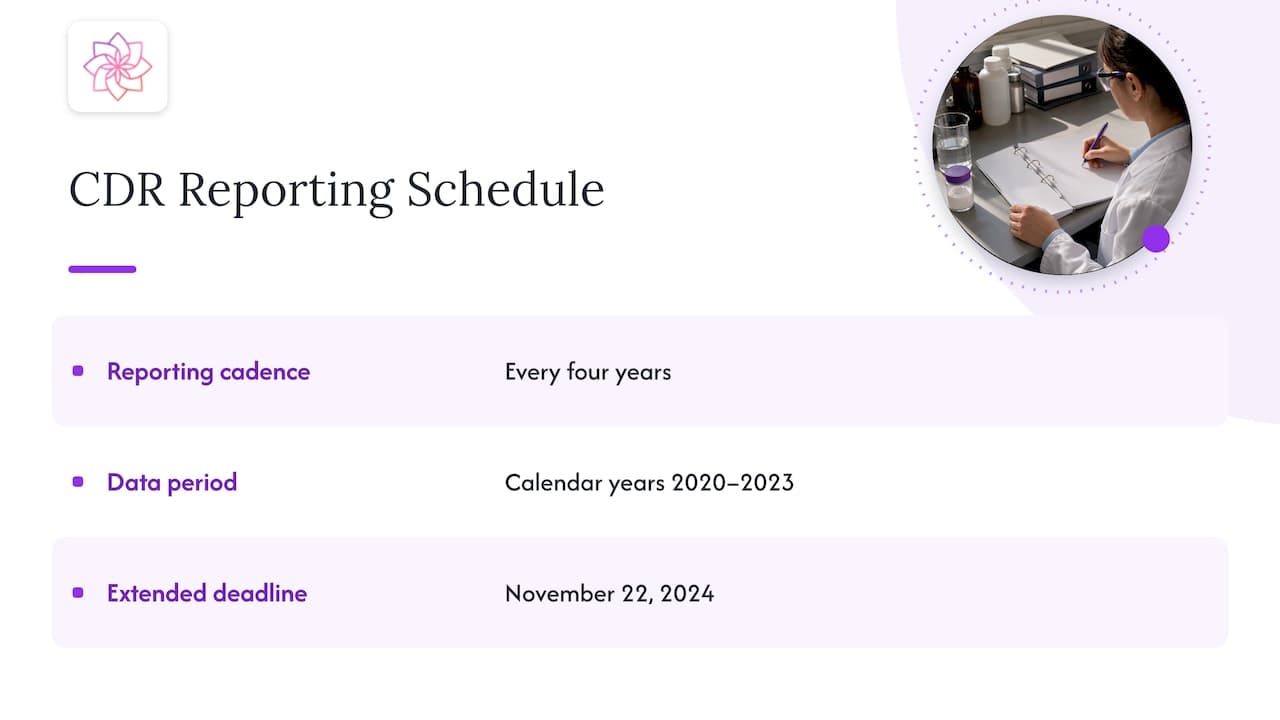
Inventory listing is not the end of TSCA duties. Manufacturers, including importers, of listed chemicals must report under the Chemical Data Reporting (CDR) rule. According to the EPA, the CDR rule requires reporting on manufacturing, processing and use every four years, and the 2024 submission period covered calendar years 2020 to 2023, with the deadline extended to November 22, 2024. Facilities importing additives above the applicable thresholds should confirm in each reporting cycle whether they are a reporting party.
A parallel point applies to workplace regimes outside the United States. Companies with Canadian sites handle a different list-based framework, for example Ontario's designated substances, which is separate from TSCA and should not be conflated with it in multi-country compliance files.
Common Mistakes in Additive Qualification
The following errors recur in qualification files, and each can be removed by process.
- Assuming the finished product is compliant, so the components are. A coating being in commerce says nothing about a newly introduced additive. If the additive is unlisted and the formulator is the importer of record, the formulator may be liable for manufacturing an unlisted chemical.
- Relying on trade names. TSCA status attaches to substances. Two products with similar names can differ completely in composition.
- Starting production while an exemption is pending. An LVE or other exemption must be granted first.
- Filing a negative certification without confirming sole use. The excluded category must be the only use.
- Allowing CBI to lapse through incomplete substantiation.
- Not dating the evidence. Inventory and rule status change; a record without a date cannot demonstrate diligence.
Documents to Request from an Additive Supplier
A procurement manager or technical director can standardize the supplier request. The following set supports both the Inventory check and the customs certification:
| Document | Purpose |
|---|---|
| Safety data sheet with CAS numbers or generic names | Identifies constituents for Inventory search |
| Written TSCA Inventory statement per product | Confirms listed status of all components |
| Statement of any SNUR, consent order or use limitation | Reveals restricted uses |
| Confirmation of importer of record and certification role | Allocates Section 13 responsibility |
| Batch consistency and specification records | Supports repeatability of the compliant composition |
| Support for LVE, polymer exemption or PMN history where applicable | Documents the pathway for any newly developed substance |
Consent orders are a useful signal. The EPA publishes sanitized consent orders tied to individual PMN substances, which show the kind of conditions the agency may attach to a new chemical, such as use or exposure restrictions that then bind downstream users.
The Astra R&D Team Perspective
From the standpoint of an additive manufacturer, TSCA status is a property of the product in the same sense that viscosity or solids content is, and it should be specified, documented and held constant from batch to batch. We see three practical consequences when developing dispersants, defoamers and rheology modifiers for coatings, adhesives, inks, plastics and composites.
First, customization and compliance are linked. A tailored additive is created to address a specific defect, such as foam stability, pigment flocculation or sag, and the chemistry chosen to solve it determines the regulatory pathway. For this reason, regulatory screening of candidate structures belongs early in the development, before laboratory qualification has built commercial momentum around a molecule that cannot be sold promptly.
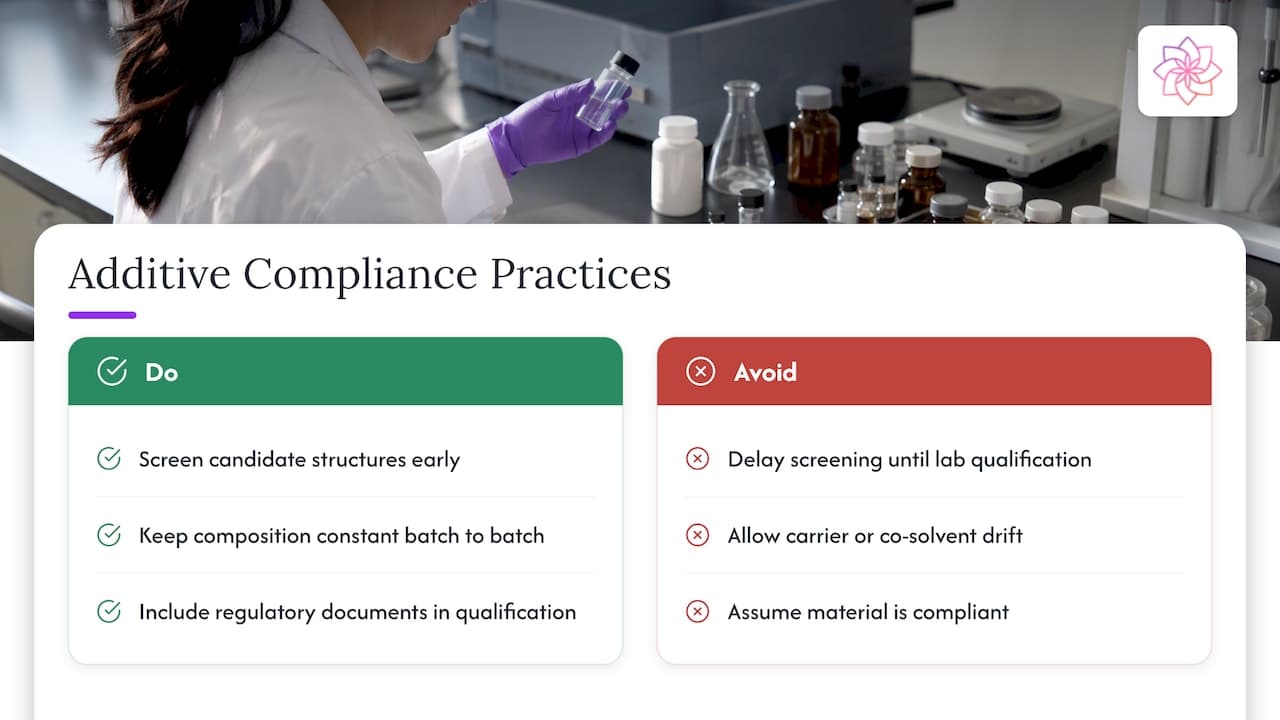
Second, batch consistency is a compliance matter as well as a performance matter. A composition that drifts, for example through a change in carrier or an additional co-solvent, can alter the list of substances that must be certified. Controlled composition and clear documentation allow a customer to certify with confidence.
Third, we recommend that customers treat regulatory documentation as part of the qualification package, alongside laboratory-backed performance data and dosage optimization. A formulator who receives technical data sheets, safety data sheets and regulatory statements together can complete the Inventory check in a single pass, and can quantify cost-in-use against a documented, compliant material rather than an assumed one.
— Astra R&D Team
Where ASTRA Additives Fit
Astra Chemical manufactures and supplies dispersants, silicone and non-silicone defoamers, rheology modifiers and functional coating additives for industrial and specialty formulations, with technical support and custom formulation guidance. The product families include ASTRA DISP® for pigment dispersion and ASTRA REACT® for reactive functional additive systems, and the full range is listed on the product catalog. Technical teams preparing a qualification file can request documentation and samples through the Astra Chemical site, and for functional additive selection the company's guide to reactive diluents and functional additives covers terminal groups and dosage.
FAQ
Does TSCA apply to additives used in small quantities?
Yes. TSCA applies to a chemical substance regardless of the dosage in the final formulation, although low production volumes may qualify the manufacturer or importer for the Low Volume Exemption, limited to 10,000 kg per year. The exemption must be applied for and granted before manufacture or import starts.
Who is responsible if an imported additive is not on the Inventory?
The importer of record is treated as the manufacturer for TSCA purposes and must make the Section 13 certification at entry. A foreign supplier's statement is useful evidence, but it does not transfer the importer's obligation.
Is an additive exempt if it is also used in food or cosmetics?
Not automatically. The exclusion applies to the substance in the excluded use. If the same chemical is sold for a coating or adhesive, that industrial use can be subject to TSCA, and a negative certification is appropriate only when the sole intended use is the excluded one.
What should be checked first when qualifying a new additive?
Check every component against the TSCA Inventory by CAS number, and obtain a written Inventory statement from the supplier for confidential components. Record the date of the check, since listing status and use restrictions can change.
Sources
- Learn About the Toxic Substances Control Act (TSCA), US EPA
- TSCA Chemical Substance Inventory, US EPA
- The New Chemical Review Process under TSCA, US EPA
- Filing a Pre-manufacture Notice with EPA
- Reviewing New Chemicals under TSCA, US EPA
- Statistics for the New Chemicals Program under TSCA
- PMN Instruction Manual 2015, US EPA
- TSCA Requirements for Importing Chemicals, US EPA
- Instructions for Reporting for the Partial Updating of the TSCA Chemical Inventory Data Base
- EPA Extends the Reporting Deadline for 2024 Chemical Data Reporting Period
- EPA proposes amendments to TSCA new chemicals, AgencyIQ
- Sanitized consent order, PMN P-16-0307, EPA ChemView
Recommended
Testing additives for this application?
Send us your current formulation challenge and our technical team will recommend an ASTRA product package for lab screening.