Millbase Viscosity Control: Replace One Target with Shear Windows
Millbase Viscosity Control: Replace One Target with Shear Windows ! Disperser mixing pigmented millbase in vessel Stable millbase viscosity comes from defining a shear-specific rheological profile, selecting dispersant and rheology modifier chemistry suited to the pigment and equipment, and controll…

Stable millbase viscosity comes from defining a shear-specific rheological profile, selecting dispersant and rheology modifier chemistry suited to the pigment and equipment, and controlling mill shear, temperature, and residence time, with every adjustment checked against grind gauge and particle-size endpoints. These targets should be tied to measurable tests, including rotational rheometer sweeps, grind gauge readings, and particle-size data, and our Astra R&D team provides technical support and sample guidance when a formulation needs closer calibration.
TL;DR:
- Profile low, medium, and high shear with a rotational rheometer, then check grind gauge or particle size; many coatings formulations target 50 to 500 nanometers.
- Test dispersant on 200 to 500 gram lab batches, adding 0.25% increments by pigment weight and logging viscosity and grind gauge after every addition.
- Choose a rheology modifier for the mill’s medium shear range, and add defoamer during milling in small doses to avoid poor wetting or unstable viscosity.
- Sample every 15 to 20 minutes during milling, recording shear rate, temperature, and grind gauge together to establish a reproducible process control window.
- During scale up, match energy input per unit volume, but assess dwell time and mill geometry separately because equal energy does not ensure matching endpoints.
Dispersant selection starts with pigment surface chemistry and solvent compatibility. An acidic pigment generally pairs with a basic dispersant backbone, and the binder's polarity has to match the dispersant's anchoring groups or wetting stalls before milling even begins. Starting dose ranges are typically set as a percentage of pigment weight, then refined through small-batch titration: add dispersant incrementally, record viscosity drop at each addition, and stop once further additions produce no meaningful change.
Rheology modifiers fall into two broad families, associative thickeners and polymeric or clay-based modifiers, and the choice matters more during milling than most formulators assume. As the SpecialChem rheology guide notes, modifiers are typically dosed before dispersing and selected to perform in the medium-shear range of the mixing equipment, since low viscosity helps initial particle wetting but medium viscosity is what actually separates agglomerates during grinding. Adding a high-shear-only modifier too early wastes energy and leaves pigment clusters intact.
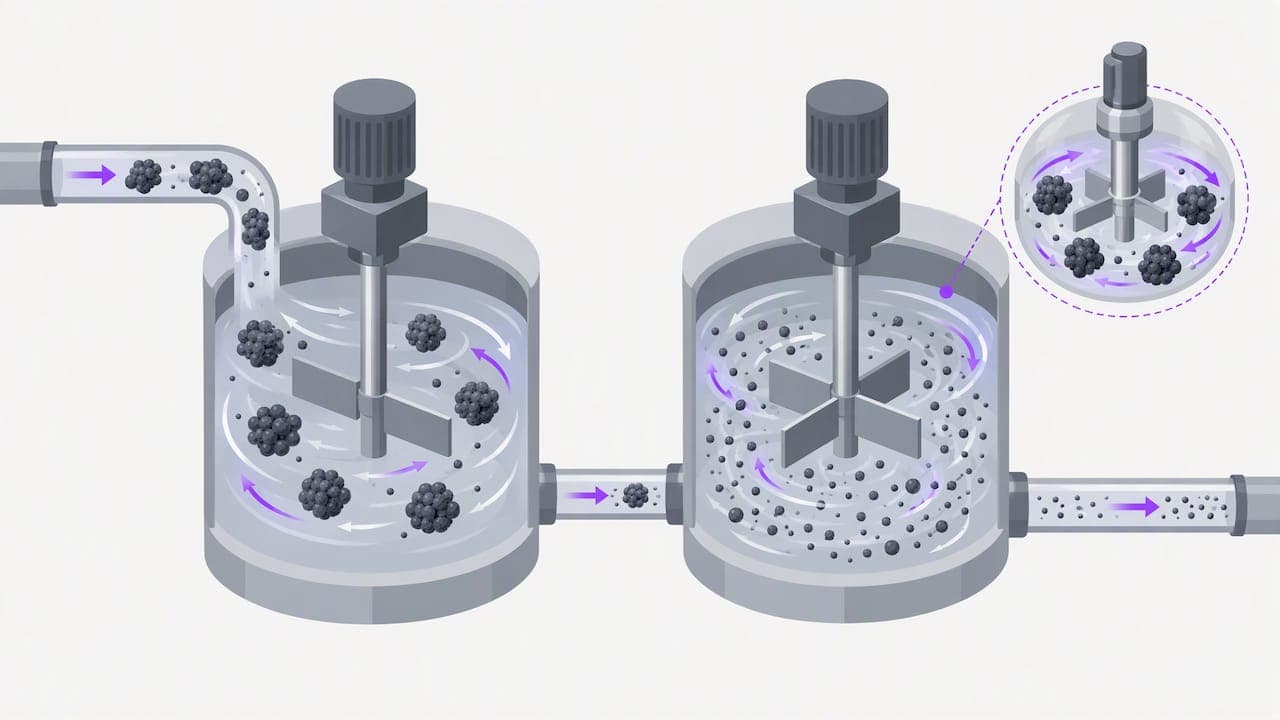
Defoamers belong later in the sequence, added during milling rather than at the wetting stage, because premature addition can interfere with pigment wetting and skew apparent viscosity readings taken afterward. Overdosing a defoamer is a common error: excess defoamer can destabilize the millbase and produce a viscosity reading that looks favorable but does not hold once the batch is let down.
A practical sequencing checklist:
- Wet the pigment in a low-viscosity vehicle to promote fast, even penetration.
- Titrate dispersant in small increments, charting viscosity after each addition.
- Introduce the rheology modifier once primary dispersion is underway, matched to the mill's medium-shear range.
- Add defoamer during milling, in minimal increments, and re-check viscosity after each dose.
Pro Tip: Run the titration on a small bench batch before committing a full mill charge; a 200-gram trial catches dosing errors that a 200-liter batch cannot easily absorb.
Process controls that change viscosity: shear, temperature, residence time, and energy input
Viscosity is not a single number. It shifts with the shear rate applied, which is why a millbase can look thin on a high-speed disperser and thick the moment it sits in a drum. The ScienceDirect correlation study confirms that millbase viscosity depends on shear rate, time, and temperature together, and that pigment interactions raise viscosity while dispersants counteract it by forming a repulsive barrier around each particle. Any viscosity specification that omits the shear rate at which it was measured is incomplete.
Four process variables deserve direct monitoring:
- Shear rate, which varies by equipment type (high-speed disperser, bead mill, three-roll mill) and must be matched to the dispersant's effective range.
- Temperature, managed through jacket cooling or batch interruption, since heat buildup during milling can thin the batch temporarily and mask an underlying viscosity problem.
- Residence time, set by a dispersion endpoint rather than a clock, since the WMU pigment dispersion study found that excessive residence time risks over-dispersing the batch and introducing gloss or haze defects.
- Energy input per unit volume, which should be tracked in kilowatt-hours per cubic meter so a process can be reproduced at a different scale.
Sampling every 15 to 20 minutes during active milling, paired with a grind gauge check at each pull, gives enough data points to draw a control window rather than relying on a single end-of-batch reading. Recording shear, temperature, and grind gauge value together at each sample point, as the ScienceDirect correlation work recommends, is what turns scattered measurements into a reproducible specification.
Viscosity measurement and specifying a rheological profile for millbases
A workable rheological profile reports viscosity at three shear windows rather than one number: low shear (predicting settling and sag resistance), medium shear (relevant to mixing and pumping), and high shear (relevant to application). A rotational rheometer sweep captures all three in a single run, while a Brookfield or similar bench viscometer is adequate for routine plant checks once the rheometer profile has established the acceptable range.
- Use a rotational rheometer for shear sweeps during development and whenever a formulation changes.
- Use a Brookfield-style viscometer for day-to-day production checks against an established window.
- Confirm the dispersion endpoint with a grind gauge reading and, where available, laser particle-size data.
- Equilibrate samples to a consistent temperature before measuring; a few degrees of variation can shift a reading enough to trigger a false rework decision.
Particle size in the 50 to 500 nanometer range strongly affects color strength, gloss, and viscosity in many coatings formulations, according to dispersion parameter research, which means a viscosity reading alone cannot confirm an acceptable dispersion without a corresponding particle-size or grind gauge check.
Formulation tactics and Astra R&D guidance: dosing, troubleshooting, and scale-up
A stepwise dosing protocol built around four checkpoints is recommended: wetting, primary dispersant titration, a premill viscosity and grind check, and incremental rheology modifier addition. A typical lab-scale run uses 200 to 500 gram samples with dispersant added in 0.25 percent increments by pigment weight, recording viscosity and grind gauge reading after each step before moving to the next.
When a batch runs thicker than expected, we suggest working through process variables before reformulating:
- Confirm wetting time was sufficient before dispersant was introduced.
- Check whether temperature drifted outside the established delta during milling.
- Verify dispersant was added incrementally rather than in one bulk charge.
- Record shear rate, temperature, and grind gauge value together at the point the problem appeared, matching the documentation approach the ScienceDirect research recommends.
Scale-up introduces its own variables. Energy per unit volume should be matched between lab and production equipment, dwell-time equivalence checked rather than assumed, and differences in grinding media size or mill geometry accounted for separately, since a bead mill and a three-roll mill will not reach the same endpoint at the same residence time even with identical energy input.
Product families cover each stage of this sequence: dispersants for primary pigment wetting and stabilization, rheology modifiers for medium-shear control during milling, defoamers for post-mill foam management, and reactive additives for formulations requiring reactive chemistry. Formulators working through a dosing question can request samples and technical consultation to address their specific pigment and binder systems.
Pro Tip: Keep a running log of dispersant increment, viscosity, and grind gauge reading for every batch; three or four logged runs usually reveal the dosing pattern a single batch cannot show.
Formulator perspective: balancing dispersion quality with production throughput
Chasing a single viscosity number wastes mill time and energy. The more durable approach defines a shear-specific profile up front and checks it against particle-size and appearance endpoints, not against a stopwatch. Small, logged titration steps catch problems before they reach a full batch, and bringing a technical supplier like our Astra R&D team into early-stage trials tends to shorten the path to a reproducible scale-up.
— Astra R&D Team
How Astra Chemical can help: product lines, samples, and technical support
Additive chemistry is supplied for each stage of millbase control: dispersants for dispersion, rheology modifiers for medium-shear rheology, defoamers for foam management, and reactive additives for reactive systems, with dosing guidance available from technical support.

Formulators working through a persistent viscosity issue, or scaling a formulation to a new mill, can review our full additive catalog or request samples directly from the ASTRA DISP® product page to begin a technical consultation.
FAQ
What causes millbase viscosity to rise unexpectedly during milling?
A viscosity increase during milling usually signals incomplete pigment wetting, reflocculation, or insufficient dispersant rather than a need for more solvent. The ScienceDirect correlation study recommends investigating dispersant effectiveness and process conditions before adjusting the formulation.
How do I measure millbase viscosity correctly?
Use a rotational rheometer to capture a shear sweep across low, medium, and high shear rates, and confirm the result against a grind gauge or particle-size check. Equilibrate the sample to a consistent temperature before measuring, since a few degrees of variation can shift the reading.
When should rheology modifiers be added during millbase preparation?
Rheology modifiers are typically dosed around the dispersing stage, before full dispersion is complete, and matched to the medium-shear range of the mixing equipment according to the SpecialChem rheology guide. Adding them too early or in the wrong shear range wastes energy and leaves pigment agglomerates intact.
What particle size range should a millbase target?
Target particle-size ranges vary by application, but many coatings formulations aim for a distribution in the 50 to 500 nanometer range, which affects color strength, gloss, and viscosity according to pigment dispersion research. Milling beyond the point where particle size stabilizes risks gloss or haze defects without improving dispersion quality.
How can I monitor process consistency across production batches?
Recording shear rate, temperature, and grind gauge value together at each sample point creates a reproducible control window, and some formulators pair this with structured quality tracking software such as the SPC platforms compared here to log batch data over time. Consistent sampling cadence, typically every 15 to 20 minutes during active milling, catches drift before it affects a full batch.
Sources
Testing additives for this application?
Send us your current formulation challenge and our technical team will recommend an ASTRA product package for lab screening.