Adhesive Pigment Dispersion Selection for Formulation Chemists
Adhesive Pigment Dispersion Selection for Formulation Chemists ! Decorative title card with chemical and pigment dispersion icons An adhesive pigment dispersion is a pre-dispersed pigment paste or suspension engineered to deliver stable, reproducible color and opacity when let down into an adhesive…
An adhesive pigment dispersion is a pre-dispersed pigment paste or suspension engineered to deliver stable, reproducible color and opacity when let down into an adhesive formulation. The single most important action for any formulator is to confirm dispersion-binder compatibility, dispersant chemistry, and controlled dosing before committing to a scale-up run, because these three variables determine whether the letdown holds together or flocculates on the mill floor.
Before running a full trial batch, check three things:
- Solvent polarity match between the dispersion's carrier and your letdown vehicle, since a mismatch strips dispersant from the pigment surface.
- Solids content against your target color strength, so you don't overdilute and lose opacity.
- Grind gauge reading on the incoming dispersion to confirm it meets the vendor's stated fineness before you build a batch around it.
Regulatory paperwork matters here too. Confirm TSCA and OSHA declarations are current, and keep an eye on the ASTRA DISP® family as a dispersant option worth trialing once your compatibility checks clear.
Key Takeaways
Adhesive pigment dispersion performance comes down to matching vehicle polarity to the letdown system and dosing dispersant within a tested window, not maximizing pigment loading alone.
| Point | Details |
|---|---|
| Compatibility comes first | Match dispersion vehicle polarity to your letdown resin before evaluating color strength or cost. |
| Dosage has an upper limit | Excess dispersant reduces protective surface coverage and can weaken adhesion and hardness. |
| Test in this order | Run grind gauge, spectrophotometry, viscosity, and stability checks before committing to scale-up. |
| Letdown stripping is common | Solvent polarity mismatches strip dispersant and trigger flocculation; test small-batch first. |
| Trial a compatible dispersant family | ASTRA DISP® is a practical starting point for formulators once compatibility checks pass. |
Pigment dispersions show up wherever an adhesive or sealant needs consistent color without sacrificing bond strength. Pigment dispersions are colored, stable suspensions formulated specifically to deliver reproducible coloration and opacity across these systems, and the vehicle type shapes which one fits.
- Waterborne latex adhesives (packaging, labels, woodworking): pigment dispersions here are typically aqueous, matched to acrylic or vinyl acetate emulsions.
- Construction adhesives and sealants: need UV stability and often higher opacity for exterior exposure.
- Structural and automotive adhesives: epoxy and polyurethane systems demand dispersions that survive high-shear mixing without shifting cure kinetics.
- Electronic and industrial adhesives: sometimes require conductive or low-ionic-content pastes, a narrower niche than standard decorative color.
Temperature swings, UV load, and regional VOC limits on solventborne systems all narrow the shortlist before you even open a datasheet.
What Technical Data Sheet Fields Actually Determine Performance?
A technical data sheet (TDS) tells you far more than the marketing copy above it, provided you know which fields drive outcomes. Solids content sets your color-strength ceiling and dictates letdown ratio math. Pigment type and particle size/grind determine both hue development and gloss retention in the cured film. Viscosity and end-use viscosity flag whether the dispersion will thicken your system unexpectedly during letdown.
- Recommended letdown vehicle: tells you the resin families the dispersion was designed against.
- Dispersant chemistry: ionic or steric, this governs solvent compatibility.
- Recommended dosage and mixing energy: your starting point for scale-up trials.
- Regulatory flags: TSCA, OSHA, and DSL/WHMIS declarations where the product ships into Canada.
Skip any of these and you're guessing at adhesion, hardness, or film formation instead of engineering it.
How Do You Choose the Right Pigment Dispersion for Your Adhesive?
Selection is sequential, not simultaneous. Working through it in order prevents wasted mill time on a dispersion that was never going to work with your binder.
- Identify pigment type and target color strength. Organic pigments give brighter, higher-strength color at lower loading; inorganic pigments and carbon black deliver opacity and UV durability at higher solids.
- Match vehicle polarity to your letdown system first. Compatibility between the dispersion carrier and your resin/solvent system outranks every other criterion, because an incompatible pair flocculates regardless of how good the pigment looks on paper.
- Check solids and dispersant chemistry, then calculate a starting dosage. Anchor groups and tail design determine whether a dispersant stabilizes pigment through charge or steric layers, which tells you whether it will hold up in a polar or nonpolar letdown.
- Plan the milling and letdown sequence. Decide whether you're running a partial pre-dispersion or a full letdown, and account for the shear history the dispersion has already seen before it reaches your tank.
- Run compatibility and scale-up checks. Small-batch letdown, short-term stability at rest, and adhesion/tack testing catch problems before they reach a production drum.
Pro Tip: Set your initial dosage window at the vendor's mid-range recommendation and test one increment above and below it. Steric dispersants generally hold up better in nonpolar or solvent-heavy letdowns, while ionic systems perform best in aqueous, higher-polarity systems.
How Do You Incorporate and Test a Pigment Dispersion in Production?
Incorporation follows a two-step logic: wet the pigment, then polish the dispersion to target fineness. Preparing dispersions typically means powder wet-out in a batching tank followed by milling passes, and skipping the wet-out step is the fastest way to end up chasing agglomerates through an entire mill run.
- Pre-wet or premix the pigment dispersion into a portion of the letdown vehicle at controlled shear.
- Add remaining letdown components in the vendor's recommended order, watching temperature rise under high shear.
- Hold shear at the target rate long enough to reach uniform color development, not just visual mixing.
- Let down to final viscosity gradually rather than all at once, checking rheology partway through.
Equipment choice matters at each stage: a high-speed disperser handles initial wetting, bead or beadless mills polish particle size down further, and rotor-stator or ultrasonic units help with viscous or hard-to-wet pastes.
- Grind gauge (Hegman): confirms fineness meets spec before you invest more mill time.
- Spectrophotometry: measures color strength and delta E against a standard batch.
- Viscosity/rheology: spindle or rotational readings flag thickening or shear-thinning issues.
- Accelerated stability: centrifuge and temperature cycling reveal separation tendencies early.
- Adhesion/tack testing: the final check that color didn't come at the cost of bond performance.
Why Do Pigment Dispersions Flocculate or Shift Color During Letdown?
Most dispersion failures trace back to one of three root causes, and each has a fast diagnostic test.
- Letdown stripping: solvent or resin polarity in the letdown can strip adsorbed dispersant off the pigment surface, triggering immediate flocculation. Run a small-batch compatibility test at production temperature and viscosity before scaling.
- Sedimentation: check with a simple settling test; often points to insufficient dispersant loading or a solids mismatch with the letdown density.
- Color inconsistency batch to batch: usually a mixing energy or letdown sequence problem rather than a pigment quality issue.
- Phase separation: centrifuge testing and pH/electrolyte checks isolate whether it's a stabilization failure or an incompatible additive interaction.
Pro Tip: Don't try to quantify dispersant adsorption directly in routine QC. It's far more practical to measure the downstream performance signals, color strength, viscosity stability, and adhesion, and treat any drift in those as your early warning system.
How Should You Store and Handle Adhesive Pigment Dispersions?
Storage conditions and regulatory paperwork are where good dispersions quietly go bad if nobody's watching. Keep dispersions within the vendor's stated temperature range, agitate before use even after short storage, and seal containers to limit headspace, since air exposure accelerates skinning and viscosity drift.
- Watch for phase separation, unexpected viscosity change, or off-odor as early deterioration signs.
- Use dispensing equipment that minimizes air entrainment during transfer.
- Label batches clearly by intended letdown vehicle to prevent cross-compatibility mistakes on the floor.
- Confirm TSCA, OSHA, and VOC classification status for solventborne dispersions before procurement sign-off.
What Should You Look for in a Pigment Dispersion Datasheet?
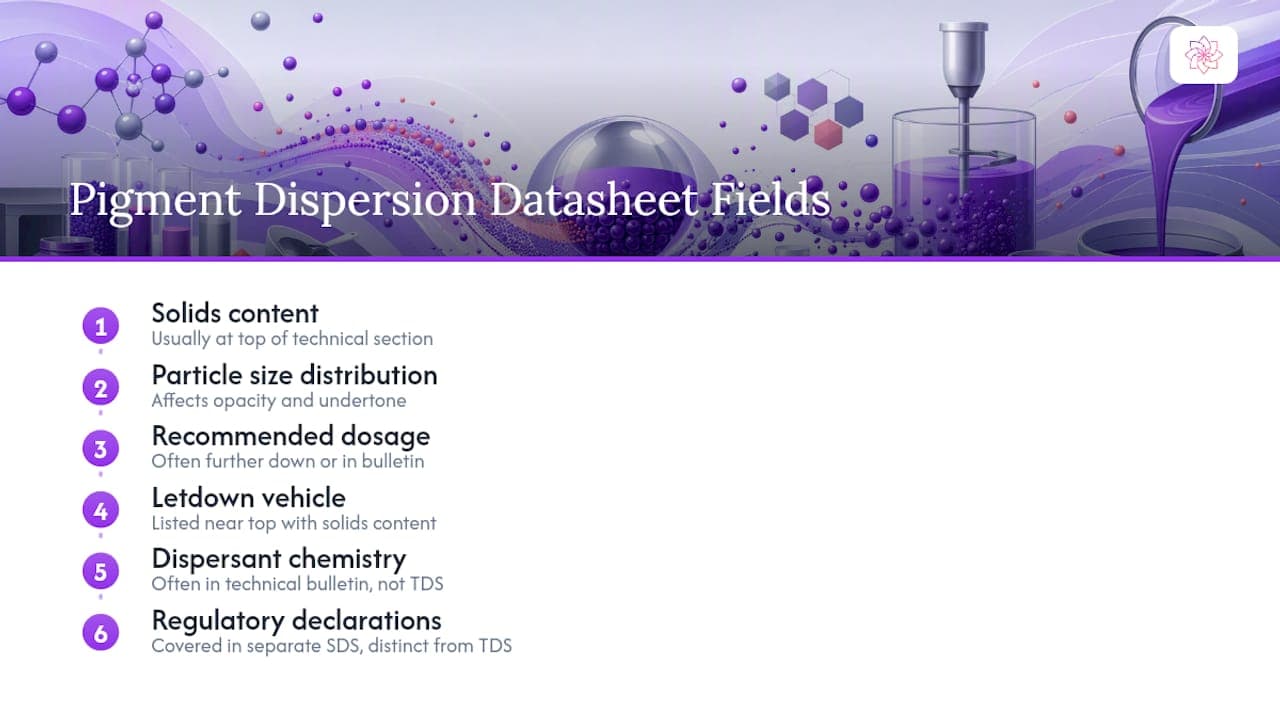
Reading a datasheet efficiently means ignoring the marketing paragraph at the top and going straight to the numbers. Solids content and recommended letdown vehicle usually sit together near the top of the technical section; dispersant chemistry and recommended dosage are typically further down, sometimes on a separate technical bulletin rather than the standard TDS.
A carbon black dispersion and an organic pigment dispersion prioritize different fields. Carbon black datasheets emphasize particle size distribution and jetness/tint strength, since opacity and undertone are the main performance variables. An organic pigment dispersion datasheet leans harder on solvent compatibility and heat stability, since organics are more prone to crystal growth or bleeding under thermal stress. Both should carry a separate safety data sheet (SDS) covering handling and regulatory declarations, distinct from the TDS's performance data.
Build your evaluation template around solids content, particle size, recommended dosage, letdown vehicle compatibility, dispersant chemistry, and regulatory declarations. Copy these six fields for every candidate you screen and comparisons across suppliers get dramatically faster.
A Manufacturer's View on Dispersion Support
Astra R&D supports formulators through sample testing and technical consulting on compatibility and dosing questions. Once your solvent-polarity and solids checks clear, the ASTRA DISP® family is worth a trial run against your specific letdown system.
Get Dispersion Support From Astra Chemical's R&D Team
Guessing at dosage windows or discovering a letdown incompatibility mid-scale-up costs far more in mill time than a proper compatibility check ever would. Astra-chemical built the ASTRA DISP® dispersant family around exactly the two variables that break most adhesive color formulations: vehicle polarity matching and dosage control that avoids the overdosing trap that erodes film adhesion and hardness.
If high-shear wetting is introducing foam into your pigment paste, Astra-chemical's non-silicone defoamer line addresses that without adding a second compatibility variable to your letdown. For a broader view of how dispersants interact with rheology modifiers and defoamers in the same formulation, the coating additives guide walks through the interactions.
The practical next step is a technical consultation: request a sample of ASTRA DISP® matched to your binder system and run it through the small-batch letdown protocol outlined above before committing to a full production trial. Reach out to Astra Chemical's technical team to start that sample request.
Sources
FAQ
What Is a Pigment Dispersion?
A pigment dispersion is a stable, pre-dispersed pigment paste or suspension formulated to deliver consistent color strength and opacity when let down into a binder system, whether that's an adhesive, coating, or ink.
Should Formulators Be Worried About Dispersion Flocculation?
Yes, flocculation from letdown incompatibility is a real risk worth testing for before scale-up, since it degrades color consistency and can compromise film adhesion once the batch is committed.
Can Flocculation or Instability in a Pigment Dispersion Be Corrected?
Often, yes. Adjusting dispersant type or dosage, switching the letdown sequence, or increasing shear during polishing can restore stability, though severe stripping usually means reformulating the letdown compatibility from scratch.
What Are the Signs of a Failing Pigment Dispersion?
Watch for phase separation, unexpected viscosity change, color drift between batches, and off-odor, all of which point to storage degradation or a compatibility issue with the letdown vehicle.
How Much Dispersant Should Go Into an Adhesive Formulation?
Start at the vendor's mid-range recommended dosage and test one increment above and below it, since too little dispersant leaves pigment unstable while too much reduces protective surface coverage and weakens adhesion.
Recommended
- Dispersants for Coatings: Selection & Dosage Guide (2026) | ASTRA CHEMICAL
- Coating Additives Guide: Selection, Chemistry & Formulation (2026) | ASTRA CHEMICAL
- Switching Coating Additive Suppliers: A Step-by-Step Migration Guide | ASTRA CHEMICAL
- Additives for Polyurethane Coatings: Selection Guide (ASTRA) | ASTRA CHEMICAL
Testing additives for this application?
Send us your current formulation challenge and our technical team will recommend an ASTRA product package for lab screening.