Knock Foam Down in One Shift: Plant R D Playbook for Polymer Emulsions
Knock Foam Down in One Shift: Plant R D Playbook for Polymer Emulsions ! Polymer emulsion foam title card illustration The fastest, most reliable way to control foam in emulsion polymerization is a compatibly tuned silicone-polyether defoamer, or a screened mineral or molecular alternative, dosed at…
The fastest, most reliable way to control foam in emulsion polymerization is a compatibly tuned silicone-polyether defoamer, or a screened mineral or molecular alternative, dosed at the low end of the supplier's range and qualified against your own recipe. Astra-chemical's ASTRA DF® silicone defoamers, ASTRA DF NS® non-silicone grades, and ASTRA DISP® dispersants each fit different points on that spectrum. No grade should go into a reactor without a bench screen first.
TL;DR:
- Using low doses of compatible defoamers and splitting the addition points can significantly reduce foam within a single shift without any new equipment or recipe changes.
- Proper screening at shear conditions actual to production is critical, as defoamer performance at bench stir speed often misrepresents its effectiveness at mill shear rates.
- Waterborne systems are more foam-prone than solvent-based ones due to surfactant stabilization, with microfoam being particularly difficult to control once macrofoam collapses.
- Silicone-polyether defoamers provide the fastest foam knockdown but require careful compatibility testing, whereas mineral oil and molecular defoamers are cheaper but less effective against microfoam.
- Persistent foam after proper dosing indicates issues outside the defoamer, such as lot variation, water quality, or depletion, and may require changing chemistries or additional process adjustments.
Before touching the recipe or the reactor geometry, a plant can usually knock foam volume down within a single shift by adjusting how and where the defoamer already on hand gets introduced. These are the changes that require no new purchase order and no engineering review.
- Start low, then titrate. Begin at the low end of the supplier's recommended range and increase only if knockdown is incomplete after two batches.
- Split the dose. Add a fraction at the grind stage and the remainder at let-down or during strip, rather than dumping the full charge at one add-point.
- Throttle the sparge. Temporarily reduce strip gas flow or reposition sparge points away from high-turbulence zones to cut foam generation at the source.
- Run a five-minute stir test. Simulate grind shear on a bench mixer with candidate defoamer grades before committing a drum to the reactor.
- Check coagulum and filter load. A rising filter change frequency or visible grit after a defoamer switch signals incompatibility, not underdosing.
Pro Tip: If foam reappears within an hour of an apparently successful knockdown, suspect microfoam rather than underdosing. Microfoam often needs a different active particle size, not more of the same chemistry.
Why Do Emulsion Polymerizations Foam So Easily?
Foam forms in emulsion polymerization because the surfactants that stabilize the latex particles do the same job on air bubbles. Every agitator pass, monomer feed addition, and sparge of nitrogen or steam introduces air, and the surfactant-rich aqueous phase wraps that air in stable lamellae and micelles rather than letting it coalesce and escape.
The operational cost shows up fast. Foam eats reactor headspace, cutting effective batch capacity and forcing slower fill rates. It carries over into condensers and vent lines, fouling equipment and creating cleaning downtime. Worse, collapsing foam at the wrong moment seeds coagulum and grit, and any batch that gouges to spec on paper can still ship off-spec once that grit shows up in a customer's filter bag.
It helps to separate macrofoam from microfoam. Macrofoam is the visible, coarse-bubble layer that forms right at the agitator surface or sparge point. Microfoam is the fine, persistent haze that survives after macrofoam collapses and is much harder to knock down. Waterborne systems are inherently more foam-prone than solventborne ones because water's high surface tension and the surfactants needed for colloidal stability actively stabilize foam rather than letting it dissipate.
Which Defoamer Chemistry Fits Your Recipe?
Three defoamer families dominate emulsion polymerization and waterborne formulation, and each trades knockdown speed against compatibility risk differently.
Silicone-polyether defoamers combine a polydimethylsiloxane (PDMS) core with polyether modification, giving strong, fast foam knockdown while the polyether segment allows compatibility tuning. This is why silicone-polyether has become the default choice for latex reactors when the grade is qualified correctly against the specific resin and surfactant package. Some silicone-polyether defoamer lines sit in this category and are built for exactly this qualification-first use case.
Mineral and organic oil defoamers offer broad compatibility and a lower cost per pound, and they handle macrofoam in many latex systems reliably. Their weakness shows up on microfoam and high-gloss films, where siloxane or molecular chemistries typically outperform them.
Molecular, silicone-free defoamers avoid silicone entirely, which matters for defect-sensitive films where even trace silicone can cause craters or fisheyes. Certain non-silicone defoamer grades occupy this space for formulators who need knockdown without any silicone footprint in the final film.
- Silicone-polyether: fastest knockdown, needs the most careful compatibility screening.
- Mineral/organic oil: cheapest, weakest on microfoam and gloss.
- Molecular/silicone-free: best for defect-sensitive films, often needs higher dose to match silicone knockdown.
For high-shear pigment grinds, 100% active defoamer compounds or shear-stable emulsions preserve droplet size and activity far better than diluted, low-active versions that break down under mill shear.
Pro Tip: A defoamer that performs beautifully at bench-scale stir speed can fail entirely at production mill shear. Always screen at the shear rate your grind stage actually runs, not a gentle lab approximation.
What Dosage and Add-Point Actually Work?
Effective defoamer dosage in industrial water-based systems generally runs between 0.05% and 1.0% by weight, with molecular grades sometimes needing the upper end of that range to match silicone performance. Starting at the bottom of that band and titrating upward avoids the classic overdose failure mode: dewetting, craters, and pinholes in the finished film.
Where you add the defoamer matters as much as how much. Splitting the dose between grind and let-down, or between let-down and strip, reduces the risk that macrofoam gets stabilized by surfactant before any defoamer has a chance to act on it.
- Grind stage: partial dose to control foam generated by high-shear pigment dispersion.
- Let-down: remainder of the dose, timed to residual foam after grind.
- Strip/monomer feed: small trim dose if sparging or feed turbulence regenerates foam late in the batch.
Incorporation shear directly sets defoamer droplet size, and droplet size drives performance. Higher shear produces finer droplets; droplets below roughly 1 µm lose knockdown efficiency, while the 2 to 10 µm range delivers the best balance of speed and storage stability. Overmixing a defoamer premix can quietly ruin a grade that tested well on paper.
How Do You Screen and Qualify a Defoamer Grade?
Every emulsion recipe behaves differently, and no defoamer works universally across resin systems. A repeatable qualification sequence catches incompatibility before it reaches the reactor.
- Bench stir test. Add candidate grades to a small batch sample at target dose and observe knockdown speed and any surface haze.
- Grind shear simulation. Run the defoamer through the actual grind shear profile to confirm droplet size holds up under mill conditions.
- Storage stability check. Hold the treated sample for one to two weeks and inspect for defoamer separation, floating oil, or re-foaming on agitation.
- Drawdown film test. Cast a drawdown and inspect for craters, pinholes, or fisheyes that signal overdose or poor compatibility.
- Filter load and turbidity check. Track filter change frequency and particle counts; a meaningful jump after a defoamer switch points to seeded coagulum, not a defoamer performance issue.
In production, three monitoring points catch problems early: foam height in the reactor headspace, carryover volume at the condenser, and filter change frequency over a rolling batch count. Formulators can also draw on structured foam testing methods to standardize how knockdown and persistence get measured across grades, which makes lab comparisons between candidate defoamers far more defensible than a visual "looks better" call.
Which Process Changes Reduce Foam Load?
Chemistry alone rarely solves a chronic foam problem if the process is actively generating more air than the defoamer was designed to handle. Sparge and strip gas flow deserve a second look before increasing defoamer dose. Lowering flow rate or relocating sparge points away from the agitator's high-turbulence zone often cuts foam generation more effectively than adding more chemistry, since every processing step that introduces air compounds the load the defoamer has to manage.
Monomer feed geometry matters too. Feeds that drop directly into the vortex at the agitator shaft entrain far more air than feeds introduced below the liquid surface near the vessel wall. Where the application allows it, deaeration under mild vacuum before transfer, or application methods like airless spray or film casting that avoid whipping air into the fluid, reduce the burden on the defoamer entirely.
Splitting defoamer additions to coincide with lower-turbulence zones in the process, rather than dosing everything at the point of highest agitation, gives the chemistry a better chance to act before foam stabilizes. Common formulation missteps around mixing intensity and shear compound foam problems in ways that mimic a defoamer failure; a broader review of water-based coating formulation mistakes covers several of these process-side traps in more detail.
Do Acrylics and Styrene-Butadiene Foam the Same Way?
Not quite. Acrylic emulsions typically run with anionic or nonionic surfactant packages and moderate colloid stabilizer loading, and their foam tends to skew toward finer, more persistent microfoam because the surfactant blend used to control particle size also stabilizes small air bubbles efficiently.
Styrene-butadiene rubber (SBR) latexes often carry higher total surfactant and rosin-soap content to manage the more hydrophobic monomer pair, and that heavier surfactant load frequently produces coarser, higher-volume macrofoam that shows up fast at the agitator surface and sparge zone. The practical consequence is that an SBR reactor may tolerate a mineral oil defoamer that handles macrofoam economically, while an acrylic system prone to microfoam often needs the finer, more penetrating action of a silicone-polyether or molecular grade.
Vinyl acetate and vinyl acetate ethylene (VAE) emulsions sit somewhere in between, and their foam behavior shifts meaningfully with plasticizer content and residual monomer level, which changes the interfacial tension the defoamer has to work against. This is precisely why a defoamer grade that performs well in one polymer family cannot be assumed to transfer cleanly to another, even when both are broadly "waterborne latex." Recipe-specific screening remains the only reliable way to confirm a grade's fit, and it is worth repeating any time a plant changes surfactant supplier, monomer ratio, or particle size target, since each of those shifts the same entry and spreading coefficients that determine whether a given defoamer chemistry will rupture foam lamellae at all.
What Environmental and Safety Factors Affect Defoamer Choice?
Regulatory pressure on formulations has pushed several defoamer classes toward lower-VOC and reduced-hazard profiles, and that shift affects which chemistry fits a given end use as much as raw knockdown performance does. Coatings destined for food-contact packaging, potable water contact, or indoor air quality certified applications carry additional restrictions on extractable content and residual monomer in the defoamer itself, not just in the base polymer.
Silicone-based defoamers generally carry a lower inherent VOC contribution than some mineral oil grades, but silicone's persistence in the film can create its own downstream problem: recoat adhesion failures and cross-contamination in shared production lines where even trace silicone transfer causes cratering in an unrelated product. Molecular, silicone-free defoamers avoid that cross-contamination risk entirely, which is part of why they remain the default choice in facilities running multiple product lines through shared equipment.
Handling and storage safety matter at the drum level too. Defoamer concentrates, particularly mineral oil based grades, can carry flash points and handling precautions that differ meaningfully from the base emulsion, and procurement teams should confirm SDS classifications match the plant's existing storage and handling infrastructure before committing to a chemistry switch. None of these considerations override the compatibility screening step. A defoamer with an ideal environmental profile that seeds coagulum in your specific recipe is not a usable solution, whatever its safety data sheet says.
How Do Temperature and Monomer Composition Change Foam Behavior?
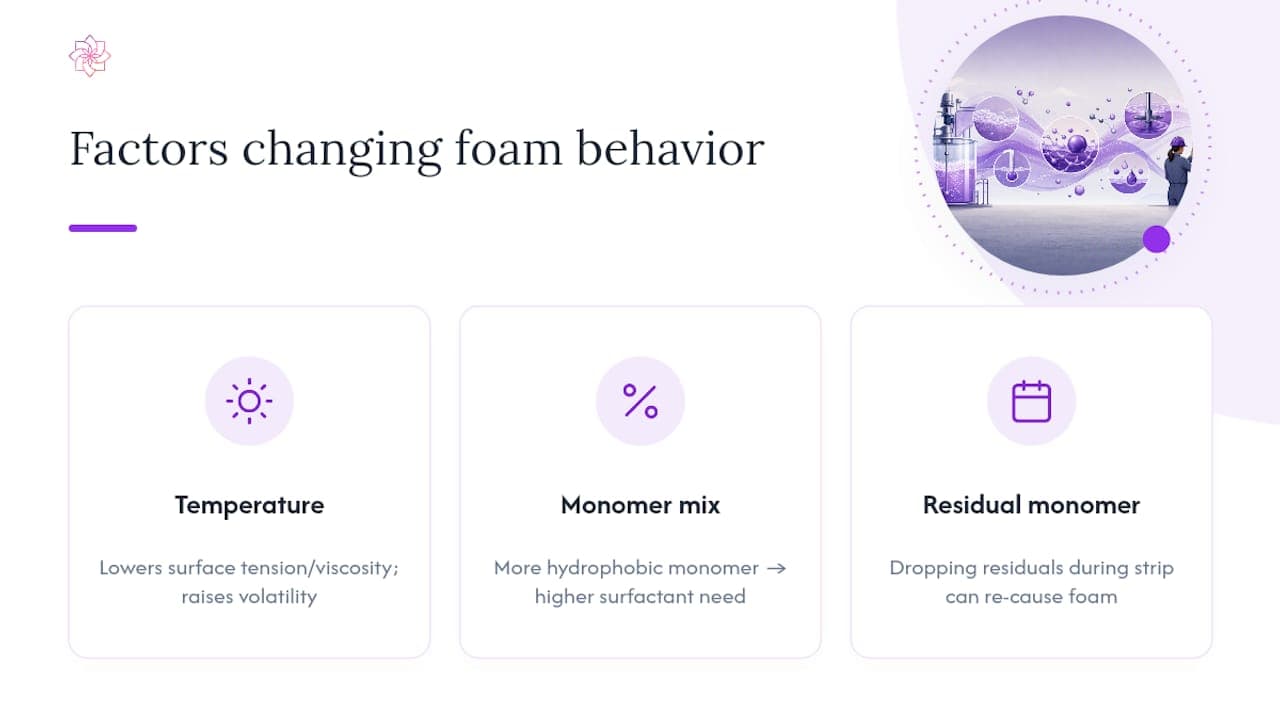
Reaction temperature shifts foam stability in ways that are easy to overlook when troubleshooting focuses only on agitation and sparge rate. Higher reaction temperatures generally lower the aqueous phase's surface tension and viscosity, which can make foam collapse faster on its own, but the same conditions also increase the volatility of any low-boiling monomer, adding more vapor-phase turbulence at the reaction surface during exotherm.
Monomer composition changes the surfactant demand of the whole system. A recipe running a higher fraction of hydrophobic monomer, styrene relative to butadiene, or a harder acrylic monomer blend, typically needs more surfactant to maintain colloidal stability during polymerization, and more surfactant means a more foam-prone aqueous phase throughout the batch. Formulators who have qualified a defoamer against one monomer ratio should not assume it transfers cleanly to a reformulated recipe with a different hard-to-soft monomer balance, even if the surfactant package looks nominally similar on paper.
Residual monomer level late in the batch also plays a role, particularly during strip stages where vacuum or steam sparge removes unreacted monomer. As residual monomer drops, the aqueous phase's interfacial characteristics shift again, which is one reason foam can reappear during strip even after knockdown looked complete earlier in the batch. Temperature ramps during strip deserve the same scrutiny as sparge rate when foam recurs at that stage.
What If Standard Defoaming Doesn't Fix Persistent Foam?
When a properly dosed, properly screened defoamer still leaves chronic foam, the problem usually lives outside the defoamer itself. Check raw material lot-to-lot variation first: a new surfactant lot, even from the same supplier, can carry a slightly different HLB balance that changes how the existing defoamer performs against it.
Water quality is a frequently missed variable. Hard water or elevated ionic content changes surfactant behavior and can destabilize a defoamer emulsion before it ever reaches the point of use, particularly for mineral oil grades that rely on stable pre-dilution.
Antifoam depletion over a long batch cycle is another common culprit. A defoamer that knocks down foam early in a multi-hour reaction can simply run out of active material by the strip stage, especially in recipes with continuous monomer feed extending the reaction time well beyond the original screening window. Consider a small trim dose late in the cycle rather than assuming the chemistry has failed outright.
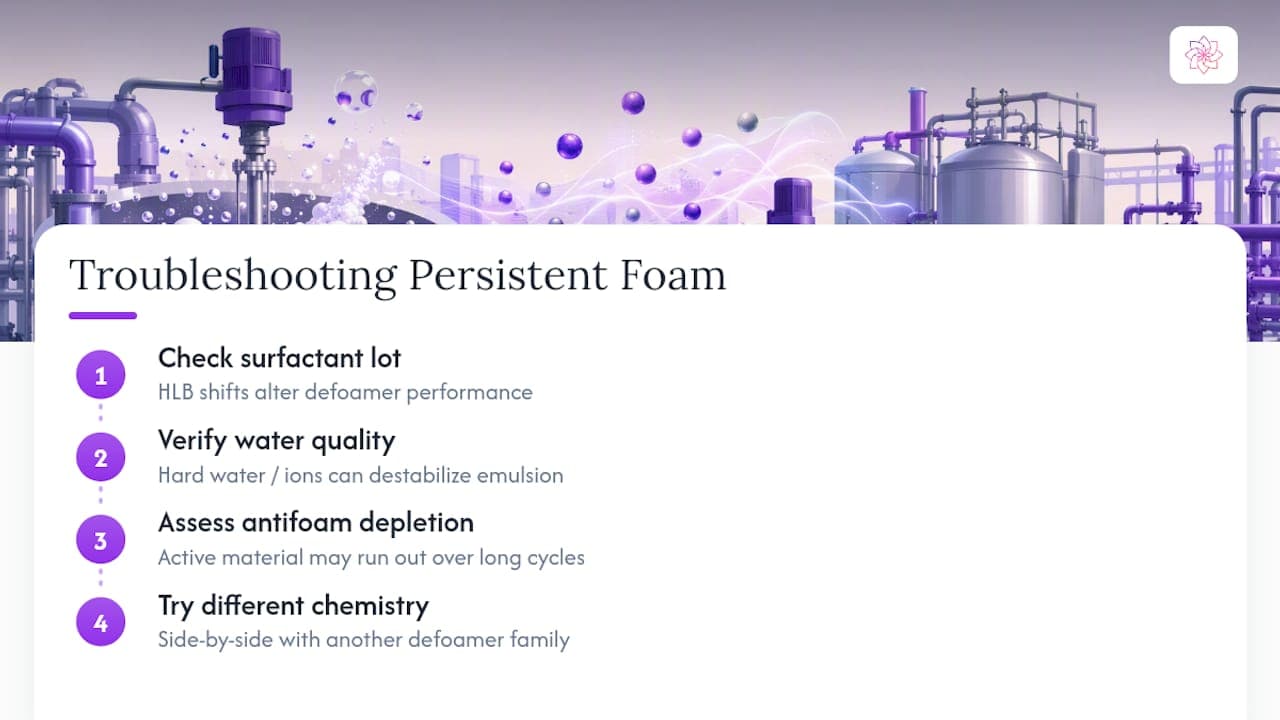
If foam persists despite ruling out lot variation, water quality, and depletion, the next step is a side-by-side comparison against a second chemistry family entirely. A recipe defaulting to silicone-polyether that still shows microfoam may respond better to a molecular grade with a different active particle size distribution, and vice versa for macrofoam that a molecular grade cannot fully suppress.
Is a More Expensive Defoamer Ever the Cheaper Choice?
Cost-per-pound is the wrong first number to compare across defoamer chemistries. Mineral oil defoamers typically carry the lowest raw material cost, but if a lower price point requires a higher dose to achieve equivalent knockdown, or leaves microfoam that triggers rework and downgrade, the effective cost per good batch can exceed a pricier silicone-polyether or molecular alternative used at a lower dose.
Coagulum and grit carry their own hidden cost structure. A defoamer that seeds even a small amount of coagulum forces additional filtration, increases filter change frequency, and in the worst case turns a saleable batch into off-spec material that has to be reworked or scrapped. Weighing defoamer cost against filter media consumption, downtime for filter changes, and batch rejection rate gives a far more accurate picture than comparing drum price alone.
The qualification process itself has a cost, but it is a bounded, one-time cost against the recurring cost of a chronic foam problem. A few days of bench screening against candidate grades is inexpensive relative to a production run that has to be slowed, reworked, or scrapped because an unscreened defoamer swap introduced coagulum three months into a supply agreement. Procurement teams evaluating defoamer suppliers should weigh not just unit price but the depth of screening and technical support offered alongside the product, since that support materially affects how quickly a new grade reaches production-ready status.
Astra R&D Takeaways and Practical Heuristics
Start low and titrate. Favor a tuned silicone-polyether for reactor duty once compatibility is confirmed. Split doses across grind and let-down rather than dosing once.
None of these heuristics substitute for recipe-specific qualification. Every recommendation here assumes a bench screen, a shear simulation, and a monitored production trial before full-scale adoption, tracked against foam height, filter load, and film defect rate.
— Astra R&D Team
Get Defoamer Samples and Bench Screening Support
Some defoamer suppliers give formulation teams a direct path from bench screen to production, pairing each product family with technical support built around the qualification steps this guide covers: stir tests, grind shear simulation, and drawdown film checks before anything scales to a reactor.
ASTRA DF® silicone defoamers deliver fast knockdown for latex reactors once compatibility is confirmed. ASTRA DF NS® covers silicone-free applications where even trace silicone risks cratering downstream. ASTRA DISP® dispersants round out the pigment-grind side of the formulation, since dispersant choice and defoamer choice interact directly at the grind stage. For deeper background on matching chemistry to film requirements, the silicone versus silicone-free selection guide walks through the same tradeoffs in more depth.
Request a sample set and bench screening support through the full coating additives lineup to get a recipe-specific recommendation before your next production run.
Sources
- Defoamers for paints and coatings (Air Products technical brochure)
- Defoamer selection in waterborne coatings (Journal of Coatings Technology article, Adams)
- Foam control in emulsion polymerization: silicone‑polyether for latex reactors (RawSource)
- Defoamers for waterborne coatings (Safic‑Alcan industry article)
FAQ
What Causes Foam in Polymer Emulsions?
Surfactants needed to stabilize latex particles also stabilize air introduced by agitation, monomer feeds, and sparging, trapping it in lamellae that resist collapse without a defoamer.
What Is a Typical Defoamer Dosage for Emulsion Polymerization?
Effective dosage generally runs between 0.05% and 1.0% by weight, starting at the low end and titrating upward based on knockdown results.
Is Silicone or Non-Silicone Defoamer Better for Latex Reactors?
Silicone-polyether grades like ASTRA DF® typically give the fastest knockdown in reactors once qualified for compatibility; non-silicone options like ASTRA DF NS® suit defect-sensitive films where any silicone transfer is unacceptable.
How Do You Know if a Defoamer Is Incompatible With a Recipe?
Watch for rising coagulum, increased filter change frequency, or craters and pinholes in drawdown film tests after a defoamer addition or switch.
Why Does Foam Reappear After a Successful Knockdown?
Persistent reappearance usually signals microfoam rather than underdosing, or defoamer depletion late in a long batch cycle, and often needs a different active particle size or a trim dose during strip.
Recommended
Testing additives for this application?
Send us your current formulation challenge and our technical team will recommend an ASTRA product package for lab screening.