5 Variables Formulators Must Screen Before Custom Defoamer Formulation
5 Variables Formulators Must Screen Before Custom Defoamer Formulation ! Decorative custom defoamer formulation title card A custom defoamer formulation is justified once an off-the-shelf product fails repeatedly under real process conditions, whether from extreme pH, high surfactant load, elevated…
A custom defoamer formulation is justified once an off-the-shelf product fails repeatedly under real process conditions, whether from extreme pH, high surfactant load, elevated temperature, or OEM-driven regulatory limits. Three variables, pH, surfactant concentration, and thermal or solvent exposure, decide whether a stock antifoam will hold up. When they don't, the practical next step is sending a process sample for bench screening before committing to plant trials.
TL;DR:
- Custom defoamers become necessary when off-the-shelf products repeatedly fail under specific process conditions such as high pH, temperature, or surfactant load.
- Matching defoamer oil polarity and particle chemistry to the surfactant class is a critical factor in ensuring formulation success across different industries.
- Selecting the appropriate base chemistry—silicone, non-silicone, or polymeric—depends on process behavior and product tolerances, affecting knockdown speed and residue.
- Bench screening should explore active concentration, carrier oil, particulate filler, emulsifier HLB, and co-solvent variables, with initial tests at 0.1 to 10% active levels for optimal performance.
- Validating a formulation requires a series of tests including foam height, shear stability, and residue assessment in conditions that mimic real process environments before scaling up.
Not every foam problem needs bespoke chemistry, but several industries hit the limits of generic antifoams constantly. Coatings formulators fight foam introduced by high-shear dispersion and surfactant-stabilized resin systems. Wastewater treatment and fermentation processes generate foam under aeration and shear that shifts by the hour as biomass and solids concentration change. Oilfield fluids carry high salinity and variable temperature that degrade conventional actives, and food-tech or adhesive lines often carry regulatory constraints that rule out common carrier oils entirely.
A custom defoamer must match process variables like pH, temperature, and chemical composition, because these factors dictate how much active ingredient the system needs and how it should be delivered. Solids loading and aeration rate change foam stability independently of chemistry, which is why a defoamer that works in a clean tank often collapses in service.
Off-the-shelf failure modes tend to repeat across sectors:
- Visible residue or haze on finished coatings or films
- Incompatibility with resins, pigments, or biological cultures
- Short functional lifetime, requiring re-dosing within hours instead of a full batch cycle
- Re-foaming after an initial knockdown, especially under continuous shear
How Do Defoamers Actually Collapse Foam?
Foam persists because surfactants stabilize the gas-liquid interface, lowering surface tension enough that bubbles resist coalescing. A custom defoamer formulation works by disrupting that stabilized film rather than simply diluting it away. Three mechanisms dominate in practice:
- Spreading and bridging: an incompatible oil droplet spreads across the bubble wall, thinning it until it ruptures.
- Interfacial displacement: the defoamer's active competes with the stabilizing surfactant for the interface and physically displaces it.
- Particulate-induced coalescence: hydrophobic solid particles (often silica) create weak points in the lamella, forcing bubbles to merge and collapse.
Formulation insight: matching defoamer oil polarity and particle chemistry to the surfactant class already in the system is the single highest-leverage decision in the entire project. Patent literature on foaming-agent compositions shows how alkyl sulfate ratios and amino-acid surfactants shift foam stability at concentrations as low as 0.1 to 10% in aqueous use, which is the same order of magnitude formulators need to counter on the defoamer side.
Silicone, Non-Silicone, or Polymeric: Which Base Chemistry Fits?
Base chemistry selection drives most of a custom project's outcome, and it depends on how the surfactant system in your process behaves and what the finished product will tolerate.
- Silicone defoamers deliver fast knockdown and spread aggressively across a wide range of surface tensions, making them a strong default for aqueous systems. They demand caution in silicone-sensitive systems such as automotive coatings or optical films, where even trace transfer causes crater defects. Astra-chemical's ASTRA DF® silicone defoamer line is built as a starting platform for exactly this trade-off.
- Non-silicone systems, built on mineral oil or ester carriers, trade some knockdown speed for lower residue risk and broader regulatory acceptance in food-contact or paper applications. ASTRA DF NS® formulations fall in this category.
- PPG and glycol-based actives hold a strong position in fermentation and water treatment because PPG's temperature-dependent solubility gives it a spreading coefficient that adjusts favorably as process temperature climbs, an advantage generic silicone blends don't replicate.
- Polymeric actives suit systems where long-term persistence matters more than instant knockdown, such as closed-loop cooling water.
Pairing base chemistry to surfactant class, not just to industry convention, is what separates a working custom formulation from a repeat of the original failure. A silicone versus silicone-free comparison is worth reviewing before locking a direction.
What Formulation Variables Should You Screen First?
Five variables account for most of the performance variation formulators see on the bench: active concentration, carrier oil type, particulate filler loading, emulsifier HLB, and co-solvent or viscosity modifiers. Each interacts with the others, so isolating one at a time wastes bench hours.
- Active concentration: start bench screening in the 0.1 to 10% range referenced in foaming-agent patent literature, then narrow based on knockdown speed.
- Carrier oil selection: mineral, silicone, or vegetable-derived, chosen against regulatory and residue constraints.
- Particulate filler: hydrophobic silica loading typically runs from 2 to 15% of the active phase, adjusted for particle-induced coalescence strength.
- Emulsifier HLB: controls how the finished defoamer disperses into the target system without separating.
- Co-solvent and viscosity: fine-tunes pumpability and dosing accuracy at the point of application.
Older patent families describe blend ratios and hydrotrope percentages as a useful reference point for how molecular-weight distribution shifts foam behavior, though every ratio needs re-validation against your specific process water and pH.
Mixing order matters: disperse the filler into the carrier oil first, then introduce the emulsifier package, and add the active surfactant-disrupting agent last to avoid premature interaction. Food and biotech-grade projects require documentation of every raw material's regulatory status before bench work even starts.
Pro Tip: *Run an orthogonal matrix varying active concentration and filler loading first, holding carrier and emulsifier constant.
What Testing Confirms a Formulation Is Ready to Scale?
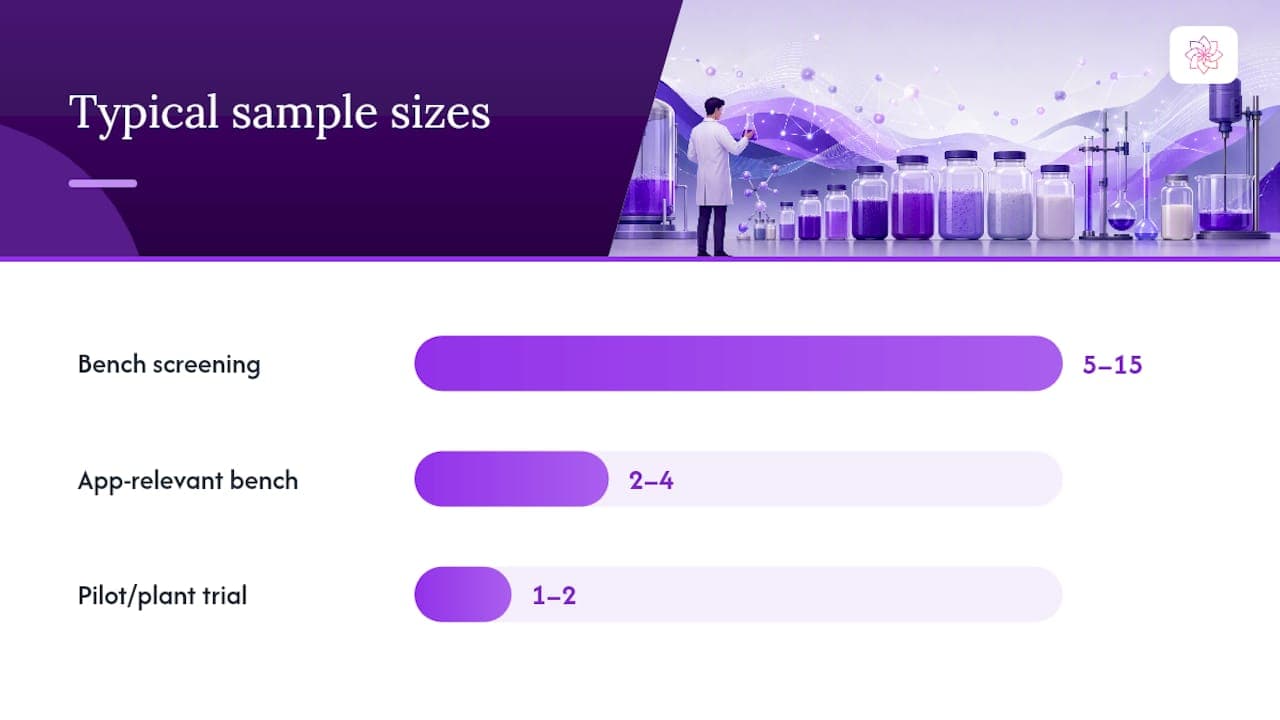
A defoamer that wins on the bench can still fail in the plant, which is why the recommended workflow always runs bench screening before an application-relevant test and only then a pilot trial. Standard screening includes Ross Miles foam height testing, dynamic foaming under mechanical shear, bubble-collapse timing, and surface tension measurement.
Acceptance criteria should be fixed before testing starts, not decided after the results come in:
- Knockdown time under 30 to 60 seconds for most aqueous systems
- Re-foam rate measured over a full process cycle, not a single dose
- Zero measurable residue impact on finished-product appearance or adhesion
- No negative effect on downstream properties such as gloss, viscosity, or microbial activity
| Test stage | Purpose | Typical sample size |
|---|---|---|
| Bench screening | Narrow active/filler/carrier combinations | 5 to 15 formulations |
| Application-relevant bench test | Confirm performance under simulated shear/pH | 2 to 4 top candidates |
| Pilot or plant trial | Verify knockdown and residue under real conditions | 1 to 2 finalists |
Real-condition verification at the plant trial stage is non-negotiable. Bench results routinely shift once shear rates, dilution water hardness, and continuous dosing enter the picture, so keep replicate data and be ready to iterate the ratio rather than starting over from scratch.
How Do You Handle Extreme Temperature, Salinity, or Solvent Exposure?
High temperature and organic solvents both accelerate carrier oil evaporation and can strip the spreading behavior a defoamer depends on, so persistence testing at process temperature is not optional for oilfield or high-temperature coating lines. High salinity or ionic strength changes how ionic versus nonionic actives partition at the interface, which means a formulation validated in soft water can underperform badly in brine.
Compatibility checks should cover:
- Resin and pigment systems, screened for haze or seeding
- Catalysts and cure chemistry, screened for interference
- Microbial cultures, screened for toxicity in fermentation and biotech applications
Pro Tip: Select high-flash-point carriers and hydrophobic fillers with robust emulsifier packages whenever solvent exposure or elevated temperature is part of the process window. A carrier that volatilizes before the batch finishes its cycle is a formulation failure, not a dosing problem.
What Do OEM and Production-Scale Customers Need Beyond the Formula?
Moving a bench formulation into production requires documentation and reproducibility work that has nothing to do with chemistry. OEM customers expect a complete data package and a supplier who can hold batch-to-batch consistency at volume.
- Safety data sheets, stability data under storage conditions, and trace-impurity disclosure
- Packaging choices between concentrate and ready-to-use formats, with shelf life stated for each
- Batch reproducibility testing against a fixed specification, not just a single approved sample
- Realistic commercial timelines for co-development, since iterative testing cycles take weeks, not days
How Astra-chemical Runs Custom Defoamer Projects
Astra R&D Team builds every custom project on lab testing and iterative bench-to-plant screening rather than a one-size answer pulled off a shelf. Case-study outcomes and partner feedback consistently point to the same pattern: formulations that start from a proven platform reach acceptance criteria faster than ones built from scratch.
Three product families anchor that starting point:
- ASTRA DF® silicone defoamers, for fast knockdown across broad aqueous systems
- ASTRA DF NS® non-silicone defoamers, for residue-sensitive or silicone-restricted applications
- ASTRA DISP® dispersants, paired with defoamer actives when carrier compatibility or particle dispersion is the bottleneck
Sample requests typically move through an iterative testing cadence, bench feedback informs a second-round sample, and technical deliverables include the data package OEM customers require for qualification.
Ready to Start a Custom Defoamer Project?
Astra-chemical shortens the distance between a failing off-the-shelf antifoam and a formulation that actually holds up in your process, because the starting point is already a proven platform instead of a guess.
A productive technical inquiry includes a short process description, a note on what you've already tried and how it failed, and the acceptance criteria your finished product must meet. That single package lets the Astra R&D Team route your sample toward the right platform, whether that means starting from ASTRA DF® for fast knockdown in an aqueous system or ASTRA DF NS® where silicone contact is off the table. Formulators working on dispersion-heavy systems should also look at ASTRA DISP® as a companion additive. Sample turnaround runs on an iterative cadence, expect a first round of candidates, bench feedback, and a refined second round rather than a single shot. Submit your process details through Astra Chemical's product line to get a lab screening started.
What Custom Defoamer Projects Teach You
The most common surprise on a custom project isn't chemistry, it's discovering that the customer's own process data was incomplete. A pH reading taken once a shift, not continuously, hides the exact window where foam collapses back in. Solve that measurement gap first, and the formulation work moves fast.
— Astra R&D Team
Sources
- SpecialChem — Foaming guide
- EP4474367 patent document (foaming agent composition)
- WO1995016515 (foaming agent compositions)
FAQ
Can You Make a Defoamer at Home?
Homemade options like vegetable oil or simethicone-based antacid tablets can suppress foam briefly in low-stakes settings, but they lack the tested spreading coefficients and dosing precision industrial processes require.
What Ingredients Go Into a Defoamer?
A typical defoamer contains a carrier oil (mineral, silicone, or vegetable-derived), a hydrophobic particulate filler such as silica, an emulsifier package for dispersion, and sometimes a co-solvent to control viscosity.
What Can Be Used as a Defoamer Besides Commercial Products?
Vegetable oils, fatty alcohols, and certain mineral oils can act as improvised defoamers by disrupting the foam lamella, but none match the consistent knockdown time or re-foam resistance of a formulation screened for the specific process.
Can Silicone Work as an Antifoaming Agent?
Yes. Silicone-based actives are among the most effective antifoaming agents available, offering fast knockdown across a wide range of surface tensions, though they require care in silicone-sensitive coating and electronics applications.
How Long Does a Custom Defoamer Project Typically Take?
Bench screening and iterative sample rounds generally run over several weeks, with plant trial confirmation adding time depending on production scheduling and how many formulation candidates need real-condition testing.
Recommended
Testing additives for this application?
Send us your current formulation challenge and our technical team will recommend an ASTRA product package for lab screening.