Wetting vs Dispersing: What Actually Separates the Two
Wetting vs Dispersing: What Actually Separates the Two ! Decorative title card illustration Wetting agents lower liquid surface tension so a resin or solvent can spread across a pigment surface; dispersing agents adsorb onto that wetted surface and keep particles apart once the mill has broken them…
Wetting agents lower liquid surface tension so a resin or solvent can spread across a pigment surface; dispersing agents adsorb onto that wetted surface and keep particles apart once the mill has broken them down. Reach for a wetting agent when pigment incorporation is slow or incomplete during grind-in. Reach for a dispersant when the millbase wets fine but viscosity climbs, color drifts, or particles reflocculate on standing. Zeta potential readings and a bench sedimentation test tell you which failure mode you're actually fighting, and the Astra R&D Team treats that diagnostic step as non-negotiable before any additive gets adjusted.
- Wetting = interfacial speed; dispersing = long-term stability
- Test zeta potential before increasing dosage of either
- Astra R&D recommends diagnosing the failure mode before reformulating
Key Takeaways
Wetting agents reduce surface tension to speed pigment incorporation, while dispersing agents adsorb and stabilize particles to prevent flocculation after the grind is done.
| Point | Details |
|---|---|
| Different jobs, different timing | Wetting acts during grind-in; dispersing acts continuously from grind through shelf life. |
| Molecular weight guides stability | Polymeric dispersants in the 5,000 to 25,000 g·mol⁻¹ range give the most durable steric stabilization. |
| Pigment type drives the decision | TiO2 often needs no wetting support; carbon black and organics usually need both wetting and dispersing. |
| Test before you dose | Zeta potential, small-scale grind, and rub-out tests catch problems before scale-up. |
| ASTRA DISP® for stubborn pigments | Astra-chemical recommends ASTRA DISP® polymeric dispersants for steric and electrosteric stabilization of organic pigments and carbon black. |
Wetting is a surface-tension problem. A pigment surface, especially one with a high-energy or hydrophobic character, resists penetration by a liquid vehicle unless that liquid's surface tension drops low enough to reduce the contact angle toward zero. Wetting agents are surfactant molecules that adsorb at the liquid-air and liquid-solid interfaces, cutting interfacial energy and letting resin or solvent flow into pigment agglomerates during the earliest seconds of grind-in.
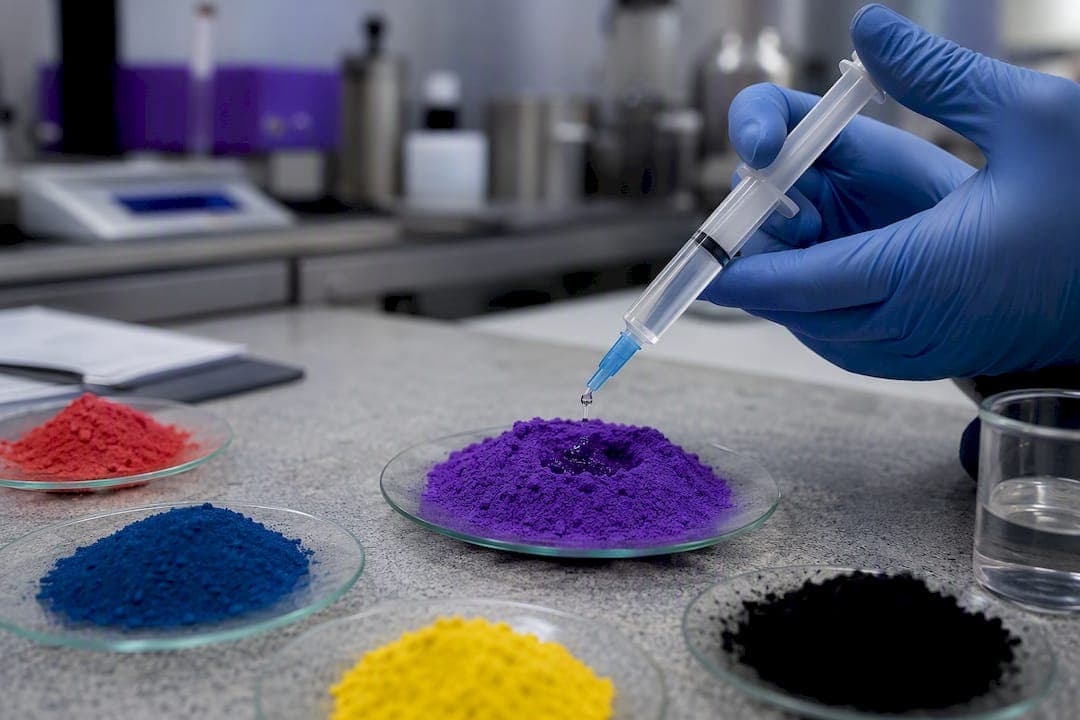
Most wetting chemistries used in coatings and inks are low molecular weight: nonionic ethoxylates, silicone-modified surfactants, fluorinated wetters for especially difficult substrates, and acetylenic diols prized for fast dynamic wetting with minimal foam. Older formulations leaned on alkylphenol ethoxylates, but the industry has largely shifted to APE-free alternatives for regulatory and environmental reasons.
Wetting alone often suffices for pigments that are naturally easy to wet, titanium dioxide in aqueous systems being the standard example. A quick contact-angle check or a small preliminary mill pass tells you fast whether you need to go further.
- Nonionic, silicone, fluorinated, and acetylenic wetters cover most substrate challenges
- APE-free wetters are now the default compliance choice
- Contact angle and a preliminary mill trial confirm whether wetting alone is enough
Pro Tip: Watch film-stage performance closely when you add wetting surfactant. Excess wetter can migrate to the film surface and cut water resistance or adhesion, so dose to the minimum that achieves full pigment incorporation, not beyond it.
Wetting Agent Vs Dispersant: What Dispersing Agents Actually Do
Dispersing agents work differently from wetting agents at a mechanistic level, and formulators who treat them as interchangeable end up with millbases that wet perfectly and then flocculate a week later. A dispersant molecule carries an anchor group, commonly an amine, sulfonate, or phosphate functionality, that binds tightly to the pigment surface. The rest of the molecule extends into the continuous phase as a solvated tail, building either an electrostatic charge barrier or a steric barrier that physically blocks particles from re-approaching each other.
Low molecular weight ionic dispersants handle electrostatic stabilization reasonably well in polar, aqueous media. Polymeric high molecular weight dispersants do more: their extended chains create a robust steric barrier that holds up in low-polarity solvent systems where electrostatic repulsion has no medium to work through.
The 5,000 to 25,000 g·mol⁻¹ range is the empirically supported molecular weight window for effective steric stabilization. Below it, chains are too short to project a durable barrier; above it, solubility and viscosity trade-offs start working against you.
- Anchor groups (amine, sulfonate, phosphate) determine which pigment surfaces a dispersant binds
- Electrostatic stabilization suits polar/aqueous systems; steric suits low-polarity solvent systems
- Binder and solvent polarity must match the dispersant's solvated tail chemistry or adsorption fails
How Wetting and Dispersing Interact During Grind and Film Formation
Timing separates the two mechanisms cleanly. Wetting acts in the first moments of grinding, when fresh pigment surface is being exposed and needs liquid penetration immediately. Dispersants act continuously from that point forward, adsorbing onto newly generated surface and holding the particle population apart through milling, storage, and shelf life. Coatings dispersion is genuinely a three-step process: wetting during grinding, mechanical separation by the mill itself, and stabilization by the dispersant to prevent flocculation afterward.
Film formation introduces its own risks. Residual wetting surfactant that never fully incorporates can migrate toward the drying film surface and weaken water resistance. Dispersant-related issues at film stage usually trace back to ionic incompatibility, where a dispersant displaces a wetting agent or reacts with a binder's own stabilizing chemistry.
Pigment chemistry drives the practical split. Titanium dioxide in water typically wets easily and needs little wetting support. Carbon black and many organic pigments are the opposite case: high surface area and strong particle-particle attraction demand both an effective wetter to get liquid onto the surface and a robust dispersant to keep it stable afterward.
- Wetting acts in seconds during grind-in; dispersing acts continuously through storage
- TiO2 rarely needs wetting support; carbon black and organics usually need both wetting and dispersing
- Ionic incompatibility at film stage often traces back to displaced or reacted additives
How Do You Choose Between Wetting and Dispersing Agents?
Selection starts with the pigment, not the additive shelf. Run through this sequence before committing a formulation to scale-up:
- Assess pigment wettability first. Check whether the pigment has a surface treatment (many organics and carbon blacks do) that changes its native surface energy, and run a contact-angle test to confirm.
- Match polarity across the system. Solvent or water phase polarity, binder polarity, and dispersant tail chemistry all need to line up, or adsorption will be weak and reversible.
- Run a small-scale grind before committing dosage. A bench millbase trial with viscosity and grind-size tracking reveals whether wetting alone resolves the problem or whether a dispersant is required.
- Measure zeta potential in aqueous or polar systems. This tells you whether electrostatic stabilization is adequate or whether you need a steric or electrosteric dispersant instead.
- Check compatibility before mixing wetter and dispersant. Anionic and cationic additives combined in the same millbase can precipitate or lose activity, so test small-scale combinations first.
- Add dispersant early in the grind sequence, ideally before or during initial milling, so it anchors on freshly exposed pigment surface rather than surface that a wetter has already occupied.
The Astra-chemical dispersant selection and dosage guide walks through this checklist with pigment-specific dosage starting points.
What Lab Tests Confirm the Right Wetting and Dispersing Strategy?
Millbase testing is where selection decisions get validated or overturned. Track three variables during the grind: viscosity development (a spike signals under-dispersion), color strength development (slow buildup signals incomplete wetting), and grind fineness against a Hegman gauge or equivalent.
- Start dosage low and titrate upward, monitoring viscosity at each addition rather than dosing to a fixed percentage from the outset.
- Check zeta potential against target ranges for the system polarity; values that sit too close to zero indicate weak electrostatic stabilization and predict flocculation on standing.
- Run a sedimentation test over days, not minutes. Hard-packed sediment that resists redispersion signals inadequate stabilization; soft, easily stirred sediment is acceptable.
- Do a rub-out test to catch flocculation that viscosity readings miss, since flocculated systems can still measure as low-viscosity fluids.
These four checks together catch nearly every dosage and compatibility error before a batch reaches production.
Common Wetting and Dispersing Pitfalls and How to Fix Them
Most formulation failures trace back to one of a handful of root causes:
- Color shift or poor color development → usually under-dispersion. Increase dispersant dosage incrementally and recheck grind fineness.
- Sedimentation or hard settling → weak stabilization. Check zeta potential and consider switching to a higher molecular weight polymeric dispersant.
- Rising viscosity mid-grind → often ionic incompatibility between wetter and dispersant. Test the combination at small scale before assuming a dosage fix will work.
- Poor adhesion or reduced water resistance in the cured film → suspect excess residual wetting surfactant migrating to the surface; reduce wetter loading and confirm with a rub-out and adhesion test.
Astra R&D Recommendations for Wetting and Dispersing Chemistry
For organic pigments and carbon black, polymeric dispersants in the steric or electrosteric range consistently outperform low molecular weight alternatives on long-term stability and color development. Electrosteric dispersants extend formulation flexibility across both waterborne and solventborne systems, reducing the need for corrective additives later in the process.
- Favor polymeric, high molecular weight dispersants for organic pigments and carbon black
- ASTRA DISP® is Astra-chemical's recommended dispersant family for steric and electrosteric stabilization across coatings, inks, and composite systems
- Case-specific dosage and pigment-loading data are available through Astra-chemical technical support
What Should You Test First?
If your millbase wets cleanly but drifts in color or viscosity over time, test dispersant dosage and zeta potential before touching your wetting agent. That single check resolves most of the flocculation complaints the Astra R&D Team fields from formulators.
— Astra R&D Team
Get Dispersant Support for Your Next Formulation
Astra-chemical built ASTRA DISP® specifically around the steric and electrosteric stabilization mechanisms covered above, with polymeric chemistries formulated to hold pigment loading stable through storage and application rather than just through the grind.

If your current dispersant is forcing you to overdose wetting surfactant just to keep a millbase workable, that's usually a sign the anchoring chemistry is mismatched to your pigment or binder polarity, not a dosage problem. The ASTRA DISP® product line covers ionic and nonionic anchoring options across aqueous and solventborne systems, and Astra-chemical's technical team will review your pigment and binder specifics against the molecular weight guidance above before recommending a starting dosage. Formulators sourcing raw dispersant intermediates can also consult the chemical sourcing resources at RJR Worldwide for supply-chain context. Request a sample or a formulation consultation directly through the ASTRA DISP® page to get dosage guidance specific to your millbase.
Sources
- Wetting and Dispersing Agents (2002)
- Comprehensive Guide to Dispersants and Dispersing Agents for Coatings (SpecialChem)
- Wetting and Dispersing Agents (ResearchGate entry)
- Dispersant mechanisms (chapter reference DOI)
FAQ
What Are Examples of Dispersing Agents?
Common dispersing agents include low molecular weight ionic dispersants with sulfonate or phosphate anchor groups and polymeric high molecular weight dispersants, such as Astra-chemical's ASTRA DISP® line, built around amine-functional anchoring for steric and electrosteric stabilization.
What Are Examples of Wetting Agents?
Typical wetting agents include nonionic ethoxylate surfactants, silicone-modified wetters, fluorinated wetters for difficult substrates, and acetylenic diols, with most modern formulations using APE-free chemistries.
What Is the Difference Between a Dispersing Agent and a Surfactant?
A surfactant is the broad category of surface-active molecules, and both wetting agents and dispersants fall inside it; a dispersing agent is a specific surfactant subtype designed with an anchor group and stabilizing tail to keep particles apart after wetting, not just to reduce surface tension.
What Is Wetting in Chemistry?
Wetting is the process by which a liquid reduces its surface tension enough to spread across and penetrate a solid surface, measured practically through contact angle, with lower contact angles indicating better wetting.
Recommended
- Wetting Agents for Coatings: Silicone, Fluoro and Acetylenic Guide | ASTRA CHEMICAL
- Dispersants for Coatings: Selection & Dosage Guide (2026) | ASTRA CHEMICAL
- 7 Water-Based Coating Formulation Mistakes and How to Fix Them | ASTRA CHEMICAL
- Rheology Modifiers for Coatings: A Practical Selection Guide | ASTRA CHEMICAL
Testing additives for this application?
Send us your current formulation challenge and our technical team will recommend an ASTRA product package for lab screening.