Formulators: Process First Foam Control for Mixing (Save up to 8%)
Formulators: Process First Foam Control for Mixing (Save up to 8%) ! Foam control mixing process title card Foam during mixing is typically controllable when process fixes come first and chemistry comes second: reduce vortexing, switch to under-surface powder induction or inline recirculation, and r…
Foam during mixing is typically controllable when process fixes come first and chemistry comes second: reduce vortexing, switch to under-surface powder induction or inline recirculation, and reserve small-dose defoamer for after compatibility qualification. Guidance from AIChE-aligned mixing technology reports and the Astra R&D Team backs this sequence: fix mechanical air entry before reaching for a bottle.
TL;DR:
- Mechanical controls like impeller positioning, baffle use, and staged powder addition can significantly reduce foam without risking compatibility issues.
- Foam formation is primarily caused by air entrainment through vortexing, surface-active ingredients, or powder carry-in, leading to costly batch losses and process delays.
- Using vacuum mixing and inline recirculation equipment for powder addition can prevent air from becoming trapped in the batch at the source.
- Chemical defoamers are best applied only after process controls are optimized, with low doses and careful compatibility checks to avoid surface defects.
- Regular monitoring of foam height and collapse time helps ensure effective foam management without unnecessary chemical use.
Foam forms when air gets trapped in a liquid faster than it can escape, and mixing operations create that condition constantly. Surface-active ingredients (surfactants, proteins, and certain polymer dispersants) lower surface tension enough that bubbles stabilize instead of collapsing. Powders dropped onto a moving liquid surface carry a thin air layer with them into the batch. Vortexing from an impeller running too fast, or too close to the surface, pulls atmospheric air straight down into the vortex core. Sparging and high-shear rotor-stator heads do the same thing by design, shearing gas into fine bubbles that resist coalescence.
The downstream costs are concrete, not cosmetic:
- Lost batch volume when foam occupies headspace meant for product
- Waste and downtime when overflowing foam forces a mixing stop
- Inconsistent fill weights and packaging defects from air-laden product
- Slower filtration, coating, or transfer steps because entrained air resists processing
Industry mixing briefs put operational losses from foam-related waste and downtime as high as roughly 8% of batch volume in poorly controlled processes. That number alone justifies auditing the mixing setup before touching chemistry.
How Do You Reduce Foam Through Mechanical Controls?
Process and equipment changes deliver the largest foam reduction per dollar spent, mainly because they attack the entrainment mechanism directly instead of managing the symptom afterward. Mechanical/process controls remain the first-line measure recommended by mixing technology specialists, and they carry zero compatibility risk.
Start with impeller geometry. Keeping blades fully submerged, off-center, or slightly tilted breaks up the classic central vortex that pulls air downward. Baffles do the same job passively, disrupting the rotational flow pattern that a vortex needs to form. Tank fill level matters too: running a batch too shallow leaves little liquid head to dampen surface disturbance.
Speed and addition sequencing come next. Staged powder addition at reduced speed, followed by a ramp-up once solids are wetted, avoids the surface cratering that traps air pockets. Vacuum mixing removes the atmosphere the foam would otherwise trap, which is why it shows up repeatedly in powder-heavy formulation work.
For processes with continuous solids loading, inline recirculation and rotor-stator mixers let you wet powders below the surface rather than at it.
A short verification sequence:
- Confirm impeller submersion and off-center placement.
- Lower mixing speed by 10 to 20% and observe vortex depth.
- Introduce powders in smaller increments at reduced speed.
- Apply vacuum where the process and equipment allow it.
- Log foam height at each step before considering chemical intervention.
Pro Tip: Run the same batch twice, once with your current impeller setting and once with the blade fully submerged and slightly off-center. Photograph vortex depth at the same mixing time in both runs. The difference is usually visible within the first two minutes.
When Should You Use Defoamers Instead of Antifoams?
Chemical control belongs after mechanical options are exhausted, not as a substitute for fixing the process. Antifoams and defoamers solve different problems: antifoams are added early to prevent foam from stabilizing in the first place, while defoamers are dosed reactively to knock down foam that has already formed. Many formulators use both, and the Springer review on foam management notes the distinction matters because timing and dose both affect gas transfer and downstream processing.
Chemistry selection depends heavily on the system:
- Silicone defoamers offer strong, fast knockdown at low dose but carry the highest risk of surface defects like craters or fisheyes in coatings and films.
- Silicone-polyether blends balance knockdown strength with improved compatibility, a combination favored in emulsion polymerization and latex reactors.
- Mineral oil-based defoamers work well in aqueous systems with lower defect sensitivity but generally need a higher dose.
- Fatty ester and alkoxylate chemistries suit food-adjacent or low-toxicity requirements where silicone is restricted.
SpecialChem's coatings guide stresses that defoamer choice in paints and coatings has to weigh defoaming power against compatibility risk, since the same additive that kills foam fastest is often the one most likely to cause film defects.
Dosing strategy matters as much as chemistry. Start at the lowest effective concentration, split doses at observed foam peaks rather than dumping the full charge upfront, and run small-scale compatibility checks (coagulum formation, film clarity, gloss) before scaling to production volume. Overdosing a defoamer can suppress gas transfer in aerated processes or leave surface defects that cost more to fix than the foam did.
Which Equipment Prevents Air Entrainment During Powder Addition?
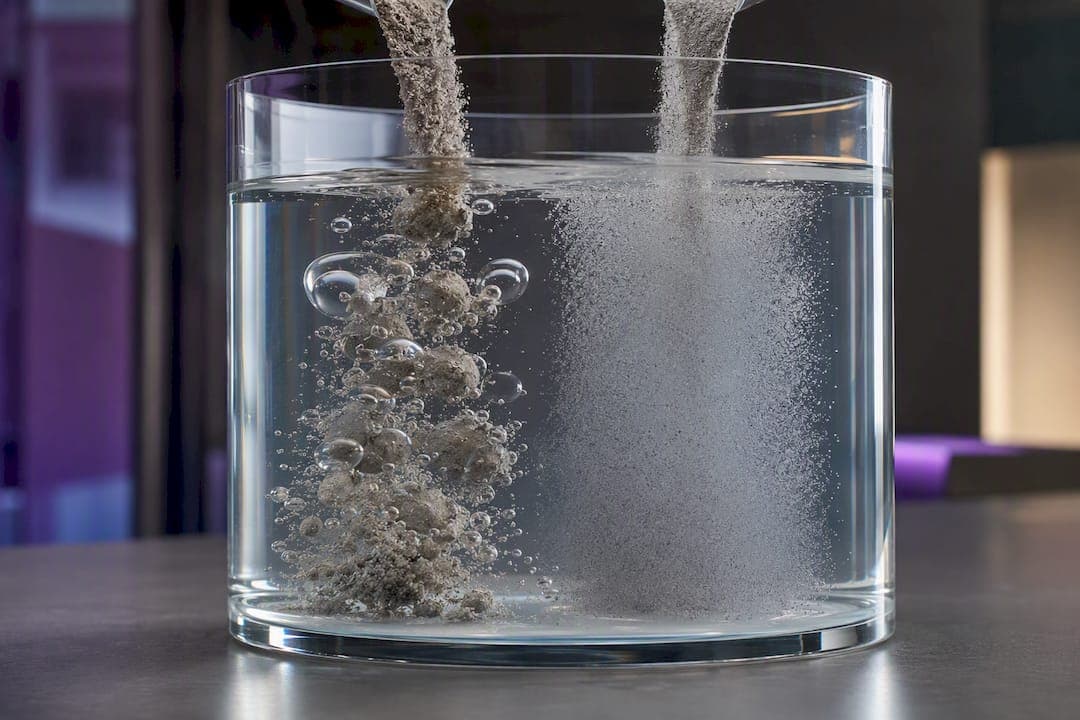
Powder addition is one of the most common foam triggers in formulation work, and specialized equipment addresses it at the source rather than after the fact. Below-surface vacuum induction systems, the Conti-TDS style of powder induction, draw dry solids directly into the liquid stream under vacuum instead of dropping them onto a turbulent surface. That eliminates the air layer powders normally carry with them into the batch.
Inline systems extend the same principle to continuous or semi-continuous processes:
- Recirculation piping that reintroduces liquid below the surface, avoiding splash-driven air uptake
- Rotor-stator inline mixers that shear and wet powders inside a closed housing rather than in open tank headspace
- Sub-surface injection points for liquid additions that would otherwise fall from a height
The economics favor this equipment in powder-heavy operations specifically. Vacuum induction is a real capital investment, but it typically pays back through reduced cycle time, fewer defoamer additions, and less product loss, a trade-off documented in technical mixing reviews. For low-powder or intermittent-batch operations, a quick process tweak like staged addition may deliver most of the benefit without the equipment spend.
How Do You Monitor and Document Foam Control?
Reliable foam control needs a measurable trigger, not a visual guess made under time pressure. Track three simple metrics: visual headspace percentage occupied by foam, time-to-collapse after mixing stops, and periodic sample checks for entrained air in the finished batch.
Build the SOP around a decision sequence:
- Define a foam action threshold (for example, foam occupying more than 15% of headspace).
- When the threshold is hit, apply process adjustments first: reduce speed, check impeller submersion, confirm addition rate.
- If foam persists after process correction, confirm chemical compatibility on a small-scale sample.
- Add defoamer at the qualified dose and add-point, then document foam height, dose, and batch outcome.
Mixing technology guidance recommends exactly this staged response instead of defaulting straight to chemistry. Small-scale qualification before scaling any defoamer addition catches compatibility problems while they are still cheap to fix.
Pro Tip: Log every defoamer addition against batch outcome for at least ten runs. Patterns in dose versus defect rate usually surface faster than formulators expect, often within the first few weeks of consistent logging.
How Do You Qualify a Defoamer or Dispersant for Your Formulation?
Selecting the right additive chemistry is a qualification process, not a guess based on a datasheet. A working checklist for formulation teams:
- Run small-scale compatibility trials before any plant-scale addition: check for coagulum, haze, or film defects.
- Test at the lowest effective dose first, then step up only if knockdown is insufficient.
- Confirm the additive's behavior across the full process temperature and shear range, not just at mixing conditions.
- Re-test compatibility whenever the base formulation changes, since a defoamer qualified for one resin or surfactant package can fail in another.
Silicone-polyether grades tend to be the preferred starting point for emulsion polymerization and latex systems, where strong knockdown at low dose matters and moderate silicone tolerance is acceptable. Silicone-free options, such as ASTRA DF NS®, become the better fit when the formulation is sensitive to silicone contamination, a common constraint in coatings destined for recoat or adhesion-critical applications.
Powder-driven foam often has a second lever besides defoaming: wetting. Dispersants like ASTRA DISP® improve how quickly powders wet into the liquid phase, which reduces the air pockets that get trapped around poorly wetted particles in the first place. Better wetting frequently lowers total defoamer demand rather than replacing it outright.
Why Sequencing Beats Chasing the Latest Additive
Formulators under deadline pressure default to adding more defoamer because it is the fastest lever to pull. That instinct usually costs more than it saves. A process fix removes the cause; a chemical fix manages the symptom and adds a new variable, compatibility, that has to be qualified and monitored for the life of the formulation.
The stronger approach treats supplier collaboration as part of process design, not a last resort. Bringing an additive supplier in during formulation review, rather than after a foam problem shuts down a batch, turns compatibility testing into a planned step instead of an emergency one.
— Astra R&D Team
Get Technical Support for Foam and Wetting Challenges
Astra-chemical supplies the two chemistry classes formulators reach for once process and equipment fixes have done their part: ASTRA DF® silicone defoamers for fast, low-dose knockdown in systems that tolerate silicone, and ASTRA DF NS® non-silicone defoamers for formulations where silicone contamination risks film defects or recoat adhesion.

Choosing between them comes down to your compatibility constraints, not just knockdown speed, and Astra-chemical's defoamer selection guide for coatings walks through the qualification steps covered above in more formulation-specific detail. If powder wetting is driving your air entrainment, ASTRA DISP® dispersants address the root cause rather than the symptom. Request a technical consultation or a sample set through Astra-chemical's product catalog to start compatibility testing against your own formulation before your next scale-up run.
Sources
- Review on foam management in fermentations (Springer, 2024)
- Reduce foaming and air entrapment during mixing
- Foaming & Air Induction in Mixing: Challenges and Solutions
- Foaming: Issues, Formation & Foam Control in Paint and Coatings (SpecialChem)
FAQ
What is edible foam called?
In food science and molecular gastronomy, stabilized edible foams are usually called "espumas," a term popularized by culinary techniques that use whipped, gas-stabilized liquids rather than industrial antifoam or defoamer chemistry.
How do you reduce foam when pouring a carbonated beverage?
Pouring at an angle down the side of the glass, rather than straight into the center, reduces the shear and turbulence that release dissolved carbon dioxide too quickly, which is the same air entrainment principle that drives foam during mixing in industrial tanks.
What is surfactant foam?
Surfactant foam forms when surface-active molecules lower a liquid's surface tension enough that air bubbles stabilize at the surface instead of collapsing, which is why formulations containing surfactants, proteins, or certain dispersants are especially prone to foaming during mixing.
How do you decrease foaming during mixing?
Reduce vortexing through better impeller placement and baffles, switch to staged or sub-surface powder addition, use vacuum mixing where available, and reserve small-dose defoamers like ASTRA DF® or ASTRA DF NS® for after compatibility qualification.
What is the difference between an antifoam and a defoamer?
Antifoams are added before mixing to prevent foam from stabilizing, while defoamers are dosed reactively to collapse foam that has already formed, and formulators often use both depending on process timing.
Recommended
Testing additives for this application?
Send us your current formulation challenge and our technical team will recommend an ASTRA product package for lab screening.