Four Lab Checks Formulators Use to Fix Haze in Clearcoats, from R&D
Four Lab Checks Formulators Use to Fix Haze in Clearcoats, from R&D ! Clearcoat haze troubleshooting title card Haze in clearcoats almost always traces back to one of five sources: particle scattering, refractive-index mismatch, poor millbase dispersion, additive migration, or moisture entrapment du…
Haze in clearcoats almost always traces back to one of five sources: particle scattering, refractive-index mismatch, poor millbase dispersion, additive migration, or moisture entrapment during cure. Start by checking particle size and index match against the resin, then run a dispersant-led millbase re-grind before touching anything else. Expect trade-offs: pulling scratch-resistant nanoparticles to cut haze will often soften mar resistance, so plan the corrective trial around both metrics at once.
TL;DR:
- Controlling particle size, refractive index, and dispersion quality at the millbase stage prevents most haze issues before reformulation becomes necessary.
- Alumina nanoparticle haze contributions increase with film thickness, making low loading and surface treatment critical for maintaining clarity in thick coats.
- Migration of polysiloxane surface additives causes haze independently of dispersion, requiring surface migration testing after cure to identify this root cause.
- Matching refractive indices with silica, especially surface-treated nanosilica, allows scratch resistance improvements without introducing haze.
- Production controls such as consistent shear, film thickness, cure humidity, and conditioned haze measurements are essential to prevent haze buildup during manufacturing.
Before reformulating anything, isolate the mechanism. A structured checklist saves weeks of guesswork on the plant floor.
- Particle and additive scattering: check nanoparticle D50, surface treatment, and agglomeration state. Scattering intensifies at higher film builds even at constant loading, since alumina haze rises proportionally with thickness.
- Additive migration: screen for polysiloxane surface segregation and light-stabilizer packages that leach or cluster near the film surface over time.
- Process variables: audit millbase quality, letdown sequence, and cure humidity. Amine blush and trapped solvent both read as haze on a gloss meter even though the root cause is entirely different.
- Measurement discipline: condition panels at fixed temperature and humidity for at least 24 hours before reading haze, since ambient moisture skews results and hides real defects.
Run these four checks in order. Most haze complaints resolve at step one or two, before any reformulation work starts.
How Haze Forms: The Optical and Physical Mechanisms You Must Control
Haze is scattered light, not lost gloss. Gloss measures specular reflection at a fixed angle; haze measures the diffuse light scattering near that angle, and a film can lose clarity while its 60-degree gloss reading stays perfectly respectable. That distinction is why relying on gloss alone to judge finish quality misses real defects.
Scattering happens when particles approach the wavelength of visible light (roughly 400 to 700 nanometers) or when their refractive index diverges from the surrounding resin. Even loadings as low as 1 to 2 percent can raise haze sharply when particle size or refractive-index mismatch is present, according to research on nano-additives in coating technology. Silica and alumina behave differently here: alumina's haze contribution grows with film thickness in a way silica's does not at comparable loadings, which is a key reason formulators default to silica when scratch additives are unavoidable.
Milling and letdown introduce a second failure mode: localized agglomeration. A millbase that reads acceptable on average particle size can still carry a tail of oversized clusters that scatter light disproportionately, since scattering intensity scales with particle volume, not particle count.
Migration adds a third mechanism entirely separate from particle scattering. Polysiloxane additives migrate to the film surface and alter surface energy and mechanical behavior regardless of how well they were dispersed in the bulk, and studies on acrylic/melamine clearcoats show that side-chain length and end-group chemistry determine how aggressively a given siloxane migrates. A low-bulk-loading defoamer can still produce visible surface haze if its chemistry favors migration.
Film thickness compounds every one of these mechanisms. The same particle load that passes at 25 microns can fail at 40 microns simply because light travels a longer scattering path.
Formulation Strategies: Additives and Product Forms That Reduce Haze
Fixing haze at the formulation level means controlling dispersion, matching refractive index, and choosing additive chemistries with low migration tendency. None of these steps require abandoning scratch or UV performance targets.
- Anchor the dispersant system. Phosphated graft copolymer dispersants used as anchor resins reduce letdown haze when dosed at optimized ratios; patent data on aqueous systems show phosphate-to-pigment ratios between roughly 0.075 and 0.15 producing the best transparency for certain transoxide pigment systems. A three-dispersant approach, combining an anchor dispersant with a primary dispersant and a co-dispersant, holds viscosity in check while improving clarity beyond what a single dispersant can deliver. Astra-chemical's dispersant selection guide walks through matching dispersant chemistry to pigment and resin type.
- Match refractive index before adding hardness. Silica is generally the safer inorganic choice over alumina when index matching is the priority, particularly once surface-treated with a siloxane shell. Properly stabilized, surface-treated nanosilica can deliver scratch improvement at low loading with no measurable haze penalty.
- Use encapsulated forms for waterborne systems. Hydrophobic UV absorbers and HALS resist incorporation into waterborne clearcoats without specialized carriers. NEAT-style micro-encapsulation lets formulators use these hydrophobic stabilizers in waterborne systems while preserving transparency and wash-out resistance, which matters most for exterior industrial clearcoats facing repeated wash cycles.
- Screen rheology modifiers and defoamers for optical impact. Not every defoamer chemistry is equal here. If migration is suspected, test a non-silicone defoamer alongside the incumbent silicone package; Astra-chemical's rheology modifier selection guide covers chemistries chosen for minimal surface-tension disruption.
- Run the trial in parallel, not sequentially. Small-scale grind, letdown panels, haze and gloss pairing on the same specimens, and a 72-hour accelerated migration check before scaling to plant trials.
Pro Tip: Read haze and gloss together on every panel, never separately. A panel that looks fine on gloss alone can still be failing on haze, and the two numbers together tell you whether the defect is scattering, migration, or surface roughness.
Processing and QC Controls to Prevent Haze at Scale
Formulation fixes only hold if production controls match them. Most recurring haze complaints in plants trace back to drift in one of four process variables.
- Millbase targets: hold dispersion viscosity and D50 particle size to a fixed range and re-check both at every batch, since re-agglomeration during storage often shows up as a viscosity creep before it shows up as haze.
- Order of addition and shear history: add dispersant to the aqueous phase before pigment introduction, and keep shear consistent through letdown. Changing shear rate mid-batch is a common, underappreciated cause of flocculation.
- Film thickness and cure window: hold film build within a tight tolerance and control humidity during cure, since proper control of particle size, additive location, and staged cure schedules reduces both blushing and haze in slurry-type clearcoat systems. Production teams tracking film build against standard thickness targets will catch drift before it reaches QC.
- QC protocol: measure haze on conditioned panels at fixed temperature and humidity, using the same haze-meter geometry every time, and re-check haze at 30 and 90 days post-cure to catch slow migration that a same-day reading misses.
Astra R&D Perspective: How Tailored Additives Solved Haze for Manufacturing Clients
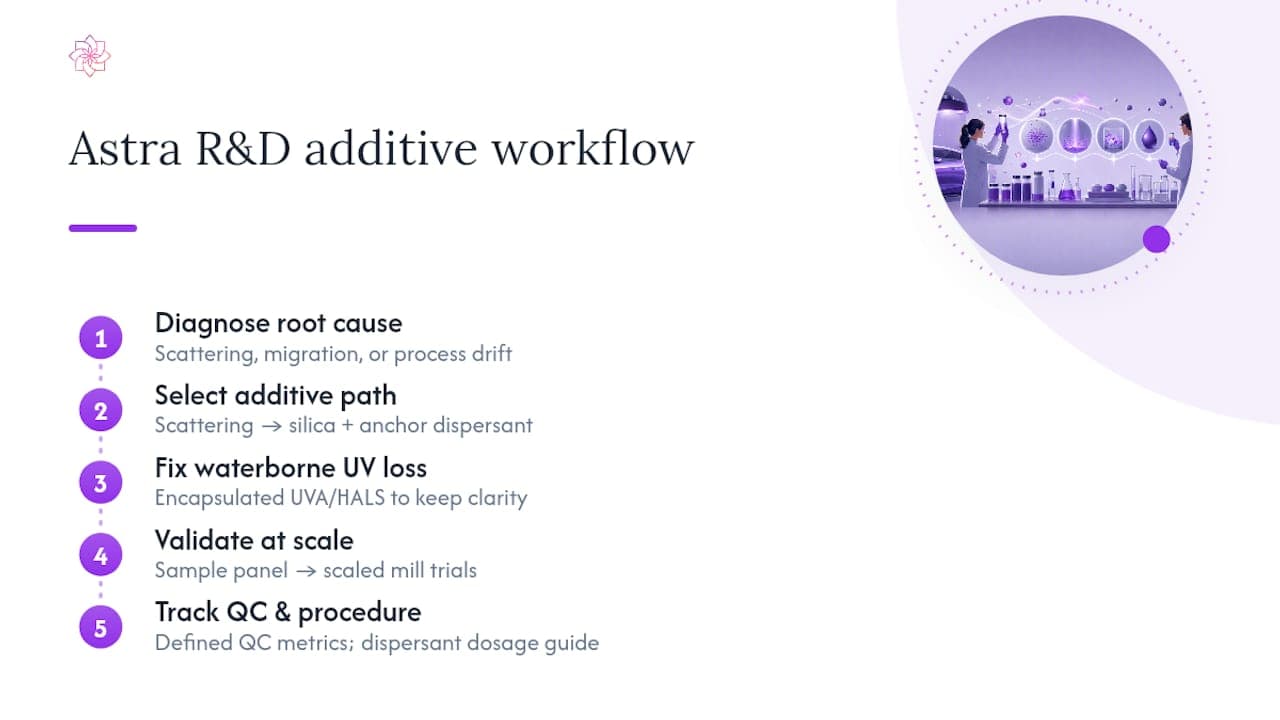
An R&D approach to haze complaints starts with the question: is this scattering, migration, or process drift? The answer dictates the additive path. For scattering issues tied to scratch-resistant fillers, the fix is typically a surface-modified silica concentrate paired with an anchor dispersant blend, not a wholesale reformulation. For waterborne systems losing clarity after UV-package addition, encapsulated UVA/HALS forms have resolved the conflict between light stability and transparency without a wash-out penalty.
Collaboration follows a fixed sequence: small sample panel trials first, then scaled mill trials once haze and gloss both clear target, with defined QC metrics tracked jointly through the trial. Astra-chemical's dispersant and dosage guide documents the lab-scale re-grind and letdown sequence this process relies on.
What the Data Actually Tells Formulators to Prioritize
Most troubleshooting guides treat haze as a single defect with a single fix, usually "add more dispersant." That advice is incomplete. The evidence points to at least three distinct mechanisms, scattering, migration, and process-driven moisture effects, and each demands a different corrective action. Treating them as one problem wastes trial cycles.

The most overlooked variable is film thickness. Formulators routinely test additive changes at one thickness and then get surprised when a haze problem reappears at production build. Index matching deserves more attention than it gets, too. Surface treatment and refractive-index engineering solve problems that dosage adjustments alone cannot.
If there is one priority to fix first, it is dispersion quality. A poorly dispersed millbase will defeat even a well-chosen, index-matched additive package, and no amount of downstream defoamer or rheology tuning corrects for it. Get the mill trial right before touching anything else.
— Astra R&D Team
How Astra-chemical Can Help You Run the Next Trial
The additive families this troubleshooting sequence depends on are supplied, built for formulators who need answers from a trial, not a sales pitch. Start a millbase stability trial with ASTRA DISP® dispersants to address re-agglomeration and letdown haze, then bring in ASTRA REO® rheology modifiers to tune leveling without disturbing optical clarity.

Where silicone migration is the suspected culprit, request a comparative trial with ASTRA DF NS® non-silicone defoamer against your current package. A practical starting point: a 5 to 10 kg grind at trial dosing, letdown panels read for haze and gloss together, and a migration check at 72 hours. Technical support is available with datasheets and a collaborative trial plan built around your specific resin and pigment system. Request samples and a technical consultation through the full additive product line to get the trial started this week.
Sources
- A novel concept for improving scratch and abrasion resistance for automotive coatings | PCI Magazine
- Improvement of the light stability of automotive water borne coatings: a difficult task
- Studying the rheology, optical clarity and surface tension of an acrylic/melamine automotive clearcoat loaded with different additives
- Aqueous coating compositions having improved transparency - EP1167475 A2
FAQ
What causes haze in clearcoats most often?
The leading causes are particle or additive light scattering, refractive-index mismatch between fillers and resin, poor millbase dispersion, and migration of surface-active additives like polysiloxanes.
Does haze always mean a gloss problem too?
No. Haze measures diffuse light scattering near the specular angle, while gloss measures specular reflection directly, so a film can score well on gloss and still show visible haze.
Can I add scratch-resistant nanoparticles without causing haze?
Yes, if particle size stays well below the wavelength of visible light and the particle's refractive index is matched to the resin; surface-treated silica generally outperforms alumina on this trade-off.
How do I tell if haze is coming from additive migration?
Run an accelerated migration check, typically 72 hours post-cure, and compare surface haze readings against a panel made without the suspect additive to isolate its contribution.
What is the fastest first step to diagnose clearcoat haze?
Check particle size and dispersion quality first with a small-scale millbase re-grind using a dispersant like ASTRA DISP®, since poor dispersion defeats even well-matched additive packages.
Recommended
Testing additives for this application?
Send us your current formulation challenge and our technical team will recommend an ASTRA product package for lab screening.