Prevent Pigment Flocculation for Formulators: Astra's 4 Step Playbook
Prevent Pigment Flocculation for Formulators: Astra's 4 Step Playbook ! Pigment stabilization playbook title card Pigment flocculation stops when three controls work together: proper wetting to displace air and open agglomerates, a dispersant chemistry anchored strongly enough to hold particles apar…
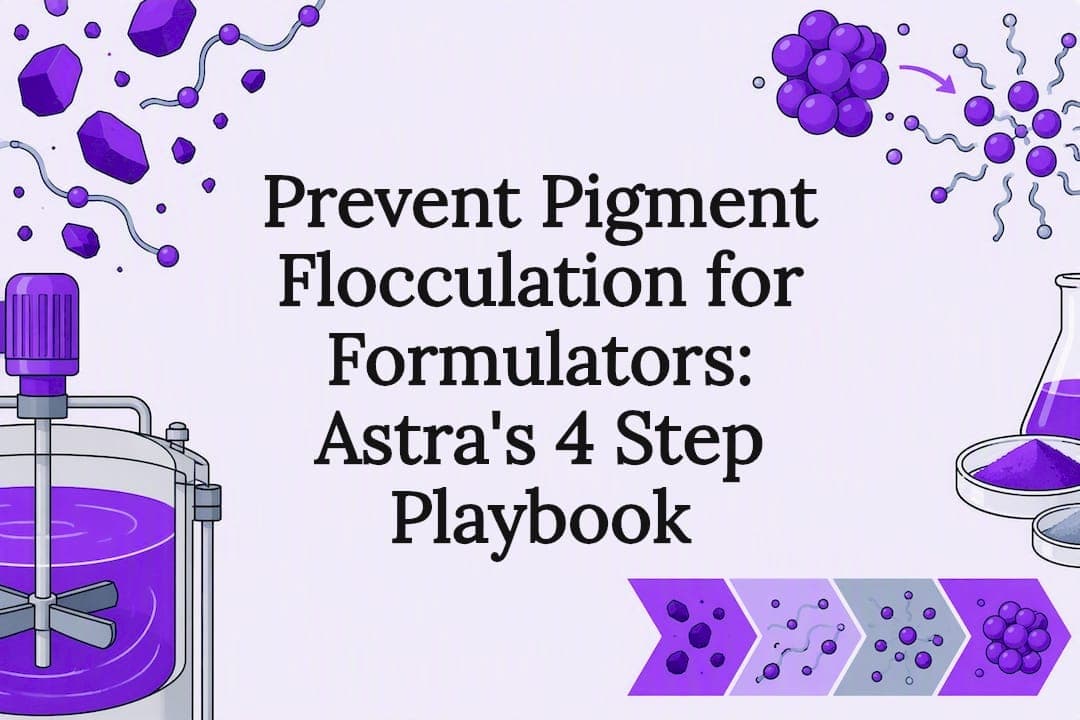
Pigment flocculation stops when three controls work together: proper wetting to displace air and open agglomerates, a dispersant chemistry anchored strongly enough to hold particles apart, and a rheological network that keeps them suspended once separated. If a batch shows early signs of flocculation, run a wetting check first, then a quick shear and redispersion test, then a short accelerated stability check before you touch dosage.
TL;DR:
- Proper wetting, dispersant anchoring, and rheological network work together to prevent pigment flocculation, so initial wetting failure cannot be fixed by rheology modifiers alone.
- Dispersant choice relies on matching the anchor group to pigment chemistry, with surface area and media polarity determining whether steric or electrostatic stabilization is more effective.
- Environmental factors like pH, ionic strength, temperature, and medium polarity can weaken stabilization, making steric approaches generally more reliable under variable storage and application conditions.
- Quick tests such as gentle shear redispersion and low-shear viscosity monitoring can detect early flocculation, while longer accelerated storage tests better predict long-term stability.
- Flocculation fixes require addressing wetting and dispersion issues first, with rheology modifiers used only after confirming that the particles are well separated and stabilized.
Flocculation happens because van der Waals attraction between pigment particles is stronger than the thermal energy keeping them apart. Left alone, particles drift together, clump, and settle. Preventing that requires introducing a repulsive force strong enough to overcome that attraction, and formulators have exactly two mechanisms to choose from.
Steric stabilization relies on a polymeric layer adsorbed onto the pigment surface, physically blocking particle contact. This approach is widely regarded as the most secure principle for preventing pigment flocculation in both solvent-based and waterborne systems, largely because it stays robust against electrolyte contamination and pH swings.
Electrostatic stabilization works by giving particles like surface charges that repel one another. It performs well in high-polarity systems, but charge repulsion depends heavily on pH and ionic strength, which makes it a less forgiving choice outside tightly controlled waterborne formulations.
- Apolar or solvent-based systems: steric stabilization almost always wins
- Waterborne systems with stable pH and low electrolyte load: electrostatic stabilization can work well and cost less
- Mixed or variable-electrolyte waterborne systems: steric or steric/electrostatic hybrid dispersants perform more consistently
- High-polarity inorganic pigments: often respond better to electrostatic approaches if formulation conditions are tightly held
The pigment's own surface chemistry, along with your medium's polarity, decides which mechanism actually gets you stable dispersion control.
How Do You Choose the Right Dispersant and Wetting Agent?
Dispersant selection starts with the anchoring group, not the polymer backbone. The anchor determines whether the dispersant actually stays attached to the pigment surface under mechanical and thermal stress, and a poorly anchored dispersant fails regardless of its molecular weight.
- Match the anchor to the surface. Amine-functional groups anchor efficiently to acidic pigment surfaces common in apolar and solvent-borne systems; carboxylate anchors suit basic oxide pigments like titanium dioxide and zinc oxide; phosphate esters work well on metal flakes and some inorganics; silane anchors bond covalently to silica-based fillers and treated pigments.
- Design the repulsive layer. A polymeric dispersant needs an anchoring segment plus solvating side chains or a graft backbone that extends into the medium, creating the physical steric barrier that keeps particles apart.
- Sequence wetting correctly. Add the wetting agent first to displace air and penetrate agglomerates, follow with the dispersant during pre-dispersion, then apply high-shear milling. Reversing this order traps air pockets that no amount of shear can fully remove.
- Calculate dosage from surface area, not weight alone. Estimate the pigment's specific surface area (from a supplier data sheet or BET measurement), then apply a coverage factor typical for that dispersant chemistry, generally 0.3 to 1.5 milligrams of dispersant per square meter of pigment surface depending on anchor strength and polymer size.
Fine-particle carbon blacks can require even more due to their extreme surface area.
Pro Tip: A well-anchored, lower-molecular-weight dispersant with strong solvating tails frequently outperforms a high-molecular-weight polymer that adsorbs poorly. Anchoring strength, not bulk, is what holds the dispersion together.
For deeper anchoring chemistry and a walk-through of dosage math by pigment class, see Astra-chemical's dispersant selection and dosage guide.
How Do Anti-Settling Agents Prevent Pigment Settling?
Rheology modifiers prevent settling by building a reversible three-dimensional network at rest, one that generates enough yield stress to hold pigment particles suspended, then breaks down under shear so the coating still flows and levels normally during application.
- Fumed silica builds a network through hydrogen bonding between silanol groups, effective in solvent-based systems.
- Smectite clays and platelet structures create a card-house structure that resists settling but can affect gloss if overdosed.
- Polymeric associative thickeners work through reversible molecular entanglement, common in waterborne coatings.
- Microfibrillated cellulose (MFC) forms a fibrous network that delivers strong anti-settling performance at low addition rates.
- Xanthan gum offers pseudoplastic behavior useful where shear-thinning at low cost matters more than maximum yield stress.
Anti-settling agents that create this reversible network can prevent sedimentation at dosages under 1% when matched correctly to the system. Match the modifier to the actual failure mode: soft, redispersible settling calls for a mild yield-stress builder, while sag on vertical surfaces or drip during application demands a stronger anti-sag network with higher low-shear viscosity.
Compatibility deserves close attention here. Certain thixotropes and dispersants interact negatively, and that interaction can destabilize a dispersion that tested fine on its own. Always test the thixotrope and dispersant together at production dosage before finalizing a formulation.
What Process Controls Prevent Pigment Shock During Scale-Up?
Sequence matters as much as chemistry. Wetting, separation, and stabilization form three sequential steps in pigment dispersion, and skipping or rushing the first step commonly produces hard settling that no rheology modifier can fix afterward.
- Wet first. Add the wetting agent to the letdown vehicle before pigment introduction so surface air is displaced as particles enter the mix.
- Add the dispersant during pre-dispersion. This is when the anchoring groups get the best access to a freshly wetted pigment surface.
- Mill at high shear to target particle size. Undermilling leaves agglomerates that no dispersant dose can separate later. Watch for low tint strength and a viscosity that climbs over the following days as warning signs of an incomplete grind.
- Dilute and let down carefully. Add solvent or water gradually to avoid shocking the dispersion with a sudden polarity or ionic-strength shift.
At scale-up, take samples at the mill discharge, after letdown, and after tank transfer, since each transition is a point where shear history and temperature change can trigger pigment shock. Match your plant mixing schedule (blade speed, dwell time) to the lab process that produced your target particle size and tint strength, not just to a target viscosity, since viscosity can look correct while dispersion quality has already drifted.
How Do You Test for Pigment Flocculation Before Shipment?
Confirming stability before a batch ships means running a short, prioritized set of checks rather than a single pass/fail viscosity reading.
- Low-shear viscosity profile: a rising trend over hours or days signals incipient flocculation even when the batch looks fine visually.
- Tint strength comparison: a drop against a known standard indicates agglomerates reforming or incomplete initial grinding.
- Visual redispersion after gentle shear: hard cake at the container bottom that resists a spatula stir points to a wetting or stabilization failure, not just settling.
- Temperature cycling and freeze/thaw: these accelerated tests predict long-term storage behavior far faster than shelf storage alone.
- Centrifuge sedimentation: compresses months of gravitational settling into hours and reveals which formulations will separate first.
For electrostatic systems, add a zeta potential measurement to confirm charge magnitude is holding at your target pH. Particle size by dynamic light scattering (DLS) or laser diffraction rounds out the picture by tracking whether particle size is creeping upward between production and delivery.
What Is the Fastest Way to Fix Flocculation Once It Appears?
A structured triage saves far more time than guessing at a fix. Settling symptoms sort into three distinct failure categories: wetting failures show up as fast, hard settling within days; stabilization failures appear as moderate settling over weeks; rheology failures present as soft settling that redisperses easily with light stirring.
- Check wetting first. Fast, hard-caked settling almost always traces back here, not to the dispersant.
- Rework the grind if particle size is off target. No dispersant addition fixes agglomerates that were never separated.
- Flush or boost dispersant dosage if the grind and wetting both check out but moderate settling still develops over weeks.
- Adjust pH or electrolyte concentration for electrostatically stabilized systems showing charge-related instability.
- Add or increase a thixotrope only after confirming the pigment itself is properly stabilized, never as a substitute for fixing wetting or dispersion.
Pro Tip: Never reach for more rheology modifier to mask a wetting or dispersion failure. It hides the symptom temporarily and often makes the underlying agglomeration worse once the network breaks down under shear.
When bench-level fixes don't resolve the issue within one or two iterations, escalate to surface chemistry analysis or send a sample to R&D. A pigment surface treatment change from a supplier, even on a grade that looks identical on paper, can silently break an anchoring relationship that worked for years.
Astra R&D's Lab-to-Plant Diagnosis for Flocculation Risk
Astra-chemical's R&D team runs a four-step diagnosis on any batch flagged for flocculation risk: verify wetting behavior visually and by contact angle, confirm particle size and tint strength against a reference standard, check charge proxy or zeta potential where electrostatic stabilization is in play, then run a short accelerated storage test before sign-off.

Formulators working through dosage math can walk through the surface-area calculation in Astra-chemical's pigment dispersion guide, or request a lab sample to validate a specific pigment/resin combination directly.
How Do Temperature, pH, and Ionic Strength Affect Pigment Stability?
Environmental conditions during storage and use shift the balance between attractive and repulsive forces long after a batch leaves the mill. Temperature swings change solvent viscosity and polymer solvation, and a dispersant that provides an adequate steric barrier at 70°F can lose effective layer thickness at elevated temperatures as the solvating tails collapse closer to the particle surface.
pH matters most for electrostatically stabilized systems, since surface charge magnitude depends directly on it. Push pH toward the pigment's isoelectric point, where positive and negative surface charges balance out, and repulsion collapses even though nothing else in the formulation changed. Waterborne paints pigmented with certain oxides are particularly sensitive to this drift, which is why production tanks need routine pH monitoring rather than a single check at batch release.
Ionic strength compounds the pH problem. Dissolved salts, whether from water hardness, a raw material contaminant, or a preservative package, compress the electrical double layer around charged particles and shorten the effective repulsion range. That is one reason electrostatic stabilization performs less predictably than steric stabilization when raw water quality or additive packages vary between plants or seasons.
Steric stabilization resists all three of these environmental pressures far better, which is the practical reason it dominates in systems where storage and shipping conditions can't be tightly controlled. Formulators shipping to varied climates should weight dispersant selection toward steric or steric-dominant hybrid chemistries rather than pure electrostatic systems.
How Does Solvent or Medium Choice Affect Pigment Dispersion?
The medium's polarity has to match the dispersant's solvating segment, or the steric barrier collapses even with a properly anchored dispersant. A polymeric dispersant with solvating tails designed for an aromatic hydrocarbon solvent will not extend properly into a highly polar medium, and the reverse is equally true.
Solvent blends introduce a subtler risk during dilution and letdown. Adding a fast-evaporating, more polar solvent late in a formulation can shift the medium's overall polarity enough to partially precipitate an already-adsorbed dispersant layer, triggering flocculation that appears only after letdown rather than during the initial grind. This is why formulators should dilute gradually and monitor viscosity and gloss during letdown, not just at final QC.
Water quality inside waterborne systems functions the same way solvent polarity does in solvent-borne systems. Hard water, high in calcium and magnesium ions, raises ionic strength and directly undermines electrostatic stabilization even when the dispersant itself is unchanged. Formulators troubleshooting an intermittent flocculation issue traced to no obvious formulation change should check incoming water quality before reworking the dispersant package.
Medium viscosity also plays a supporting role: a thicker vehicle slows the rate at which particles can diffuse into contact with one another, buying time for the stabilizing layer to do its job even in a marginal formulation. That is not a substitute for correct stabilization chemistry, but it explains why identical pigment/dispersant combinations can behave differently across resin systems of different inherent viscosity.
Why Do Different Pigment Types Flocculate Differently?
Pigment chemistry class drives which flocculation mechanism dominates, and treating every pigment with the same dispersant approach is a common formulation mistake.
Organic pigments, particularly high-surface-area types like phthalocyanines and quinacridones, carry enormous surface area per unit weight and flocculate primarily through insufficient dispersant coverage. Their surfaces are often hydrophobic, which favors amine-anchoring dispersants in solvent systems and makes wetting agent selection especially critical in waterborne versions.
Inorganic oxide pigments, like titanium dioxide and iron oxides, have lower surface area but stronger inherent surface polarity, making them more prone to electrostatically driven flocculation when pH drifts toward their isoelectric point. Carboxylate-anchoring dispersants tend to perform well here.
Carbon blacks present an extreme case: very high surface area combined with a mix of hydrophobic and oxidized surface sites. They typically need the highest dispersant loading of any common pigment class and are notoriously sensitive to undermilling, since incompletely separated carbon black agglomerates re-flocculate almost immediately.
Metallic and effect pigments like aluminum flakes flocculate through a different pathway entirely: edge-to-edge or face-to-face stacking driven by their platelet geometry rather than simple particle-to-particle attraction. Phosphate ester anchoring groups suit these surfaces better than the amine or carboxylate chemistries that work on conventional pigments.
Revalidate anchoring affinity whenever a pigment supplier or surface treatment changes, even if the grade name on the data sheet stays the same. Surface treatments are proprietary and can shift without notice.
What Formulation Techniques Prevent Flocculation Beyond Dispersants?
Dispersant selection is not the only lever available. pH adjustment is often the single most cost-effective preventative technique in waterborne systems using electrostatic stabilization: holding pH one to two units away from the pigment's isoelectric point maintains surface charge magnitude without adding any additive cost at all.
Electrolyte control matters just as much, and it is frequently overlooked because it involves raw materials formulators don't think of as "additives." Preservative packages, pH buffers, and even tap water used in production can introduce enough dissolved salt to compress the electrical double layer and trigger flocculation in an otherwise well-designed electrostatic system. Auditing raw material ionic content, and switching to deionized water for sensitive formulations, is a preventative step that costs little and prevents a recurring, hard-to-diagnose failure.
Co-solvent selection offers another preventative lever, particularly for formulations that must perform across a range of ambient temperatures. Choosing a solvent blend that keeps the dispersant's solvating segment properly extended across the expected temperature range prevents the steric collapse that pure temperature swings can otherwise cause.
Order-of-addition discipline during batch assembly, adding pigment concentrate late and gradually rather than dumping it into a partially formulated batch, reduces the risk of localized pigment shock where a small pocket of the batch sees a polarity or pH extreme before full mixing evens things out. None of these techniques replace a correctly chosen dispersant, but together they build margin into a formulation that has to survive real production variability, not just a clean lab batch.
Can Surface Treatment Changes Improve Flocculation Resistance?
Modifying a pigment's surface chemistry directly, rather than relying entirely on an adsorbed dispersant layer, is an increasingly common preventative strategy, particularly for pigments that are notoriously hard to stabilize with conventional additives alone.
Surface treatments generally work by permanently altering the chemical groups available at the pigment surface, either grafting a compatibilizing layer during pigment manufacture or coating the particle with a thin inorganic or organic shell. A silica-coated organic pigment, for example, presents a more uniform, more polar surface than the untreated pigment, which changes which dispersant anchoring chemistry performs best and can reduce the total dispersant loading needed to achieve stability.
The tradeoff is that a surface-treated pigment is not a drop-in replacement for its untreated counterpart in an existing formulation. A dispersant that anchored well to the original surface may anchor poorly to the treated one, and formulators switching pigment grades for this reason need to re-run dispersant screening rather than assuming the existing package still works. This is the same revalidation principle that applies to any pigment supplier change, but surface treatment changes make the anchoring shift larger and less predictable.
For formulators managing a range of pigment types across product lines, surface chemistry modification is best treated as a tool for solving persistent, specific stabilization problems, like a pigment that flocculates even with a well-designed dispersant, rather than a default first step. It adds cost and requires requalification, so it earns its place when conventional dispersant and process optimization have already been exhausted.
What Storage Conditions Prevent Long-Term Pigment Flocculation?
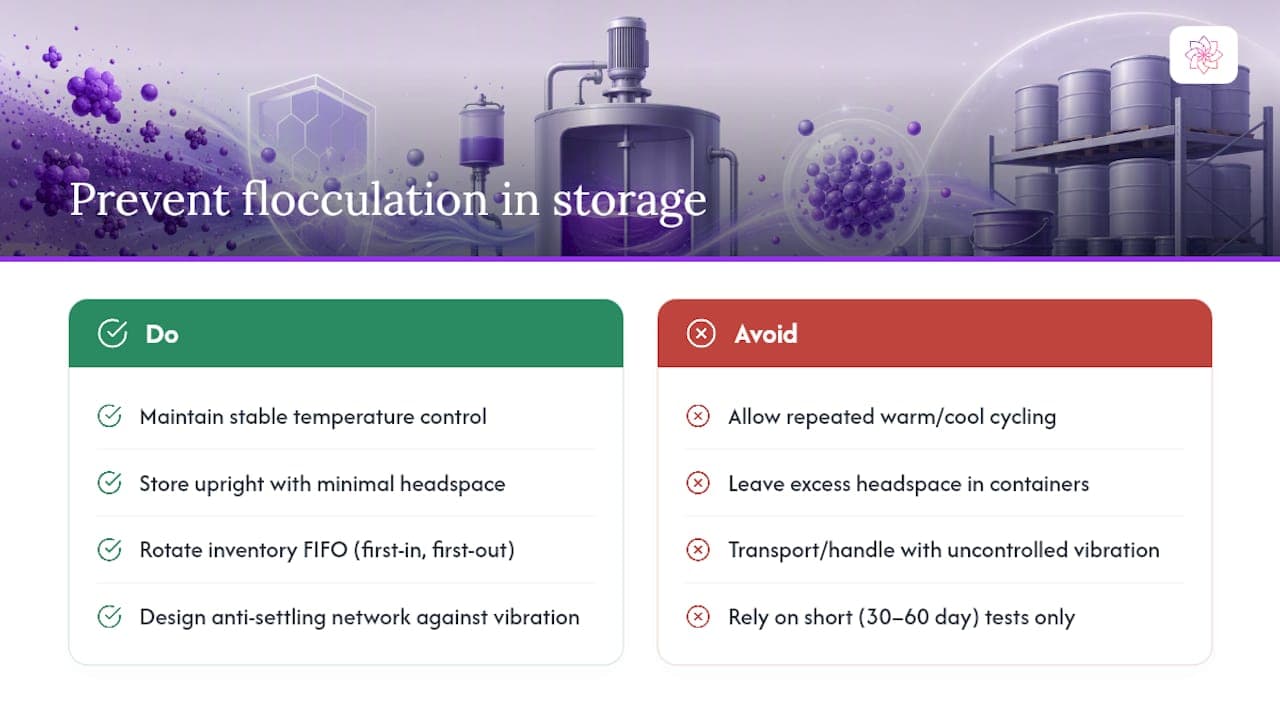
Storage conditions determine whether a properly stabilized batch stays stable through its full shelf life or slowly drifts toward flocculation before it ever reaches the customer. Temperature control tops the list: repeated warm/cool cycling during warehouse storage accelerates the same solvation collapse that causes steric stabilization to weaken during use, and it does so gradually enough that a batch can pass release testing and still fail months later in a customer's warehouse.
Container headspace and orientation matter more than most quality teams assume. Excess headspace allows more solvent or water evaporation at the container's air interface, concentrating pigment and additive levels unevenly near the top and creating a localized zone where the dispersant-to-pigment ratio no longer matches the bulk formulation. Storing drums or totes upright, with minimal headspace, and rotating inventory on a strict first-in, first-out basis reduces this risk substantially.
Vibration during transport and warehouse handling can also promote settling in marginal formulations, since it provides the mechanical energy that helps particles find their way past a weak yield-stress network. Products formulated with a properly matched anti-settling network resist this far better than those relying on stabilization chemistry alone to prevent sedimentation.
For any batch expected to sit in storage for an extended period, running the temperature cycling and centrifuge tests described earlier against the actual expected storage duration, not just a standard 30 or 60 day check, gives a far more reliable prediction of real-world shelf stability. A formulation that passes a short accelerated test can still show flocculation after a full season in an uncontrolled warehouse if the test window was too short to catch it.
Astra R&D team perspective: what actually separates stable batches from failures
Most flocculation complaints Astra-chemical's technical team encounters trace back to a shortcut in wetting or grinding, not a bad dispersant choice. Formulators chase dispersant dosage adjustments when the real fix was a longer mill pass. The second most common pitfall: adding a thixotrope without testing it against the dispersant at production dosage first. Sample requests and formulation consultations remain the fastest way to catch both before they reach the plant floor.
— Astra R&D Team
Matching Astra-chemical Additives to Your Stabilization Strategy
Once you know which mechanism your formulation needs, picking the right additive family gets a lot simpler. ASTRA DISP® dispersants are built around the anchoring and steric barrier principles covered above, suited to both apolar solvent-borne systems and waterborne formulations that need a robust, electrolyte-tolerant stabilization layer. For pigments that fight you at the wetting stage, particularly high-surface-area organics and carbon blacks, ASTRA WA® wetting agents handle the air displacement and initial pigment penetration before the dispersant ever gets to work. And where the challenge is settling rather than initial dispersion, ASTRA REO® rheology modifiers build the reversible network that keeps particles suspended without compromising flow and leveling during application.

Astra-chemical's technical team supports dosage calculations and compatibility screening directly, which matters most when you are troubleshooting an interaction between a dispersant and a thixotrope rather than starting from a blank formulation. Browse the full product line to identify the additive family that matches your stabilization mechanism, or request a lab sample to validate performance against your own pigment and resin combination before committing to a production run.
Sources
- Optimal selection and use of pigment dispersing agents — SpecialChem
- The basics of dispersion and stabilization of pigments and fillers — UL Prospector
- Decoding paint settling: a practical guide to shelf-life and stabilization — Industrial Front
FAQ
What Is the Main Cause of Pigment Flocculation?
Pigment flocculation happens when attractive van der Waals forces between particles overcome whatever repulsive force is stabilizing them, usually because of insufficient wetting, an under-anchored dispersant, or an environmental shift in pH or ionic strength. Symptom timing helps identify which cause is responsible: fast hard settling points to a wetting failure, while gradual settling over weeks points to a stabilization failure.
Should I Use Steric or Electrostatic Stabilization?
Steric stabilization is the more robust default, since it resists pH shifts and electrolyte contamination and works across both solvent-based and waterborne systems. Electrostatic stabilization can work well and cost less in tightly controlled waterborne formulations, but it depends on holding pH and ionic strength steady throughout storage and use.
How Much Dispersant Do I Need to Prevent Flocculation?
Dosage should be calculated from the pigment's specific surface area rather than a flat percentage, since high-surface-area organics and carbon blacks need far more dispersant than coarser inorganic pigments. Generally, dosage varies depending on dispersant anchor strength and polymer size; ASTRA DISP® dispersants come with technical support to refine that starting dosage for your specific pigment and resin combination.
What Is the Fastest Bench Test for Flocculation Risk?
A visual redispersion test after gentle shear, combined with a quick low-shear viscosity check, catches most flocculation risk within minutes. For a more reliable prediction, follow up with a short temperature cycling or centrifuge test, which compresses months of storage behavior into a few hours.
Can a Rheology Modifier Fix Flocculation on Its Own?
No. A rheology modifier can slow settling by building a reversible suspending network, but it cannot correct a wetting failure or an under-anchored dispersant, and using more of it to mask those problems usually makes the underlying agglomeration worse. Fix wetting and dispersion first, then add an anti-settling agent like ASTRA REO® to manage any remaining settling tendency.
Recommended
Testing additives for this application?
Send us your current formulation challenge and our technical team will recommend an ASTRA product package for lab screening.