Stop Recoat Failures: Astra's 4 Step Defoamer Compatibility Protocol
Stop Recoat Failures: Astra's 4 Step Defoamer Compatibility Protocol ! Isometric four-step compatibility testing illustration The right defoamer is the least incompatible chemistry that clears foam at the lowest effective dose, confirmed by a ladder study and correct incorporation.

The right defoamer is the least incompatible chemistry that clears foam at the lowest effective dose, confirmed by a ladder study and correct incorporation. Formulators who chase maximum knockdown before checking compatibility routinely trade foam problems for craters, fisheyes, or recoat adhesion failures. Before escalating to a stronger chemistry, run a short dose ladder, add on the grind where the formulation allows it, and inspect drawdowns for surface defects.
TL;DR:
- Using the lowest effective dose confirmed by a ladder study prevents surface defects like craters and fisheyes, especially in sensitive or clear systems.
- Silicone emulsions provide strong foam control but pose high risks of surface imperfections and adhesion issues; silicone-free or organo-modified siloxanes are safer initial options.
- Incorporating defoamers at the grind stage helps avoid surface separation, while reserve emulsions for letdown reduce incompatibility risks during mixing.
- Tolerance thresholds depend on film viscosity, application method, and system complexity, requiring process-specific testing before full-scale use.
- Troubleshooting should distinguish chemistry failure from contamination or dispersion issues, often solved by substrate cleaning, reducing dose, or improving mixing rather than reformulating.
Defoamer chemistries fall into a handful of families, and each carries its own compatibility profile. A defoamer works by destabilizing foam lamellae, and the active chemistry, along with its carrier, determines how aggressively it does that job and how much collateral defect risk it introduces.
- Silicone (PDMS) emulsions deliver strong, persistent microfoam control but carry the highest risk of craters, fisheyes, and recoat adhesion loss.
- Organo-modified siloxanes (OMS) moderate that risk while retaining much of the knockdown strength, making them a common middle ground for recoatable systems.
- Mineral-oil defoamers offer broad latex compatibility and lower crater risk, though microfoam control is comparatively weak.
- Polyether-based defoamers tend to be gentler on film appearance and fit water-based and some non-aqueous systems.
- Molecular (silicone-free) defoamers and alkyl polyacrylates suit air-release needs and clear or multi-coat systems where recoat sensitivity rules out silicone.
- Powder or wax carriers change incorporation behavior entirely, since they depend on melt or dispersion rather than emulsion mixing.
As a starting rule, try a non-silicone or OMS grade first on recoat-sensitive or clear systems, and reserve neat silicone emulsions for cases where weaker chemistries have already failed to clear persistent macrofoam.
Reproducible compatibility testing: ladder studies and lab-to-plant checks
A ladder study is the fastest way to find the lowest dose that clears foam without introducing defects, and it should be run before any chemistry substitution is considered. SpecialChem's selection guide recommends spanning the supplier's dosing window with several points, then reading both foam knockdown and surface quality at each step.
- Prepare a dose ladder across the supplier's recommended range, evaluating knockdown and defect onset at each point.
- Run drawdowns and inspect gloss, craters, and fisheyes under raking light.
- Perform a rub-up test on any suspected crater to separate a dispersion issue from a true incompatibility.
- Age a sample under shear or accelerated shelf stress and retest foam control and film appearance.
- Repeat the winning dose in a production-simulating high-shear run before committing to a plant trial.
Pro Tip: Run the ladder on the actual production mill base whenever possible; a defoamer that passes on a lab-scale shake test can still fail once it meets plant-scale shear and dispersion conditions.
Persistence matters as much as initial knockdown. A defoamer that clears foam in the can but loses activity after a shift on the production line, or after weeks on the shelf, has effectively failed the test even if the first drawdown looked clean.
How incorporation and process variables change compatibility outcomes
The same defoamer chemistry can behave acceptably or disastrously depending on where and how it enters the batch. According to Evonik's incorporation guidance, the more incompatible concentrate is often best added during the grind, while the more compatible emulsion is reserved for the letdown stage.
- Add higher-risk concentrates to the grind, where higher shear and pigment interaction help incorporate them without surface separation.
- Reserve gentler emulsions for the letdown, where lower shear better preserves their droplet size and activity.
- Predilute concentrated actives before addition to reduce localized incompatibility at the point of entry.
- Raise shear briefly during incorporation when a stronger chemistry is otherwise unworkable at low shear.
Viscosity, filler-to-binder ratio, film thickness, and application method (spray versus roller versus draw-down) all shift how visible any resulting defect becomes, so a formulation that tolerates a given defoamer at one film build may not tolerate it at another. Formulators troubleshooting foam during mixing operations will find more detail in Astra's guidance on process-first foam control.
Diagnosing defects: is it the defoamer, the process, or contamination?
Not every crater or fisheye traces back to the defoamer, and treating every defect as a chemistry problem leads to unnecessary reformulation. Practitioner troubleshooting notes point to substrate contamination and mechanical dispersion as common alternate causes.
- Wipe the substrate with solvent and re-check for the same defect pattern before reformulating.
- Run a rub-up test on the crater. If it rubs out, dispersion or incorporation is the likely cause, not the chemistry itself.
- Cast a control panel with no defoamer to confirm whether the defect exists without any additive present.
- Examine the defect under magnification for embedded particulate, which points to contamination rather than foam chemistry.
- If chemistry is confirmed as the cause, reduce dose, improve dispersion shear, or switch to a more compatible grade before abandoning the family entirely.
Cleaning substrates and equipment, tightening dispersion, and starting at the low end of the dose range resolve a large share of apparent defoamer failures without touching the formulation.
Selection framework: a four-step checklist to choose a compatible defoamer
A repeatable framework saves formulators from re-deriving the same decision on every new project. It maps film sensitivity and foam severity to a starting chemistry, then hands off to the ladder study described earlier.
- Classify film sensitivity: flat architectural coatings tolerate more aggressive chemistries than gloss industrial finishes or multi-coat clear systems.
- Identify foam type and severity: persistent macrofoam from high-shear mixing needs different control than fine microfoam trapped during application.
- Set process constraints: note available shear, grind versus letdown addition points, and application method before selecting a starting point.
- Choose starter chemistries and ladder points: begin gloss and clear systems with OMS or silicone-free molecular grades; reserve neat silicone emulsions for flat or industrial systems with persistent foam that weaker chemistries cannot clear.
Pro Tip: For multi-coat clear systems, start the ladder at the lowest supplier-recommended dose of a silicone-free molecular defoamer; escalating chemistry strength before exhausting the silicone-free options usually costs more in recoat defects than it saves in knockdown.
Environmental and regulatory compliance also factor into the starting chemistry. Some silicone actives and carrier solvents fall under stricter volatile organic compound or aquatic toxicity limits depending on the end market, so formulators should confirm the regulatory status of a candidate defoamer alongside its compatibility profile before committing to a plant trial.
Astra R&D practical guidance and how Astra supports validation
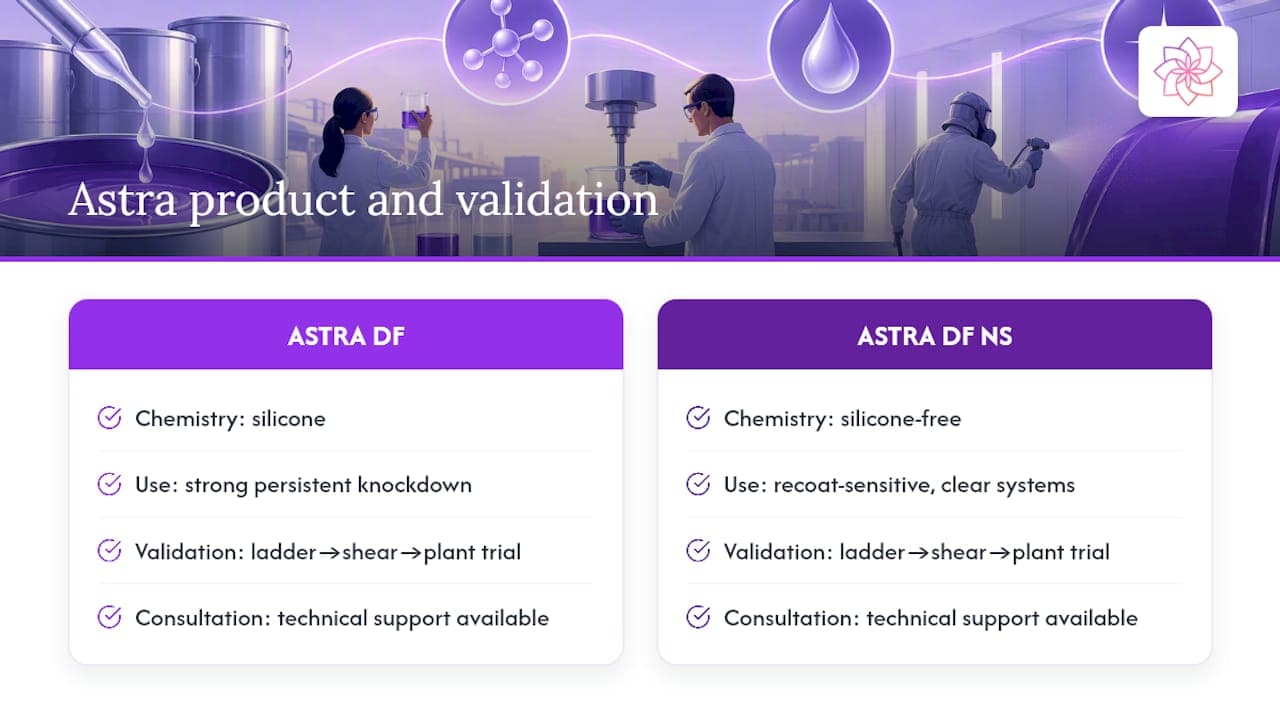
Astra R&D applies the same ladder-study discipline described above when qualifying a defoamer for a customer's system, starting at the lowest supplier-recommended dose and confirming persistence through a production-simulating shear test before recommending a plant trial. Astra's product families are organized around the same compatibility spectrum: ASTRA DF® covers silicone-based chemistries for systems that need strong, persistent knockdown, while ASTRA DF NS® covers silicone-free options for recoat-sensitive and clear systems. Formulators evaluating pH and temperature sensitivity in their own systems, or interactions with pigments and common additives such as wetting agents and dispersants, can request technical consultation to confirm compatibility before committing to a full batch run. A deeper comparison of the two chemistry families is available in Astra's silicone versus silicone-free selection guide.
A note from the Astra R&D Team
Validate on your own system before scaling. The lowest dose that clears foam without defects in your process is the only dose that matters.
— Astra R&D Team
Request samples and technical support from Astra Chemical
Formulators weighing silicone against silicone-free chemistry do not have to resolve that trade-off alone. Astra Chemical manufactures both silicone and non-silicone defoamer lines, backed by laboratory-qualified dosing support so a ladder study can move from lab data to plant validation with fewer trial batches. Technical consultation is available to cover incorporation point, dose range, and compatibility screening against resin and pigment systems. Browse the full product line or contact Astra Chemical to request samples and start a validation trial on your own formulation.
Sources
- Defoamer - Wikipedia
- Defoamers/Antifoaming agents for paint & coatings — SpecialChem
- A Defect is not an Effect! — Evonik webinar slides (Ulprospector)
FAQ
What will work as a defoamer?
Any additive that destabilizes foam lamellae can work as a defoamer, including insoluble oils, silicones, certain alcohols, stearates, and glycols. Which one actually works in a given system depends on compatibility with the resin and application method, confirmed through a dose ladder rather than assumed from the chemistry alone.
What are the different types of defoamers?
The main families are silicone (PDMS) emulsions, organo-modified siloxanes, mineral-oil defoamers, polyether types, and silicone-free molecular defoamers, each with a different balance of knockdown strength and compatibility risk. Powder and wax carriers exist as well, mainly for non-aqueous or specialty systems.
What is another name for a defoamer?
Defoamers are commonly called antifoaming agents or antifoams, and the terms are generally used interchangeably in coatings and industrial process literature. Some suppliers use "foam control agent" for the same category of additive.
Are defoamer and antifoam the same?
Yes, in practice the terms describe the same category of additive used to eliminate or prevent foam. Some technical literature distinguishes antifoams as preventive additives and defoamers as agents that knock down existing foam, but usage across suppliers and formulators is largely interchangeable.
Recommended
Testing additives for this application?
Send us your current formulation challenge and our technical team will recommend an ASTRA product package for lab screening.