5 Lab to Plant Tests to Choose an Antifoam for PSA Adhesives
5 Lab to Plant Tests to Choose an Antifoam for PSA Adhesives ! PSA adhesive antifoam testing title card Start defoamer trials with an organo-modified silicone and a compatible polyether-based non-silicone chemistry, run side by side.
Start defoamer trials with an organo-modified silicone and a compatible polyether-based non-silicone chemistry, run side by side. Test both candidates in the complete formulation under production-shear or simulated-shear conditions, not in a beaker at rest. Compatibility and the lowest effective dose matter more than raw knockdown speed, since an overdosed or mismatched antifoam causes more film defects than the foam it was meant to eliminate.
TL;DR:
- Compatibility and proper dosing are more critical than knockdown speed, as overdosing can cause film defects like craters or haze.
- Testing in full formulation under production shear conditions, including pump and mixer simulations, ensures more reliable performance than jar tests.
- Silicone-based defoamers are effective but risk migration-related defects, while organo-modified siloxanes balance efficiency with better film compatibility.
- Process changes such as inline degassing and low-shear addition can significantly reduce foam formation before adding defoamers.
- Supplier data sheets should specify dose ranges, shear stability, and detection limits for silicone contamination to guide proper selection and application.
Every antifoam for PSA adhesives works by disrupting the bubble lamellae in the aqueous phase, either by spreading across the film and thinning it or by bridging the surface with an insoluble particle. How that happens, and what it costs the coating downstream, depends on the chemistry class.
Unmodified polydimethylsiloxane (PDMS) knocks down foam fast and cheaply, but it migrates. In a pressure-sensitive adhesive, migrated silicone shows up as fish eyes, surface craters, or dead spots where tack disappears entirely. It is the most efficient defoamer chemistry and, in most PSA lines, the riskiest.
Organo-modified siloxanes trade some of that raw efficiency for compatibility. Grafting polyether or polyester groups onto the silicone backbone reduces surface migration while keeping most of the defoaming power, which is why Evonik and other suppliers position organosiloxane emulsions as the default entry point for waterborne acrylic PSA lines.
Silicone-free chemistries, typically polyether or EO-PO block copolymers, sacrifice a bit of speed for a cleaner compatibility profile. They rarely cause spotting or clarity loss, which makes them the safer first call for clear films, optical laminates, or any application where a customer will reject product on appearance alone.
Oil-based and particulate defoamers (mineral oil carriers with hydrophobic silica) still have a place on cost-sensitive commodity lines, but they carry a higher residue risk and can leave a haze on clear PSA films.
A separate distinction matters here too: air-release additives eliminate microbubbles trapped within the film during coating and drying, while true antifoaming agents prevent bubble formation at the mixing and pumping stage. Defoamers, strictly speaking, knock down foam already present on the surface of a bulk liquid. Most commercial products blend all three functions, but knowing which mechanism you actually need narrows the field fast:
- Foam forming in the mix tank or during pumping: antifoaming agent
- Bubbles already trapped in the wet film: air-release additive
- Persistent surface foam on stored or blended adhesive: defoamer
- Unknown source, mixed symptoms: test all three functions in the full formulation
There is no universal best defoamer for every PSA system. Performance swings with resin chemistry, surfactant package, and coalescent load, which is exactly why SpecialChem's selection guide recommends testing multiple chemical bases in the full formulation before committing to one.
How Do You Test and Select a Defoamer for PSA Applications?
A defoamer that performs beautifully in a jar test can still fail on the coating line, because jar tests don't reproduce the shear a real mixer, pump, or slot die applies. The screening protocol below moves from cheap, fast lab checks to production-representative validation.
- Screen candidates in the full formulation. Test each defoamer in the finished PSA batch, not the raw latex alone, and vary surfactant and co-solvent levels across a small matrix to catch interaction effects.
- Run dynamic foam and air-release measurements. A blender or Hamworthy-style dynamic foam test tells you knockdown speed; a separate air-release check (bubble rise time in a graduated cylinder) tells you whether entrained air escapes the wet film before it sets.
- Simulate production shear. Pump the batch through a gear pump loop or run it on a high-speed disperser for the same residence time as your actual line, then re-check foam and film clarity.
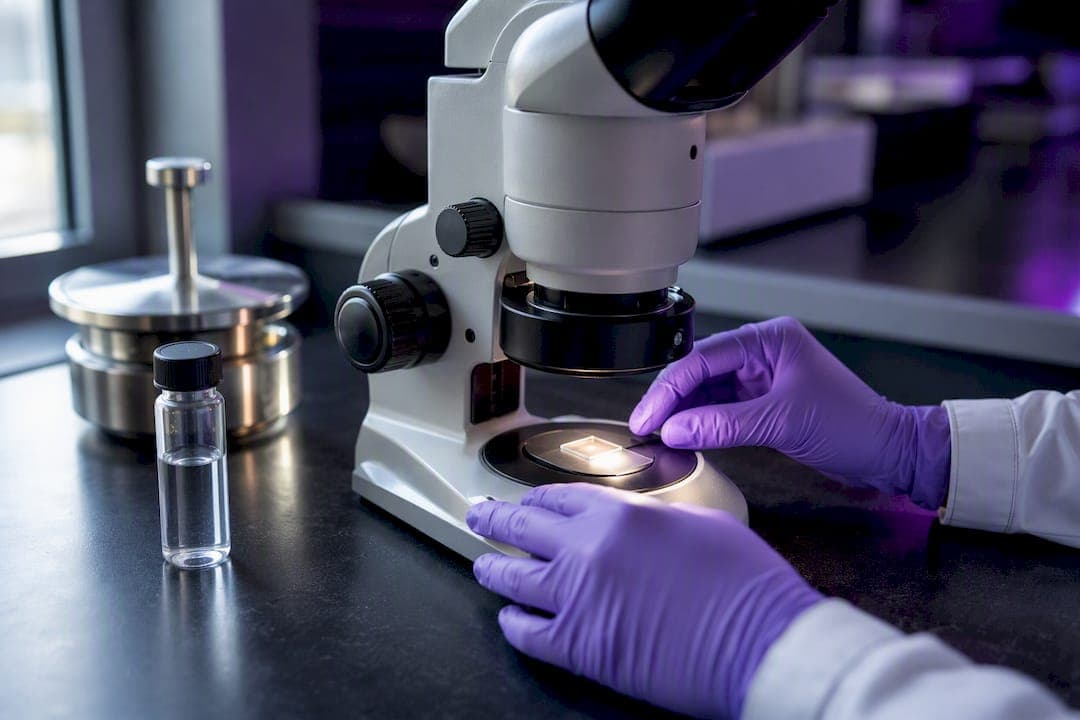
- Inspect film under magnification. Cast a drawdown, dry it, and check under 10x to 40x magnification for fish eyes, craters, or pinholes before running full adhesion testing.
- Confirm adhesive performance with FINAT methods. Peel, tack, and shear values should hold within your normal process tolerance after dosing; a defoamer that kills 15% of loop tack isn't a defoamer worth keeping, regardless of how clean the film looks.
Statistic to hold onto during titration: industry quality-control practice for PSA-grade defoamers commonly sets the PDMS detection limit at the analytical detection threshold used to confirm a product is genuinely free of unmodified silicone contamination. If surface appearance or optical clarity is a hard customer requirement, request that assay from the supplier before you scale up.
Titrate dose in small increments starting at a low fraction of a percent on total formulation weight depending on chemistry, and stop increasing as soon as foam and air-release targets are met. Going past that point buys you nothing but defect risk.
Reducing Air Entrainment Before You Reach for More Defoamer
Foam control that relies entirely on chemistry is fighting a problem that often starts at the mixer. Getting the process right lowers the foam burden a defoamer has to handle, which lets you run a lower dose with fewer side effects on the film.
- Use axial-flow impellers and staged, low-shear addition when wetting powders or adding solvent; voting at the tank surface is one of the most common sources of entrained air.
- Design transfer lines and pump selections to avoid narrow, turbulent flow paths where the batch cavitates or splashes into open headspace.
- Install inline degassing or a vacuum-holding tank ahead of the coater, with a nominal hold time long enough for microbubbles to rise and collapse before the batch reaches the die.
- Manage temperature and solids content deliberately. Cooler, higher-viscosity batches trap air longer, while defoamer mobility and efficacy both drop as viscosity climbs.
Application notes on PSA production defoaming back this up directly: process changes like staged mixing and inline degassing can cut foam generation meaningfully before a single drop of defoamer enters the tank.
Pro Tip: Before increasing defoamer dose to fix a persistent foam complaint, walk the transfer path from tank to coater with a stopwatch and a flashlight. Foam that reappears after every pump transfer is a process problem, not a chemistry problem, and no amount of additive fixes a cavitating pump.
Diagnosing Film Defects Linked to Antifoam Overdose
Fish eyes, craters, and dead spots on a PSA film usually trace back to one of three causes: silicone migration, particulate contamination, or simple overdosing. A solvent-wipe test on a suspect spot, followed by microscopy, separates true silicone spotting (which resists solvent wipe and shows a crater with raised edges) from dirt or gel contamination (which typically lifts or smears).
- Reduce the defoamer dose to the last known passing level and re-run the drawdown.
- Move the addition point earlier in the process, before high-shear letdown, so the defoamer disperses more evenly.
- Switch to the alternate chemistry class you screened in Section 3 if dose reduction alone doesn't resolve spotting.
- Add a compatible dispersant to help distribute an oil-phase defoamer more evenly and cut spotting risk.
- Re-run FINAT peel, tack, and shear tests to confirm the fix didn't reintroduce a performance trade-off.
Send samples for a PDMS assay or surface-energy test whenever spotting persists across chemistry changes. That result tells you whether you're dealing with residual silicone contamination from upstream equipment rather than the current additive.
Astra R&D's Supplier TDS Checklist for PSA Defoamers
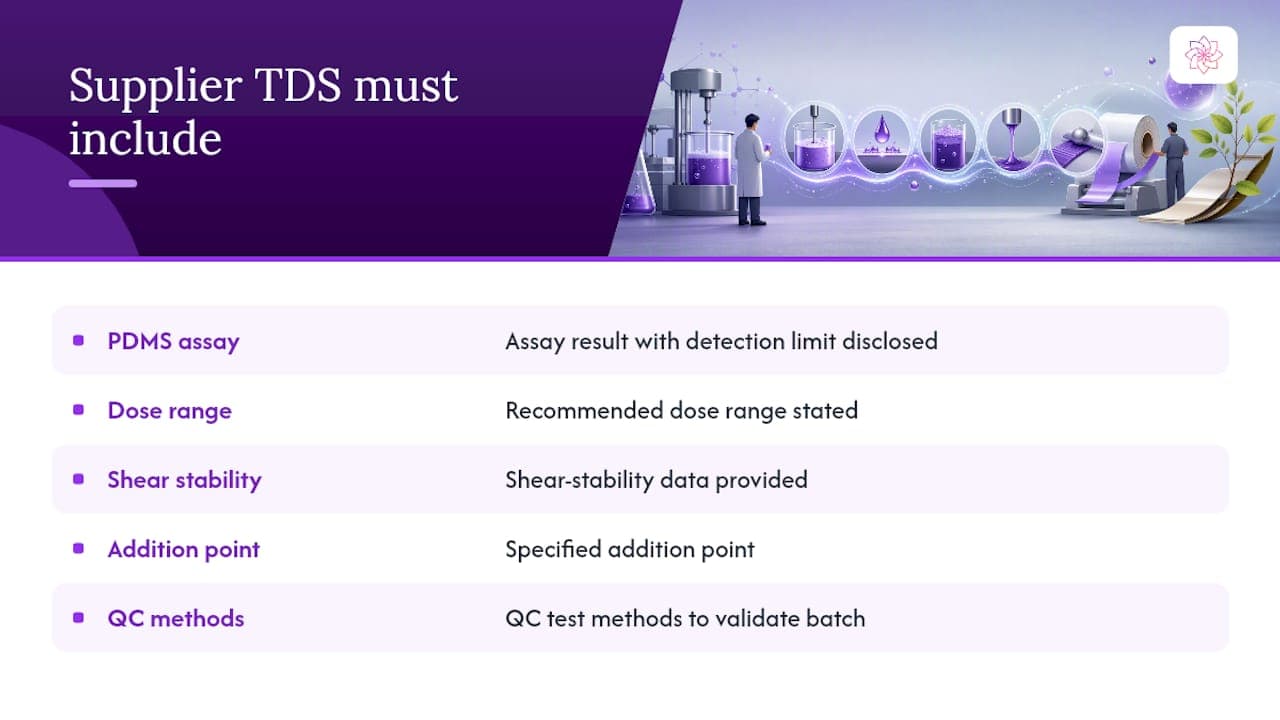
Before accepting any antifoam for production use, require the supplier's technical data sheet to state: a PDMS assay result (with detection limit disclosed), a recommended dose range, shear-stability data, a specified addition point, and the QC test methods used to validate the batch.
For silicone and organo-modified silicone defoamers, expect starting dose ranges in the low fraction-of-a-percent territory, with foam knockdown visible within minutes of full-shear incorporation. For non-silicone defoamers, dosing tends to sit slightly higher to match knockdown speed, with the trade-off of markedly lower spotting risk on clear or optically sensitive films.
A fast pilot-line shortcut: run a 30-minute shear-and-hang test on a small batch, then inspect the dried film under magnification. A clean pass shows no craters, stable tack, and foam that doesn't return after 30 minutes of static hold. ASTRA DISP® dispersants can help stabilize oil-carrier defoamers in that same test if early spotting appears.
What the Data Actually Tells Formulators to Prioritize
The instinct in most plants is to chase the fastest-knockdown defoamer and dose it aggressively when a foam complaint hits the floor. That instinct is backwards. The evidence across supplier technical files and process literature points the other way: process control comes first, chemistry selection second, and dose escalation last, not first.
Astra R&D's read on the field data is that formulators overinvest in silicone efficiency and underinvest in shear-stability testing. A defoamer that performs beautifully in a static jar test and falls apart under a gear pump loop will cause more line downtime than a slightly slower-acting product that survives production shear intact.
The single highest-leverage move available to most plants isn't a chemistry swap at all. It's fixing the mixer, the transfer line, and the degassing step so the defoamer only has to handle the foam that process control can't. Chemistry should be the last lever pulled, not the first.
— Astra R&D Team
Get Lab Support for Your Antifoam Selection
Testing two chemistry families under production shear takes real lab time, and getting the dose wrong in a pilot run costs more than the additive itself. Astra-chemical supplies both sides of that trial directly: ASTRA DF® silicone and organo-modified silicone defoamers for lines that can tolerate silicone chemistry, and ASTRA DF NS® non-silicone defoamers for clear films and spotting-sensitive applications.
Astra-chemical's technical team supports formulation trials with sample packs sized for full-formulation screening, not just jar tests, and can help design a shear-stability protocol matched to your specific coating equipment. If spotting shows up during troubleshooting, ASTRA DISP® dispersants are worth pairing into the same trial to stabilize oil-carrier antifoams before they reach the coater. Browse the full additive line or request samples and a technical consultation to get your screening matrix running this quarter.
Sources
For deeper method detail, see SpecialChem's defoamer selection guide, Evonik's technical file on waterborne acrylic PSA additives, and DesaiGlue's notes on PSA production defoaming. Coating and printing process context is available via Gather Packaging's flexo versus offset guide.
- Select Defoamers / Anti-Foaming Agents for Adhesives — SpecialChem
FAQ
What Is a Good Anti-Foaming Agent for PSA?
An organo-modified silicone or a polyether-based non-silicone defoamer are the strongest starting points, since both balance knockdown speed with acceptable compatibility in acrylic PSA films. The right choice depends on your resin, surfactant package, and how sensitive the final film is to spotting.
What Glue Won't Dissolve Foam?
Most pressure-sensitive acrylic adhesives don't dissolve foam on their own; foam forms from air whipped into the aqueous phase during mixing and pumping, and it takes a defoamer or process change to remove it, not a change in adhesive chemistry.
Is Silicone Antifoam Bad for Health?
Food-grade and industrial silicone antifoams based on modified PDMS are widely used and regulated for specific applications, but the concern in PSA manufacturing is compatibility and film defects, not toxicity. Always follow the supplier's safety data sheet for handling and exposure guidance.
What Is a Natural Anti-Foaming Agent?
Natural options like vegetable oils or fatty acid derivatives can suppress foam in some systems, but they generally underperform synthetic silicone and polyether defoamers in water-based PSA and often introduce their own compatibility issues, such as tack loss or residue.
Recommended
Testing additives for this application?
Send us your current formulation challenge and our technical team will recommend an ASTRA product package for lab screening.