Formulators & Procurement: 3 Plant Ready Fixes for Air Release in Epoxy
Formulators & Procurement: 3 Plant Ready Fixes for Air Release in Epoxy ! Clear epoxy sample showing entrapped air bubbles Air release in epoxy resin is the formulation and processing property that determines whether entrapped air escapes during mixing and cure or becomes a permanent void.

Air release in epoxy resin is the formulation and processing property that determines whether entrapped air escapes during mixing and cure or becomes a permanent void. Three levers correct poor air release: controlling the viscosity and cure profile so bubbles have time to rise, incorporating a compatible internal air-release additive, and tightening process and mix controls to limit air entrainment in the first place. Additive suppliers typically develop and qualify additive systems for exactly this problem, and formulators evaluating a fix are welcome to request samples for trial.
TL;DR:
- Air release effectiveness depends on controlling curing timing, process viscosity, and using compatible internal additives, not just applying external release agents.
- Pre-curing time and viscosity profile are critical, as they determine whether entrapped bubbles escape or get frozen during gelation.
- Compatibility testing for specific epoxy and hardener systems is essential, as no universal additive works across all formulations.
- Proper qualification involves casting test panels under production-like conditions and evaluating bubble size, distribution, and porosity on cross-sections.
- Adjusting mix order, dosage, and process parameters, including mold temperature and shear rates, is necessary to maintain consistent air release in manufacturing.
Air release is a race against gelation. As an epoxy system advances toward gel, viscosity climbs and the window for bubble rise narrows, so the cure kinetics and the initial mix viscosity together set how much entrapped air has time to escape before the network locks it in place. Research on epoxy-carbamate foam systems found that pre-curing time and viscosity profile changed cell size and homogeneity, confirming that the processing window, not just the chemistry, dictates whether gas escapes cleanly or gets frozen into the matrix (MDPI).
Surface energy at the resin-air interface governs how readily a bubble detaches once it reaches the surface. A film with high surface tension can trap a bubble at the boundary even after it has risen, which is why wetting behavior matters as much as bulk viscosity.
Rheology modifiers complicate this picture further. Thixotropic agents that build structure at rest can suspend a bubble in place, preventing it from rising at all, while the same modifiers may improve leveling once shear is removed. The net effect depends on how quickly the structure rebuilds after mixing.
Processing conditions compound or offset all of the above:
- High shear during mixing introduces more air than it removes, so mixer speed and blade geometry directly affect the starting bubble load.
- Elevated temperature lowers viscosity and speeds bubble rise, but it also accelerates gelation, so the timing has to be balanced.
- Mold or tooling pressure can either force air into the resin or assist its escape, depending on where in the cure cycle it is applied.
Internal versus external air-release approaches
Internal air-release additives, silicone and non-silicone defoamers included, work by destabilizing the film around a microbubble so it coalesces with neighboring bubbles and rises faster, or by lowering local surface tension so trapped air can detach at the surface. External and semi-permanent release agents, by contrast, are applied to the mold surface rather than the resin, forming an inert film that governs demolding force rather than internal air escape.
- Internal additives are mixed directly into the resin, which removes the mold-coating step entirely and makes them a fit for automated, high-volume manufacturing where consistency between parts matters more than fine-tuning each mold surface.
- External and semi-permanent release agents are sprayed or wiped onto tooling and form a crosslinked release film; a review of internal and external release chemistry found these films can reduce the need for repeated application, but spray method, heat, and evaporation time all affect how well they perform, and water-based versions often need heated molds to work as intended (SciIndeks).
- Trade-offs between the two show up in breakaway force and surface finish: the same review reported that internal agents mixed at low volume percentages produced measurable changes in demolding force, with only some internal chemistries matching the performance of external agents at higher loadings.
Because internal and external agents behave differently across resin and hardener systems, the same source concludes that no universal release agent exists, which makes compatibility testing with the specific formulation a requirement rather than a formality. Molded parts with controlled demolding cycles generally favor external or semi-permanent release, while continuous or automated processes favor the internal route once compatibility is confirmed.
Selecting and qualifying an air-release additive for your formulation
Selection starts with chemical compatibility: an additive has to survive contact with the specific epoxy resin and hardener without interfering with crosslinking. Silicone defoamers tend to offer strong air-release performance at low dosage but carry a higher risk of surface defects like fisheyes or recoat adhesion loss, while non-silicone chemistries trade some efficiency for a lower risk profile in multi-coat systems. Solids content and VOC profile matter for regulatory and film-build reasons, and starting dosage typically falls in a low percentage range that then gets refined through testing rather than assumed from a data sheet, a point covered in more depth in additive selection guidance for epoxy systems.
Small-batch qualification should follow a fixed protocol so results are comparable across trials:
- Mix at a controlled shear rate and temperature that mirrors the intended production process.
- Cast a test panel or block and inspect it visually and under magnification for bubble size and distribution.
- Measure porosity or void area on a cured cross-section rather than relying on surface appearance alone.
Rapid-cure epoxy research offers a caution worth building into any protocol: adding a small amount of internal mold release delayed an early step in the cure reaction, even though the final degree of cure came out similar (Wiley Online Library). That kind of shift can move demold timing on a production line even when the finished part looks unaffected.
Acceptance criteria should be set before testing begins, not after: a target void area percentage on cross-section, a surface finish standard the coating or laminate needs to meet, and a maximum demolding force if the part will be released from a mold. Watch for adhesion loss, cure delay, or blooming during qualification, since each points to an additive interacting with the cure chemistry rather than just the entrapped air.
Pro Tip: Run the qualification panel at the coldest and hottest temperatures the production line actually sees, not just at ambient, since viscosity and cure timing shift the most at the extremes.
Production checklist for mix order, dosing and QC
Moving a qualified additive into production means locking down the sequence and the checkpoints that keep results repeatable.
- Add the air-release additive early in the mix sequence, before high-shear dispersion steps, so it has time to distribute before viscosity builds.
- Use low-shear incorporation wherever the formulation allows it, since high-speed mixing reintroduces the air the additive is meant to remove.
- Start dosing qualification at the low end of the tested range and adjust upward only if void area exceeds the acceptance target.
- Monitor viscosity, pot life, and mold temperature or pressure at defined intervals, not just at batch start, since drift during a long cure cycle can reopen the air-release problem.
- Contact supplier technical support before scaling a new dosage past the pilot batch, particularly for rapid-cure systems where small additive changes shift cure kinetics.
QC sampling should pull from the start, middle, and end of a production run, checking visually, under magnification, and against a density or porosity threshold set during qualification. A batch that fails should be held and traced back to mix order or shear history before dosage is adjusted again.
Pro Tip: Log mold temperature at the point of pour, not just at the start of the shift, since ambient drift across a production day is a common source of inconsistent void results.
Why tailored additive selection outperforms a generic defoamer
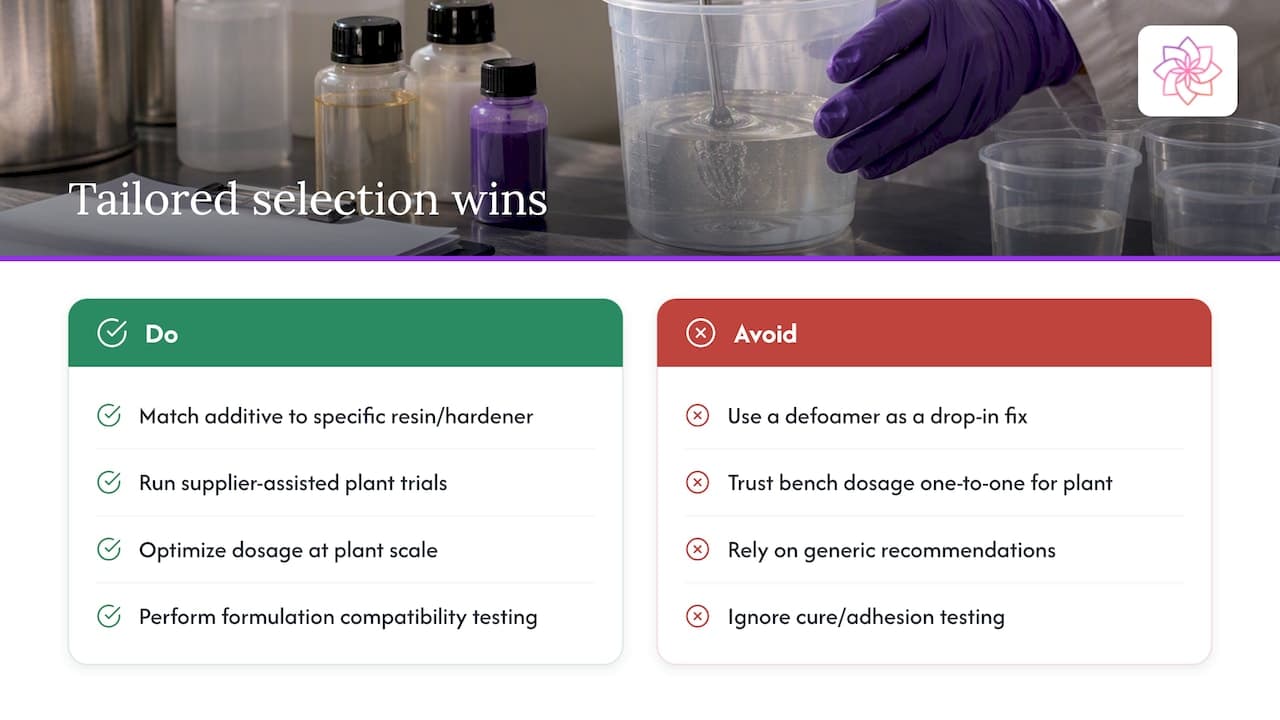
No single air-release additive performs consistently across every epoxy and hardener combination, a conclusion borne out by research showing that concentration and chemistry both shift performance from one resin system to the next (SciIndeks). Treating an additive as a drop-in fix without matching it to the specific formulation invites the cure delays and adhesion problems documented in rapid-cure systems.
Supplier-assisted trials shorten the distance between a promising lab result and a reproducible production batch, since dosage optimization on a bench sample rarely transfers one-to-one to plant-scale mixing and shear. Some R&D teams work from that premise: formulation-specific compatibility testing, not a universal recommendation, is what closes the gap between a defoamer data sheet and a defect-free part.
— Astra R&D Team
Astra additives for air release and next steps
Certain specialty chemical product families are built around the compatibility problem that qualification testing keeps surfacing. Silicone and non-silicone defoamers target internal air release directly, giving formulators a choice depending on surface-finish sensitivity and recoat requirements. Rheology modifiers shape the viscosity window that controls how much time entrapped air has to escape before gelation, and dispersants improve wetting and dispersion, which affects how cleanly a bubble detaches at the surface once it rises. Together, these types of additives address mechanisms behind air release rather than treating it as a single additive problem.

Astra Chemical supports qualification with technical consultations and sample programs sized for small-batch testing before a dosage moves to pilot scale. Formulators and procurement teams evaluating a fix for entrapped air can request samples and technical support to begin compatibility testing on their own resin and hardener system.
Sources
- Epoxy resin and release agents part I: influence of external and internal release agents on the adhesive properties of epoxy resin
- Tailoring epoxy resin foams by pre-curing with neat amine hardeners and its derived carbamates
- A novel rapid cure epoxy resin with internal mold release
FAQ
What does "air release" mean in an epoxy formulation?
Air release describes how readily a resin system lets entrapped air escape during mixing and cure rather than becoming a fixed void in the finished part. It is a formulation and process property controlled by viscosity, surface energy, and additive chemistry, not a one-time cleanup step.
Is a silicone or non-silicone defoamer better for air release?
Neither chemistry is universally better: silicone defoamers such as ASTRA DF® often work at lower dosage but carry a higher risk of surface defects like fisheyes, while non-silicone options such as ASTRA DF NS® trade some efficiency for better recoat adhesion. The right choice depends on compatibility testing with the specific resin and hardener system, since no universal release agent exists across all epoxy chemistries (SciIndeks).
How much internal air-release additive should I start with?
Qualification typically starts at the low end of the supplier's recommended dosage range and moves up only if the void area on a test panel exceeds the acceptance target. Rapid-cure systems need particular caution, since research found that small amounts of internal release delayed an early step in the cure reaction (Wiley Online Library).
What lab checks confirm an air-release additive is working?
A small-batch panel cast under production-representative shear and temperature, then inspected visually, under magnification, and by measuring porosity or void area on a cross-section, is the standard qualification check. Cure delay, adhesion loss, or blooming during that same panel signal that the additive is interacting with the cure chemistry rather than only addressing entrapped air.
Do external release agents help with air release inside the resin?
External and semi-permanent release agents are applied to mold surfaces and primarily govern demolding force and surface film, not the internal air-release behavior of the resin itself. Reducing entrapped air within the mixed resin requires an internal additive or a change to viscosity and mix controls, alongside any external release agent used for demolding (SciIndeks).
Recommended
Testing additives for this application?
Send us your current formulation challenge and our technical team will recommend an ASTRA product package for lab screening.