Procurement First: Scale Additive Production Without Supply Delays
Procurement First: Scale Additive Production Without Supply Delays ! Decorative additive production scale-up title card Scaling up specialty additive production is a re-engineering exercise, not a bigger version of the lab batch.
Scaling up specialty additive production is a re-engineering exercise, not a bigger version of the lab batch. Success depends on three non-negotiable pillars: engineered heat, mixing, and residence-time control; validated pilot evidence before capital is committed; and a qualified, redundant supply chain. Technical teams often support this work directly, offering procurement tests and formulation guidance that catch failure modes before they reach the plant floor.
TL;DR:
- Validating heat transfer, mixing, and residence time controls through pilot testing is essential, as these factors do not scale linearly and impact quality.
- Enforcing strict acceptance criteria and verifying equipment readiness before production orders prevents drift and reduces costly rework at high volume.
- Automating QC methods like viscosity, particle size charting, and solids content at scale improves batch consistency and enables real-time adjustments.
- Early supplier qualification and ordering long-lead equipment before final approval avoid supply bottlenecks that delay scale-up timelines.
- Incorporating automation and digital tools in process control helps predict failures but requires a solid understanding of the process to avoid rapid, undetected errors.
Procurement managers and technical directors chartering a scale-up program need a gate structure before equipment gets ordered, not after. The most common cause of failed transitions is skipping validation steps that seemed unnecessary at bench scale, then discovering the gap only after commercial batches start drifting out of spec, a pattern well documented in specialty chemical scale-up risk analysis.
Use this sequence to structure the pre-scale review:
- Lock the design basis. Define the product specification, target production rate, battery limits, and utility requirements (steam, chilled water, compressed air, nitrogen) before any vessel sizing begins.
- Run the pilot suite. Execute reaction calorimetry, tracer studies for residence-time distribution, foaming trials under production-representative agitation, and solids-handling tests for any powder or resin addition.
- Set acceptance criteria in advance. Define numeric pass/fail thresholds for viscosity build, particle size, and dispersion quality before the pilot run, not after reviewing the data.
- Confirm equipment and utility readiness. Verify heat-exchange area, agitator torque and power, and utility capacity match the calculated production-scale demand, per the chemical process scale-up framework.
- Validate QA methods at scale. Confirm every bench analytical method has a plant-scale equivalent that produces comparable results.
- Audit supplier capacity. Qualify primary and at least one alternate source for every raw material with lead times over four weeks.
Gate criteria worth enforcing:
- No capital release until pilot acceptance criteria are met and documented.
- No production trial without a validated at-scale QC method for the critical quality attribute.
- No supplier onboarding without a completed capacity and quality audit.
How Do You Translate Pilot Results Into Plant-Scale Engineering?
Heat transfer, mixing, and residence time do not scale linearly, and this mismatch is the single biggest source of scale-up disappointment. Heat generation from an exothermic reaction or high-shear dispersion step scales with volume, while heat removal through vessel walls scales with surface area. A ten-fold increase in batch volume can leave a jacket with roughly half the relative cooling capacity it had at pilot scale, a relationship laid out clearly in rules of thumb for scale-up. Mixing times and RTD broaden as vessels grow taller and wider, which means a formulation that dispersed cleanly in a 50-liter pilot reactor can show unmixed pockets, localized overheating, or premature gelation at 5,000 liters.
For viscous rheology modifiers and certain reactive systems, continuous processing changes the mechanism entirely rather than fighting the scale-up curve. Twin-screw reactive extrusion has demonstrated major energy and throughput gains over batch reactors for HEUR-type thickener production, because residence time and shear become tunable process parameters instead of vessel-geometry consequences. The trade-off is capital intensity and a steeper commissioning curve, so this route suits high-volume, well-characterized chemistries more than low-volume specialty runs.
Practical corrective moves for teams staying with batch reactors:
- Size jackets and coils conservatively, using reaction calorimetry data rather than pilot-scale heat-removal rates extrapolated by volume.
- Target consistent power-per-volume ratios rather than matching absolute agitator RPM between pilot and plant vessels.
- Introduce staged or metered addition for reactive components instead of single-shot dosing.
- Add static mixers downstream of the primary vessel to correct residence-time tailing.
- Reselect impeller geometry for the new tank aspect ratio rather than reusing the pilot design.
Pro Tip: Run a scale-down model before committing to plant design. Build a bench-scale system that deliberately mimics the plant's expected mixing time and heat-removal ratio, then test your formulation against it. It is far cheaper to discover a foaming problem in a 2-liter mimic than in a 10,000-liter reactor.
Which QC Methods and Analytics Actually Predict Batch Consistency?
Bench methods that worked fine during formulation development often break down the moment production volumes increase. Manual viscosity checks with a handheld spindle or single-point particle-size readings are frequently too slow and too imprecise to catch batch-to-batch drift before a bad lot ships, a gap outlined in particle size characterization guidance for production QC.
The methods worth automating or moving in-line include:
- Concentration assays for active additive content, run at a frequency tied to batch size rather than a fixed daily schedule.
- Inline or at-line viscosity measurement synchronized with the mixing or extrusion step, not just at final packaging.
- Particle size distribution for dispersions and pigment-loaded systems, tracked against a defined statistical process control band.
- Solids content and pH, both cheap to automate and highly sensitive to raw-material lot variation.
Every bench method scheduled for production use needs a parallel validation run at plant scale before it becomes the release gate. Deviations that go undetected for several batches become expensive to trace back to a root cause, according to scale-up risk documentation from pilot-to-production transitions. QC data should feed directly into batch release decisions and into ongoing supplier acceptance testing, closing the loop between what the plant produces and what the raw-material supply is delivering.
How Should Procurement Prevent Supply Bottlenecks During Scale-Up?
Supply chain instability, not equipment failure, derails more scale-up timelines than any single engineering variable. Long lead times for specialized reactors, agitators, or analytical instrumentation can add months to a commissioning schedule if ordering starts only after pilot data confirms feasibility, a risk flagged in Deloitte's analysis of global supply chain realignment.
Procurement teams should move on four fronts in parallel with the engineering work:
- Qualify at least one alternate raw-material source for every input with a single-supplier dependency, following a structured supplier qualification process.
- Place long-lead equipment orders as soon as pilot acceptance criteria are met, rather than waiting for final plant design sign-off.
- Rework packaging, transport, and warehouse storage specifications for bulk volumes; a shift from drums to totes or bulk rail cars changes handling requirements and shelf-life exposure.
- Negotiate contractual clauses covering demand variability and minimum order quantities, and build contingency inventory buffers for the first two to three quarters of commercial production.
Reducing exposure to single-source dependencies early tends to save more schedule time than any single engineering fix made later. Teams tracking additive lead times across raw-material categories can build ordering schedules that stay ahead of production ramp rather than reacting to it.
What Safety and Regulatory Steps Belong in Commissioning?
Hazard profiles shift with scale in ways that are easy to underestimate. A reaction that stayed comfortably controlled in a jacketed pilot vessel can generate heat faster than a larger jacket can remove it, which means relief systems, emergency cooling, and interlocks need re-evaluation at every scale change, not just at final commissioning.
- Reassess hazard classification for the new scale and confirm relief valve sizing and emergency cooling capacity against worst-case heat-generation rates.
- Engage EHS and regulatory teams early, particularly around waste-treatment capacity and emissions handling, since regulatory registration requirements can shape material and process choices well before startup.
- Build a commissioning checklist covering instrument calibration, control loop tuning, and defined hold points before advancing to the next process step.
- Test abnormal cases deliberately: power loss, agitator failure, and delayed addition scenarios, not just the expected operating window.
- Establish change control and batch-record documentation from day one so the plant stays audit-ready.
Pro Tip: A single successful pilot run is evidence, not proof. Treat it as one data point in an uncertainty range, and design your commissioning tests to intentionally probe the edges of that range rather than confirming the middle.
How Astra-chemical Reduces Risk During Scale-Up
Technical teams can work alongside procurement and formulation groups through the exact gates described above, supplying pilot samples, production transfer protocols, and defined acceptance criteria rather than a generic data sheet. Formulators dealing with dispersion instability, foam-related defects, or rheology drift at higher volumes get direct engineering input on which additive chemistry and dosage actually holds up past the pilot stage.
- Pilot-scale sample support sized to match a customer's actual scale-up test plan, not a one-size lab kit.
- Production transfer protocols that map bench dosage rates to plant-scale addition points.
- Procurement-facing acceptance tests covering QC metrics for coating additive suppliers, including consistency across production lots.
- Formulation support for dispersibility, foam control, and rheology issues that commonly surface only after scale-up begins.
| Scale-up challenge | Astra-chemical product line | What it addresses |
|---|---|---|
| Pigment or filler dispersion instability at higher solids | ASTRA DISP® | Wetting and dispersion consistency across batch sizes |
| Foaming during high-shear mixing or letdown | ASTRA DF® / ASTRA DF NS® | Silicone or non-silicone antifoam matched to formulation sensitivity |
| Viscosity drift or sag/leveling issues at scale | ASTRA REO® | Rheology control tuned to production shear profiles |
| Reactive chemistry transfer to continuous processing | ASTRA REACT® | Reactive additive performance under extrusion or continuous conditions |
How Does Additive Manufacturing Integrate With Existing Production Lines?
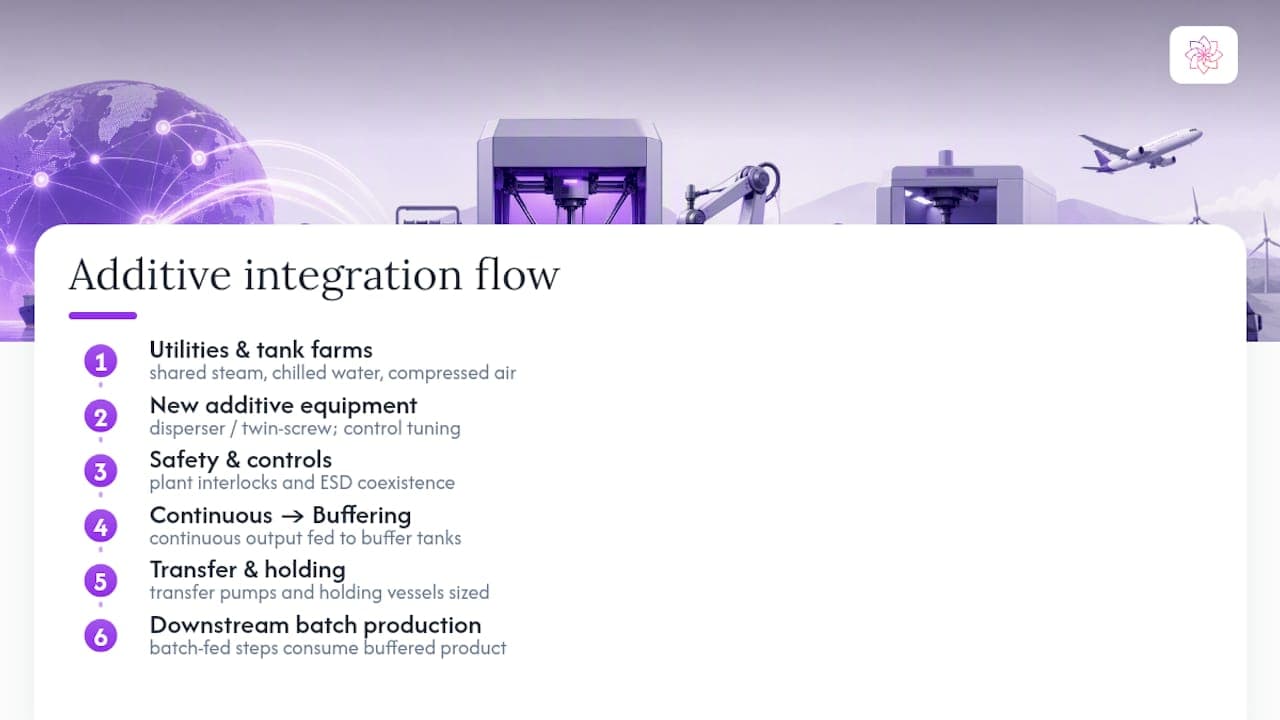
Retrofitting a new additive process into an established plant rarely means building a standalone unit. Most formulators integrate new dispersion, letdown, or extrusion steps into existing utility grids, tank farms, and material-handling systems, which means the scale-up plan has to account for shared steam, chilled water, and compressed air demand rather than treating the new line as an isolated system.
Piping and instrumentation compatibility is the first checkpoint. A new high-shear disperser or twin-screw unit installed alongside legacy batch reactors needs its own control loop tuning, but it also needs to coexist with plant-wide safety interlocks and emergency shutdown sequences without creating conflicting failure modes. Skipping this review is a common reason commissioning runs behind schedule.
Material flow matters just as much as utilities. Introducing a continuous reactive extrusion step next to batch tanks changes how intermediate product moves through the plant, often requiring new buffer tanks, transfer pumps, or holding vessels sized for the mismatch between continuous output and batch-fed downstream steps. Formulation chemists should map these transition points during the design-basis stage, not after the equipment arrives.
Cross-contamination control deserves particular attention when a new additive line shares piping runs, blending vessels, or cleaning systems with existing production. A defoamer or dispersant carryover between product families can cause defects that look like a raw-material quality issue when the real cause is inadequate line segregation or cleaning validation between changeovers.
What Role Do Automation and Digitalization Play in Scale-Up?
Automated process control turns scale-up from a reactive troubleshooting exercise into a monitored, data-driven ramp. Inline sensors for viscosity, concentration, and particle size feed control systems that can adjust addition rates or agitation speed in real time, catching drift before it produces an off-spec batch rather than after QC flags it hours later.
Predictive modeling adds another layer of protection. Structured process data combined with high-throughput experimentation and AI-assisted optimization can flag likely failure points, such as a mixing zone prone to localized overheating, before a single plant-scale batch runs, an approach detailed in predictive process optimization methods. For formulation chemists managing a multi-product plant, this kind of predictive layer shortens the number of physical trial runs needed to confirm a scale-up hypothesis.
Digitalization also changes how batch records and change control get managed. Electronic batch records with automated data capture reduce the manual transcription errors that plague paper-based systems during the chaotic early weeks of a new line, and they make audit-readiness a byproduct of normal operation rather than a scramble before a customer or regulatory visit.
The caution here: automation amplifies whatever process discipline already exists. A poorly characterized process with automated controls just fails faster and with less obvious warning than a manual one. Automation should follow validated process understanding, not substitute for it.
What Sustainability Factors Should Shape a Scale-Up Plan?
Environmental and regulatory constraints increasingly shape which chemistries even make it to the scale-up stage. Registration requirements under frameworks like TSCA can slow or redirect material adoption, and aligning chemistry choices with regulatory and sustainability drivers early avoids a costly reformulation after capital equipment is already ordered.
Energy intensity is a direct scale-up lever, not just a sustainability talking point. Continuous processes like reactive extrusion have shown measurable energy reduction against batch reactors for viscous additive grades, which means the sustainability case and the throughput case often point toward the same engineering decision rather than competing against it.
Waste-treatment capacity needs sizing for the new production volume, covering solvent recovery, wastewater treatment load, and emissions handling for any volatile components. A plant that comfortably handled pilot-scale waste streams can find its treatment capacity undersized once production volumes triple.
Supply-chain sustainability is worth building into supplier qualification criteria alongside quality and capacity checks. Sourcing decisions that account for transport distance, packaging waste, and supplier environmental practices, following sustainable supply chain practices, tend to hold up better against future regulatory tightening than sourcing based purely on unit price.
How Do You Prepare the Workforce for a Scaled-Up Process?
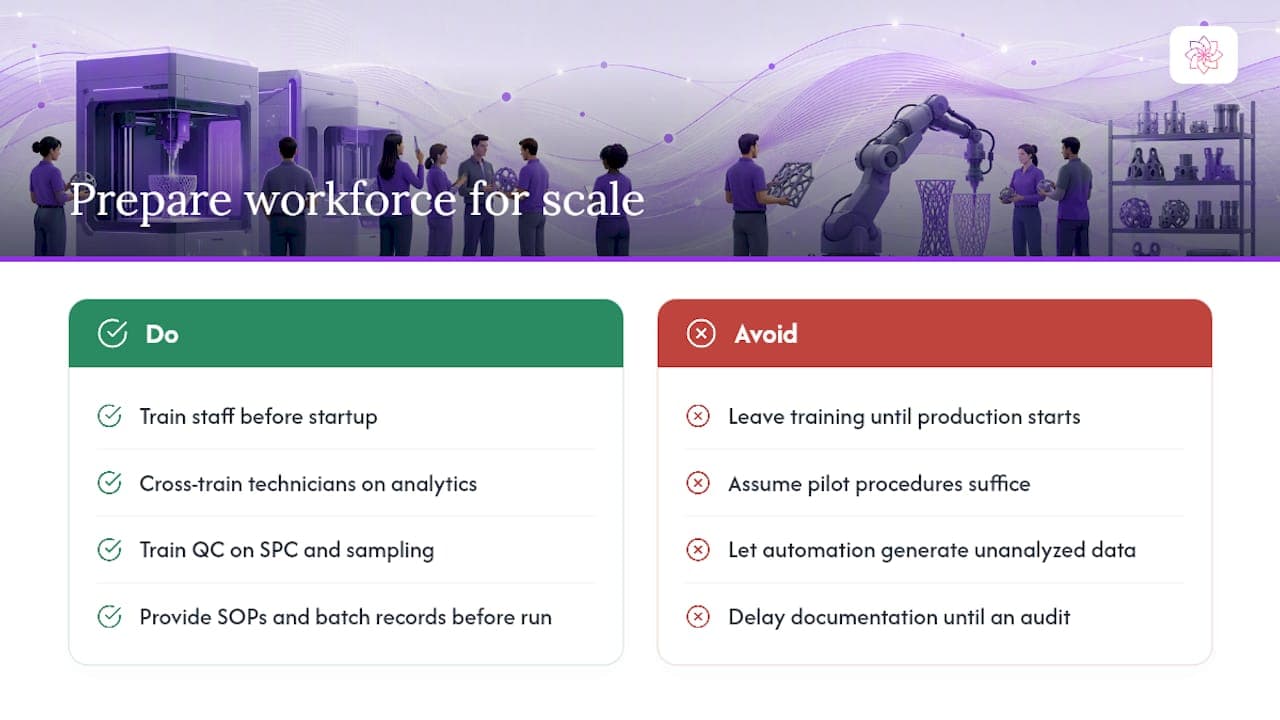
New equipment and higher throughput change what operators, technicians, and quality staff need to know, and training gaps show up fastest during the first few weeks of commercial-scale running. Operators who managed a pilot vessel by feel need documented, repeatable procedures for the plant-scale equivalent, since the tolerance for improvisation shrinks as batch value and throughput rise.
Cross-training matters more than most scale-up plans budget for. A line that adds inline analytics, automated dosing, or continuous extrusion needs technicians who can interpret sensor data and control-loop behavior, not just run manual checks. Building this competency before startup, rather than during it, prevents the awkward period where an automated system generates data nobody on shift knows how to act on.
Change management extends to quality and procurement staff as well. A QC team accustomed to single-point bench testing needs structured training on statistical process control limits and automated sampling plans before those become the batch-release gate. Procurement staff qualifying new suppliers for higher-volume sourcing need updated audit checklists that reflect commercial-scale quality requirements, not the looser tolerances acceptable at pilot volumes.
Documentation discipline is the piece most often shortchanged under schedule pressure. Batch records, standard operating procedures, and abnormal-case response protocols need to exist and be trained on before the first commercial batch runs, not drafted retroactively once an audit or customer complaint forces the issue.
Why Supplier Qualification Deserves More Weight Than Most Scale-Up Programs Give It
Engineering teams tend to treat supplier qualification as a procurement formality that runs in parallel with the "real" work of process design. That ordering is backwards. A validated process running on an unqualified or single-sourced raw material is still a fragile process, no matter how well the heat-transfer math checks out.
The programs that hold up under commercial pressure are the ones that make pilot evidence and supplier audits gate conditions for capital release, not parallel tracks that can slip without consequence. Astra-chemical's production transfer protocols exist precisely because this discipline gets skipped often enough to be predictable, not rare.
— Astra R&D Team
Get Pilot Samples and Procurement Tests From Astra-chemical
Samples, technical data, and formulation support can come directly from manufacturers of dispersants, defoamers, and rheology modifiers that scale-up programs depend on, rather than a distributor layer.
For teams working through the checklist above, the practical next step is requesting pilot samples sized to an actual production trial rather than a generic lab kit, then running them against the acceptance criteria set during the design-basis stage. Astra-chemical's technical team can also schedule a formulation review to walk through dispersion, foam control, or rheology concerns specific to a given production line, drawing on product lines like ASTRA DISP® dispersants and ASTRA DF® defoamers. Browse the full product hub to compare chemistries against a current scale-up plan, or request samples directly to start a procurement test on your own timeline.
Sources
- Specialty Chemical Scale-Up Risks: Pilot to Production
- Rules of thumb for scale-up
- Optimal design and operation of reactive extrusion processes: Application to HEUR production
- Chemical process design, scale-up and commissioning
FAQ
How Long Does It Take to Scale Up an Additive Process?
Timelines vary widely by chemistry complexity and equipment lead times, but most programs need pilot validation, equipment procurement, and commissioning as sequential rather than overlapping phases. Long-lead equipment orders and supplier qualification are the two steps most likely to extend the schedule if started late.
What Is the Biggest Cause of Additive Scale-Up Failure?
Nonlinear changes in heat transfer, mixing, and residence-time distribution cause most scale-up failures, since heat removal scales with surface area while heat generation scales with volume, per scale-up engineering fundamentals. Formulations that disperse or react cleanly at pilot scale often show unmixed zones or thermal excursions once vessel size increases.
Do I Need New QC Methods for Commercial-Scale Batches?
Yes. Bench methods like manual viscosity checks or single-point particle-size readings typically need to be automated and revalidated at plant scale, since they are often too slow or imprecise to catch batch drift, according to particle size characterization guidance.
How Does Astra-chemical Support Scale-Up Projects?
Astra-chemical provides pilot samples sized to a customer's actual trial plan, production transfer protocols, and procurement-facing acceptance tests through its product lines, alongside formulation support for dispersion, foam, and rheology issues that commonly surface during scale-up.
Should I Choose Continuous or Batch Processing for Scale-Up?
It depends on volume and chemistry: continuous methods like reactive extrusion have shown energy and throughput advantages for certain viscous rheology modifiers, per reactive extrusion case study data, but batch processing remains more practical for lower-volume or less-characterized chemistries.
Recommended
Testing additives for this application?
Send us your current formulation challenge and our technical team will recommend an ASTRA product package for lab screening.