Additive Lead Times: What to Expect and How to Shorten Them
Additive Lead Times: What to Expect and How to Shorten Them ! Decorative title card illustration Specialty formulation additives, including dispersants, defoamers, and rheology modifiers, typically move from purchase order to delivery in 10 to 30 days, according to chemical industry supply-chain dat…

Specialty formulation additives, including dispersants, defoamers, and rheology modifiers, typically move from purchase order to delivery in 10 to 30 days, according to chemical industry supply-chain data. Custom grades, hazardous-classified products, and low-volume specialty chemistries routinely exceed that window. The single highest-impact action for procurement and formulation teams is confirming two things before the purchase order is issued: the supplier's current production slot availability and the expected turnaround for the Certificate of Analysis (CoA) that releases the batch for shipment.
Before locking a delivery date into a production schedule, verify:
- The supplier's next open production slot for your grade and batch size
- Whether the item ships from finished inventory or requires a fresh batch run
- CoA and quality-release turnaround time, separate from manufacturing time
- Any hazardous material transport documentation that could add processing days
Astra-chemical supplies dispersants, defoamers, and functional additives from domestic production capacity, and the sections below break down where lead time actually gets consumed and what buyers can do about it.
Key Takeaways
Reliable additive delivery depends on mapping lead time to its component phases and negotiating CoA turnaround and dual-source commitments before a shortage forces the issue.
| Point | Details |
|---|---|
| Baseline lead time | Expect 10 to 30 days for most specialty additives, longer for custom or hazardous-classified grades. |
| Verify CoA timing first | Quality-release turnaround, not manufacturing time, is the most common hidden delay. |
| Model disruption scenarios | Plan for 2, 4, and 8 week lead-time extensions on critical materials, not just the baseline case. |
| Prioritize contracts over inventory | Lock in CAS-level dual sourcing and lead-time SLAs before defaulting to larger safety stock. |
| Domestic supply shortens migration risk | Astra-chemical's domestic production and migration guide support faster requalification when switching sources. |
Total lead time is rarely one number. It's a sum of five distinct phases, and each one carries its own failure points.
- Order processing and release. The gap between PO submission and production release depends on credit terms, technical file review, and whether the order requires a new specification sheet. Rush this step and everything downstream compounds.
- Raw material procurement. Many dispersant and defoamer formulations depend on specific CAS-numbered feedstocks. If a supplier's own raw material inventory runs thin, your order waits behind their procurement cycle, not just their production schedule.
- Production scheduling. Batch size minimums, reactor or mixer availability, and how your order fits into the plant's existing campaign all affect when manufacturing actually starts.
- Quality testing and CoA issuance. Finished batches sit in hold-for-release status until lab testing confirms specification compliance. This step alone can add several days on top of manufacturing time, a factor regulatory documentation requirements make unavoidable for most industrial chemical shipments.
- Packaging and transport. Drum versus tote versus bulk packaging, plus any hazardous transport documentation, determines how quickly product physically leaves the dock.
Typical Lead-Time Ranges by Additive Class
The 10 to 30 day window holds as a general baseline for the chemical industry, but where a specific additive falls in that range depends heavily on formulation complexity and how the product is packaged and shipped.
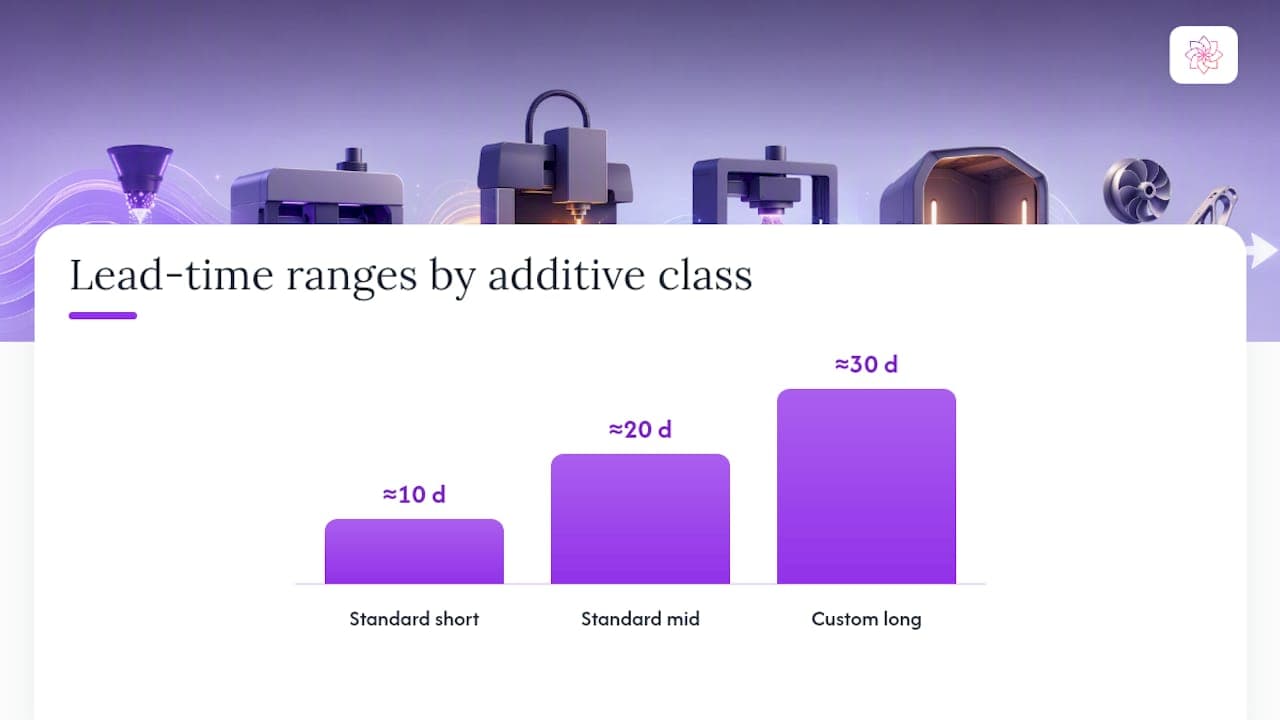
Pro Tip: Ask your supplier for lead time broken out by phase, not just a single total. A 25-day quote that hides an 8-day CoA hold behaves very differently under pressure than one where testing takes 2 days.
Standard-grade items with established production runs tend to sit at the short end:
- Rheology modifiers in common grades often ship from existing inventory or short production runs, landing near the lower bound.
- Standard non-silicone defoamers typically fall in the middle of the range, since they use widely available feedstocks.
- Custom-formulated dispersants and silicone defoamers requiring specialized handling tend toward the long end, particularly when a formulation is tailored to a specific resin system or application.
- Functional additives with hazardous classifications frequently add transport documentation time regardless of how fast production runs.
Custom grades, small-batch specialty runs, and any product with seasonal feedstock limitations push toward the long end of the range or beyond it. A defoamer built on a feedstock with a single seasonal harvest window, for instance, can quietly turn a routine reorder into a multi-week wait if that window is missed.
Why Additive Lead Times Stretch Beyond Plan
Extended lead times rarely appear out of nowhere. Most stem from a small set of recurring pressure points, and most give warning signs weeks before they hit your delivery date.
The structural causes worth watching:
- Upstream feedstock shortages at the raw material level, often tied to a single producer or region
- Plant outages or energy constraints at the additive manufacturer itself
- Transport and logistics bottlenecks, including port congestion, container shortages, and tightening carrier schedules, a pattern supply-chain disruption analysis shows hits additives and resins disproportionately
- Regulatory or CAS-level sourcing delays, particularly for restricted or newly reclassified substances
Pro Tip: Track lead-time variance, not just average lead time. A supplier whose quoted lead time hasn't moved but whose actual delivery variance has widened is often the first sign of a strained production schedule, well before a missed date shows up.
Rising minimum order quantities and slower CoA issuance are two of the clearest early warning signs that a supplier's capacity is tightening.

Securing Reliable Lead-Time Commitments From Suppliers
Procurement teams that treat lead time as a negotiated commitment, rather than a quoted estimate, get more predictable outcomes. Five tactics do most of the work:
- Negotiate forecast-driven framework agreements with explicit lead-time service-level agreements and defined remedies if a supplier misses them.
- Qualify a second source at the CAS and grade level, not just a general category match, so a true substitute exists if primary supply slips.
- Align minimum order quantities and batch scheduling with the supplier's production cadence to secure a recurring slot rather than competing for open capacity every cycle.
- Require contractual CoA turnaround times and advance notice windows for any production schedule change.
- Establish shared schedule visibility through EDI feeds, a supplier portal, or a recurring cadence call.
That last point matters more than it sounds. Predictive procurement approaches that combine supplier schedule data with feedstock pricing and logistics signals let buyers spot risk windows before they become missed deliveries. A monthly 20-minute call with a key supplier's planning team often surfaces capacity constraints that never make it into a formal notice.
What this looks like in a contract:
- Defined lead-time range by SKU, not a blanket company-wide number
- CoA issuance window stated separately from production time
- Escalation path and remedy if the SLA is missed twice in a rolling period
Setting Safety Stock and Reorder Points for Additives
Buffer inventory decisions should follow the math, not a round-number habit. Start by tracking two figures per supplier and per SKU over a rolling 12-month window: mean lead time and lead-time standard deviation.

A standard safety stock formula for variable lead time is:
Safety Stock = Z × σ(LT) × Average Daily Usage
Where Z is your desired service-level factor (1.65 for roughly 95% service level) and σ(LT) is the lead-time standard deviation in days.
Safety Stock = 1.65 × 4 × 50 = 330 kg
| Scenario | Lead-Time Extension | Planning Action |
|---|---|---|
| Baseline | No change | Maintain current reorder point |
| Moderate disruption | +2 weeks | Increase safety stock by roughly one lead-time cycle's worth of usage |
| Extended disruption | +4 weeks | Activate dual-source qualification and expedited freight options |
| Severe disruption | +8 weeks | Shift to allocation planning and prioritize critical formulations |
This 2, 4, and 8 week extension modeling approach follows the scenario planning framework that supply-chain analysts recommend for critical materials exposed to disruption. Track three metrics monthly: days of coverage on hand, supplier concentration risk (percent of volume from a single source), and perfect order rate.
Supplier Migration and R&D Timing
Switching additive suppliers or moving to a new grade always costs time before it saves any. Requalification typically runs through three stages: initial sample trials (1 to 2 weeks), accelerated stability testing (2 to 6 weeks depending on the application), and small-batch production proofs that confirm performance at scale.
- Build a scheduling cushion of at least one full requalification cycle before the old supply source runs out
- Run parallel testing on the incumbent and candidate additive side by side, rather than sequentially, to compress the timeline
- Lock in analytical testing capacity early since third-party labs have their own queue
Astra-chemical's step-by-step migration guide walks formulation chemists through requalification sequencing, and direct technical collaboration during trials tends to shorten the stability-testing phase since formulation adjustments happen in real time instead of after a failed test cycle.
What the Data Actually Tells Procurement Teams
Most lead-time advice treats every additive the same, and that's the biggest gap in how this topic gets discussed. A standard rheology modifier and a custom silicone defoamer built for a hazardous-transport-classified application do not belong in the same reorder model, yet plenty of MRP systems flatten them into one generic lead-time field.
The conventional wisdom, that longer contracts and bigger safety stock solve lead-time risk, is only half right. Excess inventory ties up working capital without addressing the actual failure point, which is usually documentation turnaround or a single-source feedstock dependency. Domestic supply with combined production and analytical capability changes that math meaningfully: resilience-focused sourcing can bring turnaround into the 2 to 4 week range for qualified items, versus 8 to 16 weeks for some imported specialty chemistries.
Prioritize CAS-level dual sourcing and CoA turnaround SLAs before increasing safety stock. Buffer inventory is a hedge against uncertainty. Contractual clarity on testing and release timing removes uncertainty at the source, and that's a better first move for most formulation additive categories.
— Astra R&D Team
Getting Predictable Additive Delivery From Astra-chemical
Astra-chemical manufactures more than 350 dispersants, defoamers, and functional additives from domestic production capacity, which shortens the transport and documentation layers that add the most unpredictability to imported specialty chemistries. The migration guide walks your team through requalification so a supplier switch doesn't blow past your production calendar.
The product lineup covers the categories procurement teams qualify most often: ASTRA DISP® dispersants for pigment and filler wetting, ASTRA DF NS® non-silicone defoamers and ASTRA DF® silicone defoamers for foam control across water-based and solvent-based systems, and ASTRA F® functional additives for performance properties beyond dispersion and defoaming. Collaborative forecasting and responsive production scheduling mean your team gets a real production slot commitment, not a placeholder date. Request a sample or a lead-time confirmation through the Astra-chemical product catalog to get a firm delivery window before your current inventory runs out.
Sources
- Lead Time in Supply Chain: Meaning, Importance & Impact for Chemical Companies
- Chemicals Supply Chain Disruptions Lead Times
- How Supply Chain Resilience Is Reshaping the U.S. Specialty Chemical Industry - ChemDive
FAQ
What is a typical additive lead time?
Most specialty formulation additives ship in 10 to 30 days from order to delivery, with custom grades and hazardous-classified products often running longer.
Why do dispersant and defoamer lead times vary so much?
Variation comes from differences in feedstock availability, batch scheduling, and CoA release turnaround, which is a documentation step separate from actual production time.
How can procurement reduce additive lead-time risk?
Qualify a second source at the CAS and grade level, negotiate contractual CoA turnaround times, and build shared schedule visibility with suppliers through regular cadence calls or a portal.
How much safety stock should we hold for critical additives?
Calculate it using lead-time mean and standard deviation rather than a flat number. A common formula is Z times the lead-time standard deviation times average daily usage, adjusted for your target service level.
Does switching additive suppliers add lead-time risk?
Yes. Requalification typically takes several weeks through sample trials, stability testing, and small-batch proofs, so build that cushion in before your current supply runs out. Astra-chemical's migration guide outlines the sequencing.
Recommended
Testing additives for this application?
Send us your current formulation challenge and our technical team will recommend an ASTRA product package for lab screening.