How to Qualify Additive Suppliers Before the First Order
How to Qualify Additive Suppliers Before the First Order ! Decorative title card illustrating supplier qualification theme The minimum evidence required to approve a new additive supplier for a trial order is a Certificate of Analysis (CoA), a Safety Data Sheet (SDS), a Technical Data Sheet (TDS), a…
The minimum evidence required to approve a new additive supplier for a trial order is a Certificate of Analysis (CoA), a Safety Data Sheet (SDS), a Technical Data Sheet (TDS), and disclosure of the test methods behind each CoA parameter. That paperwork alone is not sufficient. You also need two consistent lot CoAs, or documented retained-sample history, before a trial order proceeds to formulation trials.
The qualification effort should scale with risk. Low-risk commodity additives generally clear a desktop review. Formulation-critical materials, dispersants, defoamers, and rheology modifiers that touch final-product performance, warrant desktop review plus a pilot trial or on-site audit depending on the supplier's documented history.
- Request CoA, SDS, TDS, and lab method disclosure before any sample ships.
- Confirm two lot CoAs show consistent results within your defined tolerance.
- If either fails, escalate to a focused on-site audit rather than a trial order.
Manufacturers who prefer to skip that uncertainty can request samples and technical onboarding directly from Astra Chemical, which supplies documented lot history as part of its standard qualification package.
Key Takeaways
Qualifying an additive supplier reliably requires matching document scrutiny and audit depth to material criticality, then enforcing that approval through contract KPIs and a fixed requalification schedule.
| Point | Details |
|---|---|
| Minimum trial evidence | Require CoA, SDS, TDS, disclosed test methods, and two consistent lot CoAs before any trial order. |
| Match effort to risk | Use desktop review (Level 1) for low-risk materials and audits (Level 2 or 3) for formulation-critical additives. |
| Verify the testing, not just the number | Confirm test methods, lab accreditation, and OOS handling behind every CoA parameter. |
| Requalify on a fixed cadence | Schedule desktop or on-site requalification every two to three years, sooner if a trigger event occurs. |
| Astra Chemical as a direct option | Astra Chemical provides sample kits with historical lot data and technical liaison support to accelerate qualification. |
Technical teams waste hours evaluating suppliers that procurement should have eliminated in an afternoon. A structured pre-screen catches disqualifying issues before anyone runs a compatibility test.
- Verify legal and financial standing. Confirm business registration, basic liability insurance, and financial stability indicators. A supplier with shaky finances is a supply-continuity risk regardless of product quality.
- Confirm ISO 9001 scope and regulatory registrations. Ask whether ISO 9001 certification covers the specific product line you need, not just the corporate entity, and check TSCA or equivalent regulatory registrations. Internal specifications should also confirm process and equipment compatibility before any supplier moves forward, a step supplier qualification guidance treats as foundational rather than optional.
- Establish whether the supplier manufactures or resells. A reseller adds a layer between you and the actual production controls.
- Request CoA, SDS, TDS, declared test methods, and three recent lot CoAs. Disqualify any supplier who refuses to disclose test methods or share historical lot data.
Pro Tip: Ask for lot CoAs from three different months, not three consecutive lots from the same production run. Consecutive lots hide seasonal raw-material drift that surfaces later in your own production.
What Are the Risk-Based Qualification Levels for Additive Suppliers?
Qualification effort should match material criticality and supplier risk, not follow a single checklist for every purchase order. A risk matrix approach pairs these two variables to set the qualification level.
- Level 1: Desktop qualification. Document review only: CoA, SDS, TDS, and ISO certificates. Suited to low-criticality materials with multiple qualified alternate sources. Typical turnaround runs two to four weeks.
- Level 2: Desktop plus focused on-site audit. Adds a targeted facility visit covering the specific production line and QA controls for your material. Appropriate for formulation-critical additives with moderate supplier risk. Expect two to four months from initiation to approval.
- Level 3: Comprehensive audit plus ongoing monitoring. Full facility audit, extended trial period, and continuous performance tracking. Reserved for single-source materials or additives with direct regulatory exposure. This level typically takes four to six months.
Material criticality hinges on three questions: does the additive affect final-product performance directly, does it carry regulatory sensitivity, and is it single-sourced with no qualified backup? Two or more "yes" answers push you toward Level 2 or 3 regardless of purchase volume.
Which Test Methods and Documents Should You Demand From Suppliers?
Generic document review misses the parameters that actually predict formulation performance. Each additive class has its own critical numbers, and a supplier's willingness to disclose them separates a real technical partner from a reseller reading off a spec sheet.
- Dispersants: active content percentage and particle size distribution, since both drive pigment wetting and grind efficiency.
- Defoamers: active content and clear silicone versus non-silicone markers, since substituting one for the other changes recoatability and surface defects.
- Rheology modifiers: viscosity measured at your actual process temperature, not just at 25°C, since lab-condition viscosity data routinely misleads formulators working at elevated process temperatures.
Insist on disclosure of the analytical method behind every parameter. HPLC, GC, Karl Fischer titration for moisture content, and laser diffraction for particle sizing each carry different precision and failure modes, and a chemical supplier audit checklist treats refusal to name the method as an automatic disqualifier. Confirm whether testing happens in-house or through a third-party accredited lab; a CoA is only as reliable as the testing system that produced it.
Statistic to weigh: independent pre-shipment inspection typically costs $0 to $800 per shipment, a modest expense against the cost of a rejected production batch.
Require multiple-lot CoAs, a written retained-sample policy, agreement on retesting procedures, and a defined out-of-spec (OOS) escalation path before the first commercial order.
What Should an On-Site Audit and Pilot Trial Actually Test?
Document review tells you what a supplier claims. An on-site audit and pilot trial tell you what actually happens on their production floor and in your process.
- Facility and equipment condition. Walk the production line, check calibration logs on metering and mixing equipment, and review maintenance records for gaps.
- Batch records and in-process controls. Pull three to five historical batch records and compare in-process test data against release specifications.
- QA lab capability. Confirm the on-site lab can run the parameters listed on the CoA, rather than outsourcing critical tests without disclosure.
- Change-control documentation. Ask how the supplier notifies customers of raw-material or process changes, and request a sample change notice from the past two years.
- Design the pilot trial to match your production conditions, not idealized lab conditions. Match line speed, process temperature, and substrate to your actual run, then measure defect rate, throughput, stability over time, and ease of handling against your incumbent material.
Pro Tip: Run the pilot trial during a normal production shift, not a special demonstration run staffed by your best operators. You're qualifying the additive for the shift that will actually use it.
For higher-risk origins or significant cost exposure, bring in a third-party inspection service or independent lab rather than relying solely on the supplier's own CoA.

What Contract Terms and KPIs Protect You After Approval?
Approval without enforceable terms is a formality, not protection. The qualification report and the supply contract need to work together.
- Acceptance criteria and retest procedures. Define the exact test parameters for lot acceptance and the retest protocol when a result falls near a specification limit.
- Responsibility for failing batches. Specify who bears the cost when a lot fails after it's already in your production line, not just at incoming inspection.
- Change-notification requirements. Require written notice before any formulation, raw-material source, or manufacturing-site change.
- Lead-time and penalty terms. Attach financial or contractual consequences to missed delivery windows on formulation-critical materials.
- KPIs to track: on-time delivery rate, OOS rate, complaint resolution time, and lot-to-lot variance against your defined tolerance.
The qualification report itself should record supplier identification, risk classification, activities performed, analytical evaluation results, formal approval status, and the requalification date. Six evaluation axes, specification fit, quality system maturity, compliance readiness, supply resilience, technical support depth, and total landed cost, give a defensible framework for that approval decision.
How Often Should You Requalify an Approved Additive Supplier?
Qualification is not a one-time event. Approved suppliers drift, and the cadence for checking on them should match the risk level assigned during initial qualification.
- Level 1 suppliers: desktop requalification every two to three years.
- Level 2 suppliers: focused audit every three years.
- Level 3 suppliers: on-site audit every two to three years, plus quarterly performance monitoring in between.
Certain events override the schedule and trigger immediate requalification regardless of cycle timing: a manufacturing-site change, a regulatory action against the supplier, repeated quality events within a short window, or a shift in raw-material origin. Simple ongoing monitoring, spot CoA checks against retained samples and a supplier performance dashboard tracking the KPIs above, catches most drift before it reaches your production floor.
What Formulation-Specific Failure Modes Should You Watch For?
General supplier audits miss the failure modes specific to additive chemistry. Lot-to-lot variability in active content is the most common, and it rarely shows up on a CoA that only reports pass or fail against a wide specification band rather than the actual measured value.
- Moisture uptake in hygroscopic dispersants and rheology modifiers, which shifts viscosity and can trigger gassing in isocyanate-cured systems.
- Active-content drift between lots that stays within specification but still shifts dosing requirements in the finished formulation.
- Incompatibility with catalysts or substrates that only appears after storage, not on initial mixing.
Targeted testing, measured active content against the actual reported value rather than a pass/fail band, and accelerated storage stability testing, catches these before they reach commercial production.
A qualification process that only confirms a supplier meets specification on paper misses the drift that shows up three lots later, after the formulation is already locked into a customer's production schedule.
Astra Chemical supports qualification with tailored sample kits sized for pilot trials, historical lot trend data rather than single-point CoAs, and a technical liaison available during your own audit process. Formulation teams evaluating ASTRA DISP®, ASTRA DF NS®, and ASTRA DF® can request lot history spanning multiple production runs rather than a single representative sample.
Why Most Supplier Qualification Fails at the Wrong Step
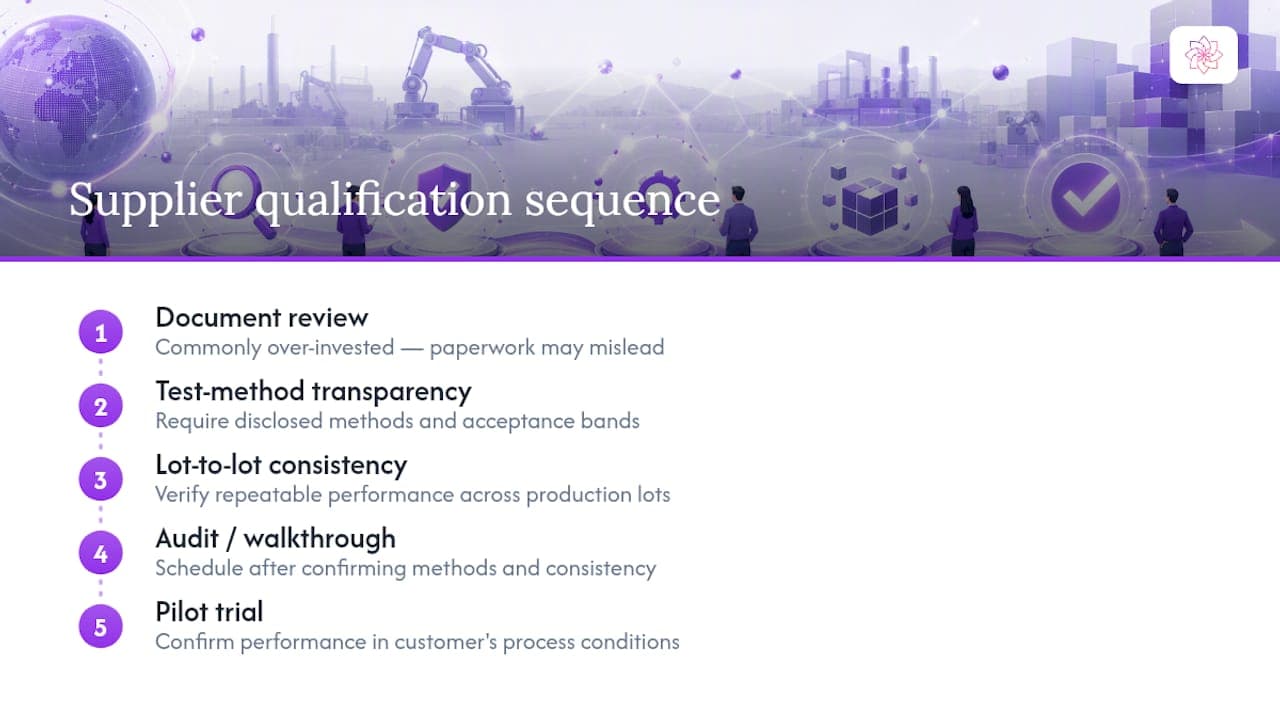
The evidence in this guide points to a specific failure pattern: most qualification programs over-invest in document collection and under-invest in verifying that the documents mean anything. A CoA with a wide specification band and no disclosed test method is not evidence. It's paperwork that looks like evidence.
Conventional supplier-audit advice treats qualification as a single pass/fail gate. That framing doesn't hold up for formulation-critical additives. A dispersant that passes desktop review can still fail in a customer's exact process temperature or mixing shear profile, which is why the pilot trial matters more than the ISO certificate for anything touching final-product performance.
The reader's real priority should be sequencing: verify test-method transparency and lot-to-lot consistency before spending audit budget on facility walkthroughs. A spotless facility with an opaque testing system is a bigger risk than a modest facility with a fully disclosed CoA methodology. Start there, and let material criticality, not supplier size or brand recognition, decide how far the qualification effort goes.
Request Samples and Start Technical Qualification With Astra Chemical
Astra Chemical shortens the qualification timeline by giving procurement teams the exact documentation this guide describes, upfront, rather than making you request it lot by lot. Every sample kit ships with historical lot CoAs, disclosed test methods, and calibration references, so your technical team can run Level 1 or Level 2 review without three separate follow-up emails.
Start by requesting a sample of the additive class relevant to your formulation. Review ASTRA DISP® dispersants for pigment wetting and grind challenges, ASTRA DF NS® non-silicone defoamers for recoat-sensitive systems, or ASTRA DF® silicone defoamers for high-foam industrial processes. The full product portfolio covers additional dispersant, defoamer, and rheology-modifier chemistries if your application falls outside those three lines. Request the supplier qualification questionnaire or schedule a technical call to walk through your specific process parameters before committing to a pilot trial.
Sources
- Chemical Supplier Audit Checklist: 50 Questions to Ask – RawSource
- Chemical Supplier Qualification Checklist (2026 Free Template) | ChemContract
FAQ
How Long Does It Take to Qualify an Additive Supplier?
Level 1 desktop qualification takes two to four weeks, Level 2 with a focused audit runs two to four months, and Level 3 comprehensive qualification takes four to six months.
What Is the Minimum Paperwork for a Trial Order?
A CoA, SDS, TDS, and disclosed test methods, plus two consistent lot CoAs or documented retained-sample history, are the minimum before a trial order proceeds.
Is an On-Site Audit Always Necessary?
No. Low-risk commodity additives generally clear with desktop review alone, while formulation-critical or single-source materials warrant a focused or comprehensive on-site audit.
How Much Does Independent Testing or Inspection Cost?
Pre-shipment inspection typically costs $0 to $800 per shipment depending on scope, a modest cost against the risk of a rejected production batch.
What Should Disqualify a Supplier Immediately?
Refusal to disclose test methods, refusal to provide historical lot CoAs, or mismatches between CoA, SDS, and shipping documentation are immediate red flags.
Recommended
- Switching Coating Additive Suppliers: A Step-by-Step Migration Guide | ASTRA CHEMICAL
- ASTRA CHEMICAL — Dispersants, Defoamers & Coating Additives Manufacturer
- Additives for Epoxy Systems: Complete Selection Guide (ASTRA) | ASTRA CHEMICAL
- Coating Additives Guide: Selection, Chemistry & Formulation (2026) | ASTRA CHEMICAL
Testing additives for this application?
Send us your current formulation challenge and our technical team will recommend an ASTRA product package for lab screening.