Stop Scale Up Failures: Five Procurement Tests for Formulation Support
Stop Scale Up Failures: Five Procurement Tests for Formulation Support ! Scale-up procurement tests title card The best formulation support pairs a technical additive partner with documented lab-to-pilot validation, not a data sheet and a sales call.

The best formulation support pairs a technical additive partner with documented lab-to-pilot validation, not a data sheet and a sales call. It means the supplier evaluates candidates against performance, compatibility, compliance, process stability, and cost-in-use before anything reaches your plant. Procurement teams should require this evidence up front. Custom formulation guidance can be structured around this framework.
TL;DR:
- Procurement should demand documented performance, compatibility, compliance, and process stability data before engaging with formulation support vendors.
- Successful lab and pilot trials require a fixed sequence: baseline data collection, formulation-specific testing, pilot-scale validation, and batch consistency verification.
- Formulation evaluation benefits from AI and model-based tools that automate data extraction and pre-filter solvents, reducing bench time and costs.
- Red flags include missing lot-specific documentation, lack of pilot data, vague impurity specs, or refusal to provide samples before purchase; these issues disqualify suppliers.
- RFQs should specify trial scope, acceptance criteria, and data ownership, ensuring technical, measurable outcomes rather than just cost or generic data sheets.
Formulation support for coatings, adhesives, inks, plastics, and composites covers a defined set of deliverables, not open-ended consulting hours. A credible provider will scope the engagement around additive selection tied to your resin and application, sample supply for bench work, structured lab testing, pilot coordination for scale verification, analytical reporting, and a compliance review against current regulatory limits.
Procurement should expect the following from any formulation assistance program before signing off on a supplier:
- Additive recommendations matched to your specific carrier system and target performance, not generic catalog picks.
- Sample quantities sufficient for real bench trials, with documented lot numbers.
- A written lab test plan with pass/fail criteria agreed before testing starts.
- Pilot-scale coordination that mirrors production mixing and cure conditions.
- Analytical reporting covering viscosity, particle size, defect counts, and stability over time.
- Clear terms on confidentiality and who owns trial data and formulation IP.
The outcomes that matter to procurement are concrete: validated scale-up with no surprises on the plant floor, fewer coating defects, consistent batch-to-batch performance, and a real cost-in-use number instead of a per-kilogram price. Lead times and sample minimum order quantities vary by additive class, so ask early. A defoamer sample for bench screening should arrive in days, not weeks.
The Five-Factor Checklist For Comparing Formulation Support Options
Scoring formulation consulting options against five factors keeps the comparison objective and stops vendors from winning on marketing language alone. This is a framework that can be used internally when validating additive candidates for coatings, adhesives, inks, and composite systems.
- Performance effectiveness. Request bench data on the specific property you need to fix (defoaming speed, dispersion stability, sag resistance) under your actual formulation, not a generic resin.
- System compatibility. Ask for compatibility data against your resin, solvent, and pigment carrier. Anchoring-group mismatch between an additive's carrier and your final system is one of the most common causes of late-stage precipitation or gelation.
- Compliance and EHS exposure. Get current SDS documents and confirmation against active VOC limits and PFAS restrictions, which are actively reshaping reformulation requirements across the industry.
- Process stability at scale. Require pilot data, not just bench data, showing the additive holds up under production mixing speeds and shear.
- Total cost-in-use. Push past unit price to loading rate, waste reduction, and rework avoided.
Pro Tip: Weight compliance and system compatibility higher for reformulation projects driven by regulatory pressure, and weight process stability higher for any additive going into a high-volume continuous line where a scale-up failure is expensive to reverse.
How Should Lab Trials And Pilot Testing Be Sequenced?
A formulation support engagement should follow a fixed sequence, and skipping steps is where most scale-up failures originate.
- Collect baseline data first. Hand your supplier the current technical data sheet, safety data sheet, historical batch records, and the exact target specification (viscosity range, gloss, defect thresholds) before any sample ships.
- Design lab trials against your real formulation. Generic resin systems in a supplier's own lab tell you little. Insist on trials run in your actual base formulation, with pass/fail metrics defined in writing beforehand.
- Run a controlled pilot before committing volume. Pilot batches should replicate your production mixing configuration and RPM ramp. Solids content, mixing strategy, and torque headroom are common drivers of scale-up variability, and progressive RPM strategies during pilot mixing reduce particle-size drift and late-stage instability.
- Verify post-pilot before full production. Confirm batch-to-batch consistency across at least two to three pilot runs, monitor impurity levels lot to lot, and get written commitments on supply continuity before the additive enters your standard formulation.
What Tools Speed Up Formulation Evaluation Today?
Formulation R&D teams increasingly bottleneck on information logistics, not chemistry itself. Gathering, reading, and normalizing technical data sheets across a dozen candidate additives eats bench time before a single trial runs. Chemistry-native AI tools now extract and normalize TDS and SDS data automatically, producing side-by-side comparisons across candidates in a fraction of the time manual review takes.

Solvent selection benefits from a similar shortcut. A model-based methodology using UNIFAC and Hansen solubility parameters can screen solvent mixtures computationally, narrowing the experimental search space before a single bench test runs. Solvents are an important part of coating formulation cost, so model-based pre-filtering can have budget implications, though experimental verification remains necessary.
Practical workflow gains worth building into your process:
- Standardized test templates across projects so results from one reformulation inform the next.
- A structured record of past candidate evaluations, so institutional knowledge survives staff turnover.
- Document extraction tools that cut data-gathering time, letting chemists spend more hours at the bench and fewer reading PDFs.
What Red Flags Should Disqualify A Formulation Supplier?
Certain gaps in a supplier's documentation should stop a bid cold, regardless of how strong the technical pitch sounds.
- No lot-specific TDS or SDS, only a generic product-family sheet.
- No pilot-scale data, only bench results from a controlled lab environment.
- Vague or missing impurity specifications on the certificate of analysis.
- No certificate of analysis offered for the actual lot being quoted.
- Refusal to provide a bench sample before requiring a purchase commitment.
Require, at minimum: a current lot-specific TDS and SDS, a certificate of analysis matching that lot, a pilot-scale sample quantity sufficient for your own trial, and a written bench test plan the supplier is willing to be held to. Batch-to-batch impurity variation, particularly in biologically derived or polymer-modified additives, can shift rheology or cure sensitivity between lots.
Pro Tip: Ask for the last three certificates of analysis on the exact additive grade you're quoting, not just one. Drift across those three tells you more about consistency than any single CoA ever will.
How Should Procurement Teams Rewrite Their RFQs?
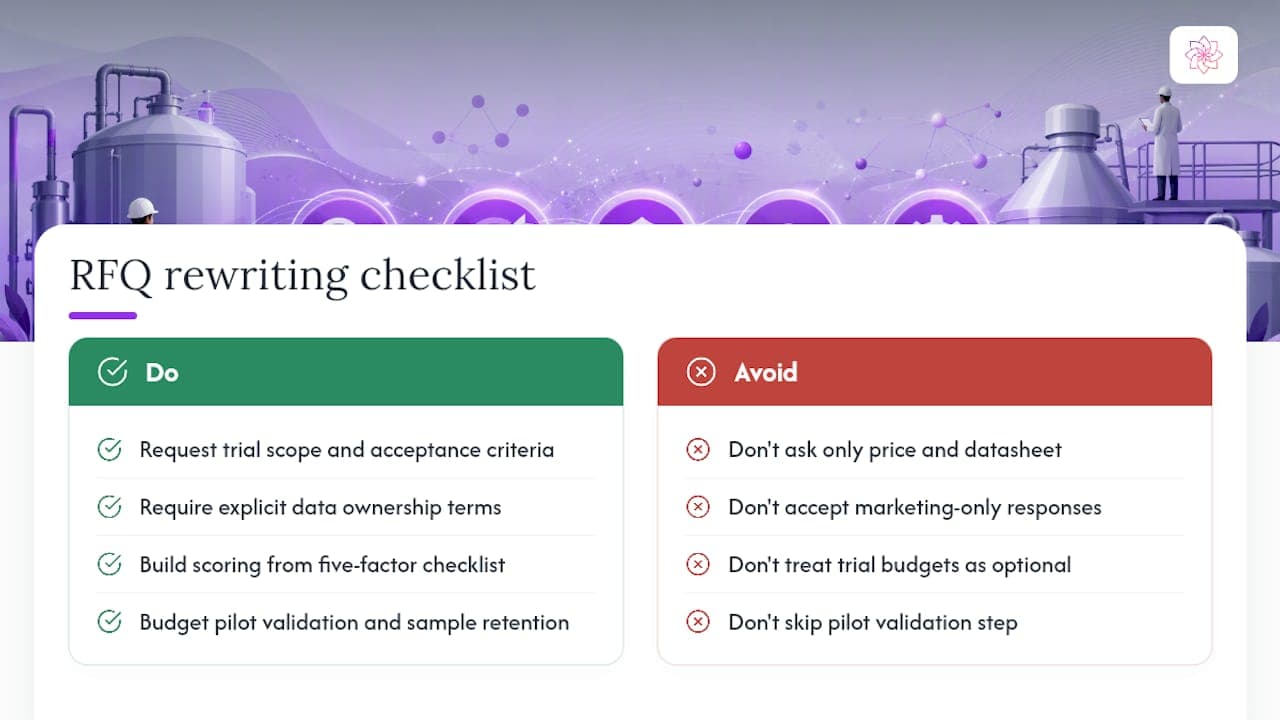
Most RFQs for formulation support ask for a price and a data sheet. That gets you a marketing response. Ask for trial scope, defined acceptance criteria, and explicit data ownership terms instead, and you get a technical response you can actually score.
Build your scoring rubric directly off the five-factor checklist, with lab and pilot pass/fail thresholds set before bids come in. A supplier who agrees in writing to specific defect-rate targets or viscosity tolerances is telling you something a glossy brochure never will. Include a clause on supply continuity commitments and confidentiality around any proprietary formulation details you share during trials.
Budget for this properly. Pilot validation and sample retention cost real money and real time. Teams that treat trial budgets as optional line items end up skipping the pilot step entirely, which is exactly where most scale-up surprises originate. A rewritten RFQ that forces documented lab work costs more upfront and saves far more downstream.
Get Direct Formulation Support From Astra-chemical
Astra-chemical is a direct manufacturer, not a reseller layering a markup between you and the chemistry. That means the same team formulating ASTRA DISP® dispersants, ASTRA DF® silicone, ASTRA DF NS® non-silicone defoamers, and ASTRA F® functional additives is the same team supporting your lab-to-pilot trials, with no reseller in between to slow down technical answers.
An R&D team can work from a five-factor framework: performance, compatibility, compliance, process stability, and cost-in-use, applied against actual formulations rather than generic systems. Sample data and trial results can remain with the client throughout the process. For deeper technical background before you engage, review the coating additives selection guide or the rheology modifiers guide, and browse the full additive catalog to see the range available for sampling. If you're currently mid-migration from another supplier, the switching suppliers checklist covers the operational handoff points worth planning for. When you're ready, request a technical audit and sample set directly through Astra-chemical to get lab-scale quantities moving toward your next trial.
Selected Sources And Technical Resources
For deeper reading on the methods referenced above: Elementics covers chemistry-native AI for coatings and adhesives R&D, DTU's research details a model-based solvent selection methodology, and Caframo Lab Solutions publishes a mixing guide for high-solids latex scale-up. Packaging buyers screening ink migration risk may also find Gather Packaging's guide to water-based inks useful for compliance context, and formulators exploring adjacent approaches can reference AAA Frictions' work on adaptive formulation.
FAQ
What Is Formulation Support In Industrial Chemistry?
Formulation support is technical guidance, additive selection, and sample-based trial work that helps manufacturers of coatings, adhesives, inks, plastics, and composites solve a specific performance or compliance problem in their formulation.
How Long Does A Typical Formulation Support Project Take?
Timelines vary by complexity, but expect an initial consultation and sample shipment within days to a couple of weeks, bench trials over several weeks, and pilot verification adding additional weeks before full scale-up sign-off.
What Does Formulation Support Typically Cost?
Costs break into consulting time, laboratory testing fees, and sample procurement, with pilot-scale trials representing the largest line item; suppliers offering free bench samples for initial screening can reduce upfront cost significantly.
Should I Require Pilot Testing Before Full-Scale Production?
Yes. Lab trials alone cannot reveal mixing, torque, or heat-distribution issues that only appear at pilot or production scale, which is why controlled pilot testing is a required step before committing full production volume.
Can Astra-chemical Provide Custom Additive Formulation Support?
Yes. Some chemical suppliers provide dispersants, defoamers, and rheology modifiers alongside technical support for additive selection, trial coordination, and scale-up verification for coatings, adhesives, inks, plastics, and composite manufacturers.
Recommended
Testing additives for this application?
Send us your current formulation challenge and our technical team will recommend an ASTRA product package for lab screening.