Avoid Six Week Recoat Failures with Astra R&D Defoamers for Formulators
Avoid Six Week Recoat Failures with Astra R&D Defoamers for Formulators ! Technician performing a coating recoat test When recoatability is the binding constraint, non-silicone defoamers or very low-dose, engineered polysiloxanes outperform conventional silicone chemistries because they minimize sur…
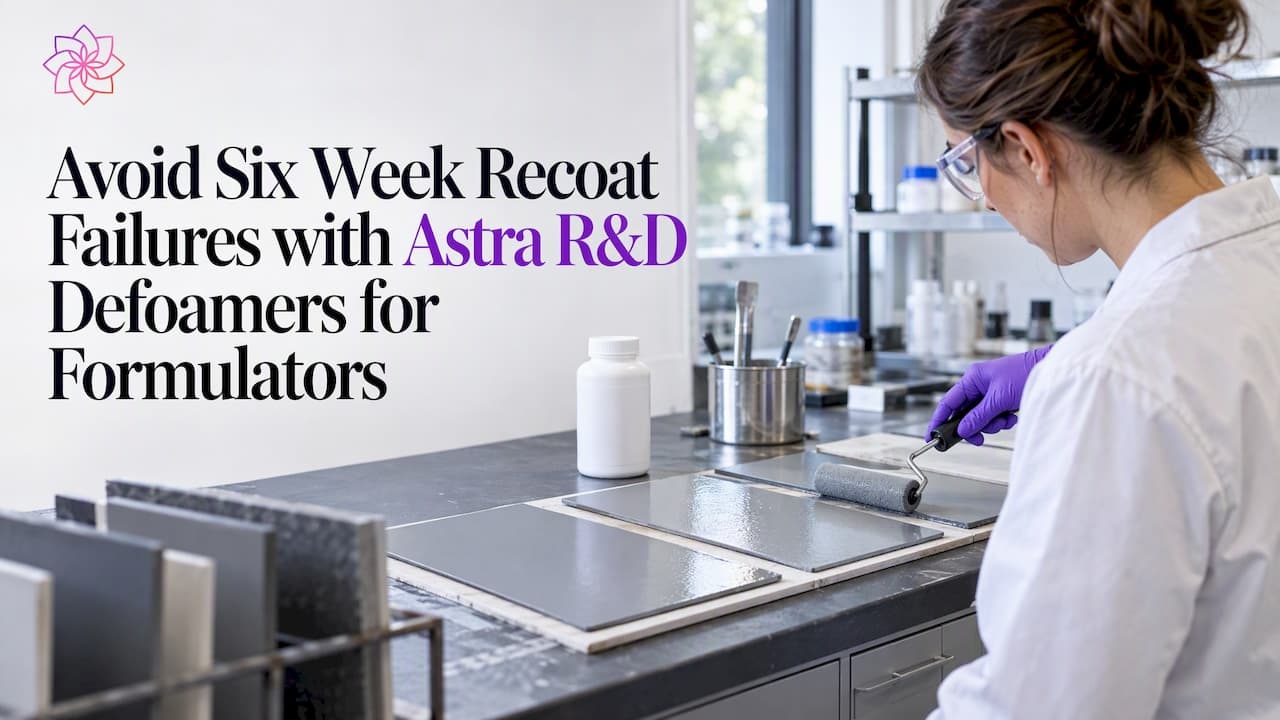
When recoatability is the binding constraint, non-silicone defoamers or very low-dose, engineered polysiloxanes outperform conventional silicone chemistries because they minimize surface migration and intercoat contamination. The second lever is process control: incorporation shear, droplet or particle loading, and the add point (millbase versus let-down) determine whether a chemically sound defoamer behaves well in production. We recommend validating both choices with ISO-style recoat testing before scale-up.
TL;DR:
- Non-silicone defoamers and low-dose engineered polysiloxanes reduce surface migration and contamination, improving recoatability especially in high-gloss applications.
- Microfoam that persists through drying can cause surface defects like craters and pinholes, while macrofoam rarely affects final film quality.
- Silicone-based defoamers offer strong deaeration but pose a higher risk of surface migration and recoat failure at excessive doses.
- Proper incorporation shear, dosing discipline, and validated testing are crucial to prevent surface defects caused by migrating defoamer components.
- Standardized ISO 16927 testing is essential for assessing actual recoatability, with pilot-scale shear validation being more predictive than simple foam-height checks.
Macro-foam, the large visible bubbles that collapse quickly, rarely causes lasting film defects. Microfoam is the real threat to recoatability: these sub-visible bubbles stabilize within the wet film long enough to survive leveling and drying, leaving behind craters, pinholes, and gloss loss that compromise the surface a second coat must bond to.
Surfactants used for pigment wetting, dispersion stability, and substrate wetting lower surface tension and, in doing so, stabilize the lamellae that trap air. This is the same chemistry that improves flow and leveling, which is why defoamer selection is always a balancing act rather than a simple maximization problem. According to SpecialChem's selection guide, targeting deaeration of microfoam, not just macro-foam knockdown, is the priority when high gloss and clean recoat are required.
- Macro-foam breaks fast and rarely survives to the dry film.
- Microfoam persists through leveling and drying, producing pinholes and craters.
- Surfactant-stabilized lamellae create the same conditions that defoamers must disrupt without damaging intercoat adhesion.
The practical consequence is that recoat testing cannot be an afterthought. A formulation that passes a simple foam-height check in the lab can still fail an overcoat adhesion test weeks later if migrating defoamer components have altered the surface chemistry of the first coat.
Defoamer chemistries and their recoatability trade-offs
Silicone defoamers, built on polysiloxane (PDMS) backbones, remain the benchmark for deaeration efficiency because of their very low surface tension and strong incompatibility with most binder systems, which is exactly what breaks foam lamellae. That same low-energy behavior is what creates recoat risk: dimethicone's well-documented surface activity means it tends to migrate toward the film surface, where excess dose can leave low-energy patches that a second coat will not wet properly.
Non-silicone chemistries, including mineral oil, polyolefin, and polyacrylate types, generally show better compatibility with the base resin and lower surface-contamination risk, which is why SpecialChem identifies them as the preferred family when recoatability, clarity, and gloss retention outrank raw defoaming power. Polymeric defoamers sit between the two extremes, often engineered for broad compatibility across both millbase and let-down stages.
- Silicone (PDMS): strongest deaeration, highest migration and recoat risk at excessive dose.
- Mineral oil and polyolefin types: lower efficacy ceiling, better film clarity and adhesion retention.
- Polymeric defoamers: engineered incorporation flexibility, often closing the performance gap with silicones.
- Hydrophobic particulates (waxes, silica) extend activity over time but require their own compatibility checks.
No defoamer is universally correct. Every selection depends on binder chemistry, surfactant load, and the production shear window the batch will actually see.
How defoamers influence recoatability and typical failure modes
Defoamer-related recoat failures follow a recognizable sequence, and matching an observed defect to its likely cause shortens troubleshooting considerably.
- Surface migration of low-energy material creates patches that a second coat cannot wet, producing edge retraction, fisheyes, or outright lifting at the interface.
- Cratering and localized gloss shifts usually point to incompatibility or overdose: the defoamer broke foam locally but left behind a surface-energy gradient the topcoat cannot level across.
- UV-cure and other high-crosslink systems are especially sensitive, because the surface chemistry present at the instant of cure is effectively locked in, leaving little opportunity for migrating additives to diffuse back into the bulk before overcoating.
Research on surface-concentrating additives confirms this mechanism: according to a CoatingsTech review, high-performance surfactants and siloxane-based additives can concentrate at the film surface after application, improving leveling in the short term while reducing intercoat adhesion later. A related feasibility study on UV coatings found that silicone additives can cause wetting problems in these fast-cure systems, and that adjusting drying or cross-linking sequence, or adding a primer, can recover overcoatability without reformulating the defoamer package. For a deeper look at how surface-active additives shape wettability, see our guide to wetting agents for coatings.
Selection and incorporation: practical criteria, dosing, and process controls
A defoamer choice that looks correct on paper can still fail if incorporation is wrong. Start with a checklist that covers the formulation's real constraints, not just its foam tendency.
- Target gloss level, binder chemistry, and surfactant profile set the ceiling for how much incompatibility the system can tolerate.
- Solids content, pigment volume concentration, and application method (spray, roll, dip) change the shear and film-build conditions the defoamer must survive.
- Intended cure schedule matters most for UV and high-bake systems, where there is little time for surface chemistry to equilibrate before recoat.
Incorporation point is just as decisive as chemistry. PCI Magazine's review of defoamer chemistry notes that shear during incorporation governs how well a defoamer compatibilizes: too much shear over-emulsifies the active phase and reduces efficacy, while too little leaves undispersed droplets that become crater sites. Millbase addition generally gives more thorough dispersion under high shear, while let-down addition preserves more of the defoamer's native droplet size for ongoing microfoam control.
Pro Tip: Run a small-scale batch that mimics production blade geometry and power input before committing to full-scale production, since pilot-scale shear rarely matches plant-scale shear.
Qualitative dosing should start low and step up only as needed, with a "sweat-in" hold and an accelerated surface-migration check (elevated temperature, short dwell, then recoat) built into every screening matrix. Our guide to foam control during mixing covers how these process variables interact with surfactant selection in more depth.
Evaluating performance: lab tests and standards (including ISO 16927)
Practical screening starts with simple, fast observations: foam height after a defined mix cycle, visual deaeration rate, and early-film inspection under raking light for craters, pinholes, or fisheyes. These catch gross problems before a formulation ever reaches a recoat test.
ISO 16927:2014 is the standardized reference for this evaluation. ISO 16927 specifies a defined method for determining the overcoatability and recoatability of paints and varnishes, covering application procedure, observation during the recoat window, and post-dry evaluation of adhesion and surface defects. Building a claim around recoatability without this kind of standardized check leaves the claim unsupported.
- Record the shear profile and dispersion method used to build each test batch.
- Apply by the same method the end product will use in service, not a simplified lab proxy.
- Vary time-to-recoat systematically and note the point at which adhesion or surface defects begin to appear.
A test matrix that captures these four variables, chemistry, shear, application method, and time-to-recoat, turns a single pass or fail result into decision-ready data.
Troubleshooting: fixes when defoamers create surface or recoat issues
When a formulation already shows recoat problems in production, work through corrective options in order of least disruption before reformulating from scratch.
- Reduce defoamer dose first, since overdose is the most common root cause of surface migration defects.
- Shift the incorporation point from millbase to let-down, or vice versa, to change droplet size and dispersion.
- Switch chemistry family, moving from silicone to a non-silicone or polymeric type, when migration persists at low dose.
- Add a compatibilizer, adjust dwell time before recoat, or extend cure to let surface chemistry equilibrate.
When these steps do not resolve the issue, the next move is a custom-engineered defoamer matched to the specific binder and surfactant system, which our custom defoamer formulation screening checklist walks through in detail.
Astra R&D: practical workflow and proof points
Our R&D team works with formulators through a structured lab-to-production workflow: initial lab screening against the target binder, shear scale-up trials matched to actual plant equipment, ISO-style recoat checks, and final production validation before full-batch commitment. This sequence catches the dose and incorporation problems described above before they reach production.
What the research actually tells formulators to prioritize
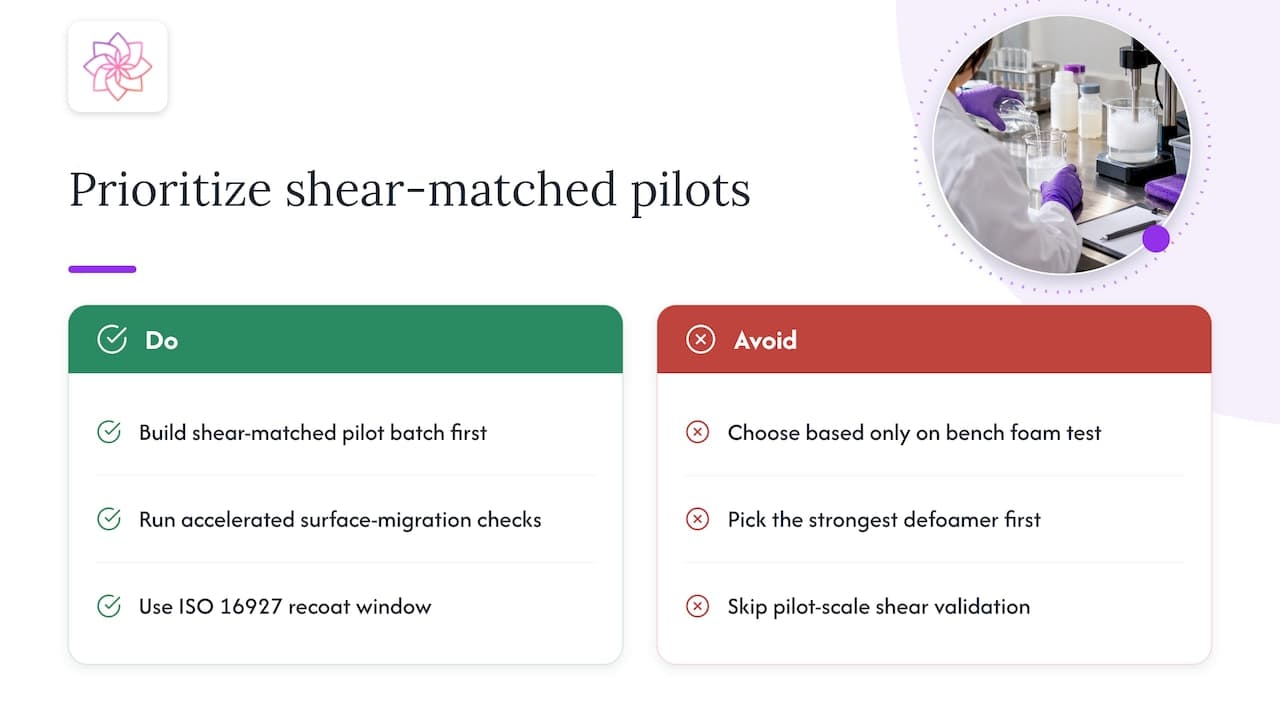
The conventional advice to "pick the strongest defoamer" gets the priority backward for recoat-sensitive work. Raw defoaming power is the easy variable to optimize and the one most likely to create a surface migration problem six weeks after the fact. What the evidence actually supports is that incorporation shear and dose discipline matter as much as chemistry family, and formulators who skip pilot-scale shear validation are the ones who see a defoamer "suddenly" cause craters at full production scale when nothing in the formula changed.
The most overrated step in most screening programs is the quick foam-height test run once at bench scale and never repeated under production shear. The most underrated step is the accelerated surface-migration check paired with an ISO 16927 style recoat window. If we had to name one priority for a formulator with limited lab time, it would be this: build the shear-matched pilot batch before the chemistry debate, not after it.
— Astra R&D Team
Product options built around recoat-safe performance
We manufacture both chemistry families this guide discusses. ASTRA DF NS® delivers non-silicone deaeration for formulations where surface migration risk must stay near zero, while ASTRA DF® offers engineered low-dose silicone performance for systems that need stronger knockdown without sacrificing recoat windows. Paired with ASTRA DISP® dispersants, these lines are qualified together in our lab before they reach your batch.

We support sample screening and shear-matched technical trials so you can validate a candidate defoamer against your own binder and application method before committing to production volume. Browse our full product range or request a sample to start a trial against your current formulation.
FAQ
What is the purpose of a defoamer?
A defoamer breaks down macro-foam and eliminates stabilized microfoam generated during mixing, application, and film formation. Its goal is to prevent entrained air from becoming trapped in the wet film, which otherwise causes pinholes, craters, and gloss defects that also compromise recoatability.
What can be used as a defoaming agent?
Common defoaming chemistries include silicone (polysiloxane) compounds, mineral oil blends, polyolefin and polyacrylate types, and polymeric defoamers, often combined with hydrophobic particulates such as waxes or silica. The right choice depends on binder compatibility, required clarity, and the production shear the formulation will see.
What is another name for a defoamer?
Defoamers are also commonly called antifoaming agents, and the terms are used interchangeably in coatings literature and technical data sheets. Both refer to additives that control macro-foam and microfoam during formulation and application.
What's in a defoamer?
A typical defoamer contains an active defoaming component, such as a polysiloxane, mineral oil, or polymeric resin, dispersed in a carrier along with hydrophobic particles that help nucleate and rupture foam lamellae. The exact composition varies by chemistry family and is chosen to match the binder system and incompatibility window required for effective deaeration.
What test standard measures recoatability?
ISO 16927:2014 specifies the standardized method for determining the overcoatability and recoatability of paints and varnishes, covering application, observation during recoating, and post-dry adhesion and defect evaluation. Formulators use it to generate comparable, defensible recoat data rather than relying on informal bench checks alone.
Sources
- Defoamers/Anti-foaming Agents: How to Select the Right Grade? — SpecialChem
- ISO 16927:2014 - Paints and varnishes — Determination of the overcoatability and recoatability of a coating
- Understanding defoamer chemistry — PCI Magazine
- Paint
Recommended
Testing additives for this application?
Send us your current formulation challenge and our technical team will recommend an ASTRA product package for lab screening.