Formulators: Tune Thixotropy to Reach 90% Recovery in Under 1 Minute
Formulators: Tune Thixotropy to Reach 90% Recovery in Under 1 Minute ! Scientist monitoring thixotropy recovery test Thixotropy control means managing two linked phenomena: structural breakdown under shear and recovery once shear stops, and we tune both through formulation chemistry and process para…
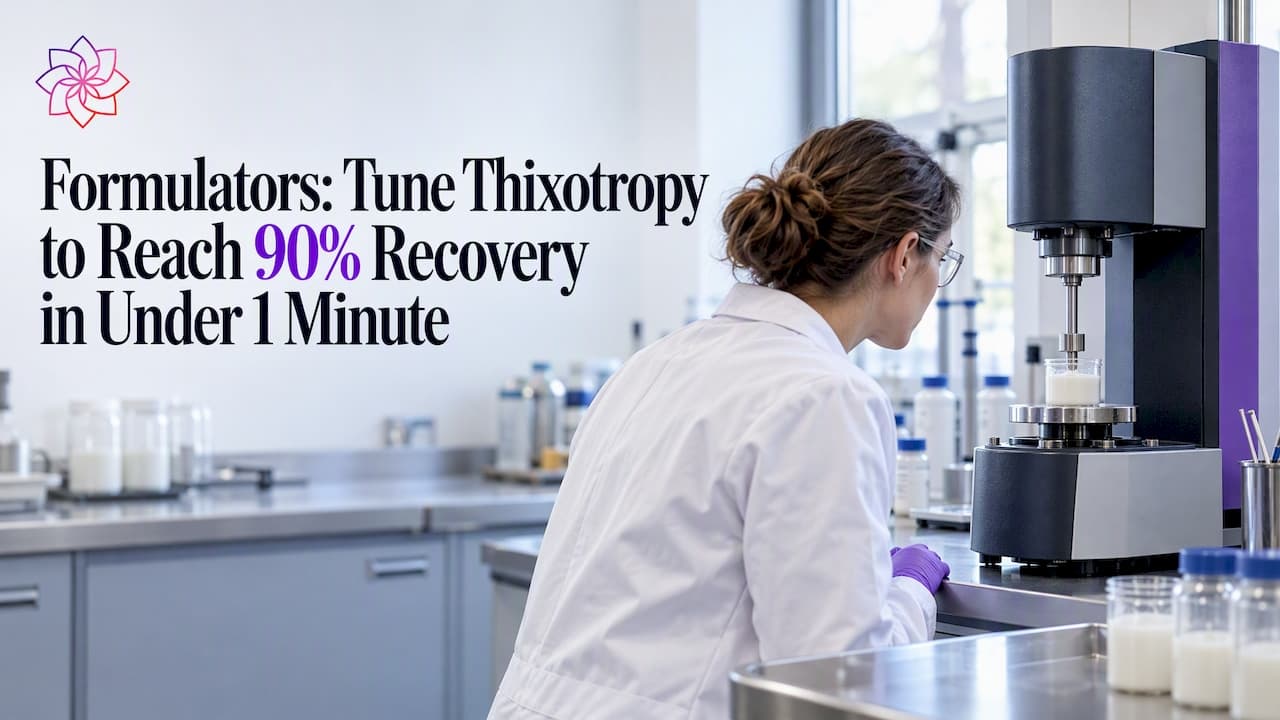
Thixotropy control means managing two linked phenomena: structural breakdown under shear and recovery once shear stops, and we tune both through formulation chemistry and process parameters rather than one alone. The primary levers are rheology modifiers, dispersants, and polycarboxylate ether dosing, paired with measurement targets such as recovery ratio and recovery time from a 3-interval thixotropy test. When done correctly, this delivers anti-sag performance, reliable pumpability, and controlled leveling in the same formulation.
TL;DR:
- The effectiveness of thixotropy control relies on measuring recovery ratio and time using a standardized 3-interval thixotropy test, not just hysteresis loops.
- Rheology modifiers, dispersants, and superplasticizers must be carefully tuned together, considering temperature and application shear rates, to achieve targeted recovery profiles.
- Fast recovery prevents sag but can cause poor leveling and nozzle clogging, while slower recovery improves leveling but risks sagging or particle settling.
- External triggers like magnetic fields are under research but are not yet practical for industrial use, making formulation chemistry the primary control method.
- Validating thixotropic behavior requires replicate testing under process-matched shear conditions, with specific targets for recovery ratio and time for each application type.
Thixotropy differs from ordinary pseudoplasticity in one critical respect: a pseudoplastic fluid thins under shear and thickens back up almost instantly when shear stops, while a thixotropic fluid takes measurable time to rebuild its internal network. That time dependence is the entire basis for control. We are not managing a viscosity curve, we are managing a kinetic process with a rate constant for breakdown and a separate rate constant for recovery.
At the microstructural level, most thixotropic suspensions rely on weak, reversible particle to particle contacts: flocculated networks held together by van der Waals attraction, bridging polymers, or associative thickener chains that link across particle surfaces. Shear disrupts these contacts and disperses the particles; once shear stops, Brownian motion and residual attractive forces let the network reform. This reformation is what Anton Paar's technical guidance describes as time-dependent recovery toward the initial structure, and it is the behavior we must characterize before any thixotropy claim is meaningful.
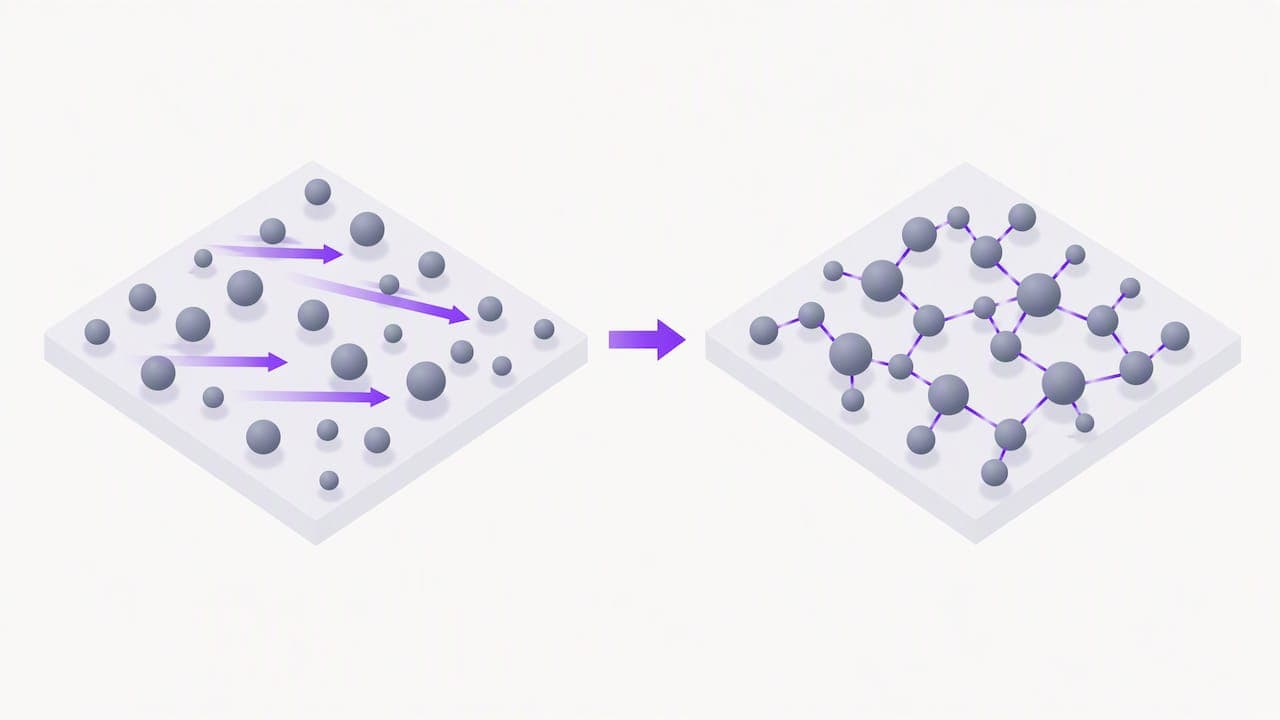
Cementitious systems complicate this picture because two processes run in parallel: reversible flocculation and irreversible chemical hydration. A cement paste can regain apparent structure through flocculation within minutes while simultaneously undergoing hydration that produces permanent, non-reversible stiffening over a longer window. Separating these mechanisms matters for anyone validating a formulation, since a recovery curve that looks favorable at five minutes can mask chemical set creeping in underneath it, as research on reversible flocculation versus irreversible hydration points out.
Across industries, the same mechanism shows up with different performance consequences:
- In coatings, flocculated pigment networks control sag resistance on vertical surfaces and leveling of brush or spray marks.
- In adhesives, structural recovery after application keeps the bead in place before cure without migrating under its own weight.
- In cementitious materials, structural build-up governs formwork pressure, pumpability, and how quickly a layer can support the next one in 3D printing.
- In personal care formulations, recovery speed determines whether a lotion or gel holds its shape in the container yet spreads easily on skin.
How to measure thixotropy and what each test result means
Measurement is where thixotropy control succeeds or fails, because a formulation lever only works if we can verify its effect with a reproducible number. The most useful protocol for formulators is the 3-interval thixotropy test, often shortened to 3iTT, which applies three sequential shear steps: a low-shear baseline, a high-shear interval that mimics application shear, and a return to low shear to track recovery.
Recommended 3iTT protocol:
- Apply a low, constant shear rate (typically 0.1 to 1 per second) for several minutes to establish a stable baseline viscosity.
- Switch to a high shear rate that matches the application (spraying, brushing, pumping, or extrusion) for a short interval to break down structure.
- Return to the original low shear rate and record viscosity recovery over time, reporting the recovery ratio at fixed intervals (commonly 30 seconds and 60 seconds) and the time required to reach a target recovery percentage, such as 90%.
The hysteresis loop area from a simple up-down flow curve is still common in quality control, but it alone can mislead formulators because it conflates breakdown rate with recovery rate and gives no information about how long structure takes to rebuild at rest. The DIN SPEC 91143-2 interlaboratory program, run between 2005 and 2010, compared flow-curve hysteresis against shear-step tests with recovery and found the step-test approach far more reproducible for quantifying time-dependent structure, which is why the committee now recommends exact test specifications rather than relying on hysteresis area alone.
Small-amplitude oscillatory shear, or SAOS, adds a complementary view by tracking the storage modulus as structure rebuilds after shear cessation. Storage modulus growth reflects the strength of reforming bridges in the network, while static yield stress measured separately indicates when particle contacts have percolated into a continuous load-bearing network. A state-of-the-art review of cement thixotropy recommends combining both metrics, since storage modulus alone can plateau before the percolated network that governs actual yield behavior has fully formed.
For production floors without access to rotational rheometers running full 3iTT protocols, a simplified thixotropic coefficient, often labeled Tb, derived from a single step-down test gives a fast pass or fail check against a reference batch. It will not replace full characterization during formulation development, but it catches batch-to-batch drift quickly on the line.
Shear rate and interval duration selection should always mirror the real process: spray application calls for high shear rates over sub-second durations, brush application calls for moderate shear over a few seconds, and extrusion or 3D printing calls for sustained high shear followed by a recovery window matched to layer deposition time.
Formulation levers: rheology modifiers, dispersants, and PCE dosing
Once measurement targets are set, formulation chemistry is the primary tool for hitting them. Three families of additives do most of the work: rheology modifiers that build the reversible network, dispersants that control how particles pack and interact within that network, and, in cementitious systems, polycarboxylate ether superplasticizers whose molecular architecture directly shapes thixotropic build-up.
Rheology modifiers split broadly into network-forming types, such as fumed silica, clays, and certain cellulosic thickeners, and associative types, such as hydrophobically modified polymers that bridge particle surfaces reversibly. Network-forming modifiers tend to deliver fast, strong recovery and are the default choice when anti-sag performance is the priority. Associative thickeners give more tunable, often slower recovery profiles that favor leveling in coatings where brush marks need time to flow out before the structure locks in.
Dispersants influence thixotropy indirectly but significantly, by controlling pigment or filler packing density. A well-dispersed system has more particle-to-particle contact points available for the thixotropic network to use, which can either amplify or suppress structural build-up depending on dosage. Under-dispersion leaves agglomerates that behave unpredictably under shear; over-dispersion can strip out the very flocculation a formulation relies on for sag resistance, so dispersant dosage has to be tuned jointly with the rheology modifier rather than optimized in isolation.
In cementitious formulations, PCE superplasticizer molecular structure and addition mode are decisive. Research on tailored superplasticizer polymers shows that highly charged PCEs with short side chains tend to increase thixotropic structural build-up while simultaneously lowering plastic viscosity, an effect that holds across paste, mortar, and full concrete scale. Addition mode matters just as much as molecular design: delayed addition of PCE, rather than direct mixing at batching, changes adsorption kinetics on cement particles and alters the resulting thixotropic profile measurably.
Practical dosage and process guidance that holds across most of these systems:
- Establish the dosage window for the primary rheology modifier first, then adjust dispersant dosage to hit the target recovery ratio without collapsing yield stress.
- Treat solid loading as a lever in its own right: higher filler or pigment volume concentration amplifies thixotropic response even with additive dosage held constant.
- Test addition order early. Pre-dispersing filler before adding the rheology modifier often gives a different recovery curve than reversing the sequence, even at identical final dosages.
- Match mixing intensity and shear history in the lab to the real process. A formulation characterized only under gentle lab mixing can show a different thixotropic profile once it passes through a high-shear production mill.
- Control temperature during both formulation and testing, since most rheology modifiers and PCE adsorption kinetics are temperature-sensitive enough to shift recovery times by a measurable margin.
Pro Tip: Run your 3iTT recovery test at the actual process temperature, not room temperature. A formulation that passes at 23°C can fail an anti-sag spec on a hot production floor.
For a deeper breakdown of rheology modifier chemistry and selection criteria, our guide to rheology modifiers for coatings covers the decision tree in more detail, and the distinction between simple shear-thinning and genuine thixotropic recovery is laid out further in our explainer on pseudoplastic versus thixotropic behavior.
Weighing anti-sag against leveling and pumpability
Every thixotropy control decision is a tradeoff, because the recovery profile that prevents sag on a vertical wall is rarely the one that gives the smoothest leveling on a horizontal surface. Fast, strong recovery immobilizes pigment and prevents dripping, but it can also freeze brush marks and spray texture in place before they have time to flow out. Slow recovery favors leveling and smooth film formation but risks sag on vertical applications and can leave suspended particles settling before the network rebuilds.
Pumpability and atomization add a second axis to this tradeoff. A fluid that recovers too quickly after the high-shear pulse inside a pump or spray nozzle can build back-pressure or clog fine nozzles, while extrusion-based processes such as 3D concrete printing need the opposite: rapid enough recovery after deposition that each layer supports the next without slumping, a balance the cement thixotropy review frames as choosing a process window rather than a single universal target.
Rules of thumb that hold across most applications:
- Choose rapid, strong recovery when the risk is sag, drip, or particle settling after deposition.
- Choose slower, more gradual recovery when the risk is poor leveling, visible application marks, or nozzle clogging during spray or extrusion.
- Choose an intermediate profile, and validate it explicitly, when the same product must be pumped, sprayed, and then resist sag once applied, since no single lever setting optimizes all three simultaneously.
| Application goal | Target recovery ratio | Target recovery time |
|---|---|---|
| Anti-sag (vertical coatings) | High recovery ratio within 30 seconds | Fast, typically under 1 minute to reach working viscosity |
| Leveling (brush/spray finish) | Lower recovery ratio at 30 seconds | Slower, allowing several minutes for marks to flow out |
| Extrusion/buildability (3D printing) | High recovery ratio immediately post-deposition | Near-immediate, to support subsequent layers |
Active control research: magneto-responsive materials and external triggers
Beyond formulation chemistry, a smaller but active body of research explores triggering thixotropic behavior externally rather than relying solely on shear history. The most developed example uses magneto-responsive particles embedded in a cementitious paste, where an applied magnetic field changes the storage modulus on demand. According to research on magneto-responsive cementitious materials, a constant 0.5 tesla field applied for 90 minutes produced roughly a 1.5-fold increase in storage modulus, effectively stiffening the paste without any additional shear or chemical trigger, while pulsed fields produced the opposite effect, inducing temporary breakdown through micro-agitation of the magnetizable particles.
These findings point to real engineering potential, particularly for applications where shear alone cannot be timed precisely enough, such as controlling buildability layer by layer in automated printing. Several constraints still limit industrial adoption:
- Magnetizable particle loading has to be compatible with final product performance, which restricts the approach to formulations that can tolerate the added filler.
- Field strength and exposure time in published work are still closer to laboratory conditions than continuous production line conditions.
- Equipment for generating and maintaining time-varying magnetic fields at production scale adds cost and complexity that most formulations do not yet justify relative to conventional chemical levers.
For most manufacturers today, active control remains a research-stage option worth monitoring rather than a near-term replacement for rheology modifiers and dispersant-based control.
Lab workflow checklist for validating thixotropy control
A consistent lab workflow is what turns a thixotropy target from a number on paper into a result the production floor can rely on.
- Prepare samples under controlled conditions: consistent mixing shear, controlled temperature, and a degassing step to remove entrained air that can distort rotational rheometer readings.
- Select measurement geometry appropriate to the suspension, favoring vane or parallel-plate geometries for coarser particle systems where cone-and-plate geometries would be disrupted by particle size.
- Run the 3iTT protocol with shear rates and interval durations matched to the real application process, not generic default settings.
- Replicate each measurement at least in triplicate to separate genuine formulation differences from measurement noise.
- Plot recovery curves and compare recovery ratio and recovery time against the acceptance criteria set during the application tradeoff analysis, treating any batch outside the target window as a fail pending reformulation or process adjustment.
Astra R&D Team: lab practice behind these recommendations
We develop and qualify dispersant, defoamer, and rheology modifier chemistries through laboratory-scale rheological testing before formulation guidance reaches production lines. That qualification work draws directly on step-shear and SAOS methods, the same measurement approaches detailed above, and it is documented alongside our rheology modifier selection guide and coating additives guide for formulators who want further technical detail.
A formulator's take on getting thixotropy control right
The starter experiment we recommend to any team is simple: run a 3iTT on the base formulation, then apply the same product by hand or spray, and compare the measured recovery curve against observed sag or leveling behavior directly. Numbers that do not correlate with what you see on the substrate mean your shear rates or intervals do not match the real process.
The most common mistake is optimizing hysteresis area instead of recovery ratio, followed closely by testing at room temperature when production runs hotter, and skipping replication because a single run "looked fine." When handing targets to process engineers, give them a recovery ratio and a time window, not a viscosity number alone.
— Astra R&D Team
Astra Chemical additives built for precise thixotropy control
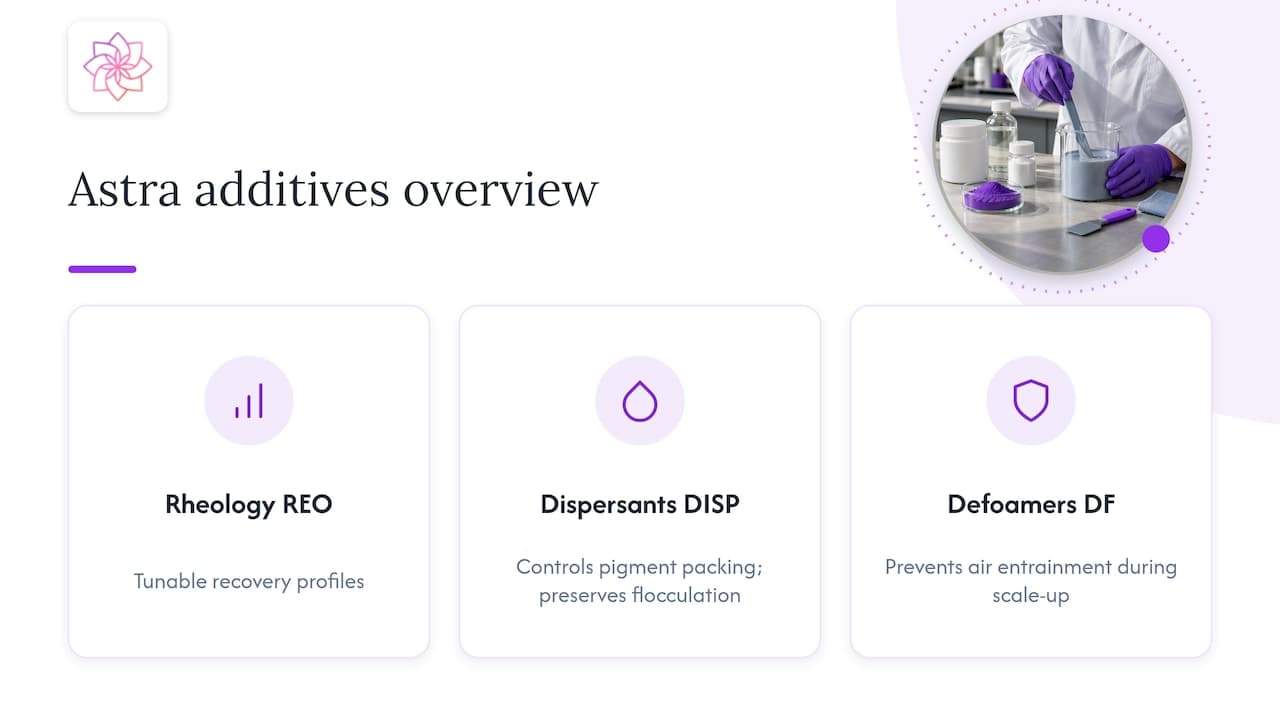
We manufacture the additive classes that map directly onto the formulation levers covered above, so moving from lab target to production batch does not mean starting over with a new supplier relationship. Our ASTRA REO® rheology modifiers are built for tunable recovery profiles, our ASTRA DISP® dispersants give formulators control over pigment packing without stripping out needed flocculation, and our silicone and non-silicone defoamer lines, ASTRA DF® and ASTRA DF NS®, keep air entrainment from distorting recovery measurements during scale-up.

Beyond the products, support typically includes technical consultation to match dosage and addition order to specific recovery targets, sample requests for 3iTT validation before production, and dosage and optimization guidance often based on laboratory qualification data.
Browse our full catalog of dispersants, rheology modifiers, and defoamers, or reach out through Astra-chemical to start a technical consultation on your specific formulation.
FAQ
What does thixotropy mean?
Thixotropy describes a fluid's time-dependent structural breakdown under shear followed by a gradual, time-dependent recovery of that structure once shear stops. Ordinary shear-thinning fluids thin and re-thicken almost instantly, while truly thixotropic fluids take measurable time, often seconds to minutes, to rebuild.
What are thixotropic behaviors?
Thixotropic behavior shows up as a fluid becoming less viscous under applied shear, such as stirring, pumping, or spraying, and then slowly regaining viscosity at rest. The key diagnostic is that recovery happens over a measurable timescale rather than instantly, which is why formulators track recovery ratio and recovery time rather than viscosity alone.
Why is ketchup thixotropic?
Ketchup holds its shape in the bottle at rest because its particle network resists flow under low stress, then thins readily once you shake or squeeze the bottle and apply enough shear to break that network down. Once shear stops, the structure slowly rebuilds, which is the same mechanism documented across common thixotropic products like paints, gels, and lotions.
What is thixotropic used for?
Thixotropic behavior is used wherever a product needs to flow easily during application but resist sagging, dripping, or settling afterward, including coatings, adhesives, printing inks, and personal care gels. Formulators engineer this with rheology modifiers and dispersants, then confirm it with step-shear recovery testing rather than assuming it from viscosity alone.
How do I measure thixotropy accurately?
The most reliable method is a 3-interval thixotropy test that applies a low-shear baseline, a high-shear breakdown step, and a low-shear recovery step, reporting the recovery ratio and recovery time rather than relying on hysteresis loop area alone. DIN SPEC 91143-2 interlaboratory testing found this step-recovery approach more reproducible than flow-curve hysteresis for quantifying time-dependent structure.
Sources
- Basics of thixotropy | Anton Paar Wiki
- Modern rheological test methods - Part 2: Thixotropy - Determination of the time-dependent structural change (DIN)
- Active control of thixotropy of magneto-responsive cementitious materials with the intervention of time-varying magnetic fields
- Rheology of Low Clinker Concretes with Tailored Superplasticiser Polymers: Control and Modelling of Viscosity and Thixotropic Structural Build-up
- Thixotropic structural build-up of cement-based materials: A state-of-the-art review
Recommended
Testing additives for this application?
Send us your current formulation challenge and our technical team will recommend an ASTRA product package for lab screening.