Measure Thixotropy in Adhesives With Step Shear and 3iTT to Stop Sag
Measure Thixotropy in Adhesives With Step Shear and 3iTT to Stop Sag ! Illustrated thixotropy measurement title card Thixotropy in adhesives is a time-dependent, reversible drop in viscosity under shear that recovers gradually once shear stops, not instantly like simple shear-thinning.
Thixotropy in adhesives is a time-dependent, reversible drop in viscosity under shear that recovers gradually once shear stops, not instantly like simple shear-thinning. That recovery lag is the entire point: it lets an adhesive flow easily through a nozzle or pump, then rebuild enough structure at rest to hold its bead shape and resist sag before cure locks it in place. Everything downstream, from additive selection to rheometer setup, exists to control how fast and how completely that structure rebuilds.
TL;DR:
- Thixotropic recovery times are critical, with some adhesives rebuilding structure in seconds for high-speed applications, while others may take minutes.
- Step-shear and 3iTT tests provide a more accurate assessment of recovery kinetics than single viscosity ratios, guiding better additive selection.
- Excessive fumed silica loading can cause pumpability issues and clogging, requiring incremental testing aligned with specific dispensing conditions.
- Temperature fluctuations significantly affect recovery, with higher temperatures often speeding and colder temperatures slowing the process, impacting field performance.
- Proper documentation from additive suppliers should include recovery curves, not just static indices, to ensure performance matches application-specific shear and timing needs.
Thixotropy describes a fluid whose internal structure breaks down under applied shear and rebuilds over a measurable, finite time once shear is removed. That word "finite" separates it from instantaneous shear-thinning, where viscosity drops and recovers on a timescale too fast to observe or exploit. The TA Instruments application note on thixotropy analysis frames this recovery lag as the mechanism that lets a fluid stay pumpable under shear and then resist flow once it settles.
Industry commentary on adhesive rheology puts it plainly: every thixotropic material is shear-thinning, but not every shear-thinning material is thixotropic. The AZoM analysis from ITW Performance Polymers identifies time-dependent recovery as the deciding factor, not the viscosity drop itself.
Thixotropy also differs from viscoelasticity, which describes how a material stores and dissipates energy elastically versus viscously under oscillation. A structured adhesive can show both behaviors simultaneously, and formulators who treat them as interchangeable end up chasing the wrong variable. Recovery itself is rarely a single clean curve. Structural rebuilding often occurs across multiple overlapping timescales, which is why no single universal model predicts thixotropic recovery across chemistries. Comparing two adhesive systems on a single index number, without knowing the underlying timescale spectrum, invites false equivalence.
Why Thixotropy Matters for Adhesive Performance and Application
Thixotropy is what lets an adhesive extrude cleanly under pump or gun pressure and then stop moving once it lands on the substrate. Without that shear-thinning drop, high-viscosity adhesives would demand excessive dispensing pressure. Without the recovery step, the bead would slump before cure, ruining gap-filling performance on vertical or overhead joints.
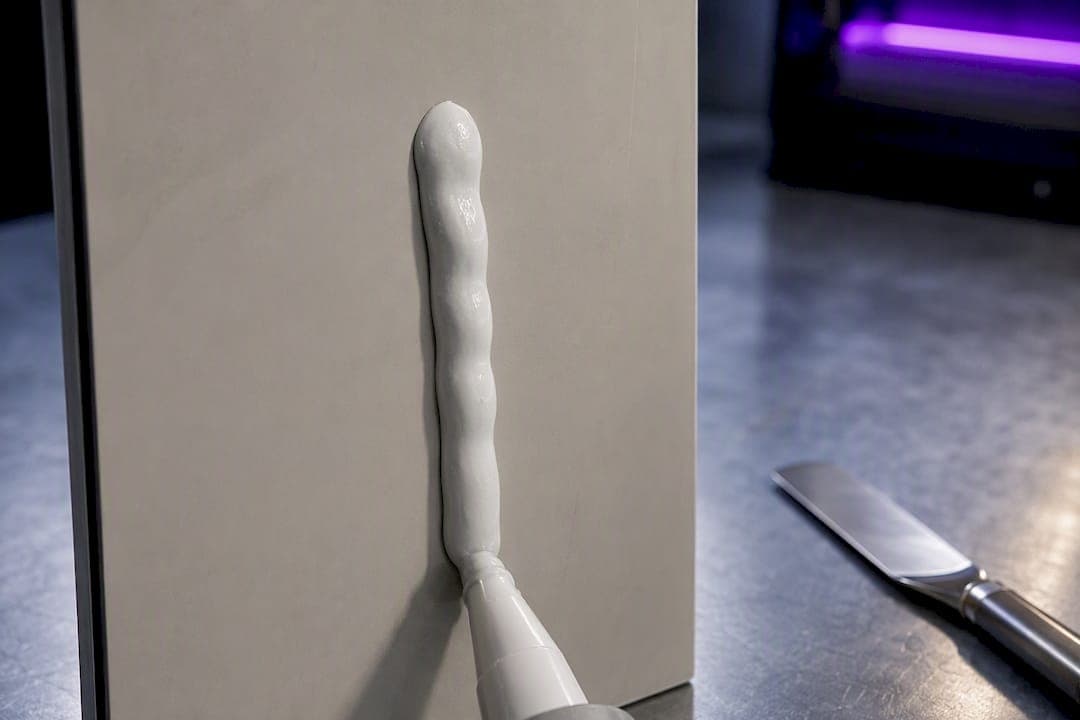
Recovery speed also governs wetting. An adhesive that rebuilds structure too fast can skate across a substrate instead of wetting it, weakening the bond line before cure even starts. One that rebuilds too slowly may migrate out of the joint, thinning the bond line and reducing gap-fill strength exactly where load-bearing performance matters most.
Recovery-time targets are not universal. A manual dispensing gun tolerates a slower rebuild because the operator controls placement and dwell time. Automated robotic dispensing, running at higher line speeds with tighter bead tolerances, needs a rebuild fast enough to hold shape within seconds, not minutes. Specifying "thixotropic" without a target recovery window is an incomplete specification.
How Do You Measure Thixotropy in Adhesives?
Two numbers dominate casual thixotropy conversations: the thixotropic index (TI), a ratio of viscosities at two shear rates, and hysteresis area, the loop formed between up and down shear ramps. Both are useful for quick screening, but the Anton Paar basics guide is direct about their limits: TI and hysteresis area compress a time-dependent phenomenon into a single static number, and modern frameworks referenced in DIN spec 91143-2 and ISO/WD 3219-1 treat them as screening tools rather than authentic characterization.
Pro Tip: Never accept a supplier's single TI value as proof of field performance. Ask for the step-shear recovery curve behind it, since two adhesives with identical TI numbers can recover at completely different rates.
More rigorous methods include:
- Step-shear tests, which jump the shear rate from high to low and track viscosity recovery over time rather than a single before/after ratio.
- The 3-interval thixotropy test (3iTT), which runs a low-shear baseline, a high-shear breakdown interval, and a low-shear recovery interval in sequence, revealing both breakdown magnitude and recovery kinetics.
- Oscillatory recovery tests, which track storage modulus rebuilding after shear cessation, distinguishing viscoelastic recovery from the shear-thinning-only response and capturing the structural changes formulators need to track through cure.
Instrument choice matters. Cone/plate geometries give precise shear-rate control for lower-viscosity systems, plate/plate suits general screening, and vane spindles handle highly filled, structured pastes that channel or slip in smooth geometries, a distinction the Adhesives Magazine QC piece covers in detail for production settings. Full characterization is not always necessary. A quick two-point high/low shear QC check catches batch-to-batch drift fast; reserve step-shear and 3iTT runs for new formulations or troubleshooting.
What Additives Create Thixotropy in Adhesive Formulations?
Formulators reach for a handful of additive classes to impart or tune thixotropic properties, each with distinct tradeoffs in processing and cured performance.
- Fumed silica builds a hydrogen-bonded network that gives strong low-shear viscosity and sag resistance, but high loadings sharply increase pumping resistance and raise nozzle-clogging risk.
- Associative thickeners rebuild structure through reversible polymer-particle interactions, generally giving faster recovery with milder viscosity buildup than fumed silica.
- Polymeric thickeners offer tunable rheology profiles but can shift cured-film flexibility or crosslink density depending on chemistry compatibility.
- Particulate structuring agents, including certain clays and specialty fillers, add thixotropic behavior through particle-particle networking rather than polymer entanglement.
Loading level drives the tradeoff more than additive family does. Pushing fumed silica loading up for stronger sag resistance can make the paste nearly unpumpable at production line pressures, a caution worth testing incrementally rather than assuming from a datasheet curve. The right test sequence adds the candidate additive in small increments, measuring bead geometry, visual sag on a vertical panel, and pump pressure at each step, then setting acceptance criteria before scaling per the match adhesion test to contract, substrate, and glue prep guidelines. Astra-chemical's guide to rheology modifier selection walks through this incremental testing logic for coatings, and the same discipline transfers directly to adhesive systems.
Design Rules and Troubleshooting for Thixotropic Behavior
Three failure modes account for most thixotropy-related complaints in adhesive production, and each has a specific diagnostic path.
- Define acceptable sag and bead geometry first. Set a maximum sag distance and minimum bead height before selecting or adjusting any additive; without a target, there is nothing to test against.
- Measure your actual dispensing shear rate. Manual guns, pneumatic pumps, and robotic dispensers operate in different shear ranges, and an additive tuned for one can underperform in another.
- Set a target recovery time in seconds, not qualitatively. "Recovers quickly" is not a specification; "80 percent structure recovery within 10 seconds" is.
Slow recovery shows up as bead slump on vertical joints; the fix usually starts with increasing structuring agent loading or switching to a faster-rebuilding associative thickener. Recovery that is too fast produces poor wetting and visible surface skinning before the bead settles into the joint. Excessive stringing during dispensing usually points to an elastic component fighting the shear-thinning response, which oscillatory testing will reveal faster than trial and error. The most efficient diagnostic sequence runs a two-point QC check first, escalates to step-shear testing if the QC flag looks abnormal, and finishes with a visual sag test on the actual substrate before releasing a batch.
Astra R&D Practitioner Notes: Working With Additive Suppliers
Requesting the right documentation from a rheology modifier supplier saves weeks of troubleshooting later. Astra R&D's technical support process asks for step-shear recovery curves, not just a single TI value, along with recovery percentage at defined time intervals and dispersion stability data under the actual mixing conditions the formulation will see in production.
Compatibility checks matter as much as the raw thixotropy data. A rheology modifier that builds excellent structure in isolation can flocculate or lose efficiency once combined with a specific resin, filler, or plasticizer package. Astra-chemical's technical team evaluates candidate rheology modifiers against the target adhesive's full formulation, not against a generic test fluid, because additive performance in isolation rarely predicts performance in the finished system.
How Do Temperature and Environmental Conditions Affect Thixotropy?
Thixotropic recovery rate is temperature-sensitive in both directions, and formulators who validate rheology at one temperature only are setting up a field failure. Higher temperatures generally accelerate molecular mobility, which can speed structural rebuilding in some systems but weaken the hydrogen-bonded or particle networks responsible for the effect in others, lowering low-shear viscosity and sag resistance exactly when a warm application environment needs it most.
Cold conditions slow recovery kinetics broadly, since reduced molecular mobility delays structure rebuilding after shear. An adhesive dispensed at 10°C may take several times longer to reach the same recovery percentage it hits at 25°C, which matters directly for line speed in unheated production environments or outdoor construction applications.
Humidity introduces a second variable for moisture-sensitive thickener systems, particularly some associative and cellulose-based thickeners, where ambient moisture uptake shifts the rheology profile over shelf life or during open-time exposure before cure. Storage conditions compound this: an adhesive that meets specification fresh from the drum can drift in rheological behavior after weeks in a warehouse with poor climate control.
The practical takeaway is straightforward. Any recovery-time target set during formulation development needs validation across the actual temperature range the adhesive will see in application, not just at a single lab-standard 23°C. A formulation qualified only at room temperature carries real risk if it ships to a facility running a colder or hotter production floor.
How Thixotropic Adhesives Perform Across Automotive, Electronics, and Construction Applications
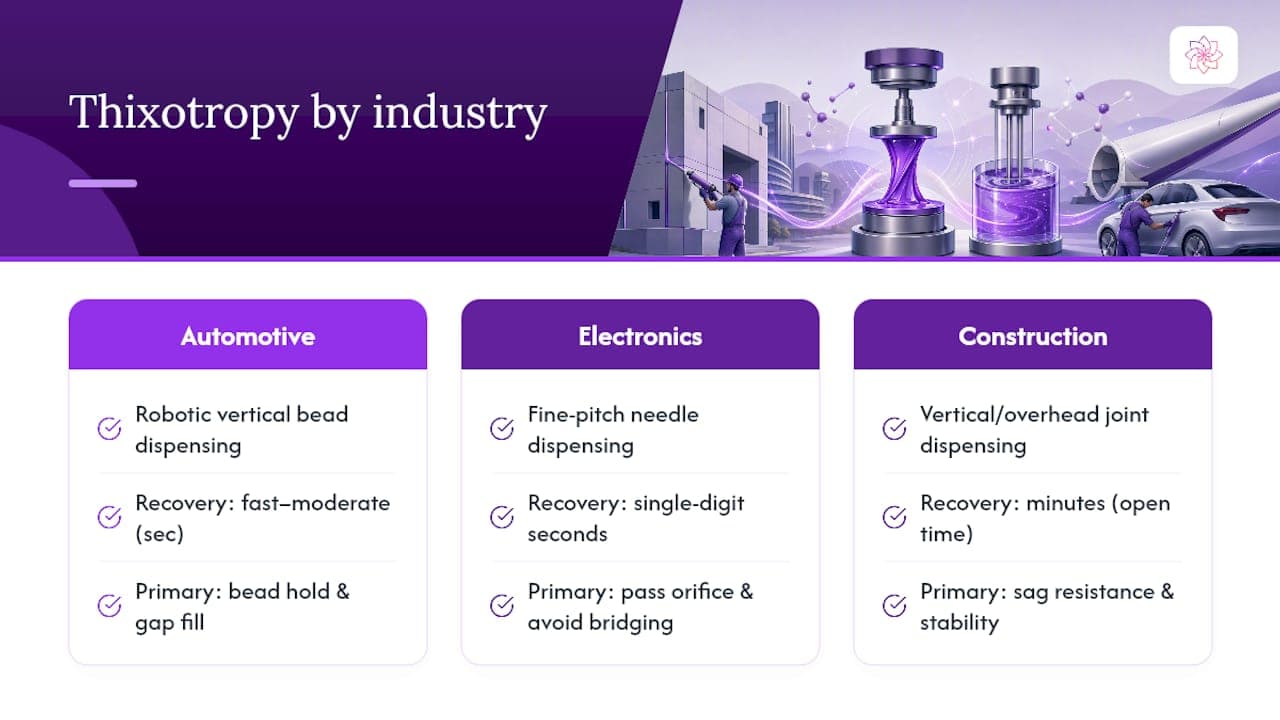
Automotive assembly lines depend on thixotropic structural adhesives to hold bead shape on vertical body panels during robotic application, where line speeds leave no time for a slow-recovering formulation to catch up before the next station. Gap-filling requirements in body-in-white assembly also lean on controlled recovery, since a bead that flows too freely before cure will thin out exactly where crash-load performance depends on full gap coverage.
Electronics assembly presents the opposite constraint in some ways: fine-pitch dispensing through small-diameter needles requires an adhesive that shear-thins enough to pass through a narrow orifice without excessive back-pressure, then rebuilds fast enough to prevent bridging between closely spaced components. Recovery windows here are typically measured in single-digit seconds, far tighter than most construction applications tolerate.
Construction sealants and adhesives, including many silicone and polyurethane-based systems, use thixotropy for vertical and overhead joint applications where sag resistance under gravity, sometimes over open times measured in minutes rather than seconds, is the primary performance driver. Thread-locking fluids represent a smaller but useful illustration of the same principle at much lower viscosity, per the general overview on Wikipedia: thin enough to flow into threads on application, structured enough to resist migration afterward.
Each industry effectively selects a different point on the same recovery-time spectrum, which is why a thixotropy specification written for one application rarely transfers cleanly to another.
What Safety and Handling Precautions Apply to Thixotropic Additives?
Fumed silica, one of the most common thixotropic agents in adhesive formulation, carries handling considerations tied to its fine particle size. Dust generation during weighing and mixing warrants local exhaust ventilation and respiratory protection appropriate to the specific product's safety data sheet, since sub-micron particulates behave differently in the respiratory tract than coarser powders.
Associative thickeners and polymeric rheology modifiers generally present lower inhalation risk in liquid or slurry form but still require the standard industrial hygiene practices for any specialty chemical additive: proper storage temperature ranges to prevent degradation, secondary containment for liquid concentrates, and compatibility checks before blending with reactive resin components.
Mixing procedures deserve particular attention with high-shear dispersion equipment. High-shear mixing that builds excessive local heat can degrade heat-sensitive thickener chemistries before they ever reach the adhesive matrix, and operators should follow the equipment and additive supplier's recommended mixing speed and duration rather than mixing until the batch "looks right." Always consult the specific product's safety data sheet for exposure limits, personal protective equipment requirements, and disposal guidance, since these vary by chemistry even within the same additive class.
What the Data Actually Tells Formulators About Thixotropy
The conventional advice on thixotropy in adhesives stops at "add fumed silica until sag disappears." That advice is not wrong, but it treats a time-dependent, multi-timescale phenomenon as a single dial, and it consistently underestimates how much recovery kinetics matter, relative to peak viscosity.
The step-shear and 3iTT data available to formulators today make it clear that two adhesives with matching thixotropic index values can behave completely differently on an actual production line, because TI captures a viscosity ratio, not a recovery curve. Formulators who specify recovery percentage at a defined time interval get a far more actionable number than anyone chasing a single index score.
The priority for any team troubleshooting sag, stringing, or slow bead recovery should not be swapping additives first. It should be characterizing the actual shear rate and rest time in the real dispensing process, then matching a rheology modifier's recovery profile to that specific window. Additive selection is the second decision, not the first.
— Astra R&D Team
How Astra-chemical Supports Thixotropic Adhesive Formulation
Getting the recovery curve right often comes down to which rheology modifier and dispersant pairing actually holds structure in your specific resin system, not just in a generic test fluid. ASTRA REO® rheology modifiers are formulated to give formulators control over low-shear viscosity and recovery kinetics without the unpredictable batch-to-batch variation that comes from working around clogging-prone loadings. Paired with ASTRA DISP® dispersants, they help keep particulate structuring agents evenly distributed through the mixing and dispensing process, which directly affects how consistently a bead holds its shape from the first tube to the last.

Technical teams often work directly with formulators to evaluate recovery-time targets against real dispensing conditions, not lab-standard shear ramps alone. If your current adhesive formulation is fighting sag, slow recovery, or nozzle clogging, request a technical consultation and sample of ASTRA REO® rheology modifiers to run against your own step-shear and dispensing benchmarks.
Sources
Formulators looking to go deeper into test methodology and modeling should start with the TA Instruments application note on rotational rheometer thixotropy analysis and the Anton Paar basics of thixotropy guide for instrument-level test setup.
- Introduction to thixotropy analysis using a rotational rheometer | TA Instruments
- Basics of thixotropy | Anton Paar
- Testing adhesive properties with viscometers and rheometers | Anton Paar
FAQ
What Are Some Common Thixotropic Materials?
Fumed-silica-thickened adhesives, certain epoxy systems, thread-locking fluids, and many construction sealants all show thixotropic behavior, alongside everyday examples like paint and ketchup that share the same structure-breakdown-and-recovery mechanism.
Why Is Ketchup Thixotropic?
Ketchup's particulate network breaks down under the shear of shaking or squeezing, thinning it enough to flow, then slowly rebuilds structure once shear stops, the same time-dependent mechanism engineered into anti-sag adhesives.
Is Thixotropic the Same as Shear-Thinning?
No. All thixotropic materials are shear-thinning, but not all shear-thinning materials are thixotropic. The distinguishing factor is that thixotropic recovery takes measurable time after shear stops, while ordinary shear-thinning reverses almost instantly.
What Is the Difference Between Thixotropy and Viscosity?
Viscosity is a single measurement of a fluid's resistance to flow at a given shear rate, while thixotropy describes how that resistance changes over time as structure breaks down under shear and rebuilds at rest.
How Long Does It Take an Adhesive to Recover Its Structure After Shearing?
Recovery time varies by formulation and additive system, ranging from seconds for fast-rebuilding associative thickener systems to several minutes for heavily fumed-silica-structured pastes, which is why formulators specify recovery percentage at a defined time rather than a generic descriptor.
Recommended
Testing additives for this application?
Send us your current formulation challenge and our technical team will recommend an ASTRA product package for lab screening.