Formulators: 5 Lab Checks to Choose Silicone or Non Silicone Defoamers
Formulators: 5 Lab Checks to Choose Silicone or Non Silicone Defoamers ! Abstract comparison of defoamer chemistry Use silicone (PDMS) emulsions when the process tolerates trace siloxane and needs low-dose, broad-range knockdown across temperature and pH.

Use silicone (PDMS) emulsions when the process tolerates trace siloxane and needs low-dose, broad-range knockdown across temperature and pH. Switch to non-silicone chemistries, oil-based, polyether, or powder, when downstream coating, printing, or food-contact requirements can't absorb silicone carryover. The trade-off is consistent: silicone wins on dose efficiency and persistence, non-silicone wins on compatibility and regulatory simplicity. Food-contact work adds a hard constraint, since only specific FDA-listed grades qualify.
TL;DR:
- Silicone defoamers require significantly lower active doses than non-silicone options but pose contamination risks in sensitive coatings and print surfaces.
- Non-silicone defoamers avoid surface defects and carryover issues but generally need higher doses and have narrower temperature and shear tolerance.
- Silicone is preferred in wastewater and high-temperature processes for its stability, while non-silicone grades are mandatory in food-contact and cosmetic applications.
- Validating an effective defoamer involves real process testing, including dose-response, persistence, and compatibility with actual process streams.
- Regulatory compliance for food-contact uses depends on specific FDA listing and residue limits, making non-silicone grades sometimes the safer choice.
Formulators rarely get to pick blind. The decision usually comes down to five measurable factors: how little product does the job, how fast it knocks down foam, how long that knockdown holds, what it leaves behind, and what it might wreck downstream. Silicone and non-silicone chemistries split cleanly across all five.
Polydimethylsiloxane (PDMS) emulsions remain the benchmark for dose efficiency. Industry technical overviews consistently identify PDMS as the dominant active for broad performance across pH ranges and temperature windows that would strip a lesser chemistry of its activity. Silicone products often require significantly lower active concentration than non-silicone products to achieve the same foam-height reduction. That efficiency comes from low surface tension and fast spreading at the foam lamella, which is also exactly why silicone carries a contamination risk wherever it lands next.
Non-silicone classes trade some of that punch for a cleaner footprint. Oil-based, polyether, and powder defoamers exist specifically because silicone oils cause defects in coatings, adhesives, and printed substrates where surface uniformity is the product. The dose penalty is real, and shear or temperature windows tend to be narrower on some grades, but the absence of siloxane simplifies everything downstream.
Key comparison points:
- Dose efficiency: Silicone typically requires a fraction of the active load of oil-based or polyether alternatives to hit the same foam-height target.
- Knockdown speed vs. persistence: Silicone knocks down fast and holds; mineral-oil and polyether grades knock down adequately but may need re-dosing in long recirculation loops.
- Residue and carryover risk: Silicone leaves a mobile film that can migrate across process equipment; non-silicone actives are far less prone to cross-contaminating adjacent process streams.
- Emulsion active percentage and droplet size: Higher active content and tighter droplet distribution generally extend persistence and reduce re-foaming, a variable worth tracking on the spec sheet rather than assuming from the label alone.
Organomodified siloxanes sit between the two camps. Comparative technical work on base oils shows that straight PDMS delivers the highest antifoaming efficiency, while organomodified variants sacrifice some of that ceiling in exchange for meaningfully better compatibility in sensitive binder systems. For a formulator stuck between "needs silicone's efficiency" and "can't tolerate silicone's defects," that hybrid class is often the first thing worth screening before committing to either extreme.
The Chemistry Behind Foam Knockdown
Every defoamer works by disrupting the same thing: a stabilized air/liquid interface. How it does that depends entirely on the active's chemistry and physical form.
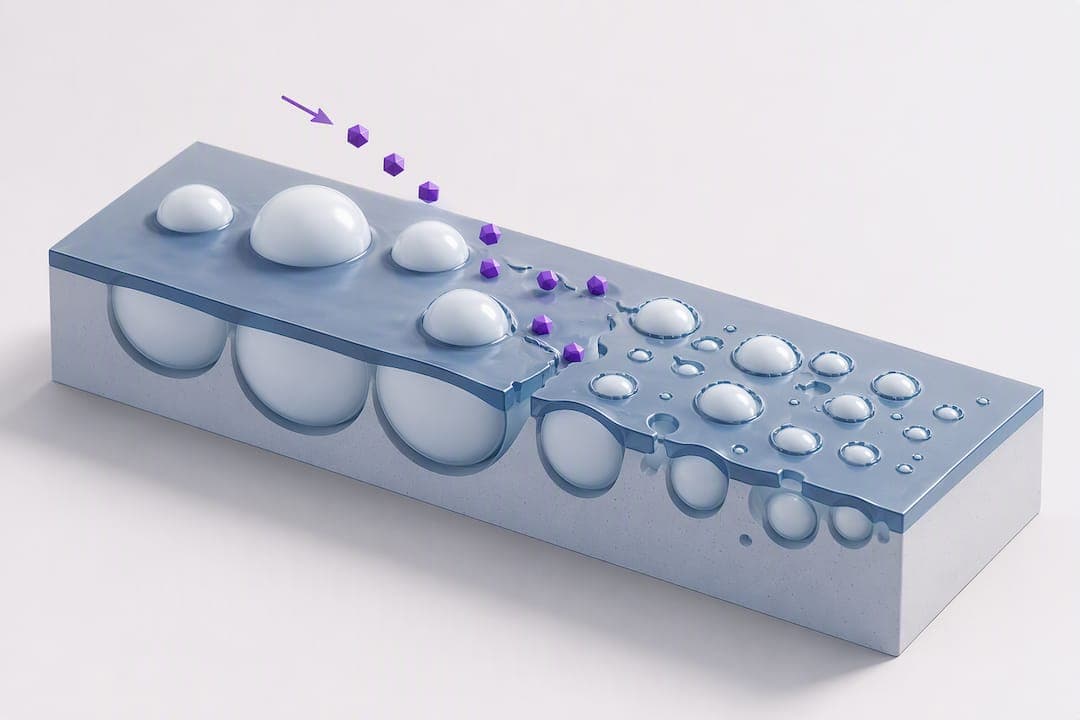
PDMS ruptures foam lamellae through rapid spreading and a low interfacial tension that outcompetes the surfactant film stabilizing the bubble. Hydrophobic silica particles, used as boosters in both silicone and non-silicone systems, work through what formulators call the pin-effect: a solid particle bridges the thin liquid film and physically punctures it, accelerating collapse. Polyether-based actives operate differently again, relying on a hydrophobic-lipophilic balance that makes them insoluble enough in the bulk medium to concentrate at the foam surface and destabilize it.
Format matters as much as chemistry:
- Neat oil — highest active concentration, fastest local action, hardest to disperse evenly in large batches.
- Oil-in-water emulsions — easier metering and dilution, the most common commercial format for both silicone and non-silicone actives.
- Inverse emulsions and powders — suited to specific process constraints, including dry-blend applications and systems where water addition is restricted.
Booster chemistry moves the needle more than most formulators expect. Technical brochures on hydrophobic silica describe particle selection as the variable that most often decides whether an oil-based defoamer will collapse foam cleanly or destabilize the coating film it's added to. Particle size, surface treatment, and loading level all shift the entering and spreading coefficients that govern whether the booster helps or backfires.
Where Each Chemistry Actually Fits in Production
Application context, not raw performance, usually decides the winner. A defoamer that outperforms everything else in a beaker can still be the wrong choice on a coating line.
- Coatings and inks. Silicone's tendency to migrate and reduce local surface tension is the direct cause of fisheyes and cratering in cured films. Formulators locked into high cosmetic standards typically default to non-silicone or organomodified grades, reserving straight PDMS for systems tested and proven silicone-tolerant.
- Paper and food-contact board. Silicone-free grades are frequently required outright, not just preferred, because trace siloxane can interfere with printability, coating adhesion, or downstream food-contact acceptance. Confirming silicone-free status is a standard qualification test point, not an assumption.
- Wastewater treatment and fermentation. Here silicone's efficiency becomes an asset rather than a liability. Low dose means low organic load added to the system, which matters directly in biological treatment and fermentation broths where excess organic carryover feeds unwanted microbial activity.
- Oilfield, mining, and high-temperature processing. Shear stability and thermal resilience dominate the decision. Certain silicone grades and organomodified siloxanes hold up under conditions that degrade lighter non-silicone oils, making them the practical default despite the compatibility trade-offs elsewhere.
For a deeper walkthrough of the coatings decision specifically, see this silicone versus silicone-free comparison for coating systems.
How to Validate a Defoamer Before It Reaches the Plant
Screening on paper only gets a formulator partway. The candidate needs to survive real conditions before it earns a spot in the production formula.
- Record the five screening variables up front: process temperature, shear intensity, pH range, solids content, and the existing surfactant package. Any one of these can flip a defoamer from effective to useless.
- Run a Ross-Miles or foam-height test against the actual plant liquor, not distilled water, since emulsion stability and droplet size shift once a product leaves the sample jar and enters a real binder or process stream.
- Build a dose-response curve, not a single data point, to find the minimum effective load and the point of diminishing return.
- Run a recirculation loop test to check persistence over time, since knockdown speed alone says nothing about how long the effect holds under continuous shear.
- Screen for surface defects on any coated or printed substrate, and use a controlled comparison against a known-silicone-free reference to isolate carryover from other defect causes like poor wetting or contamination.
Pro Tip: Start dosing at the low end of the supplier's recommended range and watch for re-foaming over the first two hours of recirculation, not just at the moment of addition. A defoamer that looks perfect at time zero can fail persistence testing badly by hour three.
Formulators building a full custom screening protocol can work from this checklist of variables to test before formulation, and plant teams troubleshooting an existing foam problem may find this foam-control playbook for polymer emulsions useful for isolating root cause before switching chemistries entirely.
Regulatory Constraints for Food-Contact Applications
Food-contact use isn't a matter of formulator preference. FDA 21 CFR 173.340 lists specific allowable food uses and maximum residue limits for dimethylpolysiloxane, and staying inside those limits depends on the exact application and concentration named in the regulation, not a general assumption that "food-grade silicone" covers every use case.
- Confirm the supplier cites the specific CFR paragraph applicable to the intended food-contact use, in writing, on the purchase order.
- Review the regulatory history, including the Federal Register amendments governing dimethylpolysiloxane coatings, before assuming a legacy approval still applies to a new process.
- When downstream customer acceptance criteria simply exclude silicone, regardless of CFR compliance, defaulting to a non-silicone grade avoids a qualification fight entirely.
Astra's Applied Decision Framework
Choosing between silicone and non-silicone chemistry comes down to weighing three variables together: raw performance, downstream compatibility, and total cost-in-use, not just unit price per pound of active. A cheaper non-silicone product that requires triple the dose and a slower line speed rarely wins on total cost.
ASTRA DF® targets processes where silicone's dose efficiency and broad-range tolerance solve the problem outright. ASTRA DF NS® covers the jobs where silicone is simply off the table, coatings, printable substrates, certain food-contact lines. ASTRA DISP® supports the dispersant side of the same formulations, since foam control and particle dispersion often need to be solved together, not in isolation. Astra R&D Team welcomes sample requests and lab-to-plant trial collaboration to dial in dose and compatibility before a full production run.
— Astra R&D Team
Get Lab Support for Your Defoamer Selection
Formulators can find comparable performance to premium silicone and non-silicone brands at a lower total cost-in-use, ideally backed by laboratory qualification data rather than a data sheet alone.
The comparisons above only go so far in a browser tab. Real process water, real shear, real binder chemistry change the answer every time, which is why Astra-chemical backs every recommendation with dosage support and batch-to-batch consistency data instead of a generic spec sheet. The ASTRA DF® silicone line and ASTRA DF NS® non-silicone line both ship with full technical documentation for regulatory and production teams that need paper trails, not just performance claims. Browse the complete product catalog to compare the full defoamer and dispersant range side by side, then request a lab sample to run your own dose-response curve against your actual process stream before committing to a production switch.
Sources
- 21 CFR 173.340 - Dimethylpolysiloxane and related substances
- Federal Register: Food additive regulations; dimethylpolysiloxane coatings
- Industrial defoamers & antifoams: Types, selection & supply – RawSource
- AEROSIL® and SIPERNAT® — Efficient booster for defoamer in paints and coatings (Evonik technical brochure)
FAQ
Is Silicone Antifoam Bad for You?
Food-grade silicone defoamers are only permitted at specific concentrations and use conditions defined in 21 CFR 173.340, and staying within those limits is what makes the use compliant. Outside food-contact settings, the concern for formulators is process compatibility, not toxicity, since silicone carryover causes coating and printing defects rather than safety issues.
Is Vinegar a Defoamer?
Vinegar is not an industrial defoamer and has no defined active mechanism for foam knockdown or persistence in a manufacturing process. Formulators need a characterized active, silicone, polyether, mineral oil, or powder, with a known dose-response curve, which household acids simply don't provide.
What Are the Disadvantages of Antifoaming Agents?
Silicone actives carry compatibility risk, since even trace carryover can cause fisheyes and cratering in coatings or printing defects on paper. Non-silicone actives avoid that risk but generally need a higher dose to match silicone's knockdown, and some grades have narrower shear or temperature tolerance.
What Are the Different Types of Defoamers?
The main classes are silicone (PDMS) emulsions, organomodified siloxanes, mineral-oil-based defoamers with hydrophobic silica boosters, polyether-based actives, and powder or dispersion formats. Each format changes handling and metering, while the underlying chemistry determines dose efficiency, temperature tolerance, and compatibility risk.
How Do I Choose Between Silicone and Non-Silicone Defoamers?
Start with the downstream constraint: if the process feeds a coating, print, or food-contact line that can't tolerate siloxane, choose non-silicone. If the process tolerates trace silicone and needs low-dose, broad-range performance, ASTRA DF® or a comparable organomodified siloxane is usually the more cost-effective route once total dose is factored in.
Recommended
Testing additives for this application?
Send us your current formulation challenge and our technical team will recommend an ASTRA product package for lab screening.