Fix Defoamer Cratering Without Reformulating: Triage for Formulators
Fix Defoamer Cratering Without Reformulating: Triage for Formulators ! Isometric illustration of coating crater triage Most cratering blamed on a defoamer is a dispersion or contamination problem in disguise, not a formulation failure.

Most cratering blamed on a defoamer is a dispersion or contamination problem in disguise, not a formulation failure. Before touching the formula, cut the defoamer dose, recirculate or stir the batch for several minutes, and pull a fresh drawdown panel. If the craters shrink or disappear, the defoamer was overdosed or poorly dispersed; if they persist unchanged, look at contamination or true incompatibility, covered next.
TL;DR:
- Cratering caused by defoamer occurs mainly from overdosing or poor dispersion, rather than formulation failure, and can often be fixed by reducing dose or improving mixing.
- Consistent crater patterns across batches indicate chemical incompatibility, while scattered, irregular craters suggest contamination or surface contaminants like mold-release residue.
- Silicone-based defoamers provide strong foam control but carry the highest recoat risk, so emulsified or copolymer versions are preferable in high-gloss systems for better compatibility.
- Proper incorporation involves a dose ladder and split dosing at the mill and let-down stages, with shear applied carefully to achieve fine dispersions without over-shearing.
- Equipment cleanliness and handling procedures are common root causes of long-term cratering, emphasizing strict cleaning and contamination controls over simple formula adjustments.
Cratering forms through Marangoni-driven flow: a droplet of low-surface-tension material sitting in a wet film pulls surrounding liquid away from itself, faster than leveling forces can smooth it back out. The result is a circular depression, often with a raised rim, that telegraphs straight through drying and cure. Defoamers work by exploiting exactly this mechanism at the air-liquid interface to pop bubbles, so a poorly incorporated or overdosed defoamer droplet can trigger the same dewetting event on the film surface it's meant to protect.
Two variables control whether that droplet actually produces a crater:
- Concentration threshold. Defects can appear at contaminant levels as low as 0.001% of total formula weight, while typical effective defoamer dosing runs 0.1% to 0.5% of the formula, or 30 to 300 ppm for active silicone.
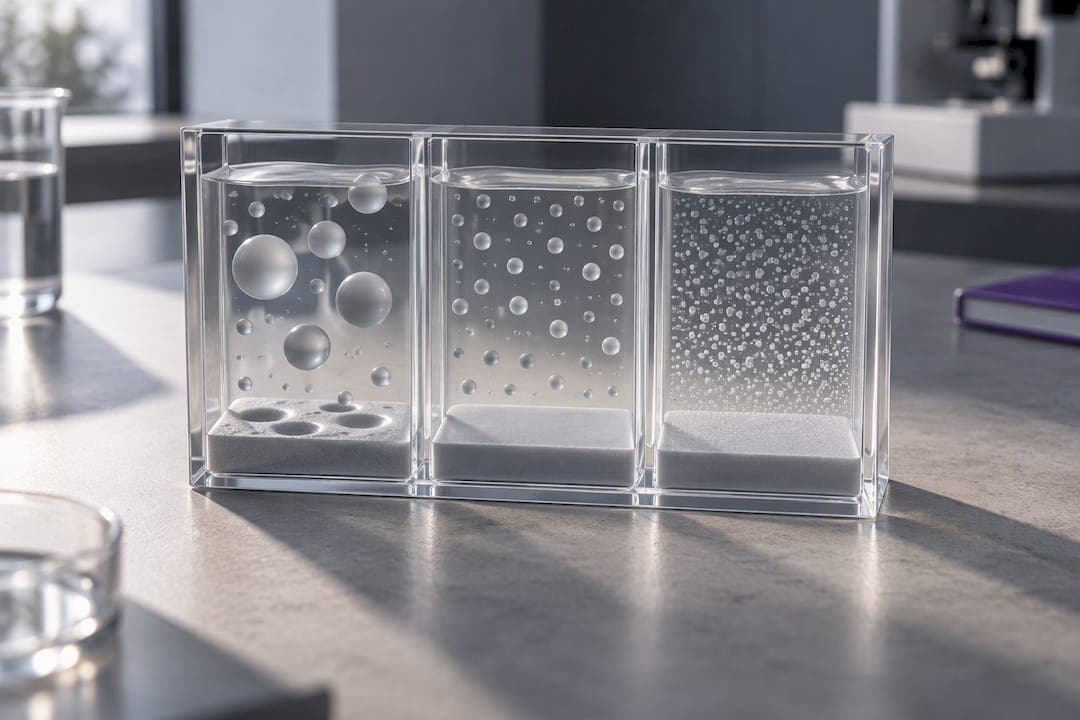
- Droplet size distribution. Coarse, poorly emulsified droplets sit at the surface and drive strong local tension gradients; well-emulsified defoamers with tighter droplet size distributions disperse that tension before it can pull the film apart.
This is why two batches with identical defoamer dosage can behave completely differently. One has silicone actives broken down to a fine, stable emulsion; the other carries a few oversized droplets that never sheared out.
How Do You Tell Contamination From Defoamer Incompatibility?
Pattern and repeatability separate the two causes faster than any lab test. Contamination tends to produce scattered, non-repeating craters that vary panel to panel from the same batch; true incompatibility produces craters that show up consistently, batch after batch, at the same dose.
- Check repeatability across panels and batches. Pull three drawdowns from the same batch. Random, non-repeating spots point to a stray contaminant; a consistent pattern points to the formula itself.
- Run a stir or recirculation test. Agitate the batch for 10 to 15 minutes and re-draw. Craters that shrink or vanish indicate a dispersion problem, not permanent incompatibility, and most crater complaints resolve after circulation or re-milling.
- Re-mill the pigment paste. If stirring the finished batch doesn't help, send the millbase back through the mill. Persistent improvement here confirms a grind-stage incorporation issue rather than a chemistry mismatch.
- Rule out fall-on contaminants. Silicone grease, mold-release residue, or fingerprint oils on the substrate produce craters even in a perfectly formulated coating. A quick wipe test with isopropanol on a fresh panel, applied before the coating rather than after, can confirm or rule this out.
Which Defoamer Chemistry Fits Your Gloss and PVC Target?
Chemistry choice is a direct trade-off between foam-knockdown strength and crater risk, and the right answer depends heavily on gloss level and pigment volume concentration.
- PDMS and neat silicone defoamers deliver the strongest microfoam control of any class but carry the highest risk of cratering and recoat defects. In waterborne gloss systems, favor emulsified or modified versions rather than neat silicone fluid.
- Silicone-polyether copolymers hold much of silicone's defoaming strength while improving compatibility in high-gloss systems, making them the more forgiving default where gloss retention matters.
- Mineral oil and polymeric (non-silicone) defoamers offer broader compatibility across mid-gloss and flat systems, though they often need a higher dose to match silicone's knockdown speed.
Pro Tip: If a high-gloss system needs silicone-level defoaming but keeps cratering, don't abandon silicone outright. Try an emulsified or copolymer-modified grade first, since the fix is often the delivery form, not the chemistry family. Astra-chemical's silicone and silicone-free defoamer comparison walks through gloss-specific selection in more detail.
What Dosing and Incorporation Steps Reduce Crater Risk?
Dose and shear determine whether a defoamer disperses as fine droplets or sits as coarse, crater-prone globules, and both deserve a structured test before any reformulation.
- Run a dose ladder. Prepare five to six panels stepping from roughly 0.1% up to 0.5% of total formula weight, or 30 to 300 ppm active silicone, and read both foam knockdown and drawdown defects at each step.
- Split the dose between grind and let-down. Adding a portion of the defoamer at the mill stage and the remainder at let-down often reduces crater incidence while preserving foam control through the product's shelf life, since a single large let-down slug is more prone to under-shearing.
- Match shear to the defoamer form. Concentrates typically need mill or high-shear disperser incorporation to break droplets down to target size; pre-emulsified grades can go in under low shear at let-down without losing performance.
The critical concentration finding matters here: because defects can trigger at contaminant levels near 0.001% while defoamer dosing runs 0.1% to 0.5%, a formula can be in-spec on defoamer dose and still crater from a trace contaminant two orders of magnitude smaller. Dose alone doesn't clear a formulator of a contamination check.
Under-shearing leaves droplets too coarse and crater-prone; over-shearing can drive droplets so fine they lose defoaming efficacy entirely, so the target is a formula-specific sweet spot rather than a maximum shear setting.
How Do You Verify a Fix Before Scaling Up?
A defensible lab protocol runs the dose ladder, foam knockdown, and drawdown checks side by side, then confirms the fix survives storage before it goes anywhere near production scale.
- Draw each ladder panel at a controlled wet film thickness and count craters per square centimeter under raking light.
- Read 60 degree gloss on each panel and compare against the unmodified control to confirm the defoamer isn't dulling the finish along with fixing the craters.
- Re-run the stir and re-mill tests on the winning dose to confirm the improvement is chemistry-driven, not just a temporary dispersion state that will separate again in the drum.
- Hold a sample at ambient and elevated temperature for one to two weeks and redraw, since some incompatibilities only surface after storage.
| Metric | Acceptance target |
|---|---|
| Craters per cm² | Zero visible craters at 8x magnification |
| Gloss deviation vs. control | Within 2 gloss units at 60 degrees |
| Recoat adhesion | No delamination on crosshatch or tape pull |
| Post-storage repeat | No new craters after 1 to 2 week hold |
What Process Controls Prevent Cratering Long-Term?
Most recurring crater problems in production trace back to equipment and handling, not the formula on paper.
- Dedicate mixing lines or run rigorous cleaning protocols between batches, since cross-batch contamination from residual low-surface-tension material can trigger craters at under 0.001% carryover.
- Ban PTFE and fluorinated lubricants anywhere near open batches or transfer lines; these are among the most common silent contaminants in coatings plants.
- Pair the defoamer with a compatible leveling additive that won't itself stabilize foam, and keep total surfactant load in view since excess surfactant can destabilize a well-chosen defoamer.
- Standardize the shear profile, addition point, and split-dose ratio in a written SOP so operators aren't improvising incorporation batch to batch.
Pro Tip: Add a five-minute stir-test check to your batch release checklist. It costs almost nothing and catches dispersion-driven cratering before the batch ever reaches a customer's line. Astra-chemical's process-first foam control guidance covers mixing shear setpoints in more depth.
How Does Astra-chemical Qualify a Defoamer for a Troubled Formula?
A fixed screening sequence involving dose ladder, shear split test, drawdown, recoat adhesion, and storage checks is recommended when addressing cratering issues. That order isolates dose problems from shear problems before anyone changes the base chemistry.
To move fast, share the following when requesting support:
- Full formula, including resin type, pigment volume concentration, and existing defoamer package.
- Millbase process details: grind time, disperser type, and mixing energy.
- Gloss target and application method (spray, roll, or flow coat).
- Any prior test results, including which dose ladder steps were already tried.
For sample qualification, ASTRA DF® silicone defoamers are typically evaluated first in high-gloss systems needing strong microfoam control, while ASTRA DF NS® non-silicone grades are the standard starting point where recoat sensitivity or silicone-free labeling requirements rule out PDMS entirely.
Astra R&D Team Perspective: Prioritize the Cheapest Fix First
Formulators default to swapping chemistry when a crater shows up, and that instinct wastes weeks. Check dispersion and contamination first; a stir test or re-mill costs an afternoon, a reformulation costs a quarter. When silicone is genuinely required for gloss, reach for an emulsion or a modified copolymer before ruling silicone out entirely. Standardized shear, split dosing, and disciplined equipment cleaning fix more crater problems than any new additive ever will.
— Astra R&D Team
Sources
- A Mathematical Model for Crater Defect Formation in a Drying Paint Layer
- Defoamers/Anti-foaming Agents: How to Select the Right Grade?
- Defoamer Selection in Waterborne (Journal of Coatings Technology)
- Understanding Defoamer Chemistry | PCI Magazine
- PPG Automotive Coatings Supplier Contamination Prevention Training
FAQ
What Are the Disadvantages of Defoaming Agents?
The main disadvantage is the crater and surface-defect risk covered throughout this article, particularly with neat silicone grades in high-gloss systems. Overdosing can also cause recoat adhesion failure, gloss reduction, and, in some resin systems, surface haze if the defoamer is incompatible with the vehicle.
What Can Be Used as a Defoaming Agent?
Common classes include silicone (PDMS) fluids and emulsions, silicone-polyether copolymers, mineral oil based defoamers, and polymeric non-silicone defoamers. Choice depends on gloss target, pigment volume concentration, and how much microfoam control the system needs, as chemistry selection guidance outlines in detail.
Is It Safe to Use Antifoaming Agents in Food?
Certain defoamer chemistries are approved for food-contact and food-processing applications under specific regulatory limits, but that use case sits outside industrial coatings formulation and requires checking the applicable food-safety regulation for the specific compound and application. Coating-grade defoamers covered in this article are formulated for industrial paint and coating systems, not food processing.
What Do Defoamers Do?
Defoamers destabilize foam bubbles at the air-liquid interface, causing them to collapse before they get trapped in the wet film. They work through the same surface tension mechanisms that, at the wrong dose or droplet size, can also trigger cratering on the coating's own surface.
How Do I Reduce Cratering Without Reformulating?
Start with the least invasive fix: reduce defoamer dose, stir or recirculate the batch, and re-draw a panel to see if craters clear. If the improvement holds after a re-mill or stir test, the problem was dispersion, not chemistry, and no reformulation is needed. Full product options are listed on Astra-chemical's product page if a chemistry change does prove necessary.
Recommended
Testing additives for this application?
Send us your current formulation challenge and our technical team will recommend an ASTRA product package for lab screening.