Titanium Dioxide Dispersion: High-Solid, Low-Viscosity Guide
Titanium Dioxide Dispersion: High-Solid, Low-Viscosity Guide ! Decorative title card illustration for titanium dioxide dispersion article A low-molecular-weight sodium polyacrylate (PAAS) dispersant strategy, combined with a controlled order-of-addition and wet milling sequence, is the most reliable…
A low-molecular-weight sodium polyacrylate (PAAS) dispersant strategy, combined with a controlled order-of-addition and wet milling sequence, is the most reliable path to stable, high-solid aqueous titanium dioxide dispersion for coatings and adhesives. Published laboratory evidence confirms that mid-kDa PAAS grades enable both high solids and manageable viscosity simultaneously, a combination that higher-molecular-weight or inorganic dispersants consistently fail to deliver at production scale.
Target metrics to judge a successful mill base:
- Solids content: up to ~50% by weight in the aqueous mill base
- Viscosity: low and processable at 100 s⁻¹ shear rate (rotational rheometry)
- ζ-potential: absolute value ≥ 30 mV (negative charge confirms adequate surface coverage)
- Turbiscan Stability Index (TSI): as low as possible over a 24-hour scan; values approaching zero indicate minimal sedimentation or creaming
Quick-start controls: add dispersant to water first, then introduce TiO2 pigment incrementally. Pre-disperse by mechanical stirring for 15–20 minutes before transferring to the mill. Monitor viscosity every 30 minutes during milling; a sustained rise signals either insufficient dispersant dose or thermal overload.
Key Takeaways
A low-molecular-weight PAAS dispersant, combined with staged pigment addition and controlled bead milling, is the most reliable strategy for producing stable, high-solid aqueous TiO2 dispersions with processable viscosity.
| Point | Details |
|---|---|
| Dispersant MW is the critical variable | Mid-kDa PAAS grades balance steric and electrostatic stabilization without bridging flocculation at high solids. |
| Run a ladder study before scale-up | Increment dispersant dose in 0.1 wt% steps and measure viscosity at 100 s⁻¹ and TSI at each level to find the optimum dose. |
| Three non-negotiable acceptance criteria | ζ-potential ≤ −30 mV, TSI ≤ 2.0 over 24 hours, and viscosity ≤ 500 mPa·s at 100 s⁻¹ confirm a production-ready mill base. |
| Temperature control prevents batch failures | Mill outlet temperature above 45°C triggers dispersant desorption; active jacket cooling is mandatory at high solids. |
| Astra-chemical ASTRA DISP® | Provides mid-kDa PAAS grades, ladder study support, and pilot-scale formulation consultation for TiO2 dispersion projects. |
The answer is surface charge and steric layer geometry. TiO2 particles carry surface hydroxyl groups that ionize in aqueous media, making the particle surface reactive toward anionic polymers. A PAAS dispersant adsorbs onto these hydroxyl sites through its carboxylate groups, simultaneously building an electrical double layer (electrostatic repulsion) and a physical polymer brush layer (steric hindrance). Both mechanisms resist particle aggregation, but their relative contribution depends directly on the dispersant's molecular weight.
At mid-kDa molecular weights, PAAS chains are long enough to form a steric barrier yet short enough to avoid bridging between adjacent particles or entangling with neighboring chains. When molecular weight climbs beyond that window, chain bridging pulls particles together rather than separating them, and viscosity rises sharply.
Key mechanistic points:
- Electrostatic repulsion depends on ζ-potential magnitude; a more negative value (≥ 30 mV absolute) indicates stronger interparticle repulsion.
- Steric stabilization depends on adsorbed layer thickness, which scales with polymer chain length up to the bridging threshold.
- Surface hydroxyl density on rutile TiO2 is higher than on most organic pigments, making polyacrylate adsorption efficient but also sensitive to pH; adsorption is strongest between pH 7 and 9.
- Bridging flocculation occurs when a single polymer chain adsorbs onto two or more particles simultaneously, a risk that increases with molecular weight and with insufficient dispersant dose.
Pro Tip: Run a molecular-weight ladder alongside your dosage ladder. Source two or three PAAS grades spanning a 2–10 kDa range, hold solids and pH constant, and measure viscosity at 100 s⁻¹ and TSI after 24 hours. The grade that minimizes both metrics simultaneously is your target MW window for that specific TiO2 grade.
How do you prepare a high-solid TiO2 mill base step by step?
The standard sequence for a bench-scale aqueous TiO2 dispersion is:
- Charge dispersant into water. Dissolve the PAAS dispersant (typically 0.3–1.0 wt% on total mill base, subject to ladder study) in deionized water at room temperature. Stir at 300–500 rpm until fully dissolved. Adjust pH to 7.5–9.0 with dilute ammonia or sodium hydroxide if the polyacrylate requires neutralization for full ionization.
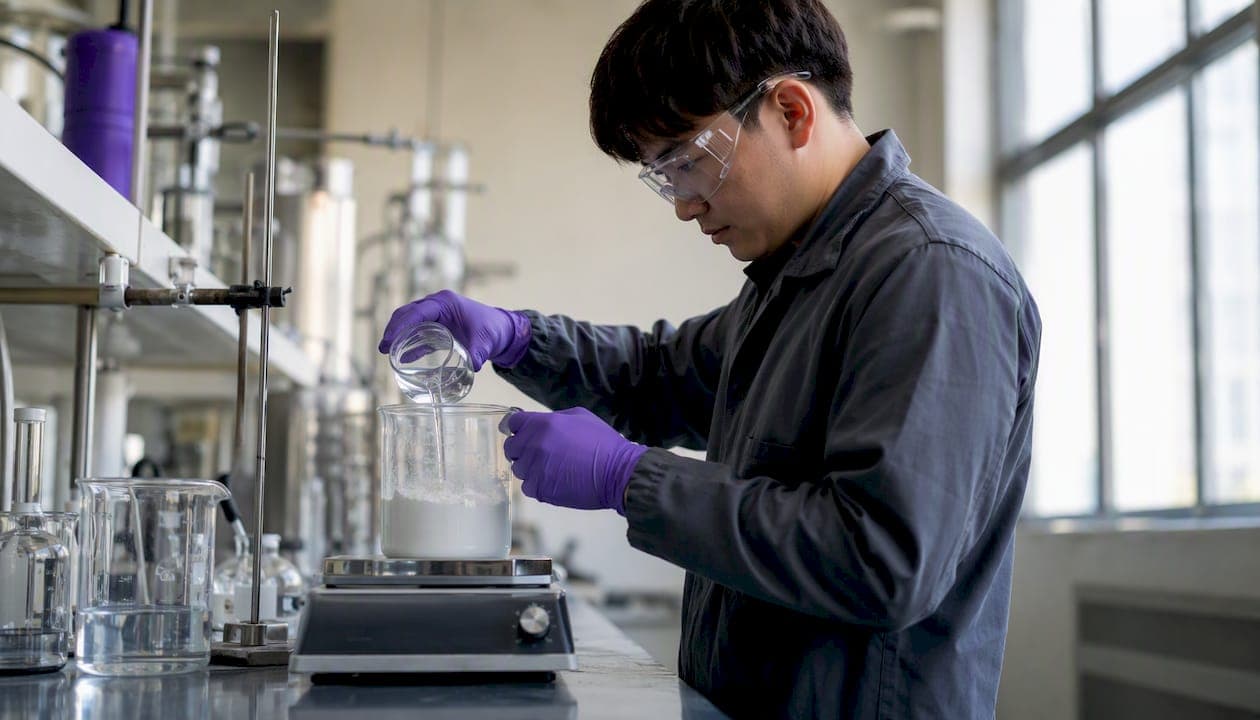
- Add TiO2 incrementally. Introduce the pigment in three to four staged additions under high-shear mixing (1,000–2,000 rpm cowles blade). Allow 3–5 minutes between additions to wet the pigment surface before the next charge. Rushing this step causes dry agglomerates that resist subsequent milling.
- Pre-disperse for 15–20 minutes. Maintain high-shear mixing until the slurry is visually homogeneous and viscosity has stabilized. Sample for initial particle size (DLS) and viscosity before transferring to the mill.
- Wet mill (bead or ball mill). Use 0.6–1.0 mm yttria-stabilized zirconia beads at 70–80% bead fill. Mill until D50 reaches the target particle size (typically 200–400 nm for coating-grade TiO2). Sample every 30 minutes for viscosity and particle size.
- Let-down and secondary additives. Dilute the mill base with the balance of water and any secondary additives (defoamer, biocide, pH buffer) after milling. Add rheology modifiers at this stage, not during milling, to avoid interfering with dispersant adsorption.
Starting-point bench recipe (wt%, mill base only — treat as a ladder study baseline):
- Deionized water: 45–50%
- PAAS dispersant (mid-kDa grade): 0.5–0.8%
- TiO2 pigment (rutile, coating grade): 48–52%
- Defoamer (non-silicone, millbase-compatible): 0.1–0.2%
Adjust dispersant dose using a ladder study protocol before committing to pilot scale. A 0.1 wt% increment ladder across five levels, with viscosity and TSI measured at each step, typically identifies the optimum dose within one bench session.
Embedded troubleshooting: If viscosity climbs during milling despite adequate dispersant dose, check slurry temperature first. Temperatures above 40°C accelerate desorption of the polyacrylate and can trigger reflocculation. Cool the mill jacket and resample before adjusting chemistry.

Which analytical tests confirm a successful TiO2 dispersion?
| Test | Instrument | Target / Acceptance Criterion | Sample Preparation Note |
|---|---|---|---|
| Stability index (TSI) | Turbiscan Lab (SMLS) | TSI ≤ 2.0 over 24 h | Dilute to ~1 wt% solids; degas before scan |
| Particle size (D50, D90) | DLS (e.g., Malvern Zetasizer) | D50: 200–400 nm; D90 < 600 nm | Dilute to a low concentration; sonicate briefly |
| Surface charge | Zeta potential (DLS cell) | ≤ −30 mV | Same dilution as DLS; equilibrate 5 min |
| Flow curve | Rotational rheometer (cone-plate) | Viscosity ≤ 500 mPa·s at 100 s⁻¹ | Measure at room temperature; pre-shear at 100 s⁻¹ |
| Solids content | Gravimetric (oven drying for several hours) | Within ±0.5% of target | Weigh before and after drying; triplicate |
Published work on PAAS-stabilized TiO2 systems used Turbiscan multiple light scattering (SMLS) and ζ-potential measurement as the primary stability indicators, confirming that a consistently high absolute ζ-potential correlates with lower TSI and better long-term sedimentation resistance. Sample at pre-dispersion, after milling, and after 7-day storage to track stability evolution.
How does rheology affect milling, handling, and final application?
Rheology is the controlling variable at every stage of processing, not just at application. During sand grinding, a mill base with viscosity above roughly 1,000 mPa·s at 100 s⁻¹ generates excessive heat, reduces bead-particle contact efficiency, and risks thermal desorption of the dispersant. Low millbase viscosity, achieved through correct PAAS selection, keeps the mill operating in its efficient shear window.
Downstream effects to monitor:
- Heat dissipation: viscosity directly governs frictional heat in the mill; target the lowest viscosity consistent with adequate pigment wetting.
- Pumpability: slurries above ~800 mPa·s at 10 s⁻¹ can cavitate centrifugal pumps; verify low-shear viscosity before transferring between vessels.
- Film leveling: after let-down, the dispersion's shear-thinning profile determines how well the coating levels before cure; a steep shear-thinning curve aids leveling but can cause sagging on vertical surfaces.
- Sedimentation in storage: a flat low-shear viscosity plateau (Newtonian behavior at rest) accelerates settling; mild thixotropy in the final formulation slows it.
Pro Tip: Pair the PAAS dispersant with a low-dose associative thickener or HEUR rheology modifier at let-down. The dispersant keeps millbase viscosity low during grinding; the rheology modifier restores mid-shear sag resistance in the finished coating without re-agglomerating the TiO2. Astra-chemical's ASTRA REO® line is designed for exactly this pairing.
What equipment and process controls matter most at scale?
The primary scale-up risks for high-solid TiO2 slurries are thermal runaway, media wear contamination, and unstable feed rates. Address them before the first pilot run.
Equipment checklist:
- Milling media: 0.6–1.0 mm yttria-stabilized zirconia beads; avoid glass beads above 40% solids due to fracture risk and contamination.
- Agitator power: size for 1.5–2.0 kW per liter of mill chamber at target solids; undersized agitators stall at high viscosity.
- Temperature control: jacketed mill with chilled water (10–15°C inlet); install a thermocouple at the mill outlet and alarm at 45°C.
- Particle size monitoring: inline or at-line DLS every 20–30 minutes; stop milling when D90 < 600 nm to avoid over-milling and viscosity rebound.
Scale-up process sequence:
- Confirm bench recipe passes all characterization targets before pilot transfer.
- Ramp solids in two stages at pilot scale: start at 35% solids, verify viscosity and temperature stability, then ramp to target solids over 20–30 minutes.
- Monitor torque or motor current draw continuously; a sustained 15% rise above baseline signals either viscosity increase or media packing.
- After milling, filter through a 50 µm screen to remove any oversized agglomerates or media fragments before let-down.
- For continuous operations, establish a steady-state residence time by measuring particle size at the mill outlet every 15 minutes until D50 stabilizes.
Batch versus continuous: batch processing suits pilot and small-volume production; continuous bead milling improves throughput consistency at volumes above roughly 500 kg/batch but requires tighter feed-rate control to prevent solids surges.
How do you diagnose and fix common TiO2 dispersion failures?
| Symptom | Likely Cause | Corrective Action | Verification Test |
|---|---|---|---|
| Viscosity rise during milling | Dispersant underdose or thermal desorption | Increase dispersant by 0.1 wt% increments; cool mill jacket | Viscosity at 100 s⁻¹ after each addition |
| Flocculation / reflocculation | pH drift below 7 or dispersant desorption | Re-adjust pH to 7.5–9.0; add dispersant top-up | ζ-potential; DLS particle size |
| Rapid sedimentation on storage | Insufficient ζ-potential or low-shear viscosity too low | Verify ζ-potential ≥ 30 mV; add low-dose thickener at let-down | TSI over 48 h; sedimentation tube test |
| Persistent foaming | Defoamer incompatibility or overdose of dispersant | Switch to a millbase-compatible non-silicone defoamer; reduce dispersant dose | Visual foam height; gloss measurement |
| Tint / color variability | Incomplete wetting or inconsistent order of addition | Enforce staged pigment addition protocol; verify pre-dispersion time | Tint strength test; particle size D90 |
QA sampling checklist (production line):
- Every batch: solids content (gravimetric), viscosity at 100 s⁻¹, pH
- Every third batch or after any raw-material lot change: DLS particle size (D50, D90), ζ-potential, TSI over 24 hours
- Monthly or after process change: full rheology flow curve (0.1–1,000 s⁻¹), tint strength, 30-day sedimentation test
Rework versus scrap: a batch showing elevated viscosity or mild flocculation that responds to a dispersant top-up and pH correction within 30 minutes is a rework candidate. A batch with D90 > 1,000 nm after corrective milling, or one that has been contaminated by media fracture, should be scrapped. Consult common water-based coating formulation pitfalls for additional root-cause guidance.
U.S. safety and regulatory requirements for TiO2 dispersion handling
The primary safety distinction in TiO2 handling is powder versus wet slurry. Dry TiO2 powder generates respirable dust that requires respiratory protection; aqueous dispersions at production solids do not present the same inhalation risk, but spray operations and tank transfers can generate aerosols.
Operator safety checklist:
- Respiratory protection (powder handling): NIOSH-approved N95 or P100 half-face respirator during bag dumping and hopper charging; local exhaust ventilation at the feed point.
- Eye and skin protection: chemical splash goggles and nitrile gloves for all slurry handling; face shield for tank transfers above 50 L.
- Ventilation: general dilution ventilation in the milling room; dedicated exhaust for spray booth operations where aerosol generation is possible.
- Spill containment: secondary containment berms around mixing and milling vessels; neutralize polyacrylate spills with water before cleanup.
- SDS management: maintain current Safety Data Sheets for TiO2 (CAS 13463-67-7) and each dispersant grade at the point of use; review annually or upon supplier reformulation.
For EPA compliance, aqueous TiO2 dispersions discharged to drain must meet local POTW pretreatment limits for suspended solids; confirm with your facility's environmental coordinator before disposing of off-spec batches.
The PAAS strategy is underused at the solids levels that matter most
The Astra R&D Team's position is direct: the PAAS dispersant approach for high-solid aqueous TiO2 dispersions is technically well-supported and practically underdeployed in U.S. coatings and adhesives manufacturing. Moving to a mid-kDa PAAS grade with a properly executed ladder study typically resolves the viscosity problem without any change to the milling equipment or process sequence.
What Astra-chemical observes when customers transition to this approach: millbase viscosity drops to a processable range, TSI values improve, and downstream let-down becomes more predictable. The formulation work is front-loaded (ladder studies, pH optimization, characterization), but the payoff at scale is a more consistent product with fewer batch failures.
ASTRA DISP® gives you a direct path from bench recipe to production
High-solid TiO2 dispersions require a dispersant supplier who can match molecular weight, charge density, and neutralization state to your specific pigment grade and target solids. Astra-chemical's ASTRA DISP® dispersant family covers the anionic polyacrylate chemistries described throughout this guide, with custom grades and technical support available for formulators moving from bench to pilot.

When you contact Astra-chemical's technical team, have the following ready to accelerate the support process:
- Target solids content and TiO2 pigment grade (rutile/anatase, surface treatment)
- Current millbase viscosity data (shear rate and temperature)
- Milling equipment type and bead size
- pH range and any neutralization constraints in your formulation
Request a sample, dosage guidance, or a formulation consultation directly through the ASTRA DISP® product page. For foam control during milling, Astra-chemical's non-silicone defoamer range integrates with PAAS-based mill bases without disrupting dispersant adsorption.
Sources
- Designing Titanium Dioxide Aqueous Dispersion with High Solid Content and Low Viscosity
FAQ
What dispersant works best for high-solid TiO2 aqueous dispersions?
Low-molecular-weight sodium polyacrylate (PAAS) in the mid-kDa range provides the best combination of electrostatic and steric stabilization for aqueous TiO2 dispersions at solids up to ~50%, as confirmed by published laboratory studies.
What ζ-potential value indicates a stable TiO2 dispersion?
An absolute ζ-potential of ≥ 30 mV (negative for PAAS-stabilized systems) is the standard acceptance threshold; values below this indicate insufficient surface charge and elevated flocculation risk.
How do you prevent viscosity from rising during bead milling?
Maintain mill outlet temperature below 45°C with active jacket cooling, verify dispersant dose via a ladder study before milling, and add TiO2 in staged increments rather than as a single charge.
What causes reflocculation after milling is complete?
pH drift below neutral is the most common cause, as it reduces polyacrylate ionization and weakens adsorption. Check pH immediately after milling and adjust to 7.5–9.0; also verify that storage temperature has not exceeded 40°C.
Can ASTRA DISP® dispersants support custom TiO2 formulation projects?
Yes. Astra-chemical's ASTRA DISP® product family includes anionic polyacrylate grades with formulation support, sample supply, and pilot-scale dosage guidance for TiO2 dispersion projects in coatings and adhesives.
Recommended
Testing additives for this application?
Send us your current formulation challenge and our technical team will recommend an ASTRA product package for lab screening.