Formulators: Inkjet Pigment Dispersion Specs to Prevent Nozzle Failures
Formulators: Inkjet Pigment Dispersion Specs to Prevent Nozzle Failures ! Inkjet pigment dispersion technical title card An inkjet pigment dispersion is a concentrated suspension of milled pigment particles stabilized in a liquid carrier, engineered to jet cleanly through a printhead without settlin…
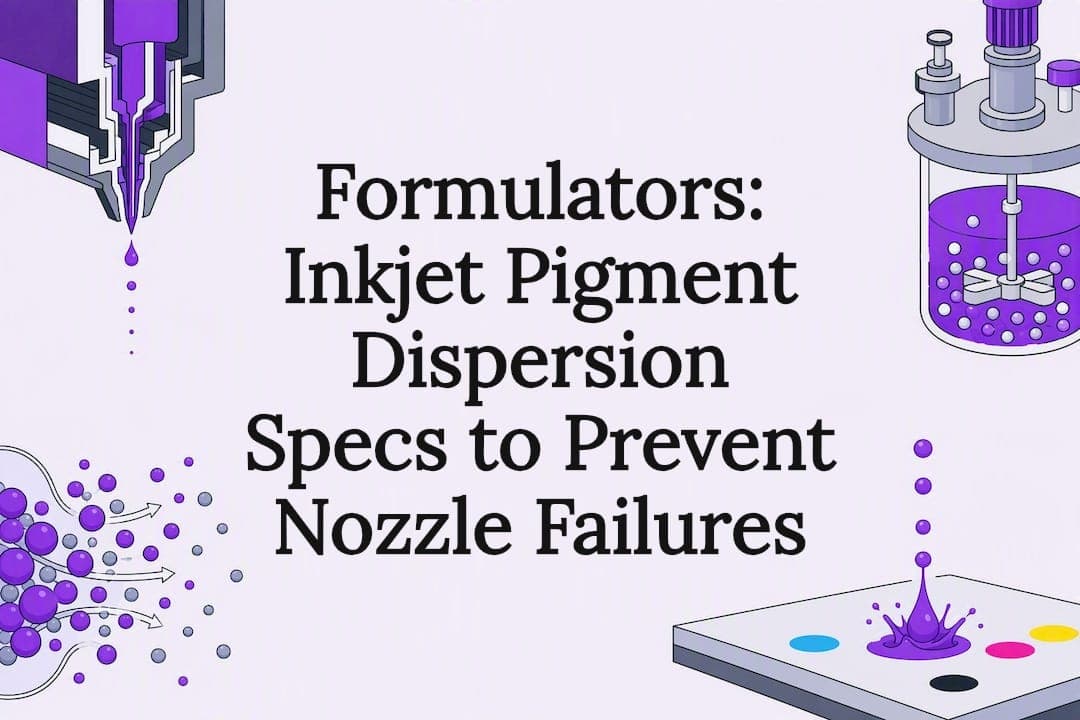
An inkjet pigment dispersion is a concentrated suspension of milled pigment particles stabilized in a liquid carrier, engineered to jet cleanly through a printhead without settling, flocculating, or clogging nozzles. Of every specification on a dispersion's data sheet, tight particle-size distribution paired with high ionic purity matters most. That combination determines printhead uptime over months of production and expands how much formulation latitude a chemist has when adjusting co-solvents.
TL;DR:
- Oversize particle counts are more critical than average particle size for preventing nozzle clogging and ensuring consistent printhead performance.
- Ionic contamination from polyvalent ions and trace organics can silently destabilize dispersions over time, even if initial qualification tests are passed.
- Particle size distribution, especially the tail of larger particles, should be measured using detailed methods like laser diffraction or light scattering, not just mean diameter.
- Cross-linked or encapsulated stabilization mechanisms outperform electrostatic systems in high-solvent or high-viscosity formulations, particularly for small-architecture printheads.
- Qualification protocols must include accelerated aging, sedimentation, and ionic purity tests to accurately predict long-term dispersion stability, preventing field failures.
A pigment dispersion does three jobs inside an aqueous ink: it carries insoluble colorant in a jettable liquid form, it resists reaggregation over the ink's shelf life, and it sets the ceiling on which other formulation ingredients you can use. Get the dispersion wrong, and no amount of downstream tweaking with humectants or surfactants will save the ink from clogging a printhead six weeks after it ships.
Each end-use application stresses the dispersion differently:
- Office and graphic arts printing demands fast drying and crisp edge definition on coated and uncoated stock without feathering.
- Packaging inks need dispersions stable enough to survive high-speed digital presses and adhesion to films, foils, or corrugated substrates, a segment where understanding the bag printing process is essential for selecting the right dispersion technology.
- Textile printing requires washfastness and colorfastness that survive repeated laundering cycles.
- Industrial and functional printing often runs at higher solids and viscosity, pushing dispersion stability limits harder than any office application.
Dispersion quality maps directly to drying behavior, substrate adhesion, and printhead uptime. A dispersion that resists desorption under solvent stress lets a formulator push drying speed with aggressive co-solvents, a trade-off Ink World has documented in high-performance aqueous systems, without triggering particle growth that clogs nozzles downstream.
Technical Attributes Every Formulator Should Specify and Measure
Before qualifying any pigment dispersion for inkjet, you need a checklist of measurable specs, not marketing adjectives. Here is what belongs on that checklist, in order of how often it causes field failures.
- Particle size distribution and oversize count. Mean particle size matters less than the tail of the distribution. For MEMS and other small-geometry printheads, the oversize particle fraction drives jetting reliability more than D50 or D90 alone, since a handful of coarse particles can deflect or block a nozzle that a thousand correctly sized particles pass through cleanly.
- Ionic contamination and trace organics. Polyvalent ions like calcium, magnesium, and iron accelerate flocculation over time, and trace impurities that seem harmless at qualification can silently destabilize a dispersion over months of storage, long after the batch has already shipped.
- Pigment concentration, color strength, and solids. These set your formulation math for shade matching and determine how much dilution room you have before viscosity or surface tension drift out of spec.
- Viscosity and surface tension windows. Printheads are tuned to narrow ranges; a dispersion that pushes either variable outside spec forces reformulation of every other ingredient in the ink.
- Microbial control and shelf-life indicators. Bio-contamination shows up as viscosity creep or odor long before visible spoilage, and it is one of the most preventable causes of returned batches.
Statistic Callout: Oversize particle counts, not average particle diameter, are the single measurement most correlated with printhead nozzle deviation and failure in small-architecture heads, according to AZoM's analysis of particle-size distribution in inkjet inks.
Pro Tip: Request a dynamic light scattering (DLS) or laser diffraction (LD) particle size report alongside a discrete Coulter or laser particle count above your printhead's nozzle diameter, not just the D50/D90 summary. A supplier who can only provide the summary numbers usually hasn't measured the tail that actually causes failures.
Dispersion Technologies and How They Stabilize Pigment Particles
Formulators generally choose between three stabilization mechanisms, and each carries distinct compatibility trade-offs worth understanding before you commit a formulation to one platform.
- Electrostatic stabilization relies on surface charge to keep particles apart; it works well in low-ionic-strength systems but degrades quickly when polyvalent ions or high-solvent-content co-solvents enter the formulation.
- Steric stabilization uses adsorbed polymer chains to create a physical barrier between particles, tolerating a wider range of co-solvents and surfactants than electrostatic systems alone.
- Surface-modified and encapsulated pigments, where a polymer shell is grafted or coated directly onto the pigment surface, improve adhesion to packaging films and resist desorption under aggressive solvent exposure better than simple adsorbed-polymer systems.
- Reactive or cross-linked stabilizers form a covalently bonded polymer network around the pigment. Patent literature on polymeric black pigment dispersions documents this approach specifically because cross-linked shells resist desorption far longer than physically adsorbed layers when the ink carries high humectant or co-solvent loads.
For small-architecture printheads where nozzle diameters leave little tolerance for particle growth, encapsulated or cross-linked chemistries generally outperform simple electrostatic dispersions. For textile applications where washfastness is the pass/fail criterion, cross-linked systems again tend to win because the bonded shell survives repeated laundering cycles that would strip a merely adsorbed polymer layer.
Selecting a Dispersant and Validating It on the Bench
Dispersant selection starts with surface area, not gut instinct. Astra-chemical's surface-area dosage method calculates a starting dosage from pigment particle size and specific surface area, giving formulators a defensible number to test against rather than an arbitrary percentage carried over from a previous project.
Once you have a starting dosage, run it through a validation sequence before committing to a full batch:
- Accelerated solvent stress testing. Expose the dispersion to your intended co-solvent package at elevated temperature for one to two weeks and track particle size drift.
- Humectant compatibility screening. Confirm the dispersion tolerates your glycol or glycol-ether humectant package without viscosity spikes or visible sedimentation.
- Nozzle ejection trials. Run the formulated ink on the actual printhead architecture you're targeting, whether thermal, piezo, or MEMS, and log misfire or deviation rates over an extended print run.
Acceptance criteria should specify oversize particle count limits above your nozzle diameter, a viscosity and surface tension window matched to the printhead manufacturer's spec, and, where available, a zeta potential band that confirms the stabilization mechanism is intact. If a bench batch fails ejection trials, check particle size drift first, then ionic contamination, before assuming the dispersant dosage itself is wrong.
Pro Tip: Keep a retained sample of every qualified batch at room temperature and at accelerated aging conditions side by side. When a customer reports a field issue eight months later, having that retain lets you distinguish a formulation problem from a shipping or storage problem in a single afternoon.
An R&D Checklist for Procurement and Quality Teams
Procurement and QC teams evaluating a pigment dispersion supplier need a short, unambiguous checklist rather than a stack of marketing claims to sort through.
- Request DLS or LD particle size distribution reports with explicit oversize counts, not just mean diameter.
- Confirm ionic contamination data for polyvalent ions and ask how the supplier controls trace organics during milling.
- Ask what bio-control measures protect shelf stability, particularly for multi-hurdle approaches that Kodak's technical team has highlighted as a differentiator for packaging and textile-grade dispersions.
- Verify pack sizes and lot-to-lot consistency data, since a dispersion that performs well in a small qualification batch can drift once scaled to production volume.
Dispersant choice and dosage are the levers most directly under a formulator's control for reducing oversize particle fractions and residual ionic load, which is why Astra-chemical publishes its pigment dispersion stability guide and dispersant dosage calculation method as working references rather than sales collateral. Technical support teams can also run sample dispersions through comparable stress and ejection protocols before a formulator commits to a production-scale trial.
Common Inkjet Pigments and Why Formulators Choose Them
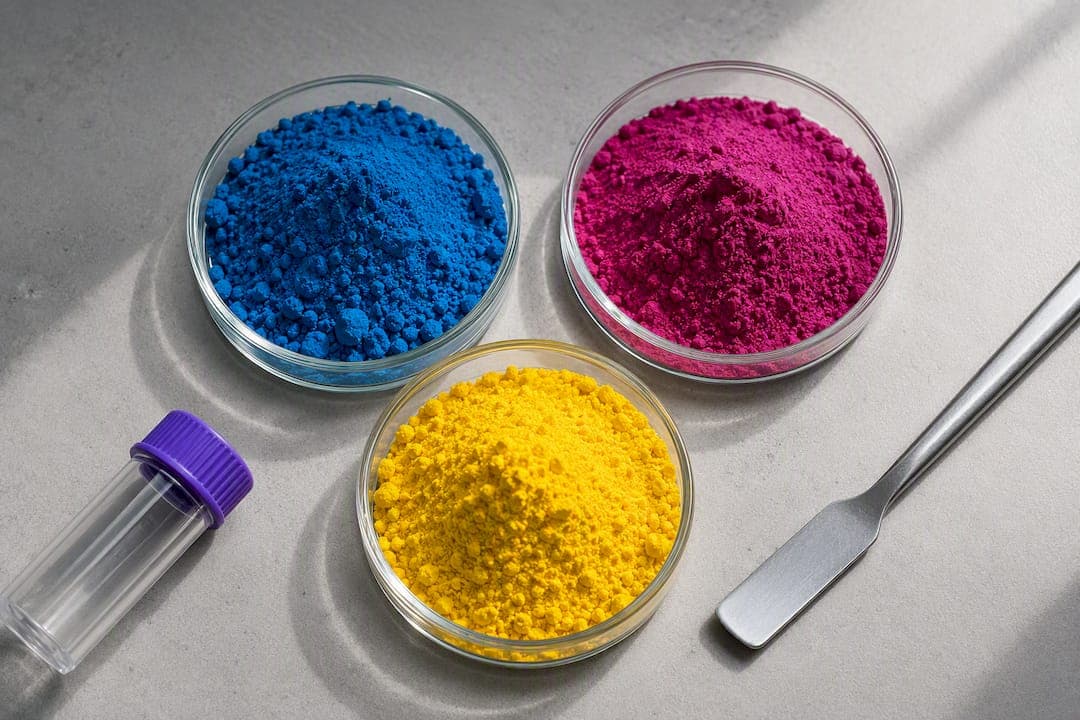
Most commercial aqueous inkjet inks build their color gamut from a small set of workhorse pigments, chosen because decades of use have proven their lightfastness, chroma, and dispersibility. PB15:3 (Copper Phthalocyanine Blue) anchors the cyan channel in nearly every commercial inkjet set, prized for high chroma and excellent lightfastness that holds up under years of outdoor or point-of-sale display exposure.
PR122 (Quinacridone Magenta) fills the magenta channel with strong chroma and good weatherability, though it can be more sensitive to milling conditions than phthalocyanine pigments, making tight process control during dispersion manufacture more important. PY74 (Arylide Yellow) remains a common yellow choice for its brightness and cost efficiency, though formulators working toward higher lightfastness specifications sometimes substitute a more weather-resistant yellow pigment depending on the end application.
These three pigments dominate not because they are the only chemistries available, but because their particle morphology disperses predictably at production scale, and decades of field data give formulators confidence in how they will behave under accelerated aging and UV exposure. A pigment with a less well-characterized crystal structure might match a target shade in the lab and still surprise a formulator with unexpected flocculation behavior six months into a production run. That track record, more than any single performance number, is why these pigments keep showing up across office, packaging, and textile inkjet formulations alike.
How Dispersion Quality Shows Up in Final Print Quality
Print quality problems that look like a printhead issue or a substrate issue often trace back to the dispersion itself. Color strength depends directly on how completely the pigment is de-agglomerated during milling; a poorly dispersed pigment leaves color strength on the table because light-scattering aggregates reduce the effective chroma per unit of pigment loading, forcing formulators to add more colorant than a well-dispersed system would require.
Gloss responds to particle size in a similar way. Coarse or poorly controlled particles scatter light unevenly at the print surface, producing a duller, less uniform finish, while a tightly distributed dispersion lays down a smoother film that reflects light more consistently across the printed area.
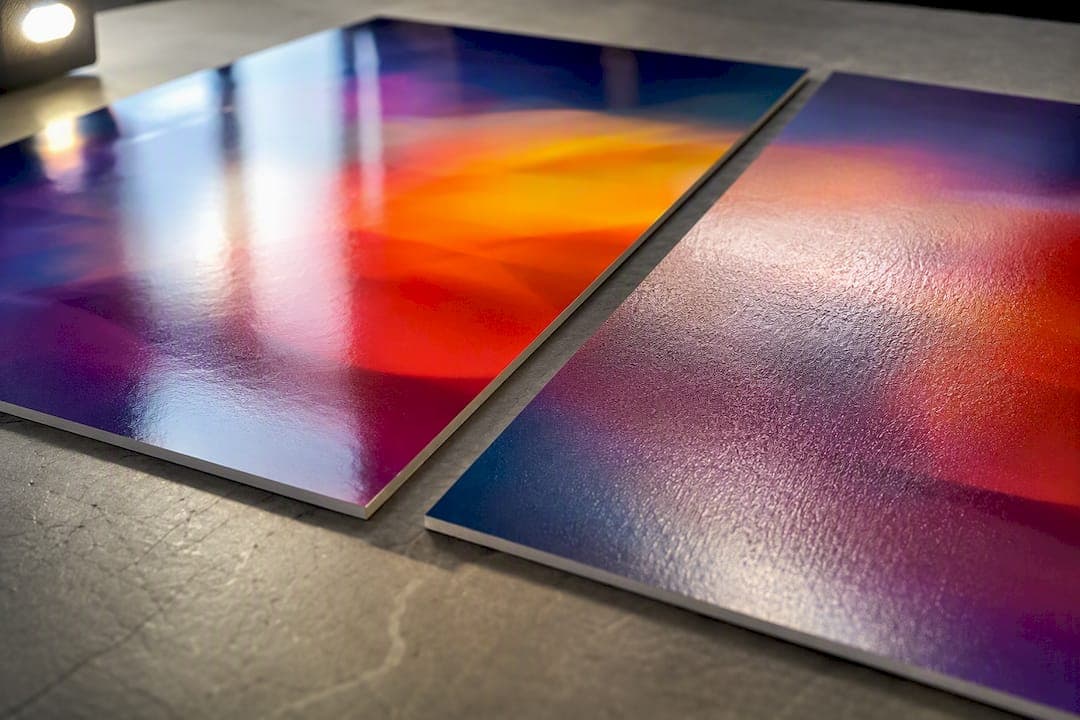
Durability, including rub resistance and washfastness for textile applications, ties back to how the pigment particle interacts with the binder or polymer network in the finished ink film. A dispersion with poor binder compatibility can leave pigment particles weakly anchored at the surface, where they abrade or wash out well before the substrate itself degrades. Formulators troubleshooting a durability complaint should check dispersion binder compatibility before assuming the fault lies with the substrate coating or the printing process itself, since a stable, well-anchored dispersion is often the difference between a print that survives a wash cycle and one that fades within weeks.
Testing Methods That Actually Predict Dispersion Stability
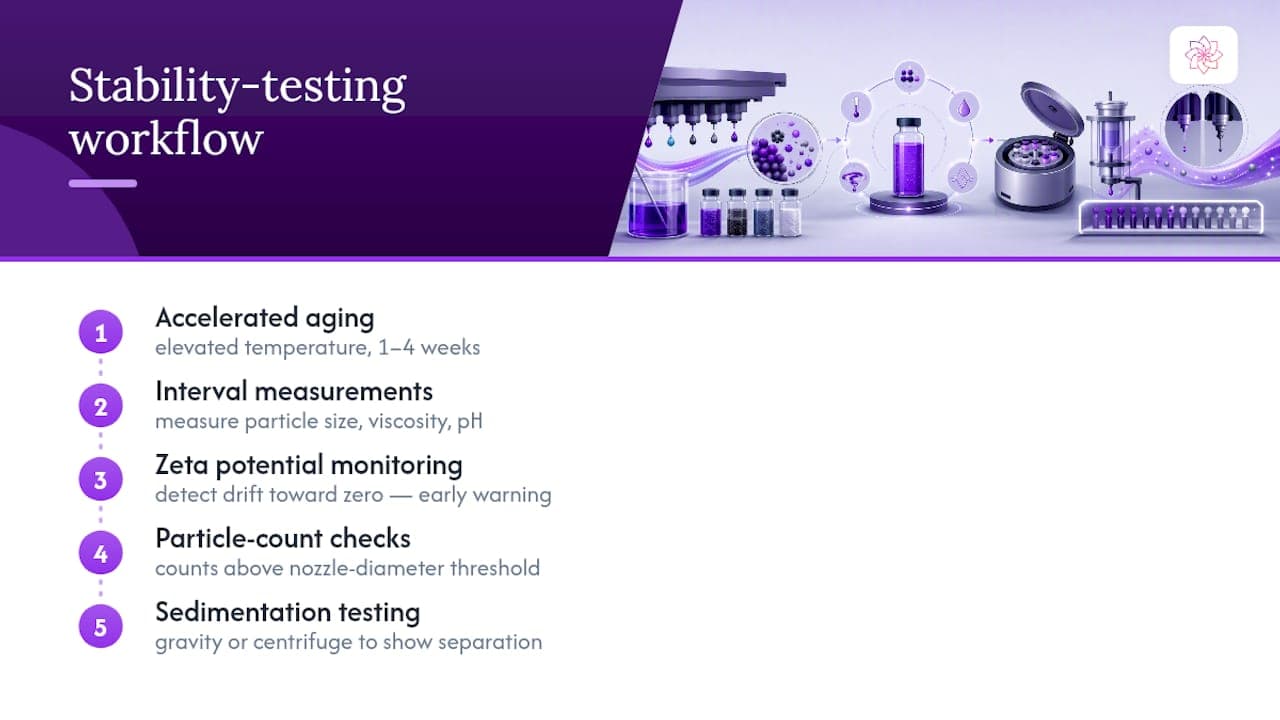
Zeta potential measurement quantifies the electrostatic charge stabilizing a dispersion, and a value that drifts toward zero over time signals that flocculation risk is rising even before visible particle growth appears. Formulators should treat zeta potential as an early warning system rather than a one-time qualification number, since a dispersion that measures well at time zero can still destabilize months later as trace contaminants accumulate or co-solvents interact with the stabilizing layer.
Sedimentation testing, whether by simple gravity settling over weeks or accelerated centrifugation over hours, gives a direct read on how quickly a dispersion separates under storage conditions. Centrifugal sedimentation compresses a months-long shelf test into a single afternoon, which makes it the practical choice for formulators screening multiple dispersant candidates before committing to a longer real-time study.
Accelerated aging, typically storage at elevated temperature for one to four weeks, forecasts long-term stability far faster than ambient shelf testing. Formulators should track particle size distribution, viscosity, and pH at each aging interval, since a shift in any of these three variables usually shows up well before a batch fails visually. Combining accelerated aging with periodic particle counts above the nozzle diameter threshold catches the oversize-particle growth that causes field failures long before a sedimentation layer becomes visible in the container.
The Specification-First Approach That Actually Prevents Field Failures
Most formulation teams still qualify dispersions on shade match and viscosity alone, then discover the real problems, oversize particle growth, ionic contamination, desorption under solvent stress, months later when a customer reports nozzle failures in the field. That sequencing is backwards. A dispersion that matches shade and viscosity perfectly at time zero tells you almost nothing about how it will behave after eight weeks in a warehouse at elevated temperature.
The conventional advice to "test viscosity and check the shade" undersells what actually predicts field performance. Oversize particle counts above the nozzle diameter threshold, ionic contamination data, and accelerated aging results catch the failures that ambient shelf testing and shade matching miss entirely. Formulators who build their qualification protocol around those three measurements, rather than treating them as optional extras, catch problems on the bench instead of in a customer's production line.
The reader should prioritize building an oversize-particle and ionic-purity screen into every incoming dispersion lot, even from a trusted supplier, because lot-to-lot drift at production scale is common and rarely shows up in a certificate of analysis that only reports mean particle size.
— Astra R&D Team
Sources
- Phthalo blue pigment — Natural Pigments
- Influence of particle-size distribution on jetting reliability — AZoM
- What's next for inkjet inks? A closer look at the dispersion shift powering better print — Kodak blog
- US20070043146A1 - Polymeric black pigment dispersions and ink jet ink compositions — Google Patents
FAQ
What Is Pigment Dispersion in Inkjet Ink?
Pigment dispersion is the process and resulting product of suspending finely milled pigment particles in a liquid carrier, stabilized against reaggregation, so the colorant can jet cleanly through a printhead nozzle.
Should Formulators Be Concerned About Dispersion Instability Over Time?
Yes. Trace polyvalent ions and organic contaminants can destabilize a dispersion gradually over months of storage even when it passes initial qualification, which is why accelerated aging and ongoing particle counts matter more than a single time-zero test.
Can Any Inkjet Printer Run Pigment-Based Ink?
No. Pigment inks require formulations specifically compatible with the printhead architecture in use, since MEMS, thermal, and piezo heads each have different tolerances for particle size and viscosity, and dye-based printers are not automatically qualified for pigment dispersions.
How Do You Fix an Unstable Pigment Dispersion?
Start by measuring particle size distribution and oversize count against the original specification, then check ionic contamination and zeta potential; most instability traces back to particle growth or contamination that a revised dispersant dosage or improved milling can correct.
What Is the Single Most Important Spec for Inkjet Dispersion Quality?
Tight particle size distribution with a low oversize particle count, paired with high ionic purity, since oversize particles are the primary driver of nozzle deviation and failure in modern small-architecture printheads.
Recommended
Testing additives for this application?
Send us your current formulation challenge and our technical team will recommend an ASTRA product package for lab screening.