Reduce Milling Time 20–60% for Formulators With Production Tested Tactics
Reduce Milling Time 20–60% for Formulators With Production Tested Tactics ! Decorative milling efficiency title card illustration To reduce milling time most reliably, prioritize media selection (smaller, higher-density beads), raise controlled tip speed and flow rate for multiple-pass grinding, and…

To reduce milling time most reliably, prioritize media selection (smaller, higher-density beads), raise controlled tip speed and flow rate for multiple-pass grinding, and correct dispersant chemistry and premix quality before touching anything else. Astra R&D Team's process reviews consistently find that these three levers, tested together in a structured trial, often shorten milling time by tens of percent without sacrificing particle size targets.
TL;DR:
- Correct feed particle size and proper dispersant dosage are the most influential factors, often reducing milling time by tens of percent without changing mill settings.
- Switching to denser or multimodal media, such as tungsten or yttria beads, can cut milling time by 20 to 60 percent but requires careful consideration of heat, wear, and compatibility.
- Mill design improvements like higher tip speeds and increased flow can shorten residence time, but they demand close monitoring of temperature, energy input, and screen open area to prevent issues.
- Maintaining equipment through regular cleaning of screens and separators, tracking bead wear, and inspecting seals minimizes delays caused by media compaction, clogging, and mechanical wear.
- Systematic experimental design using response-surface methodology and dosage sweeps uncovers optimal process combinations faster than trial-and-error, especially on difficult pigments or high-solids formulations.
Before adjusting mill settings, check whether the feed itself is the bottleneck. Coarse premix and undersized dispersant dosing force a bead mill to do deagglomeration work it was never designed for, which is the single most common reason milling runs longer than it should.
Work through these five checks in order, since each one builds on the last:
- Audit feed particle size. Compare your premix d90 against your bead diameter. Industry practice targets a feed d90 of roughly one-tenth the media size for efficient grinding. If your feed is coarser than that, add a premix or high-shear deagglomeration step before the mill.
- Trial denser or mixed-size media. Tungsten or yttria beads, or a multimodal bead mix, increase collision frequency versus standard zirconia at the same diameter.
- Raise tip speed incrementally. Move up in small steps while tracking specific energy (Espec, kWh/ton) and batch temperature at each increment.
- Run a dispersant dosage sweep. Test three to five dosage points at lab scale against your current chemistry to find the point where re-agglomeration stops slowing PSD progress.
- Confirm recirculation and screen health. Verify pump flow matches mill capacity and that the separation screen has enough open area to avoid bead compaction.
Pro Tip: Run steps 1 and 4 together in your first lab trial. A feed audit paired with a dosage sweep usually reveals whether your bottleneck is mechanical or chemical before you spend time adjusting the mill itself.
How Does Bead Size and Density Affect Milling Rate?
Smaller beads pack more collisions into the same mill volume, and denser beads deliver more kinetic energy per impact. Both effects shorten the time needed to break pigment agglomerates down to target fineness, which is why media selection is usually the first lever formulators test.
The mechanism is straightforward: a given volume of small beads has far more total surface area and far more contact points per second than the same volume of large beads. Denser media, at the same velocity, carries more momentum into each collision, so breakage happens faster per pass. A multimodal media mix4_web_2007.pdf) can outperform either size alone, because irregular bead motion disrupts the repetitive, predictable paths that single-size media falls into, generating more chaotic and effective collisions.
Statistic Callout: Comparative bead trials show that switching from standard zirconia to tungsten or yttria beads at similar diameters cut milling time by roughly 20 to 60 percent, depending on the pigment and target fineness.
That gain comes with trade-offs worth weighing before switching:
- Higher-density media generates more frictional heat, which can push viscosity and solvent loss problems if cooling isn't upgraded.
- Denser beads wear faster on the separator screen and rotor components, raising maintenance frequency.
- Tungsten carbide media costs considerably more per kilogram than zirconia, and procurement needs to weigh that against throughput gains.
- Not every screen and separator design is rated for the density and impact energy of tungsten media, so compatibility needs verification before a full production trial.
Which Mill Design Changes Cut Residence Time?
Mill architecture matters as much as media choice. High-energy pin mills with larger separation screens and higher tip speeds routinely achieve finer particle sizes in shorter residence times than disc agitator designs at comparable horsepower, because the rotor geometry generates more frequent, higher-intensity bead collisions per unit of energy input.
Tip speed defines how fast the rotor's outer edge moves and directly sets the kinetic energy transferred into each collision. Separation screen open area determines how much slurry can pass through per pass without bead carryover or clogging, and flow rate governs how many passes a given volume of material sees per unit time. High-flow, multiple-pass grinding, closer to plug flow than a single slow pass, produces more uniform particle-size reduction and often reaches target fineness faster than a single extended pass at low flow.
For readers evaluating screen and separator hardware more broadly, the tradeoffs between open area, media retention, and flow velocity mirror the same principles used in selecting the right separation media for industrial finishing processes.
When implementing these changes, work through this checklist:
- Increase tip speed in small increments, not one large jump, and log Espec after each step.
- Watch batch temperature closely, since faster tip speeds generate more heat per pass.
- Check for bead compaction at the screen face whenever flow rate changes.
- Confirm screen open area is adequate before increasing flow, or clogging will erase any time savings.
Pro Tip: Log Espec (kWh/ton) alongside PSD at every tip-speed increment. Plotting the two against each other reveals the point where additional energy input stops producing meaningful fineness gains, which is your practical ceiling for that formulation.
How Do Dispersant Choice and Premix Quality Shorten Milling?
Dispersant chemistry and dosage directly control how fast a formulation reaches its particle size target, because an undersaturated pigment surface re-agglomerates during milling and forces the mill to redo work it already finished. Getting dosage right is often a faster win than any hardware change.
The correct dispersant, dosed to fully wet and stabilize the pigment surface, prevents that re-agglomeration cycle and lets particle size distribution progress steadily instead of plateauing. Astra-chemical's technical teams typically recommend running a dosage sweep across three to five levels before finalizing a formulation, since underdosing is a far more common cause of extended milling than any mechanical limitation.
Three formulation factors deserve attention in sequence:
- Premix quality first. A proper premix step, with adequate wetting time before beads ever enter the picture, keeps feed d90 close to the target ratio against media size discussed earlier.
- Solids loading second. Higher solids concentration seems like it should speed things up, but past an optimum point it reduces bead mobility and collision frequency, which can extend milling time rather than shorten it.
- Viscosity and temperature last. Rising viscosity during milling, often from solvent evaporation or shear heating, slows bead movement and prolongs the run; active cooling and closed-loop temperature control prevent that drift. Practical studies on difficult pigments like carbon black show premix viscosity control has an outsized effect on milling rate and repeatability.
For a deeper walkthrough of dosage selection by chemistry type, see Astra-chemical's dispersant selection and dosage guide.
What Should You Measure to Know When to Stop Milling?
Over-milling wastes energy and mill time without improving product performance, so clear stopping criteria matter as much as the levers that get you there faster.
Track these endpoints during any milling run:
- D50 and D90 particle size, measured against your target specification, not an arbitrary "smaller is better" instinct.
- Viscosity trend, since a flattening curve after steady decline usually signals the dispersion has reached its practical limit.
- Color strength or tint development, especially for pigment systems where optical performance is the real endpoint.
- Short-term stability checks, a quick settling or gloss test that flags premature stopping before it reaches the plant floor.
Statistic Callout: In validated trials, a bead mix around 0.75 mm at 30 percent pigment loading reached a 128 nm particle size at 1.67 kWh/t specific energy, giving formulators a concrete energy-to-fineness benchmark to compare their own runs against.
Sample every 15 to 20 minutes during lab trials and correlate Espec against PSD at each point; production runs can extend that interval once the curve shape is established for a given formulation.
How Do You Maintain a Mill for Consistent Milling Performance?
Inconsistent milling times from batch to batch usually trace back to maintenance gaps, not formulation drift. A mill that ran a clean 4-hour cycle last month and needs 6 hours this month almost always has a mechanical explanation.
Screen and separator maintenance deserves the most attention, since partial clogging from bead fines or dried pigment buildup gradually restricts flow without triggering an obvious alarm. Inspect screens on a fixed schedule rather than waiting for a visible slowdown, and clean immediately after any batch involving high-viscosity or fast-drying formulations. Bead charge should be checked for volume loss and size distribution drift; worn beads lose mass and effective diameter over time, which quietly shifts your collision dynamics away from the profile you validated in trials.
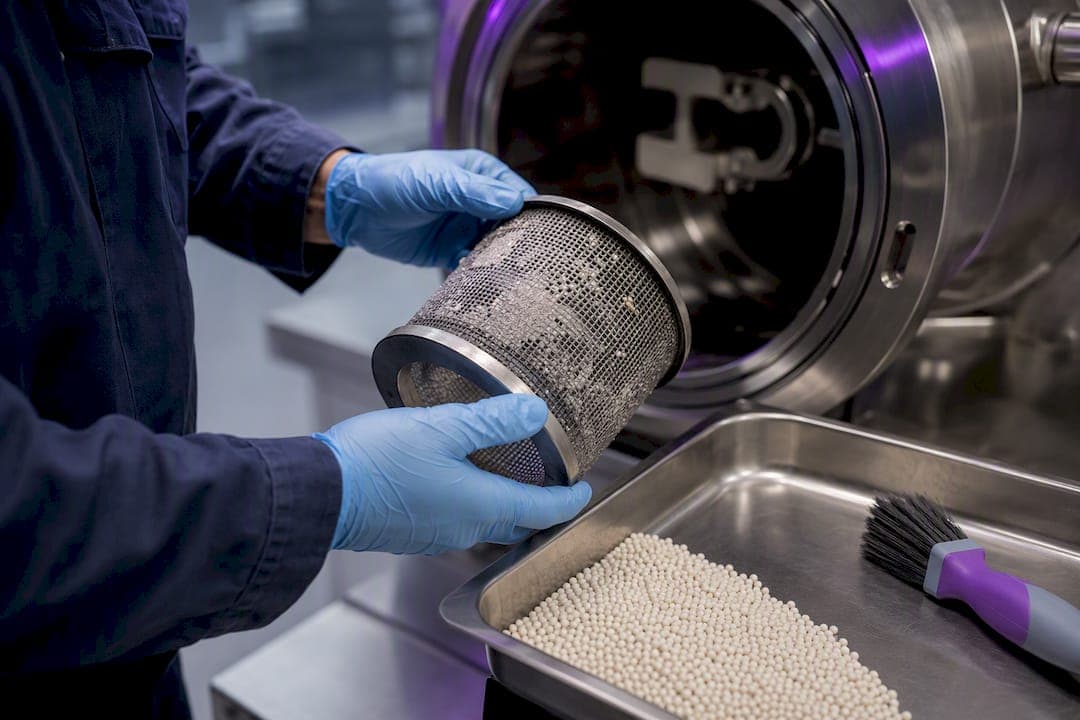
Seal and bearing wear on the rotor shaft is a second common culprit. A worn seal allows micro-leakage that changes flow dynamics inside the chamber, and a bearing running slightly out of tolerance changes effective tip speed even when the drive motor reading looks normal. Both failures show up first as an unexplained rise in milling time long before they show up as an outright mechanical failure.
Between batches, flush lines thoroughly to avoid cross-contamination that can alter dispersant performance in the next run, and log cleaning time itself as a production metric. A mill that takes 45 minutes to clean between colors instead of 20 is losing throughput just as surely as one that mills slower, and that time often gets overlooked in efficiency reviews focused only on grinding duration.
What Causes Extended Milling Times and How Do You Fix Them?
Most milling delays trace back to one of three recurring problems: media compaction, screen clogging, or bead wear that has gone unnoticed.
Bead compaction happens when flow rate and bead volume are mismatched, packing media against the screen instead of letting it circulate freely. The fix is straightforward: reduce bead charge slightly or increase flow rate, then recheck Espec to confirm collision energy hasn't dropped along with the compaction.
Screen clogging shows up as a gradual pressure rise and a slowing feed rate, often before a full stoppage. Root causes usually include undersized separation screen open area for the flow rate in use, or pigment particles that were never adequately premixed and are now blinding the screen mesh. A screen upgrade or a return to the feed-audit step covered earlier often resolves this permanently rather than treating it as a recurring cleaning problem.
Media wear is the quietest of the three because it develops gradually. Beads lose both mass and sphericity over hundreds of cycles, and worn media transfers less kinetic energy per collision even at constant tip speed. Track bead charge weight monthly and replace at a fixed wear threshold rather than waiting for milling times to visibly creep upward, since by the time the trend is obvious in production data, several batches have already run inefficiently.
A fourth, less obvious cause is dispersant depletion mid-run on formulations with marginal dosage. If milling time extends specifically on certain pigment lots but not others, revisit the dosage sweep discussed earlier rather than assuming a mechanical fault.
How Do You Design Experiments to Systematically Cut Milling Time?
Ad-hoc parameter tweaking finds local improvements, but systematic experimental design finds the actual optimum faster and with fewer wasted trial runs.
Response-surface methodology and ANOVA-based trial design let formulators vary bead size, bead mix ratio, pigment loading, and mill speed simultaneously rather than one variable at a time, which is both faster and more revealing of interaction effects. A validated optimization study using this approach identified a near-optimal combination that balanced narrow particle size distribution against minimum specific energy consumption, something a single-variable sweep would likely have missed.
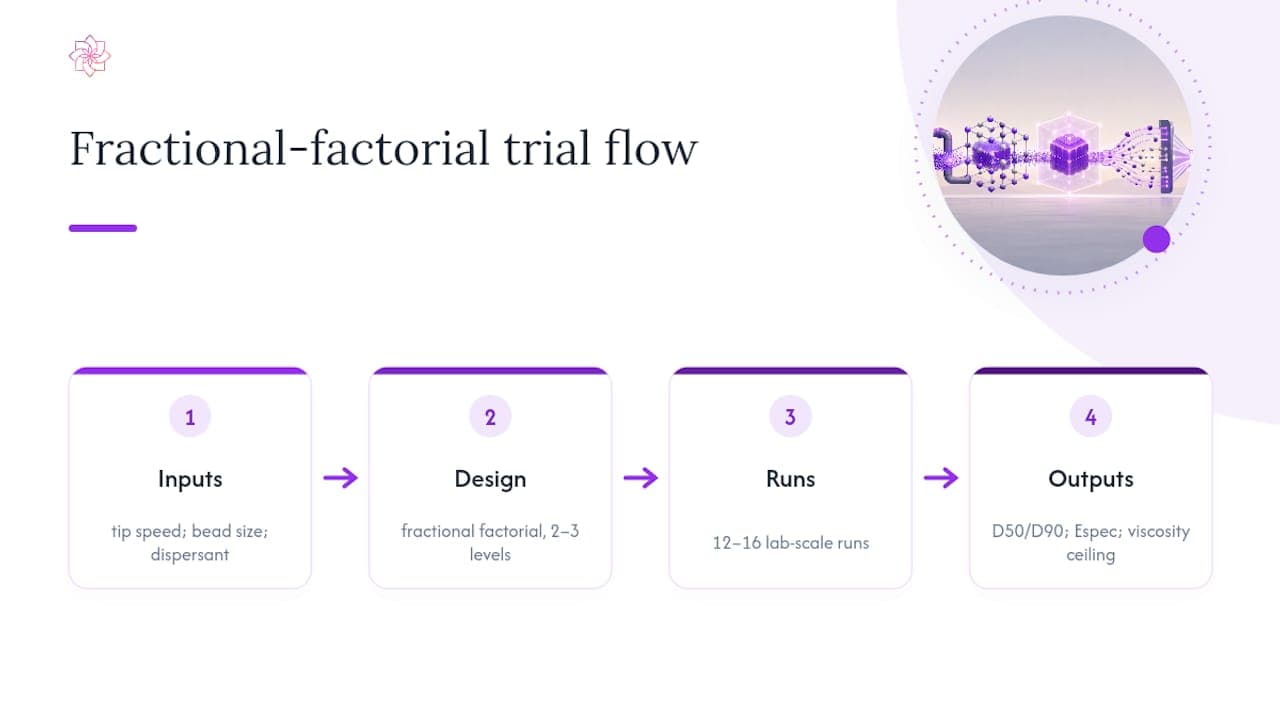
A practical trial structure for your own formulation looks like this: define your response variables first (target D50/D90, maximum acceptable Espec, viscosity ceiling), then set two or three levels for each of your key inputs, tip speed, bead size, and dispersant dosage being the usual starting three, and run a fractional factorial design rather than testing every combination exhaustively. Twelve to sixteen lab-scale runs typically reveal the dominant factors and their interactions clearly enough to set a production trial with confidence.
Choosing an easier-to-disperse pigment grade, where supply allows, is often the fastest throughput win available and should be tested alongside process changes rather than treated as a separate decision.
Astra R&D Team's Perspective: What Trials Actually Reveal
Astra R&D Team's diagnostic sequence for milling time complaints follows a consistent path: feed quality control first, then a lab-scale bead and media screen, followed by a dispersant dosage sweep, a pilot run, and finally scale-up validation. Skipping straight to mechanical changes is the most common mistake production teams make, since a large share of "slow mill" complaints trace back to underdosed dispersant or an out-of-spec premix rather than the machine itself.
The gap between what formulators expect from a media swap alone and what a coordinated trial delivers is usually significant. Bead selection alone might shave a modest percentage off milling time; combined with a corrected dosage and a validated tip-speed increase, the cumulative reduction is typically far larger. Readers running their own trials should test the pigment dispersion fundamentals and dosage relationship before assuming a hardware limitation exists at all.
— Astra R&D Team
ASTRA DISP® Dispersants: Built to Cut Re-Agglomeration Time
Astra-chemical's ASTRA DISP® dispersant line is formulated specifically to prevent the re-agglomeration cycle that quietly extends milling time on marginal dosage. Where competing dosage strategies leave pigment surfaces partially wetted, ASTRA DISP® targets faster surface saturation, which lets particle size distribution progress steadily toward target fineness instead of plateauing mid-run.

For carbon black and other difficult-to-disperse pigments, the wetting speed difference shows up directly in reduced pass counts; formulators working with these systems should review Astra-chemical's carbon black dispersion methods alongside any dosage trial. A technical inquiry gets the fastest, most useful response when it includes your vehicle chemistry, target PSD, solids loading, current mill type, and existing milling time, since that lets Astra-chemical's technical team benchmark your current process before recommending a dosage or chemistry change.
Request a sample or a guided technical consultation through the ASTRA DISP® product page to start a dosage sweep against your current formulation, or browse the full additive catalog if defoaming or rheology issues are compounding your milling challenges.
Sources
For deeper technical grounding, the particle size optimization study covers ANOVA-based parameter design in detail, while the dispersion effectiveness comparison breaks down bead-type performance data. Astra-chemical's titanium dioxide dispersion guide addresses high-solids, low-viscosity systems specifically.
- Grinding and process considerations (industry/process note)
- Improved effectiveness of dispersion processes with microsphere mills (Oliver + Batlle)
- Practical milling and dispersion studies for high-viscosity/difficult pigments (carbon black examples)
FAQ
What Is the Fastest Way to Reduce Milling Time?
Correcting dispersant dosage and premix feed size typically delivers the fastest gains, since re-agglomeration from underdosing is the most common hidden cause of extended milling runs.
Do Smaller Beads Always Mill Faster?
Not always. Smaller beads increase collision frequency, but only when feed particle d90 is properly matched to media size; mismatched feed can offset the benefit entirely.
How Much Time Can Bead Selection Save?
Comparative trials show switching to higher-density media like tungsten or yttria beads cut milling time by roughly 20 to 60 percent depending on the pigment and target fineness.
What Causes Milling Time to Creep Up Over Several Batches?
Gradual bead wear, screen clogging from unremoved pigment buildup, and worn seals or bearings on the rotor shaft are the three most common causes of a slow, unexplained rise in milling time.
Can Dispersant Choice Reduce Milling Time as Much as Mill Settings?
Yes. A dosage sweep with the correct dispersant chemistry, such as Astra-chemical's ASTRA DISP® line, often matches or exceeds the time savings from mechanical adjustments alone, and the two combined produce the largest reduction.
Recommended
Testing additives for this application?
Send us your current formulation challenge and our technical team will recommend an ASTRA product package for lab screening.