No New Chemistry Needed: Pilot Scale Additive Testing for Formulators
No New Chemistry Needed: Pilot Scale Additive Testing for Formulators ! Technician sampling a pilot mixing vessel Pilot-scale additive testing is the controlled, intermediate production stage that verifies additive performance and critical process parameters before commercial scale-up.
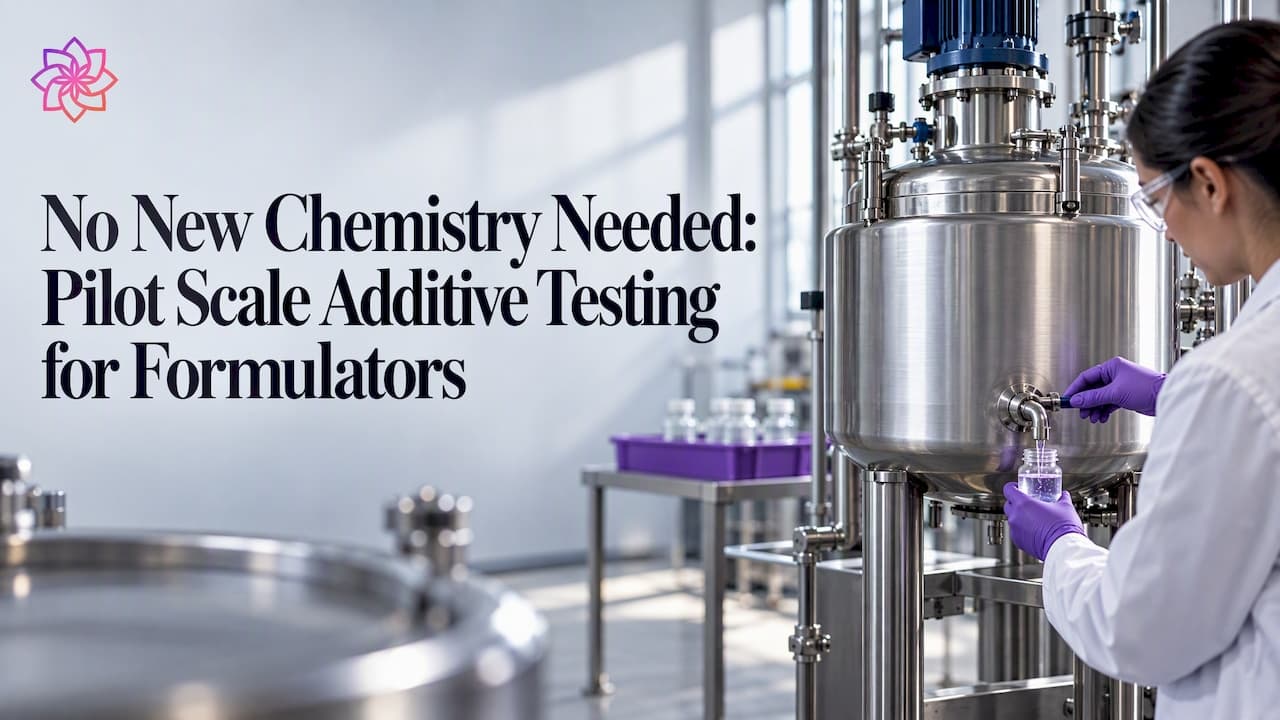
Pilot-scale additive testing is the controlled, intermediate production stage that verifies additive performance and critical process parameters before commercial scale-up. It confirms formulation stability under realistic operating conditions, identifies the process variables that govern outcomes at production volume, and reduces the risk of costly surprises during full deployment. This article outlines the test sequence, measurement priorities, and a practitioner checklist formulation teams can apply directly.
TL;DR:
- Pilot tests should be conducted whenever process configuration changes or new additives are introduced to ensure performance stability at volume.
- Critical process variables include temperatures, residence time, and dosing ratio, which must be monitored consistently during pilot runs.
- Results are most reliable when sample plans specify frequency, location, control samples, and baseline drift logging to distinguish effects from process noise.
- Pilot batches in regulated industries may require cGMP-like controls, documentation, and validation, depending on the application's compliance obligations.
- Successful scale-up depends on comparing normalized percent changes against predefined acceptance criteria, with extended, replicated trials better quantifying additive effects.
Lab-scale work answers whether a formulation performs in principle, under conditions that rarely match production reality. Pilot-scale testing answers a different question: whether that performance holds when residence time, mixing intensity, and dosing hardware resemble the commercial line. Pilot-scale processing evaluates critical variables such as injection temperatures, residence time, and additive-to-substrate ratios to verify stability and effect before scaling, which lab bench trials cannot replicate.
Certain triggers make a pilot run necessary rather than optional:
- A new additive chemistry is being introduced into an existing process line.
- The process configuration changes (new mixing equipment, altered flow path, different injection point).
- Scale-dependent risks exist, such as shear sensitivity or thermal degradation that only appears at volume.
A well-run pilot should produce validated operating ranges, inputs for standard operating procedures, and documented test data that becomes the template for commercial SOPs rather than a one-off data dump.
Key variables and metrics to capture in pilot tests
Pilot programs generate the most value when measurement priorities are fixed before the first run starts. Process variables and product metrics answer different questions, and both need a defined sampling plan to be usable.
Process variables to track:
- Injection and in-line temperatures at the dosing point and downstream.
- Residence time through the relevant process zone.
- Dosing ratio and its consistency over the run.
- Mixing intensity or shear exposure at the additive introduction point.
Product metrics to track:
- Rheology (viscosity profile, yield stress where relevant to the application).
- Particle size distribution and stability over time.
- Impurity or emission metrics where the application requires them.
A peer-reviewed pilot study using a replicated 2,000 km test cycle recorded measurable reductions in CO2 output and fuel consumption after additive introduction, according to a 2025 experimental evaluation. The result illustrates why extended, replicated pilot runs, not single-pass trials, are needed to quantify a real additive effect against normal process variation. Sampling plans should specify frequency, sample location, control samples run in parallel, and a method for logging baseline drift so that later analysis can separate additive effect from process noise.
Pilot test sequence and timeline
A structured pilot sequence follows three phases: baseline, run-in, and conditioned testing. EPA test and quality assurance protocols for additive evaluation describe this structure as the standard approach for generating comparisons robust enough to support a scale-up decision.
- Baseline period: run the process without the additive, under conditions matching planned pilot operation, to establish a control dataset against which every later measurement is compared.
- Run-in (equilibration) period: introduce the additive at the target dosing ratio and hold operation until the system reaches equilibrium, evidenced by stable readings across consecutive sampling intervals rather than a fixed clock time.
- Conditioned test runs: collect replicate measurements at steady state, then calculate percent change against the control period for each metric of interest.
Run-in duration depends on the process and the additive's mode of action; some systems equilibrate within hours, others require days of continuous dosing before readings stabilize. Ramping the dose gradually during run-in, rather than stepping directly to target concentration, helps distinguish a genuine equilibration curve from an instrument artifact.
Designing the pilot: equipment, dosing hardware, and controls
Equipment choices during pilot design determine whether results transfer to production. The pilot line should preserve the flow path geometry, shear profile, and residence time distribution of the intended commercial process, because a pilot rig that shortcuts these design principles produces data that does not extrapolate.
Dosing and sampling hardware deserve particular attention:
- Use calibrated dosing pumps with verified output, not estimated settings.
- Place injectors at the location planned for commercial use, not wherever is most convenient on the pilot rig.
- Maintain totalizer records correlated with feed or fueling records to confirm actual dosing delivered.
EPA test plans for additive verification describe supplying calibrated dosing pumps, using totalizers cross-checked against fueling records, and sending multiple additive and process samples to independent labs for elemental analysis, a practice that catches dosing drift before it corrupts a full test cycle.
Operational controls matter as much as hardware. Schedule maintenance windows outside active test periods, have a witness present for critical operations such as dosing changeovers, and log data continuously to avoid confounding variables that surface only in post-run analysis.
Pro Tip: Log every unplanned process event, however minor, during the pilot run: a five-minute pump stoppage or a temperature excursion can explain an outlier better than any statistical correction after the fact.
Regulatory and quality considerations for pilot batches
Pilot batches in regulated industries are not exempt from quality controls simply because they precede commercial production. FDA guidance on chemistry, manufacturing, and controls states that pilot-scale batches may require cGMP-like controls, equipment and SOP equivalence to the intended commercial line, and documented validation whenever a batch-size change exceeds established thresholds.
Practical implications for pilot planning:
- Confirm early whether the intended application (pharmaceutical, food-contact, or regulated industrial use) triggers cGMP obligations at pilot scale.
- Reference applicable guidance, including FDA CMC documentation and, for pharmaceutical scale-up, SUPAC principles, to understand documentation expectations before the run begins.
- Structure pilot records (batch records, analytical reports, deviation logs) so they can support future regulatory filings or supplier qualification audits without rework.
A pilot batch manufacturing checklist that distinguishes batch manufacturing records from batch production records offers a useful reference point for teams building documentation practices for the first time.
Interpreting pilot results: scale up or iterate
Raw pilot numbers mean little without normalization against the baseline period. Percent change versus control, calculated separately for each critical process parameter and critical quality attribute, is the standard way to express a pilot result in a form production leaders can act on.
Before the run, set acceptance bands for each parameter that distinguish a practically meaningful change from noise within normal process variation. A result that clears a statistical threshold but falls short of a practically meaningful improvement does not justify a scale-up decision on its own.
Common failure signatures and their typical next step:
- Metrics that never stabilize during run-in suggest the equilibration period was too short; extend it before drawing conclusions.
- Replicate runs with wide scatter point to equipment or dosing inconsistency rather than additive performance.
- A result that meets bench-scale expectations but fails at pilot scale often signals a shear, thermal, or residence-time effect that only appears at volume, warranting equipment adjustment before reformulation is considered.
Practitioner checklist for pilot-scale testing
A pilot run generates usable data only when deliverables are defined before the equipment starts. Astra R&D structures pilot support around three checkpoints.
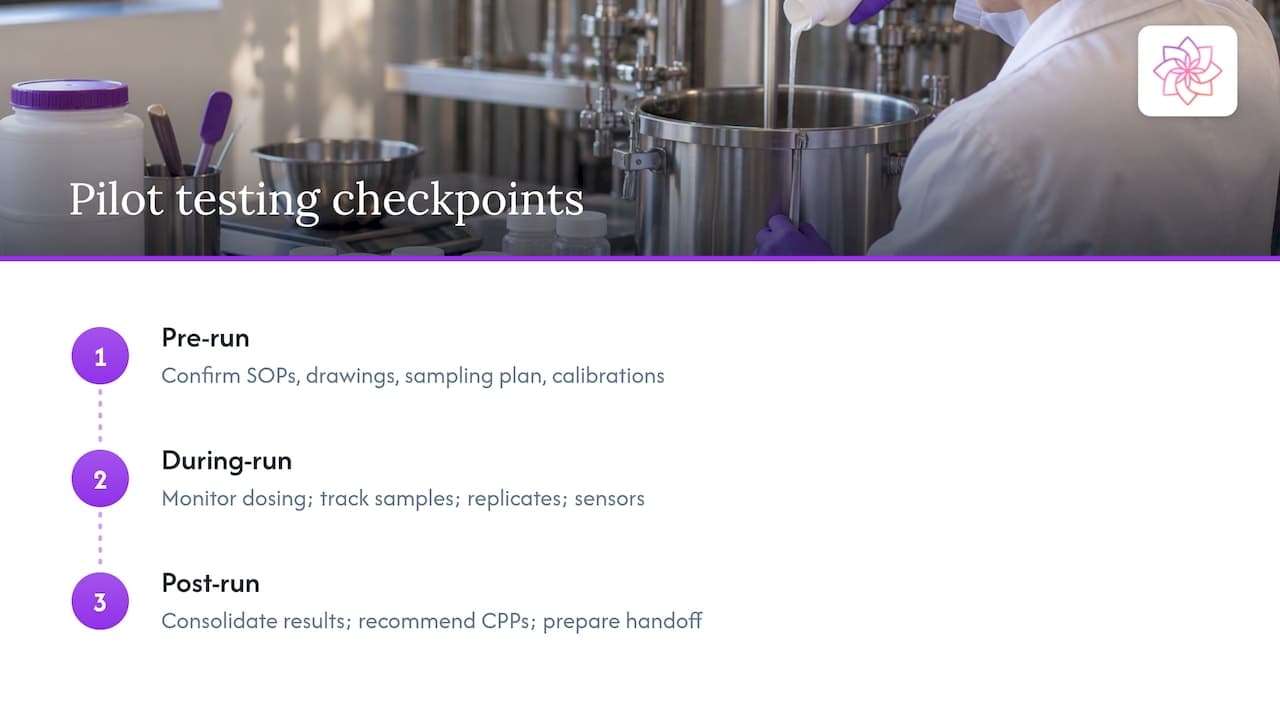
Pre-run: confirm SOPs, process drawings, the sampling matrix, acceptance criteria, and instrumentation calibration records are complete before dosing begins.
During-run: verify dosing continuously, label and track samples with a clear chain of custody, follow a defined replicate strategy, and use in-line sensors where they have been validated against lab analytics.
Post-run: consolidate analytical results into a single report, recommend critical process parameters for production, and prepare a handoff checklist for the scale-up team.
Pro Tip: Build the post-run handoff checklist before the pilot starts, not after: it forces the pre-run deliverables to match what production will actually need.
Why pilot testing deserves budget and schedule early
Pilots de-risk capital commitments and shorten commissioning time by surfacing equipment and formulation problems while they are still inexpensive to fix. Cross-functional planning, involving process engineering, quality, and the additive supplier from the start, consistently improves outcomes over pilots run in isolation. Pilot support is structured around documenting learnings in a form that transfers directly to production handoff.
— Astra R&D Team
How a chemical additive supplier can support your pilot-scale program
Formulation teams running a pilot rarely need more chemistry, they need faster answers on dosing and documentation. Technical consultation is provided alongside dispersant, defoamer, and rheology modifier products, with tailored sample kits sized for pilot volumes and dosing and injection guidance drawn from formulation work across coatings, adhesives, inks, plastics, and composites.
Astra also supports the deliverables a pilot team needs to hand off: analytical summaries, SOP inputs, and documentation to support supplier qualification. Teams evaluating a dispersant or defoamer for an upcoming pilot can review the full product catalog or request a sample evaluation to build pilot data before committing to full-scale volumes.
Sources
- Pilot-scale processing capabilities — Callaghan Innovation
- US EPA: Test and Quality Assurance Plan for ACES-II Diesel Additive
- Experimental evaluation of a novel diesel additive — MDPI (2025)
- FDA CMC guidance (pilot scale and scale-up considerations)
FAQ
What is a pilot scale?
Pilot scale is an intermediate production stage between laboratory bench work and full commercial production, run to verify formulation stability and process performance under conditions closer to real operating equipment. It typically uses equipment that preserves the flow path, shear profile, and residence time of the intended commercial line.
What are the differences between pilot scale and lab scale research?
Lab-scale research tests whether a formulation works in principle, often under simplified conditions that do not reflect production equipment. Pilot scale tests whether that performance holds under realistic process conditions, including actual dosing hardware, mixing intensity, and residence time, which is why pilot testing is treated as a distinct verification step rather than a larger lab experiment.
What is a pilot scale batch in the pharmaceutical industry?
In pharmaceutical manufacturing, a pilot scale batch is a defined intermediate batch size used to validate a process before full commercial production, and FDA guidance requires documented validation when batch-size changes exceed established thresholds. These batches often require the same cGMP-style controls, equipment equivalence, and SOP documentation expected at full commercial scale.
What are the GMP considerations for a pilot plant study?
Pilot plant studies in regulated industries may need cGMP-like controls, equipment and SOP equivalence to the intended commercial process, and documented validation records, according to FDA CMC guidance. Teams should confirm cGMP applicability before the run begins so that batch records and analytical reports are structured to support later regulatory filings or supplier qualification.
How long should a pilot test run before scaling up?
Pilot test duration depends on how quickly the process reaches equilibrium during run-in, evidenced by stable readings across consecutive sampling intervals rather than a fixed time period. Structured pilot protocols call for a baseline period, a run-in period until equilibrium, and a conditioned test period with replicates before results are considered reliable enough to support a scale-up decision.
Recommended
Testing additives for this application?
Send us your current formulation challenge and our technical team will recommend an ASTRA product package for lab screening.