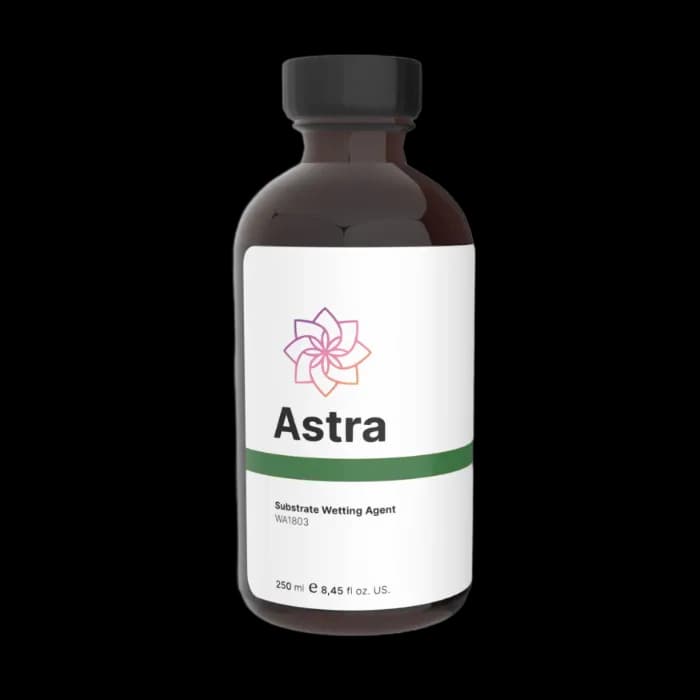
ASTRA WA®
Wetting Agents
Substrate wetting agents. Significantly reduce surface tension, prevent craters, improve flow and leveling. Some grades also have defoaming properties.
Why use substrate wetting agents?
When a coating cannot properly wet the substrate, it forms craters, fisheyes and dewetting defects. Wetting agents dramatically lower surface tension so the coating spreads evenly across difficult substrates like plastics, metals contaminated with oil, and low-energy surfaces.
Key Benefits
- Significant surface tension reduction
- Crater and fisheye prevention
- Better flow and leveling on difficult substrates
- Some grades also defoam
- Compatible with solvent, water and UV systems
- Improves edge coverage on sharp features
Impact on Coating Performance
ASTRA WA agents eliminate the most frustrating defects on contaminated or low-energy substrates. The result: cleaner finishes, lower reject rates and higher production yields.
O – organosoluble, WB – water-based, RC – radiation-curable
Product Catalog
Download TDS| Active % | Feature | TDS | Samples | |||
|---|---|---|---|---|---|---|
| ASTRA WA-3103 | Surfynol 104E | Water-based | 50% | Multifunctional additive, excellently wets the substrate, works as a defoamer and prevents foam formation, reduces surface tension, can work as a dispersant. For printing inks. | ||
| ASTRA WA-3403 | Surfynol 465 | Water-based | 100% | Good solubility in water, ensures substrate wetting, high cloud point, therefore remains transparent in high temperature curing systems. | ||
| ASTRA WA-3803 | — | Water-based / Radiation-curable | 90% | Wetting agent, affects spreading on the substrate and wetting of pigments, increases the resistance of the coating to wet abrasion. Increases associative interactions in the system. |
Articles about ASTRA WA®
Additive Supplier Collaboration: 2–3 Partners, Faster Formulation
Additive Supplier Collaboration: 2–3 Partners, Faster Formulation ! Formulation scientists reviewing an additive trial sample Collaborating with additive suppliers moves procurement from transactional buying to joint formulation and faster product improvements.
Read
Millbase Viscosity Control: Replace One Target with Shear Windows
Millbase Viscosity Control: Replace One Target with Shear Windows ! Disperser mixing pigmented millbase in vessel Stable millbase viscosity comes from defining a shear-specific rheological profile, selecting dispersant and rheology modifier chemistry suited to the pigment and equipment, and controll…
Read
Avoid Six Week Recoat Failures with Astra R&D Defoamers for Formulators
When recoatability is the binding constraint, non-silicone defoamers or very low-dose, engineered polysiloxanes outperform conventional silicone chemistries because they minimize surface migration and intercoat contamination. The second lever is process control: incorporation shear, droplet or particle loading, and the add point (millbase versus let-down) determine whether a chemically sound defoamer behaves well in production. We recommend validating both choices with ISO-style recoat testing before scale-up.
ReadNeed technical assistance?
Our team can help you select the right additive for your formulation.
Contact Technical Support