ASTRA F®
Functional Additives
Catalysts, dryers, antistatics and special additives to improve performance: elasticity, moisture resistance, salt spray resistance, hardness, conductivity.
Why functional additives matter
Functional additives are catalysts, dryers, antistatics and special compounds that fine-tune the performance of coatings. They improve elasticity, moisture resistance, salt-spray resistance, hardness and even electrical conductivity — properties that base resins alone cannot deliver.
Key Benefits
- Crosslinking catalysts for faster cure
- Drying accelerators for alkyd systems
- Antistatic properties for sensitive surfaces
- Improved elasticity and moisture resistance
- Enhanced hardness without brittleness
- Salt-spray and corrosion protection boost
Impact on Coating Performance
ASTRA F additives let formulators differentiate their products with measurable performance gains: higher hardness, longer salt-spray hours, better elasticity. Critical for industrial, marine and consumer-grade coatings.
O – organosoluble, WB – water-based, RC – radiation-curable
Product Catalog
Download TDS| Active % | Feature | TDS | Samples | |||
|---|---|---|---|---|---|---|
| ASTRA F-509 | BYK-ES80 | Solvent-based / Radiation-curable | 100% | Special compound of quaternary amine. Easily soluble in most solvents. Improves anti-static properties. |
Articles about ASTRA F®
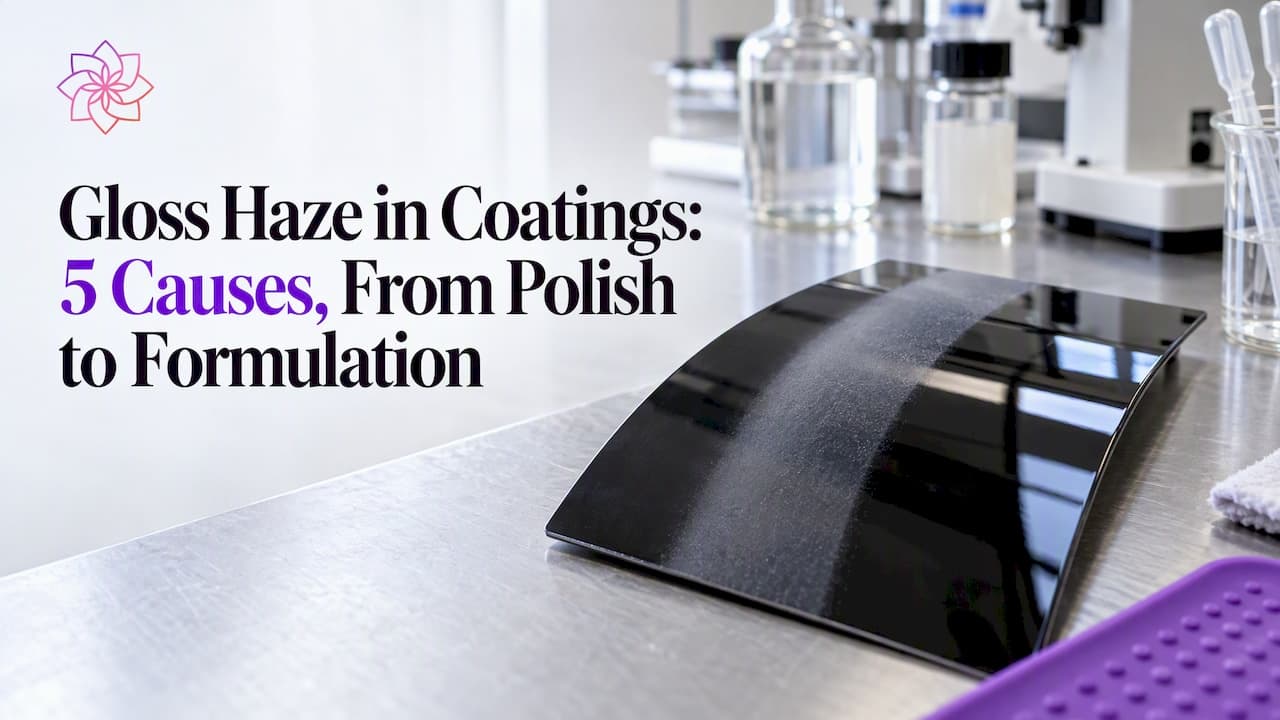
Gloss Haze in Coatings: 5 Causes, From Polish to Formulation
Gloss Haze in Coatings: 5 Causes, From Polish to Formulation ! Hazy band across a glossy black coating Reflection haze is a milky scattering of light near the specular highlight on an otherwise glossy film, and when it appears right after polishing or application, an isopropyl alcohol wipe followed…
Read
Stop Costly Resprays: 3 Lab Checks to Fix Gloss Loss in Paint
Gloss loss, often called dieback, is the dulling or hazing of a paint film after it appeared to cure normally, and it almost always traces back to solvents still trapped beneath the surface or a curing reaction gone wrong. The immediate action is simple: stop applying additional coats, give the film uninterrupted cure time in stable conditions, and check tack before deciding whether the problem is application error or something deeper in the formulation.
Read
Four Lab Checks Formulators Use to Fix Haze in Clearcoats, from R&D
Four Lab Checks Formulators Use to Fix Haze in Clearcoats, from R&D ! Clearcoat haze troubleshooting title card Haze in clearcoats almost always traces back to one of five sources: particle scattering, refractive-index mismatch, poor millbase dispersion, additive migration, or moisture entrapment du…
ReadNeed technical assistance?
Our team can help you select the right additive for your formulation.
Contact Technical Support