Surfactant Leaching in Paint: Causes, Diagnosis and Formulation Controls
Surfactant Leaching in Paint: Causes, Diagnosis and Formulation Controls ! Water streaks marking a painted interior wall Surfactant leaching is the concentration of water-soluble ingredients on the surface of a latex coating, which occurs when moisture reaches the film before it has fully cured.
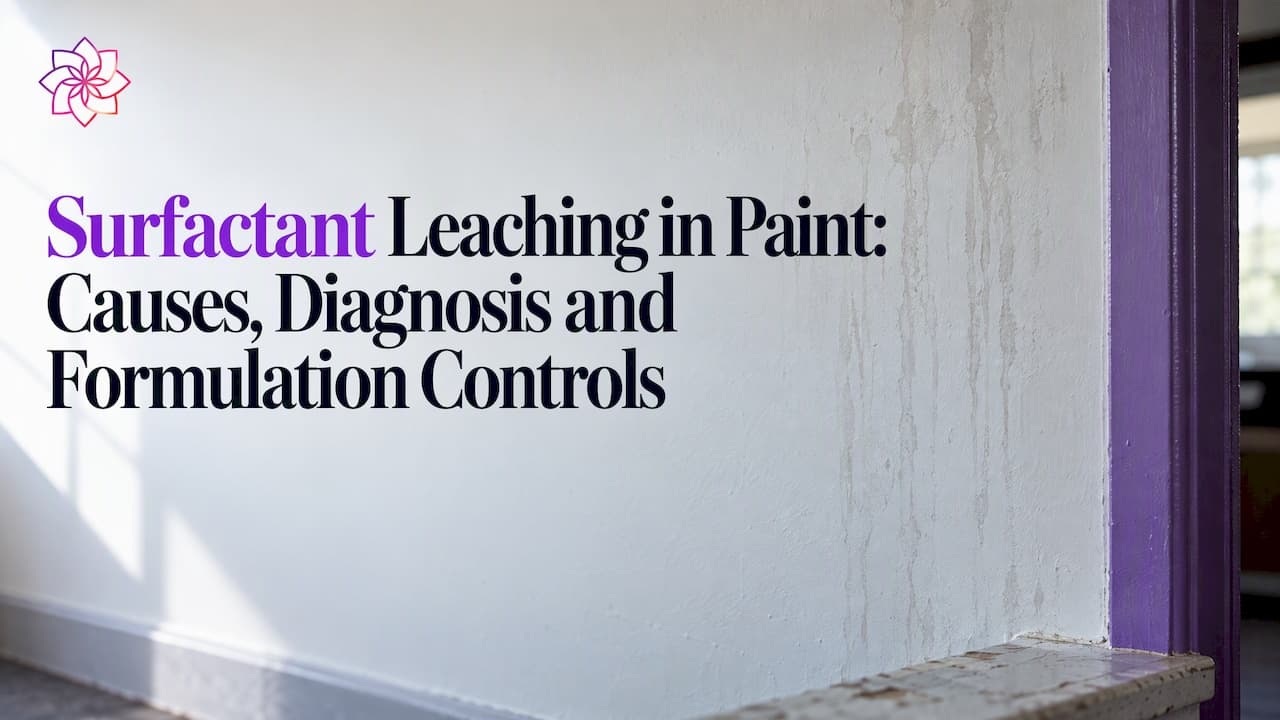
Surfactant leaching is the concentration of water-soluble ingredients on the surface of a latex coating, which occurs when moisture reaches the film before it has fully cured. The result is tan, brown or clear spots and streaks, often with an oily, sticky or soapy feel. It is a cosmetic defect that affects appearance rather than film integrity, but it generates complaints, repaints and returns, so it is a formulation and quality-control topic as much as an application one. This article covers the mechanism, the diagnostic criteria, remediation, and the formulation and process variables that determine how much water-soluble material is left free to migrate.
TL;DR
- Leaching occurs when moisture contacts a latex film before coalescence and cure are complete, extracting water-soluble surfactants and other hydrophilic components to the surface.
- Cool, humid drying conditions and deep tints made with universal colorants raise the risk, because curing is retarded and additional surfactant is present.
- It is distinguished from mold by texture and odor, and it is generally removed by washing with soap and water, sometimes over more than one cycle.
- Formulation control centers on minimizing the residual concentration of water-soluble species in the dried film, including the choice of dispersants, defoamers and rheology modifiers.
- ASTM D7190 offers a standard practice for evaluating a film's resistance to this type of staining.
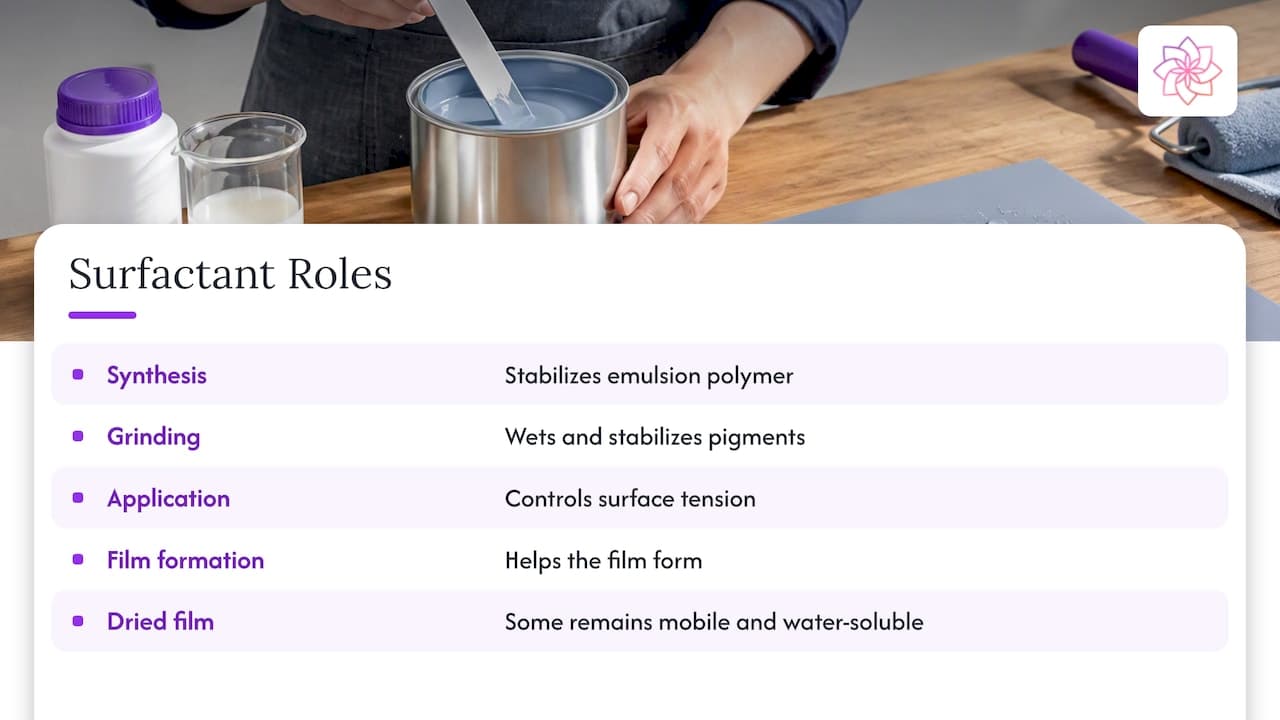
Waterborne architectural and industrial coatings depend on surfactants at several stages. They stabilize the emulsion polymer during synthesis, wet and stabilize pigments during grinding, control surface tension during application and help the film form. Not all of this material is bound permanently into the film. Once the coating dries, a fraction remains mobile and water-soluble.
ASTM describes the defect as water staining attributed to leaching of surfactants or other water-soluble materials from a latex paint film. The same phenomenon is variously called streaking, weeping, exudate or, in trade usage, "snail trails" when it runs down a wall in tracks.
Visual and tactile indicators
The defect is usually identified by a combination of appearance and feel:
| Indicator | Typical observation |
|---|---|
| Color | Tan, brown or clear spots or areas |
| Gloss | Localized glossy patches on a flat or low-sheen film |
| Texture | Oily, soapy or sticky to the touch |
| Pattern | Droplet-shaped marks or vertical streaks following runs of moisture |
| Location | Frequently bathrooms, kitchens and other humid interiors; exterior surfaces exposed to early dew or rain |
These descriptors are consistent with the visual indicators published by a major coatings manufacturer. Because the migrating material is colorless or lightly colored, the defect is most visible on deep tints and dark colors, where the contrast with the surrounding film is greatest.
Why it happens
The curing window
A latex film is not fully resistant to water immediately after it feels dry to the touch. Water evaporates first, particles coalesce, and the film gradually develops its final cohesion. During this window the film is permeable and the hydrophilic fraction is mobile. Moisture contacting uncured latex paint can extract water-soluble ingredients, and cool temperatures retard curing, which allows surfactants to separate and rise to the surface as the water evaporates from the wet or damp film.
Typical triggering events include:
- Condensation on interior walls after painting in a cool room with limited ventilation.
- Showering or cooking in a freshly painted space before the film has cured.
- Dew, fog or early rain on freshly applied exterior coatings.
- Application onto cold or damp substrates, which prolongs film formation.
Colorant load and tint depth
Tint depth matters because colorants are themselves surfactant-rich dispersions. Deeper tints, especially those using universal colorants, are more susceptible because they contain extra surfactants. A pastel base with a small colorant addition carries a lower hydrophilic load than a deep base loaded to reach a saturated color. This is one reason complaints concentrate on dark colors, and why a formulator must assess the whole system, base plus colorant, not the base alone.
The residual concentration principle
The American Coatings Association notes that performance of all waterborne paints depends on the final concentration of water-soluble materials remaining in the film after drying. This is the practical framing for formulation work. Every surfactant-bearing component added to the system contributes to a budget of mobile hydrophilic species, and the question is how much of that budget remains available to migrate once the film is exposed to water.
Distinguishing leaching from other defects
Misdiagnosis is common, because several defects share a visual footprint in humid areas. Correct identification determines whether the response is a wash, a repaint or a substrate repair.
| Defect | Surface character | Odor | Behavior when wiped | Underlying cause |
|---|---|---|---|---|
| Surfactant leaching | Glossy, oily or sticky droplets and streaks | None characteristic | Removed with soap and water, may recur | Water-soluble film components migrating after early moisture exposure |
| Mold or mildew | Fuzzy or slimy growth | Musty | Smears, returns without moisture correction | Deeper or ongoing moisture problem |
| Blistering or bubbling | Raised film | None | Film lifts | Adhesion loss, trapped moisture or vapor |
| Peeling | Film detaches | None | Flakes away | Adhesion failure, substrate contamination |
One coatings manufacturer notes that leaching is a surface issue, whereas mold is typically fuzzy or slimy with a musty odor and points to deeper moisture problems, and that leaching usually collects like water droplets and lacks the odor of mold.
Leaching versus surfactant blooming
A related but distinct term is blooming. A technical bulletin from another manufacturer states that blooming differs from leaching because it forms a visible film on protected surfaces. In practice, leaching requires a moisture event to drive migration, while blooming is associated with surfactant incompatibility or excess appearing even where the surface has not been wetted. The corrective formulation path differs: leaching is addressed through cure speed and hydrophilic content, blooming through compatibility and use level.
Is it a coating failure, and is it harmful?
The defect is aesthetic. Surfactant leaching is not harmful to the paint or to the surface it covers. The film continues to protect the substrate, and no toxicity concern is attached to the residue in the way the common search phrasing might suggest. From a quality perspective, however, a visibly stained wall is a customer-perceived failure, and a formulator should treat the defect as a performance specification item even though the film remains structurally intact.
Cleaning and remediation
Remediation depends on whether the surface is interior or exterior and on how long the defect has been present.
- Interior surfaces. Wash with soap and water and rinse. Discoloration may recur once or twice before the surfactant has been fully removed, so one cleaning cycle should not be taken as proof of failure or of success.
- Fresh exterior stains. A strong stream from a garden hose can usually rinse fresh stains, and pressure washing may be used with care so that the fresh film is not damaged.
- Weathering. Exterior surfactants may wash off with normal weathering. For masonry coatings, the American Coatings Association paper reports that under normal field conditions the water-soluble materials are eliminated by rainwater or condensation during the first few weeks without affecting appearance.
- Recurrence. If marks return repeatedly in a bathroom after cleaning, the underlying moisture and ventilation conditions should be reviewed before any repainting. Repainting without correcting them re-creates the same exposure to an uncured film.
Spraying or wetting the surface without removing the residue is counterproductive on interior walls, since additional water mobilizes more of the same material.
Evaluating leaching resistance in the laboratory
For a manufacturer, field complaints are a late signal. ASTM D7190 is a standard practice for evaluating a latex paint film's resistance to staining caused by leaching of water-soluble materials. A screening program built around this type of test allows comparison of candidate formulations, tint systems and additive packages under repeatable conditions, including cool and humid cure conditions that mirror the worst realistic field exposure.
A practical qualification matrix typically varies:
- Tint depth, including the deepest base-and-colorant combination the product line is sold in.
- Cure temperature and relative humidity before water exposure.
- Film thickness and substrate porosity.
- Additive package, including dispersant, defoamer and rheology modifier type and dosage.
Formulation levers that influence leaching
No single additive eliminates the defect, because the cause is the sum of mobile hydrophilic species and the time the film needs to become water resistant. The following variables are the ones a formulator can adjust.
Binder selection and film formation
Binders designed for early water resistance and low residual surfactant content narrow the vulnerable window. The binder is the largest single determinant, and the American Coatings Association's paper on early rain resistance addresses binder design directly. Coalescent selection and level also affect how quickly the film consolidates in cool conditions.
Pigment dispersants
Dispersants stabilize pigment and extender particles during grinding and let-down. Polymeric dispersants with strong anchoring to the pigment surface remain associated with the particle, whereas low-molecular-weight, highly water-soluble wetting agents are more readily extracted by water. Dispersant type and dosage should therefore be optimized against the pigment demand, rather than raised as a safety margin. Overdosing leaves unadsorbed, mobile material in the aqueous phase and, later, in the film. Dosage ladders, in which the dispersant level is varied against viscosity, color development and a leaching test, identify the lowest effective level.
Defoamers
Defoamers are surface-active by design. A defoamer that is excessively hydrophilic, or used at a high level to compensate for foam from other surfactants, adds to the mobile fraction and can introduce its own surface defects. Silicone and non-silicone chemistries behave differently in this respect, and the selection should reflect the base, the tint system and the application method. Using the minimum effective defoamer level is a consistent principle.
Rheology modifiers
Associative and non-associative thickeners influence water retention, open time and the way water leaves the film, and they themselves may be water-soluble. The thickener type affects how long the film stays wet and how mobile the aqueous phase is during consolidation, so it belongs in the same test matrix as the surfactant-bearing components.
Colorant system and tint strength
Because deep tints carry more surfactant, the colorant addition level at the deepest shades should be assessed explicitly. Where leaching resistance is a priority, a manufacturer can limit the maximum colorant load for a given base or assign deep colors to bases formulated for higher tint capacity.
Application and curing controls
Process conditions have as much influence as chemistry, and technical data sheets should state them clearly:
- Apply paint only in weather conditions that allow proper curing of the film.
- Avoid drying in cool, humid conditions and manage moisture, as the same guidance from a second manufacturer recommends.
- Ventilate interiors and delay showering or heavy cooking in freshly painted bathrooms and kitchens until the film has cured.
- Protect fresh exterior coatings from evening dew and forecast rain.
The same Benjamin Moore guidance states that using premium paint can help combat surfactant leaching, which is consistent with the formulation logic above: higher-quality binders and tighter control of the surfactant package reduce the mobile fraction.
Additive support for low-leaching formulations
For manufacturers who need to qualify an additive package against leaching and related surface defects, Astra Chemical supplies dispersants, silicone and non-silicone defoamers, rheology modifiers and functional coating additives, backed by technical support and laboratory-backed qualification. The ASTRA DISP® dispersant line and the broader product range can be reviewed against a specific base, pigment system and cure environment, and samples can be requested for a leaching ladder alongside existing materials.

Formulators who want to compare dosage, batch consistency and documentation can start from the main site and request a technical consultation. Additional technical background on functional additives is collected in the coating additives blog, including a guide to reactive diluents and functional additives.
Perspective: leaching as a dosage and qualification problem
In our experience, leaching complaints are rarely traced to a single raw material. They arise from the accumulation of reasonable decisions: a dispersant dosed with a generous margin, a defoamer added late to rescue a foaming batch, a thickener chosen for application feel, and a universal colorant loaded to reach a deep shade. Each choice is defensible in isolation, and together they enlarge the pool of mobile hydrophilic material.
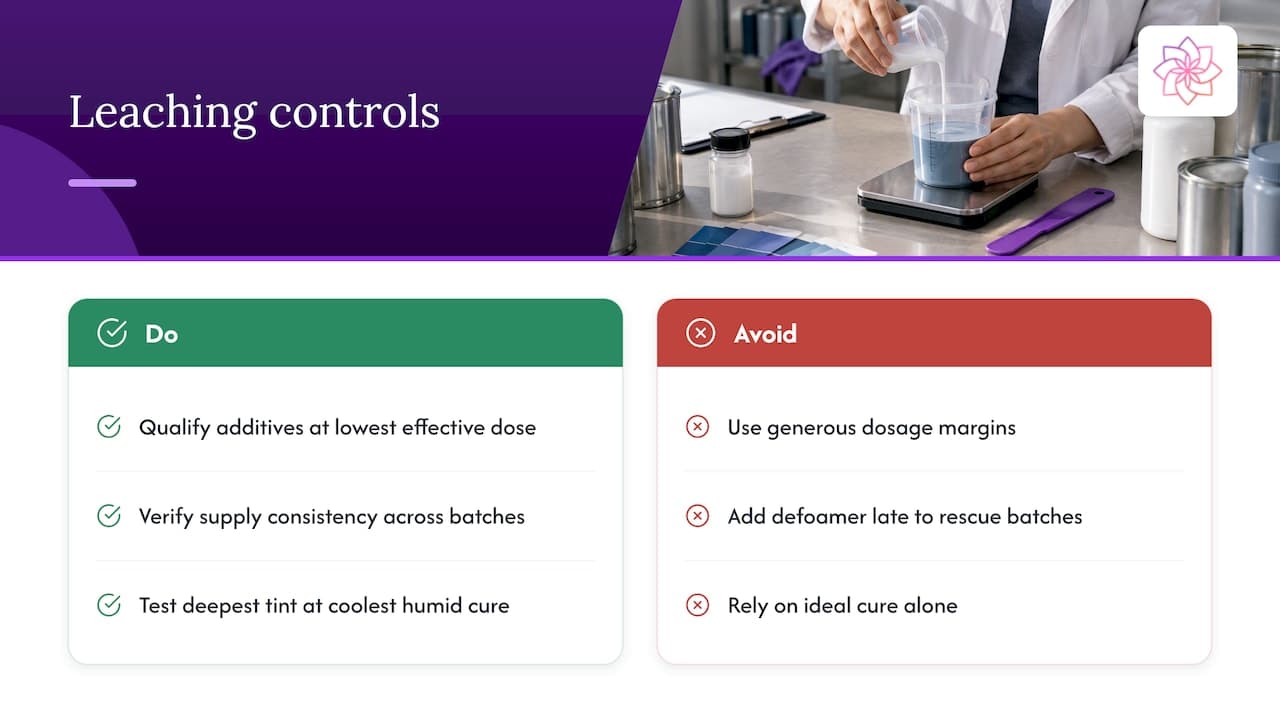
We therefore approach the problem from the additive side as a question of optimized dosage and consistent supply. An additive qualified at its lowest effective level contributes less to the residual burden than one dosed conservatively. Batch-to-batch consistency is equally important, since a leaching ladder run on one lot is only meaningful if later lots behave the same. This is why our technical support centers on dosage ladders, laboratory-backed qualification and documentation that production and regulatory teams can rely on.
We also recommend that leaching resistance be evaluated at the deepest tint and under the coolest, most humid cure condition the product will realistically meet, rather than at standard laboratory conditions. A formulation that passes only under ideal cure is a formulation that will generate field complaints.
— Astra R&D Team
FAQ
Does surfactant leaching mean the paint has failed?
Not structurally. It is an aesthetic concern and does not harm the paint or the surface beneath. It may still be a performance complaint, since the staining is visible, and it can indicate that the film was exposed to moisture before it cured.
How can leaching be told apart from mold?
Texture and odor are the first checks. Leaching collects like water droplets and has no musty smell, while mold is fuzzy or slimy with a musty odor. Persistent growth that returns after cleaning points to a deeper moisture problem that should be assessed by a qualified inspector or contractor.
Will washing remove it permanently?
Washing interior surfaces with soap and water and rinsing is the standard remedy. The marks may reappear once or twice before the surfactant is fully removed, so repeated cleaning is normal, and repainting should wait until the cause of the moisture exposure has been corrected.
Why do dark colors show it more?
Deep tints made with universal colorants contain extra surfactants, which increases the mobile fraction in the film. The same quantity of migrated material is also more visible against a saturated color than against a light one.
Can additives eliminate leaching?
No additive removes the risk alone. Dispersant, defoamer and thickener selection and dosage influence how much water-soluble material remains in the film, but binder design, tint load and cure conditions have equal weight. Qualification against a standard practice such as ASTM D7190 is the reliable way to confirm performance.
Sources
- Surfactant leaching: causes and solutions (Sherwin-Williams)
- How to fix surfactant leaching and paint streaking (Sherwin-Williams project center)
- Surfactant leaching troubleshooting (Benjamin Moore)
- ASTM D7190 standard practice to evaluate leaching of water-soluble materials
- Surfactant leaching technical bulletin (Dunn-Edwards)
- Surfactant leaching technical bulletin TB14 (Florida Paints)
- Early rain resistance and surfactant leaching resistant binder (American Coatings Association)
Testing additives for this application?
Send us your current formulation challenge and our technical team will recommend an ASTRA product package for lab screening.