Surfactant and Defoamer Interactions in Coatings Formulation
Surfactant and Defoamer Interactions in Coatings Formulation ! Formulator adding defoamer to foaming coating In a waterborne formulation, surfactants and defoamers work against each other by design.
In a waterborne formulation, surfactants and defoamers work against each other by design. Wetting agents, dispersants and emulsifiers stabilize the air/liquid interface, while the defoamer must enter that interface and destabilize it, and it must do so without leaving craters, haze or gloss loss. The outcome depends on entry and spreading behavior, on the controlled incompatibility of the defoamer with the medium, on the point of addition and on the shear applied. This article sets out the mechanisms, the practical consequences for coatings, adhesives and inks, and a qualification approach that reduces trial and error.
TL;DR
- Surfactants stabilize foam lamellae; defoamers must enter and spread on those same films, so every surfactant added to a formulation changes the defoamer demand.
- A defoamer needs selective incompatibility: too soluble and it is inactive, too insoluble and it causes craters, fish-eyes and crawling.
- Macrofoam and microfoam need different strategies, and microfoam typically calls for lower-viscosity carriers and good entry and spreading coefficients.
- Point of addition and shear matter as much as chemistry: hydrophobic silica and wax-containing defoamers usually belong in the millbase.
- No universal defoamer exists; qualification should be run in the actual formulation, with dosage ladders and defect assessment.
Foam bubbles are only stable when foam-stabilizing substances are present in the liquid phase, and in general any interfacially active substance can stabilize foam, as the review Defoamers in the Coatings Industry explains. In pure liquids, bubbles rise and burst at the surface without forming persistent foam, which is why defoaming test method literature begins from the drivers of foam formation and destabilization.
A modern waterborne coating is a surfactant-rich system. Defoamer selection work published in the Journal of Coatings Technology notes that foam problems in aqueous systems arise in production as well as in application, and that emulsifying agents, wetting agents and dispersants are often formulated into coatings to achieve specific effects. Each of these additives adsorbs at the air/liquid interface, lowers surface tension and introduces elasticity into the lamella. That elasticity is the property that lets a thin film resist rupture, and it is the property the defoamer must overcome.
The practical consequence is that surfactant and defoamer cannot be selected independently. A formulation change that appears unrelated to foam, such as switching the pigment dispersant or raising the wetting agent level to improve substrate wetting, can shift the foam balance and the defoamer demand at the same time.
Where the surfactants come from
Surfactants enter a coating or adhesive from several directions, and each source should be counted when foam appears:
- Polymer emulsion: the latex carries the emulsifier package used during emulsion polymerization, as noted in PCI Magazine coverage of macro and microfoam, which lists surfactant packages in the polymer system among the factors contributing to foam.
- Pigment dispersants and wetting agents: added at the grind stage to stabilize pigment and lower surface tension on difficult substrates.
- Functional additives: rheology modifiers, slip and leveling agents, and substrate wetting additives that are themselves surface active.
- The defoamer itself: commercial defoamers are not surfactant-free, as the next section shows.
What a defoamer contains, and why it matters
Defoamers are complex systems. According to the test methods literature, they are generally composed of carrier liquids such as glycols or mineral and silicone oils, emulsifiers and wetting agents, and active components such as hydrophobic solids, modified silicones or fatty acids. The carrier transports hydrophobic particles to the foam lamella, where they destabilize the interface, while the emulsifier controls the rate at which the defoamer disperses into the water phase.
This composition means the interaction is not only between a defoamer and the formulation surfactants. The emulsifier inside the defoamer competes with, and is influenced by, the surfactants already present. A strongly emulsified defoamer disperses quickly and persists longer but may be less active at the interface. A weakly emulsified one is more active at first but may be less stable on storage and more likely to produce surface defects.
Mechanism: entry, spreading and the entry barrier
The classic criteria for a functioning defoamer are summarized in the Chimia review of defoamers in the coatings industry: the defoamer is a low surface tension liquid, it is insoluble in the medium to be defoamed, and it has a positive entering coefficient and a positive spreading coefficient. Insolubility keeps the active phase available as droplets. A positive entering coefficient allows a droplet to penetrate the air/liquid surface. A positive spreading coefficient lets it spread across the film and thin it locally until it ruptures.
Surfactants complicate each of these steps. Adsorbed surfactant layers raise the resistance a droplet meets when it tries to bridge the film. The review Mechanisms of Foam Destruction by Oil-Based Antifoams describes this as the entry barrier: fast-acting defoamers have a low barrier and rupture films rapidly, whereas slow or ineffective ones remain trapped in the Plateau borders until drainage compresses them sufficiently to enter the surface. The same work encourages formulators to judge additives by these kinetic factors rather than by static property measurements alone.
Two practical readings follow:
- A defoamer that performs well in a lightly surfactant-stabilized model system may fail in a high-surfactant production formulation, because the entry barrier is higher.
- Defoamers with hydrophobic particles, such as hydrophobic silica, tend to lower the entry barrier relative to oil alone, which is one reason oil-plus-particle systems are widely used.
Antagonism and synergy among surfactants
Mixed surfactant systems do not behave additively. A 2022 study on mixed surfactants and foam stabilization is not the source of this point; the relevant observation from the foam literature surfaced in current search results is that mixed surfactants can show antagonistic or synergistic effects at the air/liquid interface, either stabilizing or destroying foam. For the formulator the implication is direct: replacing one wetting agent with another, or combining a dispersant with a leveling additive, can produce a foam response that cannot be predicted from the individual components.
Selective incompatibility: the central design principle
The core of industrial foam control is selective incompatibility, a point made in the coatings defoamer review. A defoamer that is too compatible dissolves into the bulk phase and becomes ineffective as a foam-control agent. One that is too incompatible produces surface defects such as craters, fish-eyes and crawling. Practitioners manage this by tailoring the defoamer to the polarity of the system, using hydrophilic defoamers for low-polarity systems and hydrophobic ones for highly polar or high-shear systems, so that the defoamer migrates to the air/liquid interface without degrading the film.
Surfactants shift this balance. A higher surfactant load solubilizes more defoamer into micelles and into the aqueous phase, effectively raising its compatibility and lowering its activity. Conversely, a low-surfactant system leaves the defoamer more incompatible than intended, which raises the risk of defects. The same defoamer can therefore be too weak in one formulation and too aggressive in another.
Typical failure patterns
| Observation | Likely interaction | Direction of adjustment |
|---|---|---|
| Foam returns after hours or days | Defoamer solubilized or consumed by surfactant micelles, or adsorbed onto pigment | Review hydrophobic particle content, dosage, and consider a more incompatible type |
| Craters, fish-eyes, crawling | Defoamer too incompatible or locally concentrated | Reduce dosage, select a more compatible type, improve incorporation |
| Haze or gloss loss | Hydrophobic particles or incompatible droplets scattering light | Lower dose, finer droplet size, different active |
| Persistent microfoam in the film | Insufficient entry and spreading on small bubbles, viscosity too high | Lower viscosity carrier, different chemistry for microfoam |
| Poor recoatability or intercoat adhesion | Migration of silicone or surface-active species | Evaluate non-silicone chemistry |
Macrofoam and microfoam respond differently
The PCI Magazine article on macro and microfoam in low-VOC waterborne systems distinguishes between the two. Macrofoam is typically handled by surface-active defoamers that destabilize the lamella on contact. Microfoam, with bubbles of roughly 10 to 100 µm, remains entrained in the liquid film because its small radius limits buoyancy, as described by Stokes' law. Removing it requires additives with the necessary entry and spreading coefficients to penetrate these fine bubbles, often with lower-viscosity carriers that reach the lamella more effectively.
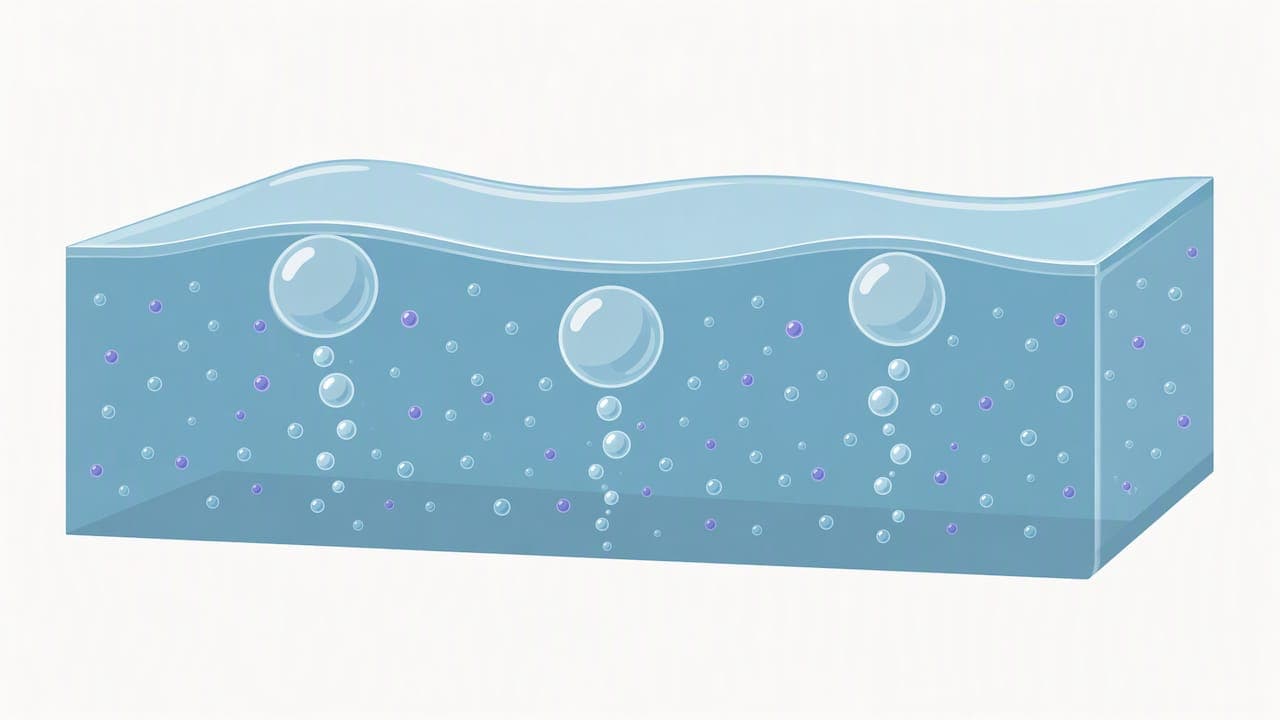
In surfactant-rich systems the distinction is particularly relevant. High surfactant levels generate fine, stable bubbles during application by roller or spray, and these bubbles can be trapped as the film sets. A defoamer chosen only on macrofoam knockdown in a bench test may leave pinholes and micro-bubbles in the dried film.
Point of addition and shear
The interaction is also physical. The Journal of Coatings Technology study on waterborne defoamer selection shows that incompatible defoamers, particularly those containing hydrophobic silica or waxes, must often be added at the millbase stage to ensure homogeneous distribution. When they are added in the let-down with insufficient shear, the defoamer stays locally concentrated, which frequently produces surface defects even when the chemistry is right. Dosage and point of addition are commonly adjusted together to balance defoaming efficiency against the risk of gloss reduction or haze.
A practical split used in many waterborne production routines:
- Grind stage: a defoamer is added to suppress foam during dispersion, where wetting agents and dispersants generate the most foam under high shear. A more incompatible type is often acceptable here because shear will distribute it.
- Let-down stage: a more compatible or post-add defoamer is used to control foam from the emulsion and from low-shear mixing, and to address foam at filling or application.
Splitting the dose between stages frequently gives better results than a single, larger addition.
Using solubility parameters to reduce screening time
Selection by trial and error is slow. Research reported in 2020 by Yuki Kato and colleagues applied Hansen Solubility Parameters to match the affinity of an antifoaming agent with the principal foam-generating surfactants, reporting correlations between 0.860 and 0.953 and positioning the method as a way to reduce time-intensive trial and error. HSP does not replace laboratory qualification, but it can narrow a candidate list before foam height and defect testing begin.
A qualification protocol for surfactant-rich systems
The following sequence limits the number of variables changed at once and keeps surfactant effects visible:
- Fix the surfactant package. Qualify the defoamer after dispersant, wetting agent and rheology modifier choices are settled, or repeat the screening whenever one of them changes.
- Screen a dosage ladder. Test at least three levels, for example low, medium and high within the supplier's recommended range, rather than a single dose.
- Test at two points of addition. Compare millbase against let-down, and a split addition.
- Measure foam dynamics. Record initial foam knockdown and foam persistence over time, using a method relevant to the process (high-shear mixing, roller application, spray or pump circulation).
- Assess film defects. Draw down on the actual substrate at production film thickness; examine for craters, fish-eyes, pinholes, haze and gloss at 20°, 60° or 85° as appropriate.
- Run aging. Store the finished product, including heat aging, and re-test foam and defects, since defoamer-surfactant balance changes as the defoamer is solubilized or separates.
- Check downstream properties. Intercoat adhesion, recoatability, water resistance and, in adhesives, bond strength.
The PCI Magazine discussion of evolving foam control additives reinforces why this is necessary: the belief in a single universal defoamer is a misconception, because the balance between foam control and surface aesthetics depends on factors such as pigment volume concentration, coalescing solvents and substrate porosity, which drive defects like haze, craters and dewetting.
Silicone and non-silicone chemistries
The choice between silicone and non-silicone defoamers is often framed by surfactant interaction as well as by defect risk. Silicone-based actives are highly effective at low dose and have low surface tension, which gives strong spreading, but they can create cratering and recoat problems when poorly dispersed. Non-silicone chemistries, such as mineral oil or organic polymer-based types, are frequently selected where recoatability, intercoat adhesion or silicone-free requirements apply. Neither class is inherently superior; the better choice depends on the surfactant system, polarity, shear and end-use. Astra Chemical supplies both silicone and non-silicone defoamers, so the comparison can be made within one supplier's range and one documentation set.
Perspective: how we approach surfactant-defoamer balance
Our experience with customer formulations is that foam rarely originates from a single additive. It arises from the full surfactant inventory, and defoamer selection is therefore a system question rather than a product question. We start from the formulation: the polymer type, the dispersant and wetting agent levels, the rheology modifier, the process shear and the target film properties. Only then do we propose candidate defoamers, and we do so in the knowledge that the optimum dosage is often lower than first assumed when the point of addition is right.
We also treat dosage optimization as part of the product, not an afterthought. A defoamer used at the minimum effective level reduces the risk of craters and haze and lowers the total cost-in-use, which in our view is the correct basis for comparing additives, rather than price per kilogram. Laboratory-backed qualification, batch-to-batch consistency and complete documentation allow a formulator to move from trial to production with fewer iterations.
— Astra R&D Team
Defoamers and dispersants from Astra Chemical
Formulators working through surfactant-defoamer questions can review the full Astra Chemical product range, including the ASTRA DF and ASTRA DF NS defoamer lines and the ASTRA DISP dispersant line. Technical support and custom formulation guidance are available for coatings, adhesives, inks, plastics and composites, and sample requests can be arranged through the Astra Chemical site. Pricing is not published and is quoted on request.
FAQ
Can a surfactant and a defoamer be used in the same formulation?
Yes, and most waterborne products contain both. The surfactant provides wetting, dispersion or emulsification, while the defoamer is selected to control the foam those components create. The two must be qualified together, because the surfactant level changes how much defoamer is solubilized and how readily it enters the foam film.
What are the disadvantages of antifoaming agents?
The main risks are surface defects, namely craters, fish-eyes, crawling, haze and gloss loss, when the defoamer is too incompatible or poorly dispersed. Overdosing can also worsen foam persistence or affect recoatability. These risks are managed through dosage ladders, correct point of addition and testing in the real formulation.
What is the main ingredient in a defoamer?
There is no single ingredient. According to the test methods literature, defoamers combine a carrier liquid such as glycol, mineral oil or silicone oil, emulsifiers, and active components such as hydrophobic silica, modified silicones or fatty acids. The active component is what breaks the foam film, and the carrier and emulsifier govern how it is delivered.
Does dish soap act as a defoamer?
No. Dish soap relies on surfactants such as sodium lauryl sulfate, sodium laureth sulfate and an alkyldimethylamine oxide to clean grease, and the foam it produces is part of its function. Surfactants of this type stabilize foam rather than suppress it.
Why does foam return after a defoamer initially works?
Common causes are defoamer solubilized or consumed by the surfactant system, adsorption onto pigment, or an entry barrier that rises as surfactant accumulates at new interfaces. Reviewing dosage, point of addition and defoamer polarity usually resolves it, with a split addition between millbase and let-down being a frequent remedy.
Sources
- Defoamers in the Coatings Industry, CHIMIA (doi 10.2533/000942902777680478)
- Defoamers in the Coatings Industry, CHIMIA full text
- Defoaming Test Methods, American Coatings Association
- Defoamer Selection in Waterborne Systems, Journal of Coatings Technology
- Mechanisms for Combating Macro and Microfoam in Low-VOC Waterborne Systems, PCI Magazine
- Evolving Foam Control Additives, PCI Magazine
- Mechanisms of Foam Destruction by Oil-Based Antifoams, Langmuir
- Hansen Solubility Parameters for defoamer selection, PMC
- Dawn Dish Soap Ingredients
Testing additives for this application?
Send us your current formulation challenge and our technical team will recommend an ASTRA product package for lab screening.