Outgassing in Powder Coating: Causes, Prevention, Repair
Outgassing in Powder Coating: Causes, Prevention, Repair ! Blisters and pinholes in powder coating Outgassing in powder coating is the release of trapped air, moisture or vapor from the substrate, or from contaminants on it, while the film is melting and curing.
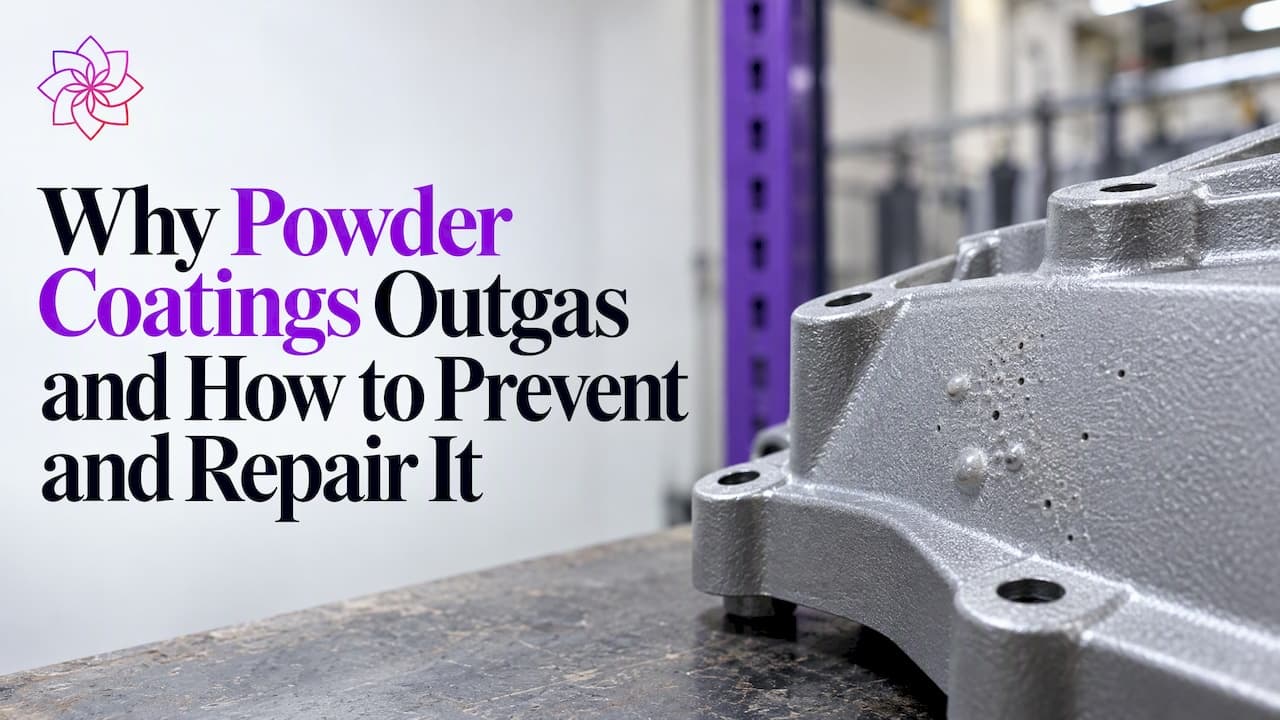
Outgassing in powder coating is the release of trapped air, moisture or vapor from the substrate, or from contaminants on it, while the film is melting and curing. The gas passes through the molten powder before the film gels and leaves bubbles, blisters or pinholes. It is prevented by controlling three variables: the condition of the substrate, the thermal sequence before and during cure, and the gas-release behavior of the powder formulation. This guide covers the mechanism, the substrates and contaminants involved, a method for separating outgassing from look-alike defects, prevention steps and the rework path once a film has cured.
TL;DR
- Outgassing occurs when gas trapped in porous castings, galvanized steel or surface contamination expands during cure and escapes through the molten film before it gels.
- The typical defects are pinholes, bumps, bubbles and blisters, sometimes with loss of intercoat adhesion.
- Prevention rests on thorough cleaning, preheating (prebaking) the part above the powder's cure temperature, coating while the part is still warm, and holding film thickness within specification.
- Outgas-forgiving powder formulations use additives that open a temporary pathway for gas and then seal it, but they extend tolerance rather than remove the need for process control.
- A cured outgassing defect cannot be patched reliably: the damaged layer is stripped, the substrate is cleaned and outgassed, and the part is recoated.
The Powder Coating Institute's glossary defines gassing as air or gas escaping from beneath a coating and producing blisters, bubbles or small holes, and notes that it frequently occurs with zinc or aluminum castings or galvanized steel. The term outgassing is used for the same event in shop practice.
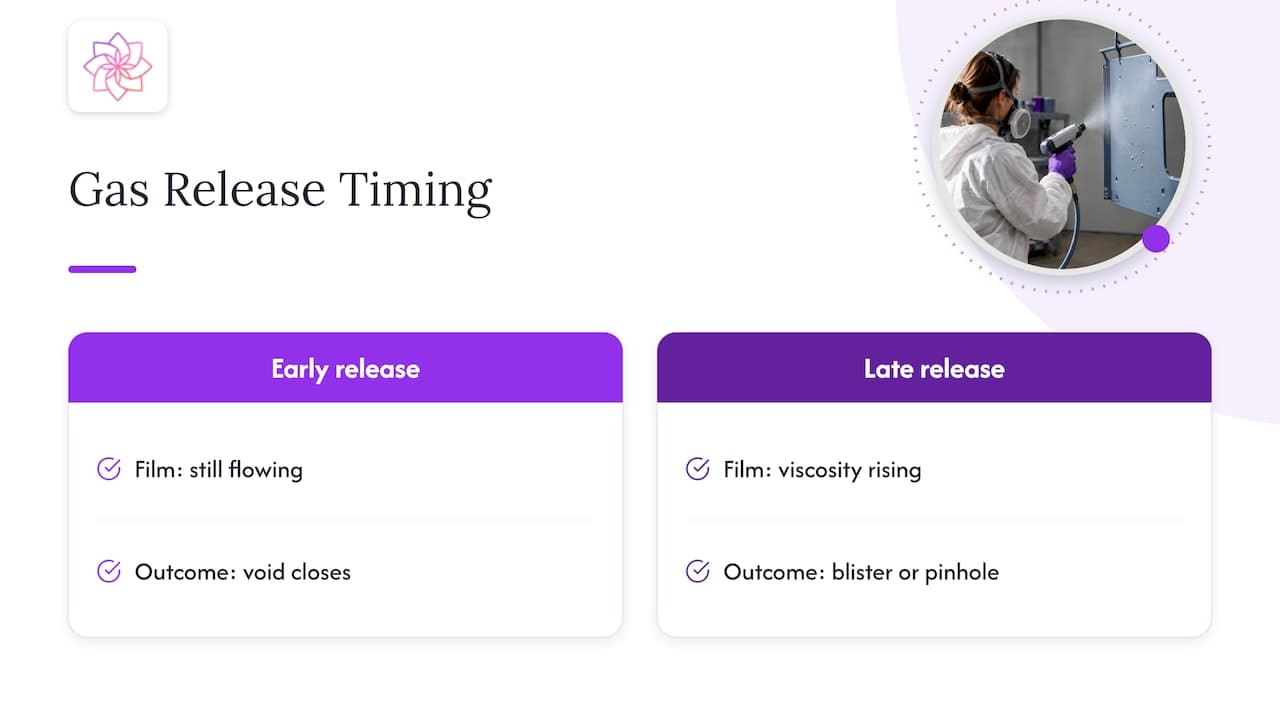
The mechanism is physical. A powder film melts and flows within a defined window before crosslinking raises its viscosity and fixes the surface. Any gas released during that window must travel through a liquid film. If the gas arrives early, the film still flows and the void closes. If it arrives late, when viscosity is rising, the bubble either freezes in place as a blister or bursts and leaves a crater-like pinhole that the film can no longer fill.
According to Products Finishing, outgassing occurs when air or gas trapped in porous iron, steel or aluminum expands during heating, and the typical resulting defects include bumps, bubbles and pinholes, often accompanied by loss of intercoat adhesion. Severity varies with the source: outgassing from galvanized steel and cast parts can range from fine pinholes to large blisters.
Substrates and conditions that cause it
Several independent sources of gas exist, and a single defect often involves more than one. The Products Finishing article attributes outgassing to trapped gas or air in porous cast metal, gases in galvanized substrates, surface contaminants such as oil and grease, and high coating thickness.
| Source | Mechanism | Typical location |
|---|---|---|
| Porous castings (steel, aluminum, zinc, magnesium alloy) | Air trapped in micro-porosity expands on heating and migrates to the surface | Random across the casting, often near thick sections |
| Hot-dip galvanized steel | Residual oxides retain air or moisture that is released as vapor during cure | Across the zinc surface, worse where the zinc layer is thick |
| Weld seams and joints | Gas or liquid is held in crevices and porous weld metal | Along welds and overlapping seams |
| Oil, grease, die-release agents | Contaminants vaporize under cure heat | Localized or part-wide, depending on origin |
| Excess film thickness | A thicker film lengthens the escape path and gels with gas still inside | Heavy-build areas, recesses, Faraday cage edges |
The substrate list comes from Powder Coated Tough, which names hot-dipped galvanized steel and cast metal parts, including steel, aluminum, zinc and magnesium alloy castings, as the most prone. The same article notes that metal oxides remaining on galvanized steel can retain air or moisture and release water vapor or air during curing, causing blisters or voids.
Zinc surfaces deserve a separate note because they are chemically active. ASTM D7803-25, the standard practice for preparing hot-dip galvanized steel for powder coating, states that the zinc coating constantly changes and that, during the formative patina stages, the poorly adhered oxide/hydroxide layer must be removed for proper adhesion. A surface that looks clean can therefore still carry a layer that holds gas and weakens adhesion.
Process-side contributors matter as well. The IFS Troubleshooting Guide, a powder manufacturer's reference, lists oil or moisture in compressed-air lines, poor cleaning or pretreatment, moisture in the powder, substrate porosity and excessive film thickness among the contributing causes of craters, pinholing and micro-pinholing. In practice, this means a plant can see outgassing-like defects on a perfectly sound substrate when the air supply or powder storage is at fault.
Telling outgassing apart from craters and other defects
Corrective action fails when the defect is misdiagnosed. Preheating a part cures nothing if the real cause is silicone contamination, and a pretreatment change does nothing for a porous casting.
A practical field distinction, given in a powder coating defect identification guide, is that an outgassing pinhole penetrates through the film to the substrate and may show a cylindrical channel under magnification, often over porous areas such as welds, castings and galvanized surfaces. Contamination craters are shallow, bowl-shaped depressions with raised rims that do not reach the substrate and can occur on any substrate.
Pattern and location add evidence:
- Defects on all parts: Products Finishing reports that defects occurring everywhere on all parts suggest the parts are not being cleaned adequately, while defects in isolated areas are probably caused by a die-release product.
- Defects only on castings, welds or galvanized parts: substrate porosity or zinc oxides are the leading suspects.
- Defects that follow heavy film areas: thickness is contributing, and gun settings or part racking should be reviewed.
Isolation tests
Three simple tests narrow the field before any process change is made.
- Bypass pretreatment. The Fabricator describes sending a clean, laboratory-pretreated test panel through the line while the normal pretreatment is bypassed. If the panel stays defect-free, the defect is likely linked to pretreatment rather than the coating line itself.
- Test the powder on a standard panel. Products Finishing advises that if cold-rolled steel panels coated at the intended film thickness and cure temperature show pinholes under a microscope, the powder supplier should be consulted, since the material itself may be the source.
- Use a clean, simple coupon. A coupon-based approach holds that pinholes on a clean coupon point to a process or material problem, while a clean coupon points toward the part's geometry or substrate.
The same source describes a cure audit, in which thermocouples on the part verify the oven profile and its uniformity across width and height. An oven that runs unevenly can gel the film early in one zone and trap gas there, so the audit belongs in any investigation that returns inconsistent results.
Preventing outgassing before the powder is applied
Clean thoroughly
Surface contaminants such as oil, grease and other foreign materials can vaporize during curing and cause outgassing defects, and Products Finishing recommends proper surface cleaning to remove them before coating. For castings, residual machining oils and polishing compounds can sit within pores and re-emerge during heating, so cleaning alone may not suffice, which leads to the thermal step below. For galvanized parts, removal of loose oxide or hydroxide layers, as ASTM D7803-25 describes, is part of preparation rather than an optional extra.
Compressed-air quality is a related control. Oil or moisture in air lines introduces contamination after the part has been cleaned, so filters and moisture traps in the air system should be checked whenever craters or pinholes appear without an obvious substrate cause.
Preheat (prebake) to drive gas out first
The most widely used countermeasure is to release the trapped gas before the powder is on the part. Products Finishing gives the guidance as heating the substrate to at least 15°C (30°F) higher than the part metal temperature specified on the powder's technical data sheet, then coating it before it cools. The thermal logic is straightforward: gas that has already escaped cannot disturb the film, and the powder then sees a substrate that is no longer releasing vapor at its gel point.
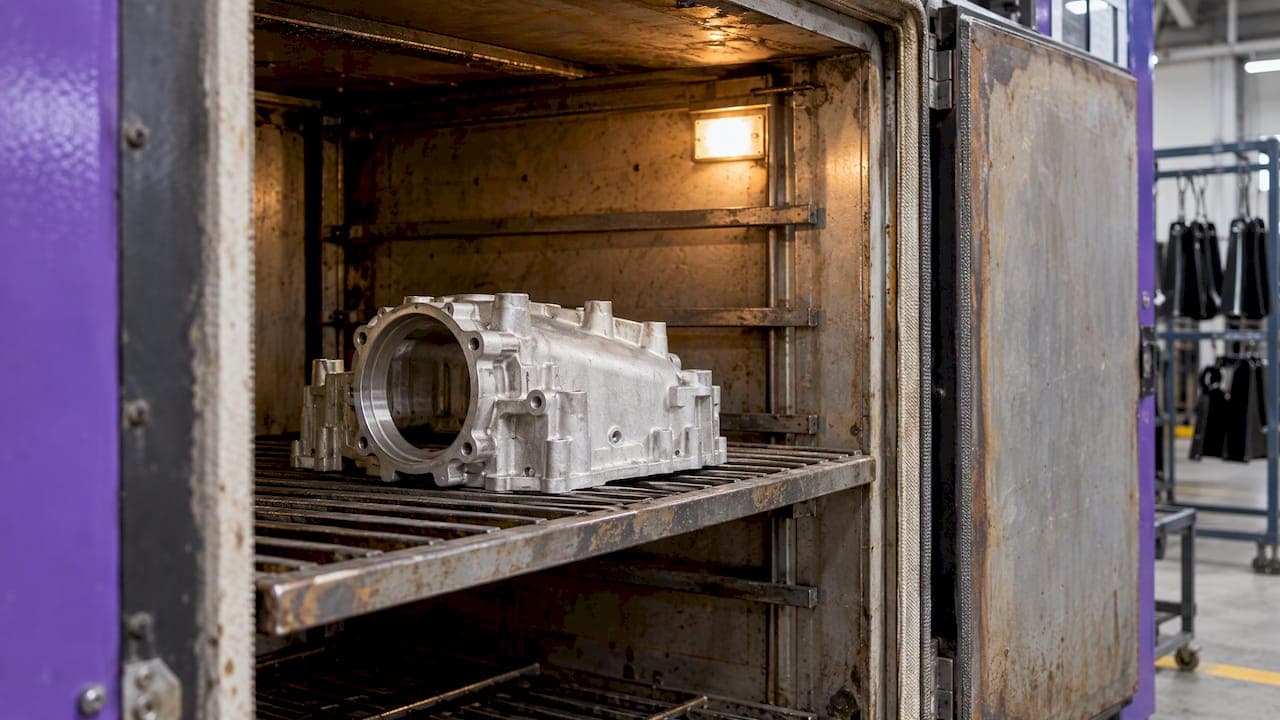
Timing is as important as temperature. The same article advises coating while the part is still warm, roughly 25 to 30°F above ambient, to prevent re-absorption of moisture or air into the substrate's porosity. A prebaked casting left to cool in a humid plant can take on moisture again and reproduce the original defect.
A typical sequence for a porous casting is:
- Clean and dry the part.
- Bake at or above the powder's cure temperature, per the technical data sheet and the guidance above.
- Remove and allow the part to cool only to the warm range, not to ambient.
- Apply powder at specified film thickness.
- Cure on the standard schedule.
Some parts are too porous for a single prebake. Repeat cycles can be considered for such castings, but the powder supplier's technical data sheet should set the bake conditions, because overbaking can affect certain chemistries and colors.
Control film thickness
Film build is a variable that is easy to adjust and often neglected. Heavy films hold gas longer and gel before it escapes. Reviewing gun settings, part orientation and rack spacing, and checking build on recesses and edges, reduces the thickness spread across a part. Where outgassing persists at the specified thickness, a thinner film within the supplier's recommended range is a legitimate trial.
Select a forgiving powder system
Where substrate and process controls cannot fully eliminate gas release, the formulation can widen the tolerance. Outgas-forgiving (OGF) powders incorporate additives that create a soft, fluid passageway for gas to escape and then collapse to seal the void, as Powder Coated Tough describes. The same source notes that these powders use a waxy substance to let evolving gas escape, and that some powder manufacturers supply an additive for on-site incorporation.
There are limits. A forgiving powder raises the amount of gas the film can tolerate, but it does not change the fact that a heavily contaminated or severely porous substrate will still outgas violently. The additive also changes surface behavior, so gloss, texture, recoatability and mar resistance should be confirmed on the actual part. The additive is best treated as one layer in a defense, positioned after cleaning and preheat.
Repairing a cured outgassing defect
Once a film has cured with pinholes or blisters, cosmetic touch-up rarely holds, because the underlying cause remains in the substrate and the void usually extends to the metal. The recommendation published by a powder manufacturer is to strip the damaged layer, clean and outgas the substrate, then apply a new powder coating.
The order of operations matters. Stripping without a subsequent outgassing bake simply exposes the same porous metal to the same heat. Treat the rework as a repeat of the process with a corrected substrate condition, and record the bake parameters that finally produced a defect-free panel so that they can be applied to the next lot.
A diagnostic workflow for production lines
A consistent sequence reduces trial-and-error changes:
- Examine defects under magnification: do they penetrate to the substrate (outgassing) or form shallow bowls with raised rims (contamination)?
- Map the pattern: all parts, isolated areas, or only certain substrates and geometries.
- Run a clean coupon and a pretreatment-bypass panel.
- Audit oven profile with thermocouples on the part.
- Check air-line filters, moisture traps and powder storage conditions.
- Introduce a preheat step for porous or galvanized parts and verify timing from oven to booth.
- Review film thickness distribution.
- Only then evaluate a formulation change with the powder supplier.
Perspective: where additive chemistry fits
We approach outgassing from the formulation side, and our view is that most recurring cases are not solved by a single additive. In our experience of supporting formulators across coatings, adhesives, inks, plastics and composites, defects of this kind are surface-tension and gas-release problems that appear whenever a film sets before its volatiles leave. Foam traps air by design, and a film that cannot release it keeps the defect.
That is why defoamers, dispersants and rheology modifiers are evaluated together rather than in isolation. A defoamer, silicone or non-silicone, controls air entrainment and release, a dispersant affects pigment wetting and the viscosity the film shows during flow, and a rheology modifier shapes how long the film stays open. Each choice has a trade-off, for instance silicone defoamers can aggravate cratering or recoat problems in sensitive systems, which is why non-silicone grades exist, and why laboratory-backed qualification on the customer's own substrate and cure schedule is part of our process.
Our recommendation for procurement managers and technical directors is to specify the failure mode first, measure the cost-in-use of a fix, including rework and scrap, and then choose the additive and dosage that address it. Optimized dosage and batch consistency reduce the variability that makes diagnosis so difficult in the first place.
— Astra R&D Team
Additive support for formulators
For manufacturers working on coating, adhesive, ink, plastic and composite formulations, we supply dispersants, silicone and non-silicone defoamers, rheology modifiers and functional additives, with technical consultations and sample requests to qualify a grade against a specific defect. The full range, including ASTRA DF and ASTRA DF NS defoamers, is listed on our products page, and the ASTRA DISP dispersant line addresses pigment wetting and film-flow behavior. For background on selecting functional components, see the guide on reactive diluents and functional additives. Formulators can open a qualification discussion through the Astra Chemical home page.
FAQ
Does preheating always prevent outgassing?
No. Preheating removes much of the gas that would otherwise escape during cure, but it works only if the part is coated while still warm, since cooling allows moisture or air to re-enter porous metal. Severely porous castings or contaminated parts may still outgas, and the powder's technical data sheet should govern the bake temperature.
Which substrates are most likely to outgas?
Hot-dip galvanized steel and cast metals are the main offenders. These include steel, aluminum, zinc and magnesium alloy castings, as well as weld seams and any part with oil in its pores.
How is an outgassing pinhole different from a crater?
An outgassing pinhole goes through the film to the substrate and often sits over a weld, casting or galvanized surface. A crater is a shallow bowl with a raised rim that does not reach the metal and can appear on any substrate, usually because of contamination such as oil or silicone.
Can an outgassing defect be touched up?
Reliable correction requires rework. The damaged layer is stripped, the substrate is cleaned and outgassed, and a new powder coating is applied, because the gas source remains in the metal beneath a spot repair.
Do degassing additives solve the problem on their own?
They widen the tolerance of the powder by providing a temporary escape path for gas that then seals. They do not replace cleaning, preheating or film-thickness control, and they should be verified on the finished part for appearance and recoatability.
Sources
- Powder Coating Glossary of Terms and Definitions, Powder Coating Institute
- Dealing with Outgassing: Root Causes and Mitigation Techniques, Powder Coated Tough
- Outgassing and Powder Coating Defects, Products Finishing
- ASTM D7803-25, Standard Practice for Preparation of Zinc (Hot-Dip Galvanized) Coated Iron and Steel Product
- Powder Coating Defects Identification Guide
- Fixing Adhesion Failures and Bubbles in Powder Coating on Zinc, Products Finishing
- What's behind the powder coating defect?, The Fabricator
- Eliminating Pinholes, Products Finishing
- Pinholes in Powder Coating and How to Prevent Them
- Outgassing in Powder Coatings and how to prevent it
Testing additives for this application?
Send us your current formulation challenge and our technical team will recommend an ASTRA product package for lab screening.