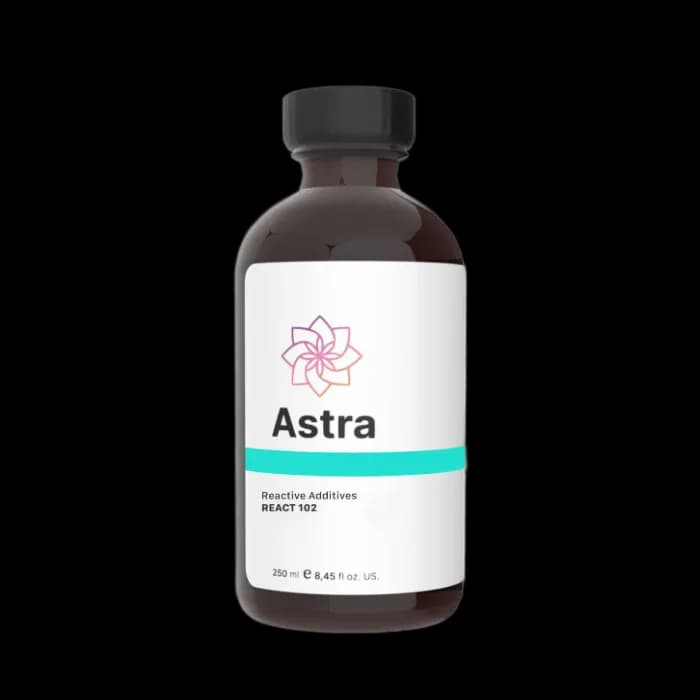
ASTRA REACT®
Reactive Additives
Reactive additives that integrate into product molecular structure during curing (heat, UV, catalysts). Modify final material properties.
Why use reactive additives?
Reactive additives integrate into the polymer network during curing (heat, UV, catalysts). They modify final film properties permanently rather than just remaining on the surface as conventional additives do.
Key Benefits
- Permanent modification of film properties
- Reacts with isocyanates, acrylates, epoxies
- Does not migrate or extract over time
- Improved weather and chemical resistance
- Enhanced flexibility and durability
- UV-curable and 2K systems compatible
Impact on Coating Performance
ASTRA REACT additives create permanent, lasting improvements in coating performance. Unlike surface-active additives, they become part of the polymer matrix for lifetime durability.
O – organosoluble, WB – water-based, RC – radiation-curable
Product Catalog
Download TDS| Active % | Feature | TDS | Samples | |||
|---|---|---|---|---|---|---|
| ASTRA REACT-1002 | — | Radiation-curable | 100% | Modified polysiloxane with acrylate terminal groups -C(O)CH=CH2, can react with resins. Used in radiation-curable systems to modify resins and achieve new system properties. | ||
| ASTRA REACT-102 | KF-6000 | Solvent-based | 100% | Modified polysiloxane with terminal groups -CH2OH, can react with resins. Used in PU systems, can react with isocyanates. Improves elasticity, smoothness, moisture resistance, weather resistance. | ||
| ASTRA REACT-1102 | — | Solvent-based | 100% | Modified polysiloxane with terminal groups -CH2CHOCH2, can react with resins. Used in epoxy systems to modify resins and achieve new properties of the system. | ||
| ASTRA REACT-1202 | — | Solvent-based | 100% | Modified polysiloxane with terminal groups -CH2CHOCH2, can react with resins. Used in epoxy systems to modify resins and achieve new system properties. | ||
| ASTRA REACT-1302 | KF-8012 | Solvent-based | 100% | Modified polysiloxane with terminal groups -CH2NH2, can react with resins. Used in melemine urethane systems to modify resins and achieve new system properties. | ||
| ASTRA REACT-1402 | KF-2012 | Solvent-based | 100% | Modified polysiloxane with one terminal group -CH20C(0)C(CH2)CH3, can react with resins. Used in acrylate systems to modify resins and achieve new system properties. | ||
| ASTRA REACT-1502 | — | Solvent-based / Radiation-curable | 100% | Organosilicone with two -OH groups, used for modification of polyurethanes and polyesters, as well as UV-curable resins. | ||
| ASTRA REACT-202 | KF-6001 | Solvent-based | 100% | Modified polysiloxane with terminal groups -CH20H, can react with resins. Used in PU systems, can react with isocyanates. Improves elasticity, smoothness, moisture resistance, weather resistance | ||
| ASTRA REACT-302 | KF-6002 | Solvent-based | 100% | Modified polysiloxane with terminal groups -CH20H, can react with resins. Used in PU systems, can react with isocyanates. Improves elasticity, smoothness, moisture resistance, weather resistance. | ||
| ASTRA REACT-402 | — | Solvent-based | 100% | Modified polysiloxane with terminal groups -CH20H, can react with resins. Used in PU systems, can react with isocyanates. Improves elasticity, smoothness, moisture resistance, weather resistance. |
Articles about ASTRA REACT®
Additives for Epoxy Systems: A Complete Selection Guide
Why epoxy coatings and flooring systems fail without a purpose-built additive set, how defoamers, dispersants, leveling agents, adhesion promoters, reactive silicone modifiers, antistatic additives and thixotropes are matched to epoxy chemistry, and which formulation errors create craters, amine blush or poor adhesion on concrete.
ReadAdditives for Polyurethane Coatings: A Complete Selection Guide
Why 2K PU chemistry is ruled by the isocyanate, how reactive silicone modifiers bond into the PU network, and how to choose adhesion promoters, dispersants, defoamers, slip additives and rheology modifiers for solvent-borne 2K PU, waterborne PU and PU flooring systems.
Read
The Complete Guide to Coating Additives: Selection, Chemistry, and Formulation
A senior formulator's reference to the ten functional additive families that determine whether a coating works in the lab, on the line, and in the field.
ReadNeed technical assistance?
Our team can help you select the right additive for your formulation.
Contact Technical Support