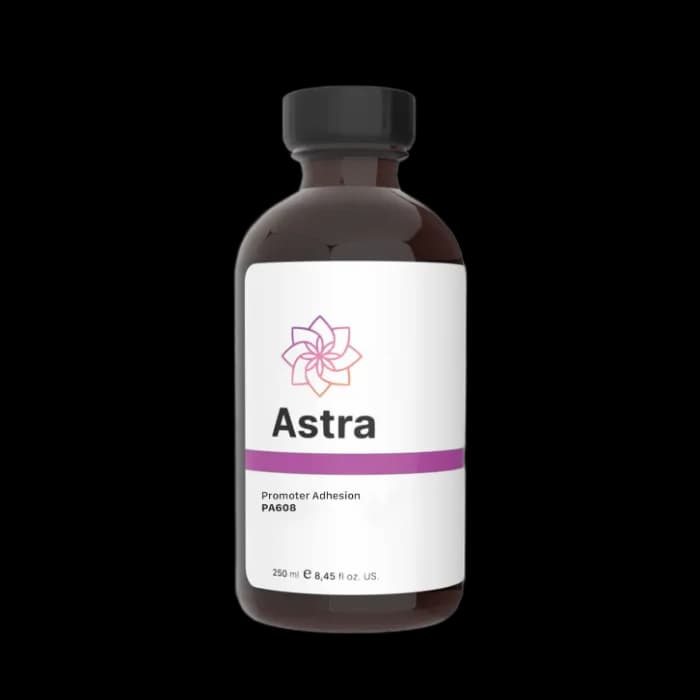
ASTRA PA®
Adhesion Promoters
Specialized additives to enhance adhesion strength between surfaces (metals, plastics, glass, composites). Modify surface, improve wettability and chemical compatibility.
Why use adhesion promoters?
Adhesion promoters enhance the bond between coatings and difficult substrates: plastics, metals, glass, composites. They modify surface energy and create chemical bridges for lasting adhesion.
Key Benefits
- Stronger bond to difficult substrates
- Works on plastics, metals, glass, composites
- Improved water and humidity resistance
- Better salt spray performance
- Reduced delamination risk
- Available for solvent and waterborne systems
Impact on Coating Performance
ASTRA PA adhesion promoters solve the most challenging substrate adhesion problems. Essential for coatings on polypropylene, stainless steel, glass and other low-energy surfaces.
P – organosoluble, WB – water-based, RC – radiation-curable
Product Catalog
Download TDS| Active % | Feature | TDS | Samples | |||
|---|---|---|---|---|---|---|
| ASTRA PA-1208 | Elementis-ADP | Solvent-based / Water-based | 75% | Good compatibility with thermosetting systems. Can participate in crosslinking of paintwork. Promotes adhesion to non-ferrous metals, improves impact resistance and elasticity. | ||
| ASTRA PA-1308 | Lubrizol-2063 | Solvent-based / Water-based | 60% | Good compatibility with resins, can react with melamine resins, NCO groups. Significantly improves adhesion to metals, moisture resistance, resistance to salt fog. | ||
| ASTRA PA-908 | — | Solvent-based / Water-based | 100% | Contains epoxy groups, designed for water systems. Stable in water for a long time. Improves adhesion to inorganic substrates (stainless steel, glass, etc.) |
Articles about ASTRA PA®
Additives for Epoxy Systems: A Complete Selection Guide
Why epoxy coatings and flooring systems fail without a purpose-built additive set, how defoamers, dispersants, leveling agents, adhesion promoters, reactive silicone modifiers, antistatic additives and thixotropes are matched to epoxy chemistry, and which formulation errors create craters, amine blush or poor adhesion on concrete.
ReadAdditives for Polyurethane Coatings: A Complete Selection Guide
Why 2K PU chemistry is ruled by the isocyanate, how reactive silicone modifiers bond into the PU network, and how to choose adhesion promoters, dispersants, defoamers, slip additives and rheology modifiers for solvent-borne 2K PU, waterborne PU and PU flooring systems.
Read
The Complete Guide to Coating Additives: Selection, Chemistry, and Formulation
A senior formulator's reference to the ten functional additive families that determine whether a coating works in the lab, on the line, and in the field.
ReadNeed technical assistance?
Our team can help you select the right additive for your formulation.
Contact Technical Support