Wetting Agents for Coatings: The Complete Selection Guide
Why coatings crawl, crater and fish-eye, the difference between substrate wetting and pigment wetting, how static and dynamic surface tension decide which product to use, and how to select a wetting agent for waterborne, solvent-borne and UV systems.
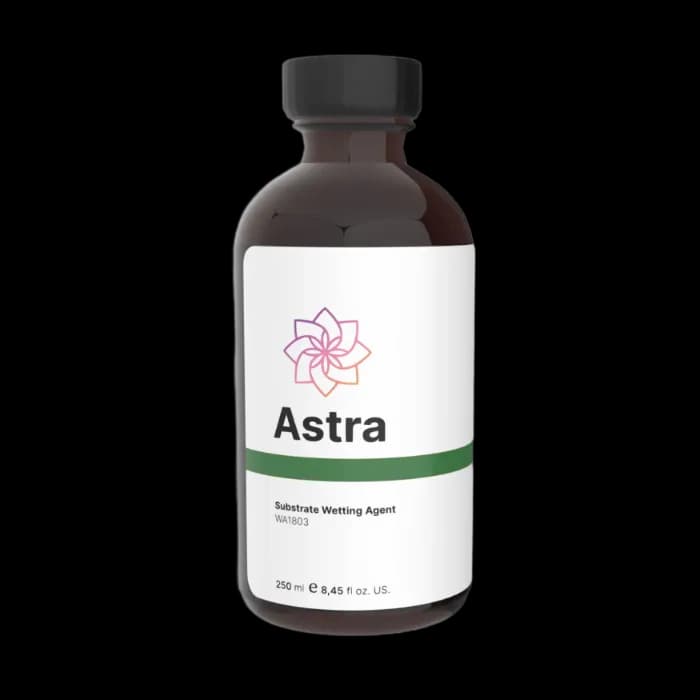
Why coatings crawl, crater and fish-eye, the difference between substrate wetting and pigment wetting, how static and dynamic surface tension decide which product to use, and how to select a wetting agent for waterborne, solvent-borne and UV systems without creating foam or adhesion problems.
A Coating That Does Not Wet Fails Before It Dries
Every defect that appears on a finished coating can be traced back to an early stage of the process. Wetting is the very first interaction between the liquid coating and the surface it meets — the substrate or the pigment. If that interaction is wrong, nothing that happens later can fully compensate for it.
Poor substrate wetting produces crawling, retraction, craters and fisheyes. Poor pigment wetting produces long grind times, high viscosity and dispersions that flocculate during storage. Both problems have the same physical origin: the coating's surface tension is too high for the surface it has to cover.
A wetting agent lowers surface tension at the critical interfaces — liquid-to-solid (substrate or pigment) and liquid-to-air — so the film can spread evenly, penetrate surface texture and let the resin adsorb onto the pigment.
What ignoring wetting costs:
- Crawling and retraction on low-energy substrates (plastics, coated metals, composites)
- Crater and fisheye defects after application
- 20–40% longer dispersion time in the mill
- Pigment flocculation, settling and colour drift during storage
- Extra defoamer and leveling agent needed to compensate for defects the wetting agent could have prevented
Two Types of Wetting — Two Different Problems
The word "wetting" is used for two distinct jobs in coating formulation. Confusing them is the most common reason a wetting agent selection fails.
Substrate Wetting
The coating must spread over the substrate without retracting into droplets or crawling away from edges and corners. This happens only when the liquid's surface tension is lower than the substrate's surface energy.
| Substrate | Surface energy (mN/m) | Wetting difficulty |
|---|---|---|
| Steel, clean | 40–50 | Easy |
| Aluminium | 35–45 | Moderate |
| Treated wood | 30–40 | Moderate |
| Powder-coated surface | 25–35 | Difficult |
| Polypropylene | 20–30 | Very difficult |
| PTFE | 15–20 | Extremely difficult |
Working rule: if the substrate surface energy is below 35 mN/m, a substrate wetting agent is almost certainly required. Below 25 mN/m, only silicone or fluorinated products will work reliably.
Pigment Wetting
During dispersion, the wetting agent displaces air and moisture from the pigment surface so the grind resin can adsorb onto it. This is related to dispersant function but distinct from it.
- Wetting agent — lowers surface tension so the liquid makes initial contact with the pigment
- Dispersant — provides steric or electrostatic stabilisation once the pigment is separated
In waterborne systems the two functions are often combined in one product, which simplifies the formulation and shortens the grind.
Static and Dynamic Surface Tension — the Selection That Most Formulators Get Wrong
Surface tension is not a single number. The value measured on a resting liquid (static) differs from the value that exists at the moment the liquid is being applied (dynamic). Most application processes are fast: spraying, roller coating, curtain coating and gravure printing all stretch the liquid surface in milliseconds.
Static surface tension describes the equilibrium state. It matters for levelling, sagging and final appearance.
Dynamic surface tension describes the liquid surface during rapid deformation. It decides whether a fast-moving film can wet a substrate before it sets.
The key point: a wetting agent that works on static surface tension may be useless at the application speed of your line. This is why two products with similar chemistry can behave completely differently in practice.
| Situation | Critical parameter | Product family |
|---|---|---|
| Dip coating, slow application | Static surface tension | Standard polyether siloxanes |
| Spray, roller, gravure | Dynamic surface tension | Acetylenic diols (Surfynol-type) |
| High-speed curtain coating | Dynamic surface tension | Acetylenic diols, modified |
| Foam-sensitive systems | Both + foam stability | Low-foam grades, twin siloxanes |
Acetylenic diol chemistry (the family behind Surfynol-type products) is the classic answer to dynamic wetting problems because it adsorbs at the surface faster than conventional surfactants.
The Three Chemistries of Wetting Agents
Polyether-Modified Siloxanes (Silicone Wetting Agents)
The most common substrate wetting agents in industrial coatings. The silicone backbone delivers very low surface tension (18–22 mN/m), while the polyether side chains provide compatibility with the coating matrix.
Advantages:
- Strongest surface tension reduction among conventional products
- Excellent on low-energy substrates
- Effective at very low dosage (0.05–0.3%)
Considerations:
- Can reduce intercoat adhesion when overdosed
- Some grades stabilise foam
- Polyether structure must match the system (hydrophilic for water, hydrophobic for solvent)
Fluorinated Surfactants
Reduce surface tension further than silicones (15–18 mN/m). Reserved for extreme wetting challenges.
Advantages:
- Lowest achievable surface tension
- Works on the most difficult substrates
Considerations:
- Higher cost
- Growing regulatory pressure on PFAS-containing chemistries
- Availability varies by region
Organic Surfactants and Acetylenic Diols
Cost-effective and excellent for dynamic wetting. Acetylenic diols have a unique combination of wetting and defoaming behaviour that makes them standard in waterborne systems.
Advantages:
- No silicone-related adhesion problems
- Good dynamic wetting
- Some grades simultaneously reduce foam
Considerations:
- Weaker on very low-energy substrates than silicone
- Higher dosage required (0.2–1.0%)
- Can increase water sensitivity
Diagnose First, Dose Second
A wetting problem is a symptom, not a diagnosis. The same visible defect can have several causes, and the correct additive depends on which cause is present.
| Symptom | Root cause | Correct action |
|---|---|---|
| Crawling on plastic | Substrate energy too low | Silicone or fluoro wetting agent |
| Craters / fisheyes | Local contamination | Clean process + wetting agent to reduce tension gradient |
| Slow pigment grind | Poor pigment wetting | Wetting-dispersing agent, longer grind |
| Flocculation in storage | Insufficient stabilisation | Dispersant with wetting function (ASTRA DISP®) |
| Craters returning after dosing | Foam micro-bubbles | Low-foam wetting agent + defoamer |
| Poor wetting + poor levelling | Combined defect | Multifunctional wetting-leveling product |
The most common misdiagnosis: adding more wetting agent to a coating that already has a contamination problem. The wetting agent reduces the surface tension of the whole film, which can make the gradient steeper instead of flatter. Clean the process first, then adjust the additive.
Matching the Product to the Resin System
| System | Recommended chemistry | Notes |
|---|---|---|
| Waterborne (emulsions, dispersions) | Hydrophilic polyether siloxanes, acetylenic diols | Watch foam; test wetting agent + defoamer pair |
| Solvent-borne | Silicone or fluorinated, appropriate HLB | Low dosage, check recoatability |
| UV-curable (100% solids) | Low-VOC silicone, twin siloxanes | Must not inhibit cure or migrate to the surface |
| High-solids | Low-viscosity agents | Avoid viscosity increase |
| Powder coatings (wet-on-powder) | Silicone wetting agents | Very low dosage, adhesion test mandatory |
In waterborne systems the wetting agent and the defoamer must be tested as a pair. Some combinations are antagonistic: the surfactant structure that wets well also stabilises foam, and a defoamer that destroys foam can destroy wetting. The practical solution is a low-foam wetting agent plus a compatible defoamer from the same formulation strategy (ASTRA DF® series).
Dosage and the Adhesion Limit
Wetting agents are surface-active: they migrate to interfaces. In a cured film that means the surface. Overdosing creates exactly the defects the formulator is trying to remove — cratering, poor recoatability, intercoat adhesion loss.
| Type | Typical dosage | Maximum safe dosage |
|---|---|---|
| Silicone substrate wetting | 0.05–0.3% | 0.5% (verify adhesion) |
| Fluorosurfactant | 0.01–0.1% | 0.2% |
| Organic surfactant / acetylenic diol | 0.2–1.0% | 2.0% |
| Combined wetting-dispersing | 0.5–3.0% | Per product technical data |
The 24-hour rule: measure intercoat adhesion after 24 hours, not after 1 hour. Many wetting agents show acceptable adhesion immediately after cure and fail the crosshatch test a day later, when migration to the surface has completed.
ASTRA WA® — Wetting Agents for Every System
ASTRA WA® covers substrate wetting across waterborne, solvent-borne and UV-curable coatings, including low-foam, defoaming and dynamic-wetting grades.
Substrate wetting — waterborne and universal:
| Product | Comparable to | Active | System | Key feature |
|---|---|---|---|---|
| ASTRA WA-1003 | BYK-345 | 100% | WB / RC | Wetting + levelling for water systems, stable in water |
| ASTRA WA-1103 | BYK-346 | 50% | WB / RC | Reduces surface tension, does not harm recoatability |
| ASTRA WA-1203 | BYK-347 | 100% | WB / RC | Universal wetting, excellent substrate coverage |
| ASTRA WA-1403 | BYK-348 | 100% | O / WB / RC | Rapid levelling, water and UV systems |
| ASTRA WA-1503 | BYK-349 | 100% | WB | Strong wetting, does not stabilise foam |
| ASTRA WA-1603 | Tego Twin 4000 | 100% | WB / RC | Low-foam wetting, twin structure |
| ASTRA WA-1703 | Tego Twin 4100 | 100% | WB / RC | Low-foam wetting, substrate coverage |
| ASTRA WA-1803 | Tego 270 | 100% | O / WB / RC | Universal wetting, no foam stabilisation |
| ASTRA WA-1903 | Tego 240 | 100% | WB / RC | Wetting + levelling for water systems |
| ASTRA WA-2003 | Tego 260 | 100% | O / WB / RC | Rapid levelling, water and UV |
| ASTRA WA-2103 | Tego 265 | 100% | O / WB / RC | Prevents crater formation, water + solvent |
| ASTRA WA-2203 | Tego 280 | 100% | O / WB / RC | Prevents craters, water + solvent |
| ASTRA WA-2403 | DC-67 / DC-5211 | 100% | O / WB / RC | Reduces surface tension, levelling, UV compatible |
| ASTRA WA-2503 | Tego Twin 4000 (Evonik) | 100% | O / WB / RC | Wetting without foam provocation |
| ASTRA WA-2603 | Tego 245 (Evonik) | 100% | O / WB / RC | Water + UV, surface tension reduction |
| ASTRA WA-803 | Tego 245 | 100% | O / WB / RC | Water systems, prevents cratering |
| ASTRA WA-3603 | — | 100% | WB | Silicone wetting, no foam stabilisation |
Dynamic wetting and acetylenic diol grades:
| Product | Comparable to | Active | System | Key feature |
|---|---|---|---|---|
| ASTRA WA-103 | Surfynol 104E | 50% | WB | Wetting + defoaming action |
| ASTRA WA-203 | Surfynol 420 | 100% | O / WB / RC | Wetting + defoaming, dynamic wetting |
| ASTRA WA-1303 | Surfynol 465 | 100% | WB | Dynamic surface tension control, hydrophilic |
| ASTRA WA-2303 | DO-75 / OT-75 | 100% | WB | Dynamic tension, crater prevention, levelling |
| ASTRA WA-2703 | Surfynol 604 | 100% | WB | Dynamic wetting, crater prevention |
| ASTRA WA-2803 | Surfynol 607 | 100% | WB | Dynamic wetting, high hydrophilicity |
| ASTRA WA-2903 | Tego Twin 4000 | 100% | WB | Wetting + defoaming for aqueous systems |
| ASTRA WA-3003 | Surfynol 104BC | 50% | WB | Multifunctional: wetting + defoaming |
| ASTRA WA-3103 | Surfynol 104E | 50% | WB | Multifunctional wetting + defoaming |
| ASTRA WA-3203 | Surfynol 440 | 100% | WB | High cloud point, stays transparent |
| ASTRA WA-3303 | Surfynol AD-01 | 100% | WB | Non-ionic, static + dynamic wetting, low foam |
| ASTRA WA-3403 | Surfynol 465 | 100% | WB | High cloud point, transparent films |
| ASTRA WA-3703 | Surfynol 104PG | 50% | WB | Multifunctional wetting + defoaming |
Fluorosurfactants and special grades:
| Product | Comparable to | Active | System | Key feature |
|---|---|---|---|---|
| ASTRA WA-403 | — | 15% | WB / RC | Strong surface tension reduction |
| ASTRA WA-503 | Dupont FS-3100 | 100% | O / WB / RC | Extreme wetting, flow improvement |
| ASTRA WA-603 | Low-foam fluorosurfactant | 100% | O / WB / RC | Strong wetting, no foam stabilisation |
| ASTRA WA-703 | Surfynol 440 | 100% | WB | Wetting + levelling, crater prevention |
| ASTRA WA-903 | 3M FC-4430 | 100% | O / WB / RC | Water systems, crater prevention |
| ASTRA WA-303 | Low-foam wetting agent | 100% | WB / RC | Wetting without foam stabilisation |
| ASTRA WA-3503 | TROYSOL LAC | 100% | WB / RC | Combined wetting + dispersing function |
| ASTRA WA-3803 | — | 90% | WB / RC | Spreading + pigment wetting |
| ASTRA WA-3903 | — | 90% | WB / O | Spreading + pigment wetting |
| ASTRA WA-S01 | — | 60% | WB | Anionic substrate wetting, spreading + levelling |
A Simple Decision Sequence
- Is the problem on the substrate or on the pigment? Substrate → wetting agent. Pigment → dispersant with wetting function (ASTRA DISP®).
- Is the substrate below 35 mN/m? Yes → silicone or fluorinated chemistry. No → an organic surfactant may be enough.
- Is the application fast (spray, roller, gravure)? Yes → check dynamic surface tension and prefer acetylenic diol grades.
- Will the coating be overcoated? Yes → keep the dosage low and run the 24-hour crosshatch test.
- Is foam a concern? Yes → low-foam wetting agent paired with a compatible defoamer (ASTRA DF®).
All product names, trade names and trademarks mentioned are the property of their respective owners. BYK, TEGO, Surfynol, TROYSOL, Dupont, 3M and Evonik are trademarks of their respective companies. Comparable products are listed for reference only.
Key Takeaways
- Identify the problem first: substrate wetting and pigment wetting require different products
- Static and dynamic surface tension are different properties — match the product to the application speed
- Silicone wetting agents are the most versatile, but dosage is limited by recoatability and adhesion
- In waterborne systems test the wetting agent and defoamer as a pair
- Acetylenic diol grades solve dynamic wetting and reduce foam simultaneously
- Verify intercoat adhesion after 24 hours, not immediately after cure
- Start at the low end of the dosage range — overdosing creates the defects you are trying to remove
Testing additives for this application?
Send us your current formulation challenge and our technical team will recommend an ASTRA product package for lab screening.