Levelling Agents: The Complete Guide to a Perfect Coating Finish
Why surface defects are a surface tension problem, how silicone and silicone-free chemistries differ, the recoatability trade-off that decides most selections, and how to use levelling additives for slip, soft-touch, hammer finish and anti-graffiti effects.
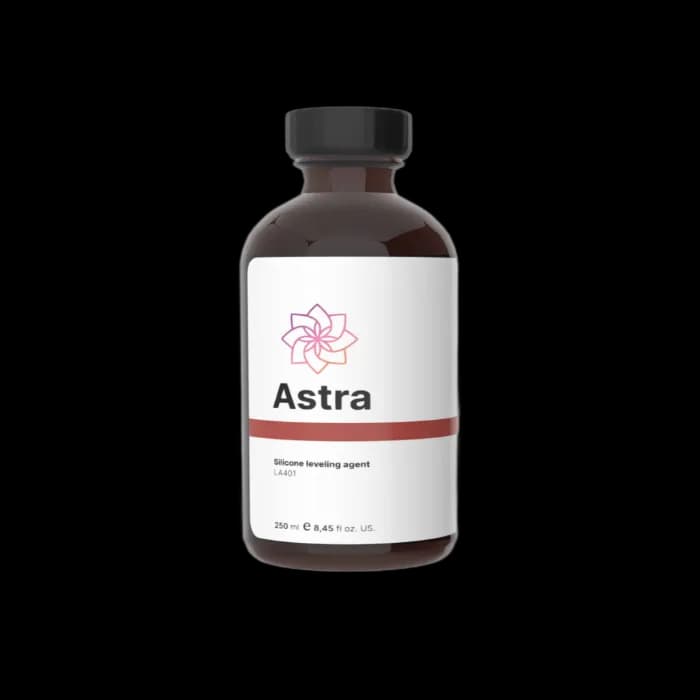
Why surface defects are a surface tension problem, how silicone and silicone-free chemistries differ, the recoatability trade-off that decides most selections, and how to use levelling additives for slip, soft-touch, hammer finish and anti-graffiti effects.
A Coating Is Judged by Its Surface
A coating can pass every durability test in the specification and still be rejected on delivery, because the customer sees the surface before anything else. Orange peel, brush marks, roller texture, craters and fisheyes are visible proof that something went wrong — and they generate complaints regardless of how well the film performs.
The defects are not random. Almost all of them come from the same root cause: surface tension differences within the wet film.
When surface tension is uneven across a freshly applied film, liquid flows from areas of low surface tension toward areas of high surface tension. That flow is what pulls a film into ridges, dimples and craters instead of letting it settle flat.
A levelling agent works by equalising surface tension across the wet film. It reduces the gradients that drive unwanted flow, so the film relaxes into a smooth, uniform surface before the resin locks it in place.
Defects a levelling agent addresses:
| Defect | Appearance | Mechanism |
|---|---|---|
| Orange peel | Regular dimpled texture, spray application | Film cannot relax before viscosity rises |
| Brush marks | Parallel ridges | Applicator drag, insufficient flow-out |
| Roller texture | Stippled surface | High-shear application, fast viscosity recovery |
| Craters | Round depressions with a raised rim | Localised low surface tension spot |
| Fisheyes | Craters with a visible contaminant centre | Oil, silicone or dust contamination |
| Bénard cells | Honeycomb pattern, often colour-related | Convection cells during drying |
| Picture framing | Thick edges on panels | Edge flow and evaporation differential |
Levelling, Wetting and Slip Are Three Different Jobs
These functions are frequently confused because many products deliver more than one. The distinction matters when you are diagnosing a problem.
Substrate wetting happens first. The coating must spread across the substrate without crawling. This requires the liquid's surface tension to be below the substrate's surface energy.
Levelling happens next. Once the film is down, it must flow out and eliminate texture before viscosity rises too far.
Slip is a property of the cured surface. It governs friction, scratch resistance, blocking and how the coating feels to the touch.
A single silicone additive can contribute to all three. That is convenient in formulation and inconvenient in troubleshooting — increasing the dose to fix levelling can push slip high enough to break intercoat adhesion.
Diagnostic rule: if the coating crawls or beads up on the substrate, that is a wetting problem. If it covers the substrate but keeps texture, that is a levelling problem. Adding a levelling agent will not fix poor substrate wetting.
Silicone vs Silicone-Free: the Primary Decision
Silicone levelling agents (ASTRA LA®)
Polyether- or polyester-modified polysiloxanes. The siloxane backbone provides very low surface tension; the organic modification controls compatibility with the resin system.
Strengths:
- Strongest surface tension reduction — 20–22 mN/m
- Effective at very low dosage, typically 0.05–0.3%
- Also deliver slip, mar resistance and easy-clean properties
- Work on low-energy substrates where organic additives fail
Limitations:
- Recoatability risk if overdosed — the additive migrates to the surface and the next coat cannot bond
- Some grades stabilise foam, particularly in water-based systems
- Silicone contamination is a real concern on shared production lines
- Compatibility must be verified; incompatible grades cause haze in clear coats
Silicone-free levelling agents (ASTRA LA NS®)
Polyacrylate-based. They work by a different mechanism: instead of dropping surface tension dramatically, they equalise it across the film and improve flow-out.
Strengths:
- No recoatability problems — safe in multilayer builds
- Do not stabilise foam; several grades actively assist defoaming
- No silicone contamination risk
- Excellent in clear coats where haze is unacceptable
Limitations:
- Less effective on very low-energy substrates
- Higher dosage required, typically 0.1–1.0%
- Weaker slip contribution — a separate slip additive may be needed
Decision rule
Start silicone-free if the coating will be recoated, if it is a clear coat where haze matters, or if the line also produces coatings that must not be silicone-contaminated. Start silicone if the substrate is low-energy, if slip and mar resistance are required, or if maximum levelling power is needed at minimum dosage.
The Recoatability Trade-Off
This is the single most common cause of levelling agent failure in the field, and it is worth understanding precisely.
A silicone levelling agent works partly because it migrates toward the air interface. That is what lets it equalise surface tension across the film. The consequence is that after cure, a silicone-enriched layer sits at the very top of the coating.
If nothing is applied on top, this is beneficial — it delivers slip, mar resistance and easy-clean behaviour. If a second coat is applied, the new layer has to bond to a low-energy silicone surface, and adhesion can fail.
How to manage it:
- Dose conservatively. Most intercoat adhesion failures occur above 0.3% of a high-active silicone grade. Start at 0.05–0.1%.
- Use grades documented as recoatable. Several ASTRA LA grades are specifically characterised as not affecting overcoating ability — LA-101, LA-201, LA-601, LA-1201, LA-1601, LA-2701, LA-3001.
- Use reactive silicones in multilayer systems. Grades containing acrylate or hydroxyl functionality crosslink into the film instead of remaining mobile at the surface. LA-3201, LA-3301, LA-3501, LA-3601, LA-3701 (acrylate, UV) and LA-4301 (hydroxyl, PU and melamine) belong to this group.
- Switch to silicone-free. ASTRA LA NS® grades avoid the problem entirely.
- Always test. Apply a second coat after 24 hours and run a cross-hatch adhesion test per ASTM D3359 or ISO 2409. Do this at the intended dosage, in the final formulation.
Rule of thumb: if the coating will be recoated, either the levelling agent must be reactive or it must be silicone-free. A non-reactive silicone at high dosage in a multilayer system will eventually produce a delamination complaint.
Craters: Diagnosis Before Dosage
Craters are the defect most often blamed on levelling agents, and often incorrectly. There are three distinct causes and they need different responses.
Contamination craters (fisheyes). A droplet of oil, silicone or grease creates a local low-surface-tension spot. The surrounding coating flows away from it. Under magnification there is a contaminant at the centre. Fix the contamination source — compressed air lines, mould release, hand cream, machine oil. A levelling agent reduces the severity but does not eliminate the cause.
Foam craters. A bubble reaches the surface, bursts, and the film cannot close before viscosity rises. No contaminant at the centre; often accompanied by pinholes. This is a defoamer problem, not a levelling problem.
Additive incompatibility craters. An incompatible additive — frequently an overdosed defoamer or an incompatible silicone — forms a separate phase that behaves like contamination. Reduce dosage or switch to a more compatible grade.
Several ASTRA grades are specifically documented as crater-reducing: LA-1501, LA-1701, LA-1901, LA-2101, LA-3101, LA-4501 in the silicone line; LANS-505NS, LANS-605NS, LANS-1305NS, LANS-1505NS, LANS-1605NS in the silicone-free line.
Matting Agent Orientation
A less obvious function of some levelling additives, and a valuable one in low-gloss systems.
Matt coatings rely on silica or wax particles positioned at the film surface to scatter light. If those particles settle unevenly or orient poorly, gloss becomes patchy and the sheen varies with viewing angle — the coating looks blotchy rather than uniformly matt.
Certain silicone additives influence how matting particles orient as the film dries, producing a more uniform matt appearance at the same matting agent loading. In practice this can reduce matting agent demand, which also protects mechanical properties, since high matting loadings weaken the film.
ASTRA grades documented as affecting matting agent orientation: LA-1501, LA-1701, LA-1801, LA-3101, LA-4201, LA-4501.
Levelling Additives for Special Surface Effects
Beyond defect correction, several grades in the range are used deliberately to create a surface property. These are among the highest-value applications of the chemistry.
Slip and mar resistance
Reduces surface friction, so the coating resists scratching and scuffing in handling and service. Important in furniture, coil coating, can coating and automotive interiors.
- LA-2301, LA-2401 (TEGO 482 type, water-based, 55% active) — slip plus anti-blocking, improved scratch resistance
- LA-2501 (DC-18 / DC-3238 type) — slip and anti-blocking for water-based and solvent systems
- LA-2601 (DC-54 type) — excellent slip without generating or stabilising foam
Soft-touch
A velvety, warm tactile surface used on premium consumer goods, automotive interiors and appliance housings.
- LA-2001 (BYK-UV3510 type) — developed for UV systems, also usable in epoxy and water-based
- LA-2201 (DC-51 / DC-3289 type, water-based, 80% active) — soft-touch with improved abrasion resistance
Hammer finish
A deliberate decorative texture resembling hammered metal, used on machine tools, enclosures and industrial equipment. Here the additive creates controlled surface disruption rather than eliminating it.
- LA-2801 (DC-61 type, solvent-borne, 10% active) — excellent hammer effect
- LA-2901 (water-based, 25% active) — hammer effect with pattern coarseness adjustable by dosage
Anti-graffiti and easy-clean
The additive orients at the surface and lowers surface energy so far that paint, marker and dirt cannot adhere properly and can be wiped away.
- LA-4001 (BYK-SILCLEAN 3700 type) — anti-blocking and easy-clean for clear systems
- LA-4701, LA-4801 (BYK-SILCLEAN 3720 type) — remain in the surface layer, anti-graffiti effect
- LA-4601 — anti-vandal effect through surface orientation
- LA-3801, LA-3901 (reactive, UV) — anti-graffiti with crosslinking into the film
Dirt pick-up resistance
- LA-1901, LA-3401 (BYK-UV3510 / TEGO 2300 type) — effective wetting and levelling with contamination resistance
- LA-4101 (KP-366 type) — dirt resistance with improved gloss
Reactive Levelling Additives for UV Systems
UV-curable coatings present a specific problem: cure is fast, so the film has very little time to level, and the additive cannot be allowed to migrate freely because it would interfere with surface cure or with adhesion of subsequent layers.
Reactive silicone levelling additives solve this by carrying acrylate functionality that crosslinks into the network during cure. The additive works during the liquid phase, then becomes a permanent part of the film.
| Product | Analogue | Function |
|---|---|---|
| ASTRA LA-3201 | TEGO 2100 | Acrylate-functional polymer, levelling and slip |
| ASTRA LA-3301 | TEGO 2200N | Levelling, reduced migration |
| ASTRA LA-3501 | TEGO 2500 | Participates in crosslinking, modifies film properties |
| ASTRA LA-3601 | TEGO 2100 | Anti-blocking in UV systems |
| ASTRA LA-3701, LA-3801 | TEGO 2700 | Crosslinks, protective and anti-graffiti effects |
| ASTRA LA-3901 | BYK-UV3505 | Levelling with anti-vandal surface |
| ASTRA LA-1301, LA-1401 | TEGO 432 | Levelling, slip and substrate wetting for radiation cure |
Dosage and Test Protocol
Dosage guidance
| Type | Typical dosage | Maximum before defects | Note |
|---|---|---|---|
| Silicone, high active (100%) | 0.05–0.3% | 0.5% | Verify intercoat adhesion above 0.2% |
| Silicone, diluted (10–50%) | 0.2–1.0% | 2.0% | Dosage scales with active content |
| Silicone-free acrylate | 0.1–1.0% | 1.5% | Recoat-safe across the range |
| Reactive silicone (UV) | 0.5–2.0% | 3.0% | Crosslinks; higher loading tolerated |
| Slip / soft-touch | 0.5–3.0% | Per TDS | Effect-driven, not defect-driven |
Always start at the lower end. Overdosing a levelling agent converts a texture problem into an adhesion problem, which surfaces later and is harder to diagnose.
Test protocol
Levelling performance depends heavily on application method, so lab drawdowns alone are not sufficient.
| Test | Method | Pass criterion |
|---|---|---|
| Levelling | Real application method at target film build | No orange peel, brush or roller texture |
| Craters | Spray panel, 20 panels minimum | Zero craters at target build |
| Gloss / DOI | 20°/60° gloss, distinctness of image | Meets or exceeds control |
| Haze | Clear coat over black panel | No visible haze |
| Foam | Shake test plus spray panel | No increase vs control |
| Intercoat adhesion | Recoat at 24 h, cross-hatch | 4B–5B (ASTM D3359) |
| Slip | Coefficient of friction, or subjective feel | Meets target |
| Storage | 40 °C / 30 days, then re-test levelling | No loss of performance |
The intercoat adhesion test is the one most often skipped and the one that catches the most expensive failures.
Interaction With Other Additives
Levelling agents do not act in isolation. Three interactions matter in practice.
Levelling agent and defoamer. Both operate at the air interface, and a strong silicone leveller can stabilise foam that the defoamer is trying to break. Always test the pair in the final formulation. Several ASTRA grades are documented as not stabilising foam — LA-301, LA-401, LA-701, LA-801, LA-1701, LA-1801, LA-2601 — and are the safer starting point in water-based systems.
Levelling agent and wetting agent. Both reduce surface tension, so their effects add. It is easy to overshoot and hit the recoatability limit with a combination that looked safe when each additive was evaluated alone.
Levelling agent and matting agent. Discussed above — the interaction is often beneficial, but it means changing the leveller can visibly change gloss in a matt system. Re-measure gloss after any levelling agent change in low-sheen products.
ASTRA LA® — Silicone Levelling Agents
49 grades covering solvent-borne, water-based and radiation-curing systems. Selected products:
| Product | Analogue | System | Active | Application focus |
|---|---|---|---|---|
| ASTRA LA-101 | BYK-306, EFKA 3033, TEGO 415 | Solvent | 15% | Slip and levelling, recoatable |
| ASTRA LA-201 | BYK-310 | Solvent | 25% | Slip and levelling, recoatable |
| ASTRA LA-601 | BYK-300 | Solvent | 50% | Slip and levelling, recoatable |
| ASTRA LA-701 | BYK-320, BYK A525 | Solvent / RC | 50% | Levelling, low crater, no foam stabilisation |
| ASTRA LA-1201 | BYK-331 | Solvent / WB / RC | 100% | Levelling, recoatable |
| ASTRA LA-1501 | TEGO 450 | Solvent / WB / RC | 100% | Low crater, matting orientation |
| ASTRA LA-1601 | BYK-333 | Solvent / WB / RC | 100% | Levelling and slip, recoatable |
| ASTRA LA-1701 | TEGO 410 | Solvent / WB / RC | 100% | Low crater, matting orientation, no foam |
| ASTRA LA-2001 | BYK-UV3510 | Solvent / WB / RC | 100% | Soft-touch effect, UV focus |
| ASTRA LA-2301 | TEGO 482 | Water-based | 55% | Slip, anti-blocking, scratch resistance |
| ASTRA LA-2801 | DC-61 | Solvent | 10% | Hammer finish effect |
| ASTRA LA-2901 | — | Water-based | 25% | Hammer finish, dosage-tunable pattern |
| ASTRA LA-3101 | BYK-9565 | Solvent / WB / RC | 100% | Anti-crater, water and stain resistance |
| ASTRA LA-3201 | TEGO 2100 | Solvent / RC | 100% | Reactive acrylate, UV levelling |
| ASTRA LA-4201 | BYK-378 | Solvent / WB / RC | 100% | Universal, slip, matting orientation |
| ASTRA LA-4301 | TEGO 5000 | Solvent | 100% | Hydroxyl-reactive for PU and melamine |
| ASTRA LA-4801 | BYK-SILCLEAN 3720 | Solvent / WB | 100% | Anti-graffiti, anti-blocking |
ASTRA LA NS® — Silicone-Free Levelling Agents
15 polyacrylate grades for recoatable and clear systems:
| Product | Analogue | System | Active | Application focus |
|---|---|---|---|---|
| ASTRA LANS-105NS | BYK-358N | Solvent / RC | 50% | Levelling and substrate wetting |
| ASTRA LANS-305NS | BYK-356 | Solvent / RC | 100% | Levelling for solvent and powder |
| ASTRA LANS-405NS | BYK-361N | Solvent / RC | 100% | Strong wetting, no transparency loss |
| ASTRA LANS-505NS | BYK-OK, BYK-special | Solvent / RC | 100% | Crater elimination |
| ASTRA LANS-605NS | EFKA-3777, DC 837 | Solvent / RC | 70% | Fast levelling, anti-crater |
| ASTRA LANS-705NS | Elementis-495 | Solvent / RC | 50% | Levelling with defoaming action |
| ASTRA LANS-905NS | BYK A560, BYK-392 | Solvent / RC | 50% | Levelling, defect prevention, foam control |
| ASTRA LANS-1005NS | BYK-394 | Solvent / WB | 80% | Strong wetting, WB and solvent |
| ASTRA LANS-1105NS | BYK-380 | Solvent / WB | 50% | Levelling, broad compatibility |
| ASTRA LANS-1205NS | BYK-381 | Water-based | 50% | Levelling, surface tension reduction |
| ASTRA LANS-1305NS | EFKA-3600 | Solvent | 100% | Fast levelling, anti-crater |
Trademark notice: BYK, TEGO, EFKA, Elementis, SILCLEAN, Momentive and other product names are the property of their respective owners. References are for identification only and do not imply affiliation or endorsement. "Analogue" indicates comparable chemistry and property range, not identity. Always validate with your own testing.
Key Takeaways
- Surface defects are almost always a surface tension gradient problem; levelling agents work by equalising tension across the wet film
- Wetting, levelling and slip are three different jobs — if the coating crawls on the substrate, a levelling agent will not fix it
- Silicone (ASTRA LA®) gives maximum levelling at minimum dosage; silicone-free (ASTRA LA NS®) gives recoat safety and clear-coat clarity
- The recoatability trade-off decides most selections: if the coating will be overcoated, use a reactive or silicone-free grade
- Diagnose craters before changing dosage — contamination, foam and additive incompatibility need different responses
- Some silicone grades improve matting agent orientation, which can reduce matting agent demand and protect film properties
- Reactive acrylate grades are the correct answer for UV systems, since they level in the liquid phase and then crosslink in
- Levelling agents deliberately create slip, soft-touch, hammer finish and anti-graffiti effects — this is high-value application, not just defect correction
- Always test intercoat adhesion at 24 h with a cross-hatch test; this is the most-skipped test and the most expensive failure
Testing additives for this application?
Send us your current formulation challenge and our technical team will recommend an ASTRA product package for lab screening.