Spray Viscosity Control for Coatings and Adhesives
Spray Viscosity Control for Coatings and Adhesives ! Operator spraying a coating onto a test panel Spray viscosity control means designing a rheology profile, not hitting a single cup time.

Spray viscosity control means designing a rheology profile, not hitting a single cup time. A sprayable coating must thin enough under the high shear of the gun to atomize into fine droplets, then recover enough at low shear to resist sagging and pigment settling on the substrate. Reliable control therefore combines three layers: a measurement method that matches the shear regime of the application, a temperature and equipment window that is held constant, and a formulation whose rheology modifiers, dispersants and defoamers keep the profile stable from batch to batch. ASTRA Chemical supplies dispersants, silicone and non-silicone defoamers and rheology modifiers for this purpose, with technical support and custom formulation guidance for coatings, adhesives, inks, plastics and composites.
TL;DR
- Spray viscosity is a profile: low apparent viscosity at the high shear of the gun, higher viscosity at rest for sag resistance and pigment suspension.
- A flow cup is a quality-control shortcut; cone-plate measurement at high shear (ASTM D7395, ISO 2884-1) reflects spraying more directly.
- Temperature, equipment type and solvent loss shift the working viscosity window, and a narrow cup specification can correspond to only a few degrees Celsius.
- Rheology modifiers, dispersants and defoamers are the formulation levers that keep the profile consistent without relying on reduction at the booth.
Viscosity governs how a liquid coating leaves the nozzle, travels as droplets, lands, levels and holds its position. Industry references summarize the effect plainly: lower viscosity improves atomization and fine mist formation, while an appropriate viscosity at rest controls film thickness and prevents sagging on vertical surfaces. Adhesive and sealant plants face the same dependence between viscosity, application ease and bond consistency.
The core formulation trade-off is documented in a Paint Foundation article on coating rheology: atomization improves with lower viscosity at the high-shear conditions of the gun, whereas sag resistance and control of pigment settling require higher viscosity at low shear. The target is therefore a rheology profile across a range of shear rates. A single number, such as a cup time, describes only one point on that curve.
This has direct consequences for production:
- A coating that is too thick at the gun atomizes coarsely, producing orange peel or a rough surface.
- A coating that is too thin at rest runs or sags and loses film build.
- A coating whose viscosity drifts between batches forces booth operators to compensate with solvent or water additions, which alters solids, dry time and film properties.
Spray viscosity control is consequently a formulation-and-quality-assurance problem first and an application problem second.
Measuring viscosity at the right shear rate
The measurement method should represent the shear that the coating experiences. Three instrument classes are commonly distinguished in the Paint Foundation rheology overview:
| Instrument | Approximate shear regime | Typical relevance |
|---|---|---|
| ICI cone and plate | About 10,000 s⁻¹ | Brush, roller and spray application |
| Krebs Stormer | About 60 s⁻¹ | Medium-shear processes such as mixing and pumping |
| Brookfield | Low to medium shear | Storage stability, settling, sag tendency |
Standards reflect the same logic. ISO 2884-1:2024 specifies absolute dynamic viscosity measurement of paints, varnishes and binders with cone-plate geometry at 9,000 to 12,000 s⁻¹ and states that the value indicates resistance to brushing, spraying and roller coating. ASTM D7395-18 specifies cone-plate measurement at 500 s⁻¹ as an alternative to No. 4 Ford cup measurement for quality control and producer-user specifications, and refers to ASTM D4287 for higher shear rates of 10,000 to 12,000 s⁻¹.
A practical measurement scheme for a spray coating therefore combines:
- A high-shear value (cone-plate, 10,000 s⁻¹ range) that predicts atomization behavior.
- A medium-shear or cup value that serves as a fast shop-floor and incoming-batch check, correlated against the instrument values.
- A low-shear value that predicts sag resistance and settling in the can and on the part.
Flow cups remain useful because they are inexpensive and quick, but a cup time is a correlation tool. When a producer-user specification is written, stating the cup type, size, temperature and, where possible, a cone-plate equivalent removes ambiguity between supplier and customer.
Temperature, solvent loss and the narrow window
Viscosity of most liquid coatings changes steeply with temperature, so a cup specification is only meaningful with a stated temperature. A Paint & Coatings Industry feature from April 2022 shows a 26 ± 2 second cup specification mapping to a window of only about 3°C (26.5 to 29.5°C, or 80 to 85°F). Above that window, low viscosity leads to runs, sags and film-build problems, while faster solvent evaporation produces dry spray, reduced gloss and more orange peel.
Heating is sometimes used to reach sprayable viscosity without adding diluent, especially for high-solids and 100% solids systems. A 2018 RadTech paper by Kristy Wagner notes that sprayable viscosities can be difficult or costly to achieve in 100% solids UV coatings, that basic heated coating systems cost $5,000 to $7,000 to install, and that excessive or prolonged heating degrades stabilizers and can cause premature polymerization. For UV-curable coatings, Wagner's 2006 PCI Magazine article advises against heating above 120 to 140°F (49 to 60°C) for extended periods.
The formulation implication is that reducing the temperature sensitivity and the dependence on diluent in the coating itself widens the operating window and lowers the burden on booth controls.
Equipment sets the target viscosity
No single spray viscosity exists for a coating family; the gun and the fluid delivery system define it. Reported ranges from Wagner's 2006 article include:
| Application equipment | Reported working viscosity |
|---|---|
| Conventional and HVLP guns | 22 s Zahn 1 up to 25 s Zahn 2 |
| Air-assisted airless (200 to 1,200 psi fluid pressure) | About 28 s Zahn 3 |
| Rotary atomizers | Up to 45 s Zahn 3 in commercial use |
The differences follow from atomization physics. Graco's spray technology white paper describes airless spraying as using high fluid pressure for atomization without compressed air, suited to medium and high viscosity fluids, with lower finish quality but high speed and transfer efficiency. Nordson's documentation on KVLP guns states that these guns operate below 10 psi (0.69 bar) of atomizing and pattern air, which reduces bounceback and overspray, and that atomization is typically coarser than air spray with high-viscosity fluids and high flow rates.
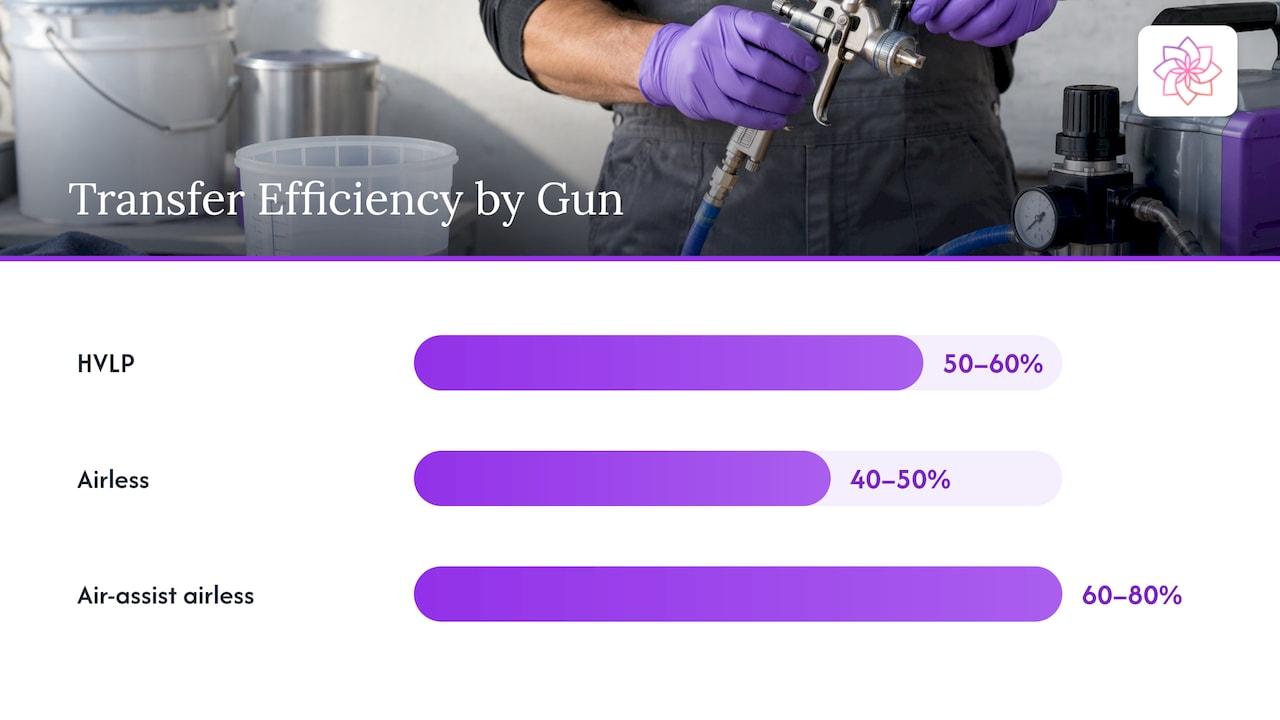
Transfer efficiency adds a cost dimension. Products Finishing reported ratings of 50 to 60% for HVLP guns, 40 to 50% for airless guns and 60 to 80% for air-assist airless guns, and recommended larger HVLP fluid nozzle and air cap sizes as viscosity increases: 0.6 to 1.2 for low-viscosity materials, 1.4 to 1.8 for medium viscosity and 2.0 and above for high-viscosity topcoats, primers and paints.
Shear behavior matters as well. The Paint Foundation's 2012 application technology article explains that thixotropic paints that thicken under high shear are poor candidates for high-shear airless systems, and that finely atomized spray exposes more droplet surface area, so rapid carrier evaporation limits equipment choice. A coating developed for one delivery system should be qualified on the specific equipment its customers use.
What actually controls droplet size
Intuition suggests that low shear viscosity at the nozzle determines droplet size. The evidence is more specific. A 1999 Journal of Coatings Technology study by Glass and co-authors on waterborne latex coatings found that higher dynamic uniaxial extensional viscosity produced larger Sauter mean droplet diameters and broader size distributions, while high-shear-rate shear viscosity and low-deformation storage modulus did not correlate with droplet size. Droplet size decreased with higher spray pressure and smaller orifice diameter, although higher pressures introduced pulsations from turbulence.
For formulators this means that two coatings with identical cone-plate viscosity at 10,000 s⁻¹ can still atomize differently, because the thickener chemistry influences extensional behavior as the liquid sheet breaks into droplets. Rheology modifier selection should be validated by spray testing and droplet or pattern evaluation, not by shear viscosity alone.
Diagnosing viscosity-related spray defects
Spray defects often point back to viscosity or temperature. One industry presentation on inline viscosity control links orange peel to excessive distance, shop temperature that alters viscosity or a clogged nozzle; runs and sags to excessive viscosity and slow drying; color variation to uncorrected viscosity fluctuation; solvent pop to inadequate viscosity and temperature control; and blisters to high surface-film viscosity trapping volatiles.
| Symptom | Viscosity-related cause | Formulation or process response |
|---|---|---|
| Orange peel, rough film | Viscosity too high at the gun, or rapid solvent loss | Review high-shear profile and thickener type; control booth temperature |
| Runs and sags | Low viscosity at low shear, excess film build | Raise low-shear viscosity or recovery; verify temperature window |
| Pigment settling, color drift | Weak low-shear structure, dispersion instability | Optimize dispersant and rheology package |
| Foam, pinholes, craters | Air entrained in mixing and pumping | Select a defoamer matched to the system |
| Batch-to-batch variation | Uncontrolled viscosity at filling or mixing | Tighten raw material and process specifications |
Spray technique and surface preparation also matter. A guide to panel-by-panel spray coating to avoid streaks illustrates how overlap and sequence influence finish uniformity once the fluid itself is behaving consistently.
On water-based systems, diluting at the point of use must be done in small increments. A spray equipment guide from a coatings applicator manufacturer recommends additions of under 5% and a maximum of 10%, noting that excessively low viscosity causes sag and fisheyes while excessive viscosity causes a rough eggshell finish through poor atomization and inhibited leveling.
Adjusting viscosity through formulation
Because field reduction changes solids, cost and film properties, the preferred route is to build the target profile into the formulation. The Paint Foundation overview lists the usual rheology modifier families: cellulosics, ASE, HASE, HEUR and HMPE for waterborne systems, and organoclays, polyamides and castor-oil derivatives for solventborne systems. Each family contributes differently across the shear range, so the choice depends on whether the priority is high-shear atomization, low-shear sag control or leveling.
Three additive classes interact closely in a sprayable formulation:
- Dispersants control pigment and filler wetting and stabilization. Poorly stabilized pigment flocculates, and flocculation raises low-shear viscosity unpredictably and can shift color between batches.
- Rheology modifiers build the shear-thinning and recovery behavior that separates atomization from sag resistance.
- Defoamers remove air introduced during mixing, pumping and spraying. Silicone and non-silicone chemistries behave differently in different systems, and defoamer choice affects surface defects as well as apparent viscosity.
For reactive and 100% solids systems, reactive diluents offer a way to lower viscosity while remaining in the film; ASTRA Chemical's technical article on reactive diluents and functional additives covers terminal groups, dosage and selection.
Holding viscosity constant in production
Production consistency is where much of the cost sits. A 2024 study in the Journal of Coatings Technology and Research by Tiedje and colleagues showed that online spray monitoring can instantaneously detect production deviations, including changed paint viscosity or pigmentation, air and paint flow-rate deviations and worn equipment parts, and that most of the undetected deviations would have caused quality problems in thickness, color, surface structure or process efficiency. The authors attribute the poor manageability of spray painting to the interaction of turbulent air flow, electrostatic fields, complex paint viscosity and booth conditions.
A consistent program typically includes:
- Specifying viscosity at defined temperature, instrument and shear rate for every released batch.
- Controlling additive dosage by weight and addition order, since both influence dispersion and thickener activation.
- Verifying viscosity at the point of application, with temperature recorded alongside.
- Monitoring pump capacity as well as pressure: Carboline's application guidance observes that a pump can generate enough pressure to atomize industrial coatings yet lack fluid capacity because of viscosity.
- Maintaining equipment, because worn nozzles alter the spray pattern in the same way that viscosity drift does.
Our perspective on spray viscosity
Spray problems are often reported as application defects, yet the cause is frequently set at the formulation stage. A coating that depends on solvent or water additions at the booth carries its viscosity variability into the customer's process. Our approach is to treat the dispersant, rheology modifier and defoamer as one system and to qualify it across the shear range the coating will encounter, from the can to the gun to the substrate.
Our product range covers dispersants, silicone and non-silicone defoamers, rheology modifiers and functional coating additives, and our technical support and custom formulation guidance are directed at dosage optimization and laboratory-backed qualification. We design for batch consistency and full documentation so that a formulation validated in the laboratory behaves the same way in production. The aim is comparable performance to premium additive brands at a lower total cost-in-use.
Astra R&D Team
Qualifying additives for a spray system
Formulators and technical directors evaluating additives for spray viscosity control can structure the work as follows:
- Define the application: equipment type, target film thickness, substrate, bake or cure conditions.
- Set the viscosity specification with method, temperature and shear rate, referencing cone-plate and cup values.
- Evaluate dispersant efficiency first, since pigment stabilization sets the baseline viscosity.
- Adjust the rheology modifier to obtain the shear-thinning and recovery profile.
- Select the defoamer last, checking compatibility and surface defects after spraying.
- Confirm the result on the production spray equipment at the temperatures expected in the booth.
ASTRA Chemical offers technical consultations and sample requests to support this sequence, with custom formulation guidance for coatings, adhesives, inks, plastics and composites. The complete range is listed on the ASTRA Chemical product page, and further technical material is available in the coating additives blog.
Where to start with ASTRA additives
For sprayable coatings and adhesives, the relevant lines are the dispersants (ASTRA DISP®), the defoamers (ASTRA DF® and ASTRA DF NS®) and the rheology modifiers, all described on the ASTRA Chemical products overview. Technical staff can discuss a target viscosity profile, the application equipment and the dosage range for a specific formulation.

Procurement managers and technical directors can request samples through the website to begin laboratory-backed qualification.
FAQ
What is the right viscosity for spraying a coating?
The value depends on the equipment. Reported ranges include 22 s Zahn 1 up to 25 s Zahn 2 for conventional and HVLP guns, about 28 s Zahn 3 for air-assisted airless guns and up to 45 s Zahn 3 for rotary atomizers, according to Wagner's PCI Magazine article. The specification should always state the cup, the temperature and ideally a cone-plate value.
Is a flow cup sufficient for viscosity control?
A flow cup is a quick quality-control check, and ASTM D7395-18 recognizes cone-plate measurement at 500 s⁻¹ as an alternative to the No. 4 Ford cup. For spray behavior, a cone-plate measurement at about 10,000 s⁻¹ reflects the application shear more directly, as described in ISO 2884-1:2024.
Why does the same coating spray differently in summer and winter?
Viscosity falls as temperature rises, and solvent evaporates faster. In the cited Paint & Coatings Industry example, a 26 ± 2 second cup specification corresponded to only a 3°C window. Controlling booth and material temperature, and formulating for lower temperature sensitivity, keeps results consistent across seasons.
Can additives reduce the need for thinning at the booth?
Rheology modifiers, dispersants and defoamers establish the viscosity profile inside the formulation, so that the coating arrives at a sprayable state without large reductions. Dosage and chemistry are system-specific, and ASTRA Chemical's technical team supports that selection.
Sources
- Xometry: What is Viscosity?
- Paint Foundation: Additives and Rheology of Paints and Coatings, October 2021
- ISO 2884-1:2024
- ASTM D7395-18
- Paint & Coatings Industry, April 2022 feature
- RadTech 2018: Viscosity Control of Spray Applied Coatings
- PCI Magazine: UV Curing on 3-D Metal Parts
- Graco: Choosing the Right Liquid Spray Technology
- Nordson KVLP documentation
- Products Finishing: A Primer on Transfer Efficiency and Tip Sizes
- Paint Foundation: Best Application Technology, 2012
- Journal of Coatings Technology, March 1999: Parameters Influencing the Spray Behavior of Waterborne Coatings
- Inline viscosity control presentation, CTT 2021
- Spray equipment guide, June 2020
- Tiedje et al., Journal of Coatings Technology and Research, 2024
- Carboline: How to manipulate coating viscosity
- Panel by panel spray coating guide
Testing additives for this application?
Send us your current formulation challenge and our technical team will recommend an ASTRA product package for lab screening.