Solvent Pop in Paint: Causes, Identification and Repair
Solvent Pop in Paint: Causes, Identification and Repair ! Solvent-pop craters in a cured purple paint panel Solvent pop is a film defect in which solvent vapor or trapped air escapes through a paint film that has already skinned over, leaving small blisters, pinholes or crater-like openings.
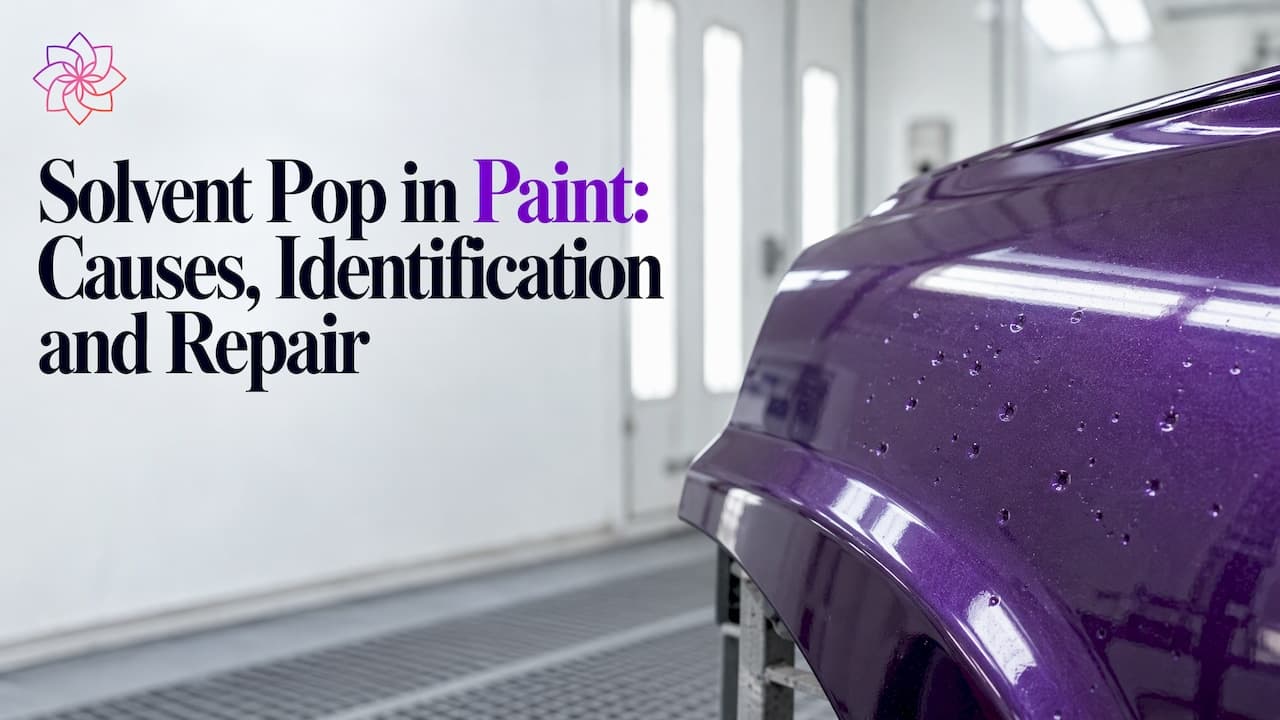
Solvent pop is a film defect in which solvent vapor or trapped air escapes through a paint film that has already skinned over, leaving small blisters, pinholes or crater-like openings. It is caused by solvent leaving the wet film faster than the film can flow back together, and it is prevented by balancing solvent evaporation rate, film build, flash time and bake schedule. Surface-level pops can often be sanded and refinished, while pops beneath the surface require the affected coating to be removed and reapplied.
This guide covers how to recognize solvent pop, how it differs from fisheyes and other defects, which formulation and process variables drive it, how to repair it, and where additive selection supports a more forgiving coating.
TL;DR
- Solvent pop appears as open-topped blisters, pinholes or small craters, typically on the most recently applied film, and is caused by solvent or air escaping after the surface has skinned.
- The main drivers are excessive film build, insufficient flash time, a thinner or reducer that evaporates too fast for the conditions, excessive air movement, and bake or infrared heat applied too early or too intensely.
- Surface pops can sometimes be sanded out and refinished; pops that originate below the surface require sanding back to the undercoat or complete removal and recoating.
- Prevention rests on following the technical data sheet for film build, solvent selection and cure schedule, supported by a formulation with controlled flow, wetting and air release.
The defect has several names in the trade: solvent popping, boiling, blowing, and, in a milder form, pinholing. One major refinish manufacturer describes solvent pop as open blisters on the finished surface. A second automotive finishes guide characterizes it as small bubbles, pinholes or crater-like openings in or on the paint film. A U.K. refinish guide gives a size reference: open-topped blisters up to 1 mm in diameter on the most recently applied film.
In visual terms, the defect shows the following characteristics:
- Clusters of small blisters or pinholes, frequently concentrated around body lines, edges, corners and other areas of heavier film build.
- Openings that are open-topped rather than sealed domes, because the vapor has already broken through the surface.
- Defects that appear after the film has begun to skin or during force drying, rather than at the moment of spraying.
Technical literature on liquid film defects groups solvent pops, boils and pinholes together as tiny craters caused by overly rapid solvent loss from the wet paint, and notes that the same appearance can be influenced by pigment clusters, surface roughness, solvent evaporation rates, oven temperature and trapped air.
The mechanism: why a skinned film traps solvent
A wet coating loses solvent from its surface. As long as the film remains fluid, solvent diffuses upward and any disturbance left behind levels out. Problems start when the top layer loses mobility before the lower layer has released its solvent. The primary cause is liquid solvent trapped beneath a surface that skins over too quickly, so that vaporizing solvent pushes through the film and leaves bubbles, pinholes or craters.
A long-standing finishing-industry analysis frames it as a viscosity problem: solvent evaporates so quickly that the increasingly viscous liquid paint cannot flow into the resulting void. The same source notes that popping becomes more frequent in hotter environments as film thickness rises, which is why facilities without climate control are particularly exposed in peak summer. In baked coatings, bubbles tend to form during the bake cycle when the top layer skins before most of the solvent has escaped, and when they break they leave craters.
Three variables therefore determine the outcome: how fast solvent is supplied to the surface, how fast the surface loses mobility, and how much time and flow remain for the film to heal. Every cause listed below acts on one of these three.
Distinguishing solvent pop from other defects
Correct diagnosis precedes correct repair, because fisheyes, air entrapment and dust contamination each require a different corrective action. Manufacturer troubleshooting guidance separates them by timing and by what is found in the defect:
| Defect | When it appears | Diagnostic feature | Root cause |
|---|---|---|---|
| Solvent pop | After the film skins over, or during force drying | Pinholes revealed when the area is sanded | Solvent or vapor escaping through a skinned film |
| Air entrapment | While the film is still wet | Can be removed by compounding | Air introduced during mixing or application |
| Dust contamination | While the film is tacky | A speck of dirt sits in the crater | Airborne or surface particulates |
| Fisheyes | During or shortly after spraying | Small circular craters across the film | Surface contamination such as oil, wax, silicone or grease |
A practical rule follows from the table. Defects that open up shortly after application and are circular and isolated point toward contamination. Clusters that develop during flash-off, bake or infrared exposure, concentrated where film is heaviest, point toward solvent entrapment. Quality teams that record defect location, film thickness and process conditions at inspection can sort these categories quickly, and a structured final inspection checklist is a convenient way to standardize that record across shifts and lines.
Causes in application and drying
No single published source covers the full list, but the manufacturers that document the defect converge on the same set of factors.
Film build and flash time
Excess film thickness is the most consistently cited cause. One manufacturer lists high film builds, an overly fast reducer or hardener for the spray conditions, excessive airflow over the repair area, and bake temperature or infrared lamp proximity that is too high. Another refinish guide adds layers applied too thick and too soon after each other, ignored flash-off time, force drying immediately after spraying, and a spray booth airflow that is too fast. Heavy wet coats stack solvent beneath a surface that begins to skin before the lower layers can release it.
Solvent selection and evaporation rate
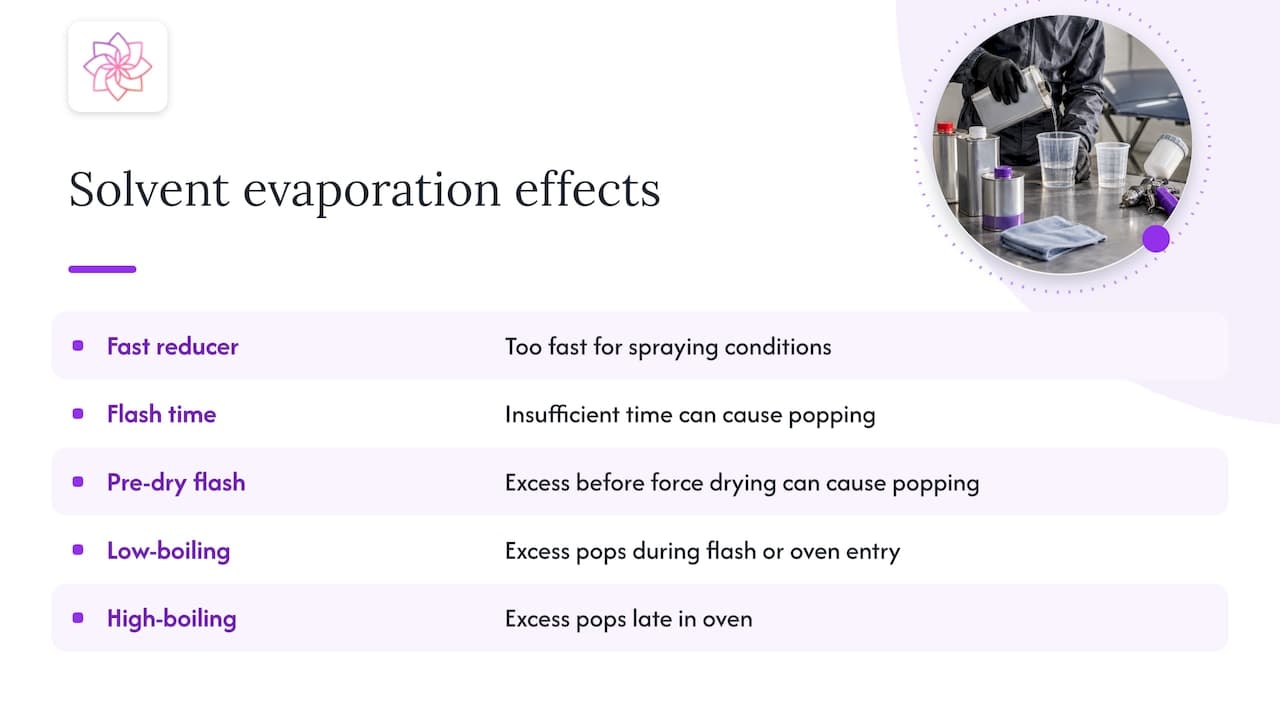
A thinner or reducer that evaporates too fast for the spraying conditions, together with insufficient flash time and excessive purge or flash time before force drying, is on the list of causes in U.S. automotive finish guidance. The balance between low-boiling and high-boiling solvent fractions matters in baked systems. Too much low-boiling solvent can pop the film during flash or on entering the oven, while too much high-boiling solvent can cause popping late in the oven.
Application viscosity and equipment
Spraying viscosity and atomization also influence film behavior. Industrial troubleshooting guidance associates solvent popping with an improper solvent for the prevailing temperature, improper handling of spray equipment, a film applied too thin to flow properly, and excessive viscosity at application. The apparent contradiction with the film-build cause is resolved by recognizing that the film must be applied at the correct viscosity and thickness for it to flow and release solvent in the intended sequence.
Oven and infrared profile
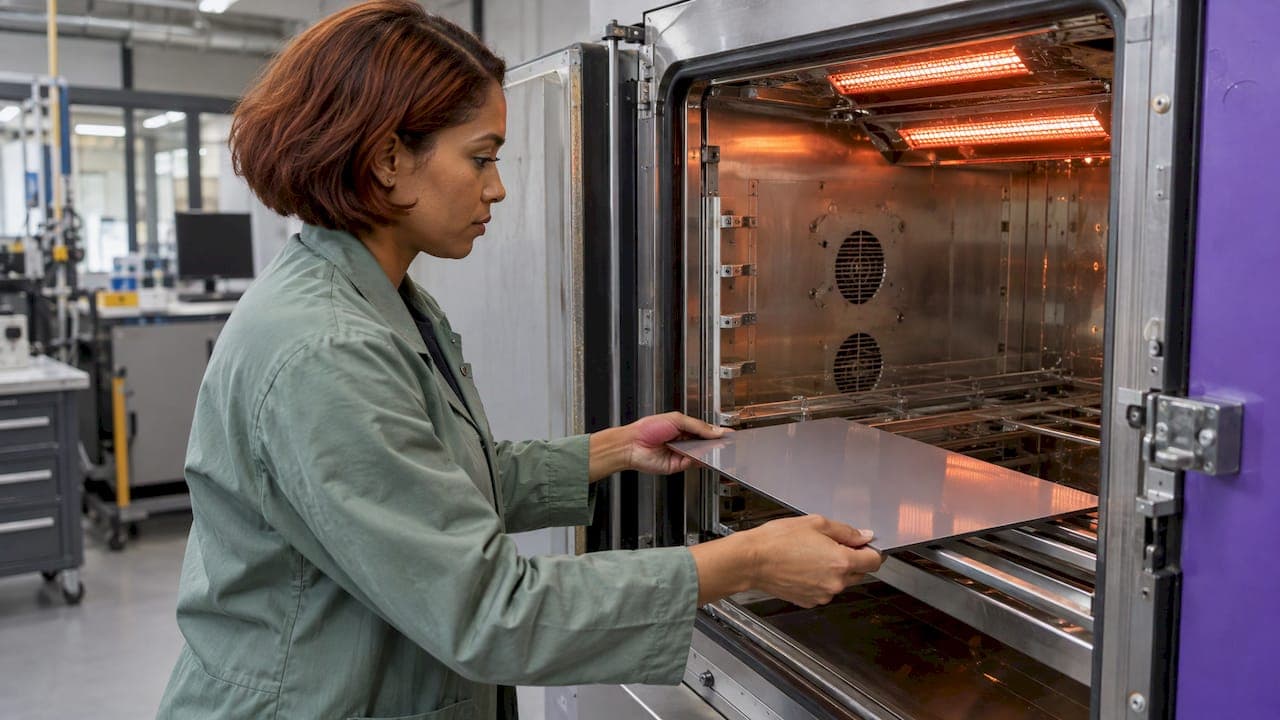
A designed experiment simulating a customer's curing ovens found that convection and infrared oven temperatures were the most significant factors causing solvent pop, with convection the larger of the two. The conditions in the first portion of the bake are as influential as the peak temperature, since that is when the surface can skin before the bulk has released solvent.
Formulation variables that raise or lower the risk
For a coating manufacturer, the application causes above translate into formulation questions. The same coating can be forgiving or fragile depending on how its rheology, wetting, air release and solvent package are set.
| Formulation variable | Effect on solvent pop risk | Typical lever |
|---|---|---|
| Solvent blend evaporation profile | Fast-leaving fractions encourage early skinning | Adjust the ratio of low- and high-boiling solvents for the intended bake or flash window |
| Viscosity build after application | Rapid viscosity rise prevents flow into voids | Rheology package tuned so the film stays mobile long enough to level and release solvent |
| Pigment dispersion quality | Pigment clusters are a recognized contributor to crater-type defects | Dispersant selection and loading matched to pigment surface and resin system |
| Entrained air and micro-foam | Trapped air can produce bubbles and pinholes that resemble solvent pop | Defoamer or air-release additive suited to the resin chemistry |
| Cure kinetics | Catalyst and accelerator level shift the point at which the film loses mobility | Cure package balanced against the oven profile |
The last row has direct experimental support: in the oven study cited above, combining correct oven temperatures with proper accelerator levels and activator types consistently minimized solvent pop while maintaining acceptable film hardness and cure. The implication is that formulation and process optimization work together, and neither substitutes for the other.
Repair: when sanding is enough
Repair decisions depend on whether the defect is confined to the surface or originates deeper in the film.
- Surface blisters. Sand the blisters smooth and refinish.
- Severe cases. Sand back to the undercoat and refinish.
- Persistent traces. Sand until all traces of the pops are removed, apply filler if necessary, and respray with topcoat.
The depth test is practical: sand a small area and inspect for pinholes. Pinholes that appear on sanding are a diagnostic sign of solvent pop rather than air entrapment, and they indicate that the cause must be corrected before the refinish is applied, otherwise the same schedule will reproduce the defect.
Acceptance criteria for cosmetic finishes can also be quantified. One vehicle manufacturer's service documentation classifies solvent pop as low risk when it is under 1.5 mm in diameter on flat or near-flat panels and under 1.0 mm on or near character lines. Industrial coating buyers typically set their own size and frequency limits in the supply specification.
Prevention checklist for coating manufacturers and applicators
- Follow the technical data sheet. Use the reducer and hardener appropriate to booth conditions, apply the recommended film build, keep the booth at the recommended bake temperature and time, and maintain correct airflow.
- Build in thin, wet coats with adequate flash. Apply paint in thin wet films with sufficient drying time between coats and allow sufficient flash-off before force drying.
- Keep the heat source at distance. Infrared equipment placed too close or switched on too early accelerates skinning.
- Match the solvent to the temperature. Select a slower thinner for hot, high-airflow conditions, and verify that the spraying viscosity is within specification.
- Control the oven ramp. Verify temperatures at regular intervals, and use a gentler first zone for heavier film builds.
- Keep the surface and the material clean. Contamination and pigment clusters produce crater defects that are easily confused with solvent pop.
- Record conditions when defects occur. Film thickness, booth temperature, humidity, flash time and oven profile allow a defect to be traced to its cause.
Perspective
Solvent pop is usually described as an application error, and in many plants it is. In formulation work, however, the same defect is often a sign that a coating has a narrow processing window. A system that tolerates only one film build, one flash time and one oven ramp will produce pops whenever any of them drifts.
Our approach is to widen that window. Dispersion quality, rheology development, air release and foam control each influence how long a film stays mobile and how cleanly it releases what it holds. ASTRA DISP® dispersants, ASTRA REO® rheology modifiers and the ASTRA DF® and ASTRA DF NS® defoamer lines (silicone and non-silicone) are designed to give formulators control over these variables, with technical support and laboratory-backed qualification so that dosage is optimized for the resin system rather than assumed.
We also treat batch consistency as part of defect prevention. A film that behaves identically from lot to lot allows the process window to be set once and held, which lowers the total cost-in-use compared with correcting rework downstream.
Astra R&D Team
Additive support for a more forgiving formulation
Astra Chemical manufactures dispersants, silicone and non-silicone defoamers, rheology modifiers and functional coating additives for coatings, adhesives, inks, plastics and composites, with technical consultation and sample requests available to formulators. For teams investigating pinholes, craters or foam-related defects in a specific system, the ASTRA DISP® dispersant range, the ASTRA DF® defoamers and the ASTRA DF NS® non-silicone defoamers are the usual starting points, and the full portfolio is listed on the product catalog.

Formulators evaluating terminal groups, dosage and selection of functional additives can also consult the guide to reactive diluents and functional additives, and further technical material is collected on the Astra Chemical blog.
FAQ
What is solvent pop in paint?
Solvent pop is a defect in which solvent vapor or trapped air breaks through a paint film that has already skinned over. It leaves small open blisters, pinholes or craters, commonly up to about 1 mm across. It is associated with heavy film build, fast solvents, insufficient flash time and excessive heat.
Can solvent pop be sanded out?
Sometimes. When the pops are confined to the surface, sanding smooth and refinishing can correct them. When they extend below the surface, the area must be sanded back to the undercoat, primed and refinished. A small test sanding that reveals pinholes confirms the diagnosis and the depth of the problem.
How is solvent pop different from fisheyes?
Fisheyes are small circular craters that appear during or shortly after spraying and are caused by surface contamination such as oil, wax, silicone or grease. Solvent pop develops after the film skins over, during flash-off or force drying, and is caused by solvent escaping through the film. Cleaning procedures address fisheyes, while film build, solvent choice and cure schedule address solvent pop.
Does solvent pop occur in air-dried coatings?
It is most often discussed in baked and force-dried systems, because bubbles typically form in baked coatings rather than in air-dried finishes. Air-dried films can still show pinholing if film build is excessive or air movement skins the surface early, so the same flash and film-thickness controls apply.
Sources
- Solvent Pop (refinish guidance, United States)
- Automotive finishes troubleshooting guide (United States)
- Understanding and Preventing Solvent Popping in Paint
- Liquid Coatings Troubleshooting Guide
- Problem Prevention Guide (refinish)
- Understanding Liquid Film Defects, Products Finishing
- Preventing Solvent Pop, Products Finishing
- Paint Defect Rectification, service manual
- Final Inspection Checklist: Manufacturing and Building
Testing additives for this application?
Send us your current formulation challenge and our technical team will recommend an ASTRA product package for lab screening.