Slip and Mar Additives for Coatings: Selection Guide
Slip and Mar Additives for Coatings: Selection Guide ! Coated panels meeting on a test bench Slip and mar additives lower the coefficient of friction (COF) at the coating surface so that an object dragged across the film slides instead of digging in.
Slip and mar additives lower the coefficient of friction (COF) at the coating surface so that an object dragged across the film slides instead of digging in. Selecting one is a balance between friction, gloss, recoatability, foam and compatibility with the resin system. Formulators get the most reliable result when they qualify the additive together with the dispersant and defoamer package that surrounds it, with laboratory support from a supplier that offers technical consultation and sample requests. ASTRA Chemical supplies dispersants, silicone and non-silicone defoamers, rheology modifiers and functional additives with that kind of support.
TL;DR
- Slip additives reduce surface friction. Mar resistance follows because a low-friction film deflects a hard object instead of being scratched by it, so one additive often serves both purposes.
- The main chemistries are polysiloxanes (silicones), waxes and fluorinated or other specialty products. Each trades slip against recoatability, haze and cost in a different way.
- Additive loading is low, but the wrong additive can cause cratering, haze, intercoat adhesion loss or stabilized foam. Qualify it in the full formulation, not in isolation.
- Measure COF and mar or scratch resistance on the finished film, at several loadings, after cure and after aging.
- Dispersants and defoamers interact with surface additives. Choosing them as one package shortens qualification.
Slip is the relative movement between two objects in contact. A slip additive reduces the coefficient of friction, which is the ratio between the force needed to move one surface over another and the force pressing them together. A patent describing slip additive technology explains the practical consequence: with a lower COF, an object slides more freely across the coating, which reduces marring and blocking and removes the squeak of sliding contact.
Mar is a shallow surface deformation, typically a visible scuff or fine scratch that does not penetrate the film. It differs from deep scratching and from abrasion, which is gradual wear. The relationship to slip is mechanical. According to a US patent on coating additives, the same additive can deliver both functions because surface lubricity can deflect a hard object touching the film, giving a greater apparent film hardness. The film is not harder in the bulk sense. The contacting object simply loads it less.
This distinction guides the design of a test program. A formulator who needs stackable parts that do not stick or squeak is primarily solving a friction problem. A formulator whose film shows fingernail or packaging scuffs is solving a mar problem. The additive family may be the same, but the target specification, the loading and the test method are not.
How slip additives work at the surface
Most slip additives function because they sit at the film-air interface. Two behaviors matter to the formulator.
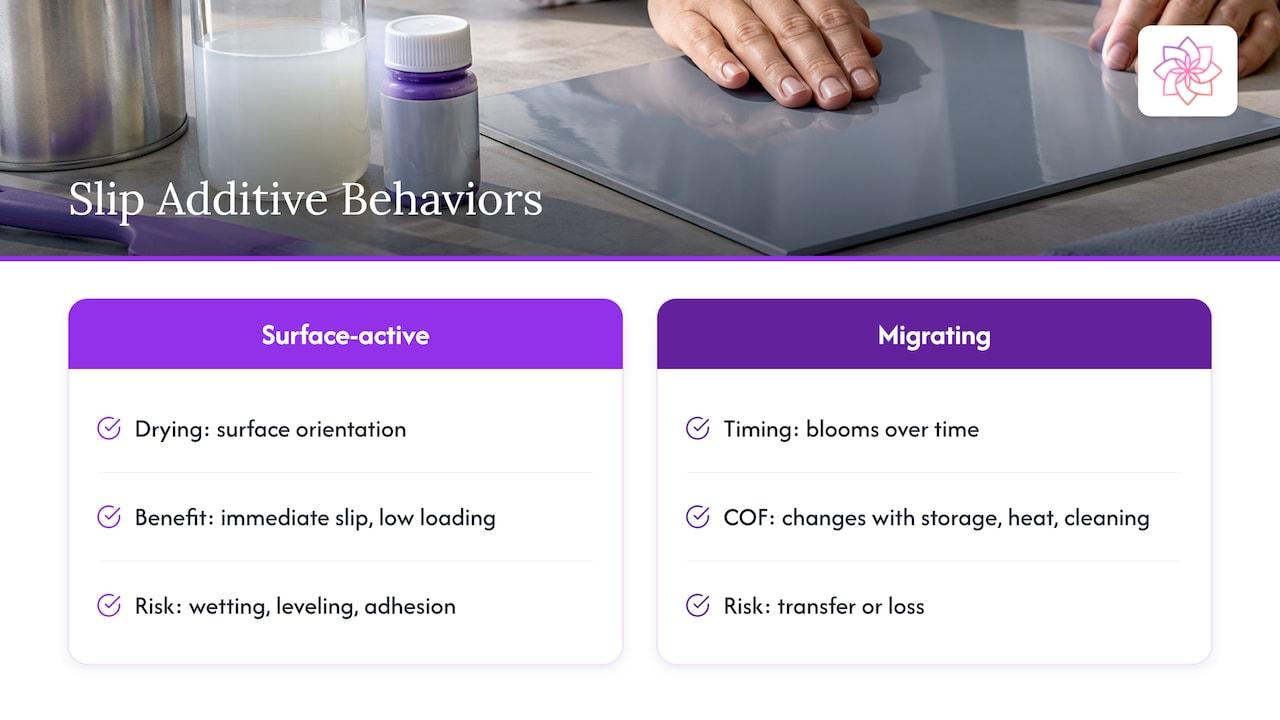
Incompatible, surface-active additives. Polysiloxanes and many waxes have limited compatibility with the binder. During drying they orient toward the surface and form a thin, low-energy layer. The benefit is immediate slip at very low loading. The risk is that the same low surface energy interferes with wetting of the substrate, with leveling and with the adhesion of the next coat.
Additives that migrate. Some slip agents, particularly in polymer films, bloom to the surface over time. The Handbook of Antiblocking, Release, and Slip Additives treats diffusion and migration as central to selection: how the additive is distributed between bulk and surface, how mobility affects the choice, how it can transfer to contacting materials and how it can be lost. For coatings, that means the COF measured one day after cure may not be the COF measured after storage, heat exposure or repeated cleaning.
Chemistries used for slip and mar control
The table summarizes the families formulators most commonly evaluate. It describes general behavior, and individual products within each family vary.
| Family | Typical effect | Main formulation considerations |
|---|---|---|
| Polyether-modified polysiloxanes | Strong slip, improved substrate wetting, good leveling | Can stabilize foam, can affect recoat and intercoat adhesion at higher loading |
| Polysiloxane gums or high-molecular-weight silicones | Durable slip and mar resistance at low loading | Dispersion stability in the carrier and in waterborne systems with coalescing solvents |
| Polyester-modified or acrylate-modified silicones | Slip with better compatibility and recoatability | Compatibility with binder, cost relative to simple silicones |
| Polyethylene, PTFE and carnauba-type waxes (micronized or emulsion) | Slip, mar and burnish resistance, some matting | Gloss reduction, haze, settling of dispersed particles, clarity in clear coats |
| Non-silicone organic slip agents | Slip where silicone contamination is a concern | Generally lower efficiency, compatibility must be confirmed per resin |
The patent literature highlights a real stability issue for the gum-type products. As the slip additive patent notes, a polysiloxane gum dispersed in a carrier fluid should remain stable in aqueous coatings, including in the presence of organic solvents such as coalescing aids, because phase separation causes loss of formulation homogeneity. Waterborne formulators therefore need to verify storage stability of the finished paint, not just the film properties.
Where slip and mar control matters
The applications differ in what the film must survive.
- Industrial wood and furniture coatings. Stacking, sanding, packaging and handling cause mar. Slip is also a tactile property here.
- Coil and general metal coatings. Forming, stacking and transport scuffs are the concern, so slip and mar resistance support the line speeds.
- Plastic and consumer electronics coatings. Soft-touch and clear coats must resist fingernail and key scratches without visible haze.
- Packaging and overprint varnishes, inks. Slip controls machine handling, blocking in stacks and rewinding behavior.
- Floor coatings. Here slip control must be balanced with safety. The slip additives discussed in this article lower friction, and a floor system that needs the opposite, a deliberately rougher surface, uses anti-slip aggregates, not slip additives.
- Composites and adhesives. Surface friction matters for release, handling and demolding behavior, and the additive must not compromise bond strength.
Formulation trade-offs to plan for
Additive loading in coatings is small, yet the effects are large. Because the additive is concentrated at the surface, a fraction of a percent on formulation weight can change the interface completely. Most problems arise in five places.
Craters, fisheyes and poor wetting
Surface-active silicones lower surface tension, which can help wetting of difficult substrates but can also cause cratering when the additive is incompatible or when contamination from another batch is present. If craters appear after a slip additive is introduced, the first checks are the dosage, the order and shear of addition, and whether the additive was premixed into a compatible portion of the formulation.
Foam
Many slip additives are also surfactants. Foam that is generated during manufacturing or application then needs a defoamer that does not itself worsen defects. Silicone defoamers are efficient but can contribute to cratering in sensitive systems, while non-silicone defoamers avoid that risk at some cost in efficiency. For this reason the slip additive and the defoamer should be screened as a pair. ASTRA Chemical supplies both ASTRA DF silicone defoamers and ASTRA DF NS non-silicone defoamers.
Gloss, haze and clarity
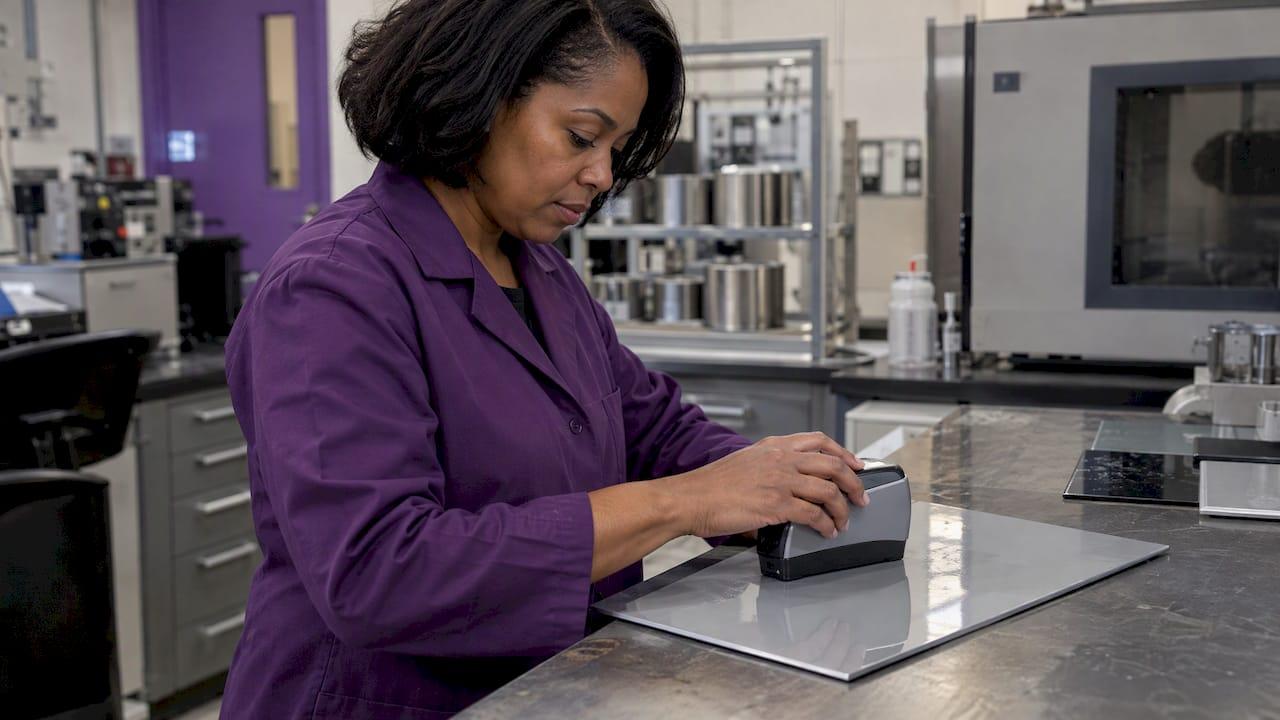
Wax-type slip additives scatter light. In a high-gloss or clear system, even a modest loading can reduce gloss or add haze. Soluble silicones reduce the problem but may not give the same mar resistance. Evaluate gloss at 20, 60 and 85 degrees on the finished film at the planned loading.
Recoat and intercoat adhesion
A low-energy surface that resists scuffs also resists the next coat. In multi-coat systems, test intercoat adhesion after the full cure schedule and after the maximum recoat window the application allows. Where recoatability is critical, consider modified silicones designed for compatibility, or apply the slip additive only in the top coat.
Contamination in shared equipment
Silicone-containing slip additives, once introduced, can travel on tanks, lines and filling equipment into products that must be silicone-free. Planning dedicated equipment, or a validated cleaning routine at changeover, protects later batches. Reviewing production line cleaning methods is part of that planning when the same line runs both silicone-containing and silicone-sensitive products.
How to select and qualify a slip or mar additive
A structured qualification program avoids the trial-and-error that results when additives are proprietary and their chemistry is not fully disclosed. Selection is typically made through vendor assistance or accumulated experience, and the wrong additive chosen to fix a problem can create a new one, a point made in the PCI Additives Reference Guide.
- Define the target. Write down the COF range, the mar test and the acceptance criterion, the gloss window, the recoat requirement and any restricted-substance limits such as silicone-free or food-contact constraints.
- Fix the base formulation. Complete pigment dispersion and defoamer selection first, since both change the surface behavior that the slip additive acts on. ASTRA Chemical's ASTRA DISP pigment dispersants are one part of that base.
- Run a loading ladder. Prepare the base at three or four additive levels, including a control, and add the additive under the same shear and at the same stage. Use a ladder instead of a single level, because slip often plateaus while side effects continue to increase.
- Apply and cure under production conditions. Film thickness, flash-off, bake schedule and substrate all shift the surface orientation of the additive.
- Measure early and after aging. Record COF and mar resistance after cure, after a defined storage period and after the heat or humidity exposure the product will see.
- Check the side effects. Gloss, haze, leveling, craters, foam in the can and in the film, intercoat adhesion, and package stability.
- Confirm batch repeatability. A result that cannot be reproduced from lot to lot is not qualified. Request retained samples from consecutive lots and repeat the key tests.
At several of these steps the supplier's technical team shortens the work. ASTRA Chemical offers technical consultations, sample requests and custom formulation guidance, and its stated approach combines laboratory-backed qualification with dosage optimization support and documentation for regulatory and production needs.
Measuring slip and mar performance
A specification is only as good as the test behind it. The common measurements are as follows.
- Coefficient of friction. Static COF is the force needed to start sliding, and kinetic COF is the force needed to keep sliding. ASTM D1894 measures both, though that standard is written for plastic film and sheeting. Coated panels are often tested with an adapted sled or a method agreed with the customer, so the report must state the sled material, load and speed.
- Mar and scratch resistance. Methods range from fingernail and coin tests to linear abraser and crockmeter methods, and instrumented scratch testers. Pick the one that imitates the field damage, and report both the load that first produces visible damage and the appearance rating at a fixed load.
- Gloss retention after marring. Measure gloss before and after a fixed abrasion cycle. A coating can look similar by eye yet lose measurable gloss in the marred area.
- Intercoat adhesion and recoatability. Cross-hatch or pull-off tests after the recoat window.
Always run comparisons on the same substrate, film thickness and cure schedule, and use at least three replicates. COF in particular is sensitive to humidity, to surface cleanliness and to how recently the sample was handled.
Troubleshooting guide
| Symptom | Likely cause | First adjustment |
|---|---|---|
| Craters or fisheyes after adding slip additive | Incompatibility, overdosing or contamination | Reduce dosage, improve incorporation, review defoamer type |
| Slip is high initially but falls over weeks | Additive loss or migration, or removal by cleaning | Move to a more anchored chemistry or increase compatibility with the binder |
| Hazy clear coat | Wax or insoluble additive above its compatibility limit | Lower loading, use a finer or emulsified grade or a soluble silicone |
| Poor recoat adhesion | Low-energy surface layer | Restrict the additive to the top coat, use a recoat-friendly modified product |
| Persistent foam | Surfactant effect of the additive | Pair with a suitable silicone or non-silicone defoamer |
| Good COF, poor mar resistance | The mar mode is deeper than lubricity can address | Review film hardness, crosslink density and the test method |
Perspective: treat the additive package as a system
In our laboratory work with coatings, adhesives, inks, plastics and composites, the slip additive is rarely the only variable that decides the result. The pigment dispersion, the defoamer and the rheology profile determine how the film forms at the surface, and therefore where a surface-active additive ends up.
For that reason we recommend qualifying the dispersant, defoamer and functional additives together. Our silicone and non-silicone defoamers, rheology modifiers and dispersants are developed with this interaction in mind, and our technical team supports dosage optimization so that the lowest effective level is found, which also keeps cost-in-use down.
Our aim is comparable performance to premium brands at a lower total cost-in-use, with batch consistency and documentation that production and regulatory teams can rely on.
Astra R&D Team
Support from ASTRA Chemical
Formulators who need a dispersant and defoamer package that supports a slip and mar target can start from the full ASTRA Chemical product range, which includes ASTRA DISP®, ASTRA REO®, ASTRA DF®, ASTRA DF NS® and further functional additive lines. Sample requests and technical consultations are part of the direct supply model, and custom formulation guidance is available for coatings, adhesives, inks, plastics and composites.
For reactive diluents and other functional additives, the ASTRA Chemical article on terminal groups, dosage and selection covers further selection logic, and the technical blog collects related guides.
FAQ
What is the difference between a slip additive and a mar additive?
A slip additive lowers the coefficient of friction of the film surface. A mar additive is chosen to prevent shallow scuffs. In practice one product often does both, because lower friction deflects a contacting object and reduces visible damage. The specification, test method and loading should still be set separately for each goal.
How much slip additive should be used?
The level depends on the chemistry, the resin and the film. Because these additives act at the surface, effective levels are low, and a loading ladder with a control is the dependable way to find the lowest dose that meets the COF and mar targets. Higher doses raise the risk of craters, haze, foam and recoat problems.
Can slip additives affect recoating?
Yes. A surface layer of low surface energy can reduce wetting and adhesion of the next coat. Test intercoat adhesion across the full recoat window, consider modified silicones designed for recoatability, or limit the additive to the final coat.
Do slip additives need a defoamer?
Often. Many slip additives are surface-active and can stabilize foam during manufacture or application. Screen the defoamer with the slip additive, and choose between silicone and non-silicone types according to your cratering and recoat sensitivity.
Sources
Testing additives for this application?
Send us your current formulation challenge and our technical team will recommend an ASTRA product package for lab screening.