How to Reduce Formulation Cost in Coatings and Adhesives
How to Reduce Formulation Cost in Coatings and Adhesives ! Coating ingredients measured beside a bench scale Reducing formulation cost in a coating, adhesive, ink or composite system rarely means buying cheaper raw materials.
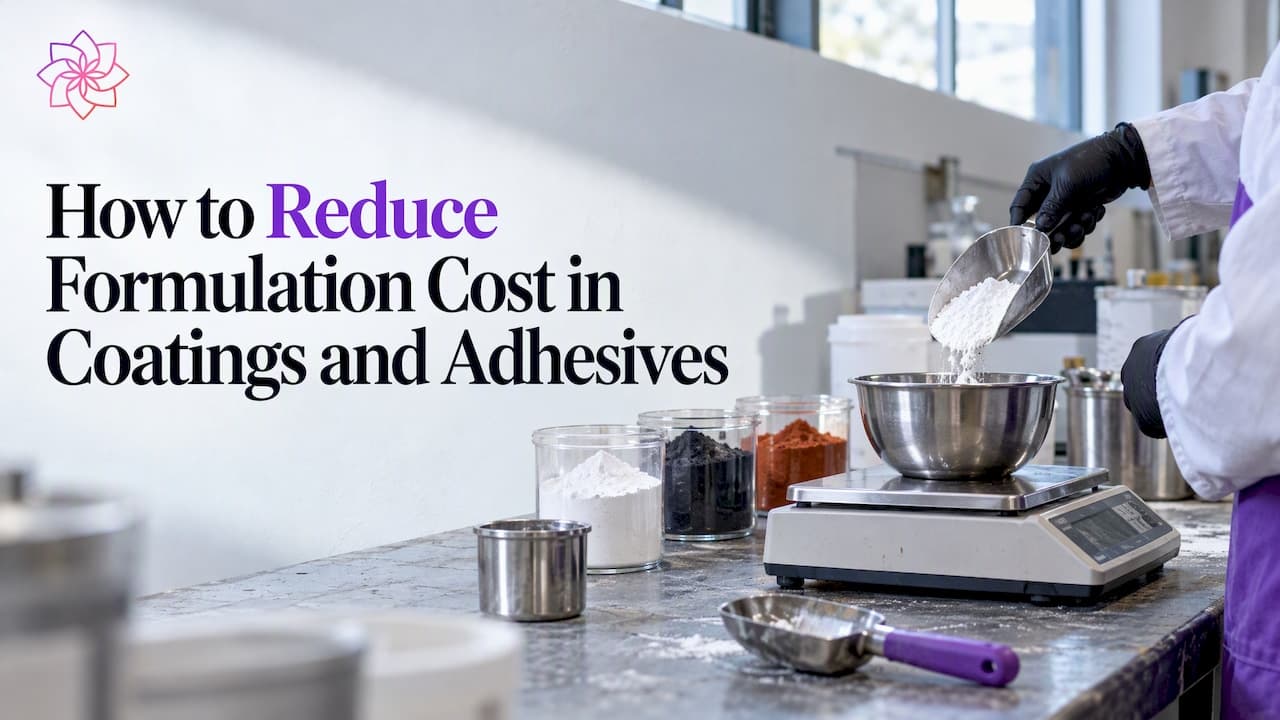
Reducing formulation cost in a coating, adhesive, ink or composite system rarely means buying cheaper raw materials. It means lowering the cost-in-use of the finished product: the minimum effective additive dosage, higher pigment utilization, fewer batch rejections, shorter dispersion and de-aeration times, and a supply chain that delivers the same material performance from lot to lot. A lower price per kilogram that requires a higher dosage, or that introduces foam, flooding or viscosity drift, is a more expensive additive in practice.
This guide sets out a methodical route for technical directors, formulation chemists and procurement managers: how to establish a baseline, how to determine minimum effective dosage, where dispersants, defoamers and rheology modifiers affect cost, and how to carry an optimized formula into mass production without losing the savings.
TL;DR
- Cost-in-use, not price per kilogram, is the correct metric: calculate additive cost per unit of finished product at the minimum dosage that meets specification.
- Run a dispersant demand study per pigment and a designed experiment per additive; both replace guesswork with a defined process window.
- Calculate dosage on an active-content basis, and record both as-supplied and active dosage, so that carrier effects do not distort comparisons between candidates.
- Evaluate defoamers and dispersants together, since each changes the performance of the other, and validate at production shear and temperature rather than at laboratory-ideal conditions.
- Batch consistency and measurement discipline protect the savings after scale-up.
Additives typically represent a small share of the bill of materials by weight, yet they govern outcomes that carry large cost: pigment loading, grind time, defect rate, rework and shelf life. Comparing two dispersants or defoamers on invoice price alone ignores at least five variables.
| Variable | How it changes real cost |
|---|---|
| Active content | A product at lower price per kilogram may contain less active material, so more of it is needed for the same effect. |
| Minimum effective dosage | A candidate effective at 0.3% on total formula costs less than a cheaper candidate that needs 0.6%. |
| Process time | Faster wetting and dispersion raise mill throughput and reduce energy use per batch. |
| Defect and rework rate | Craters, pinholes, flooding, floating and settling convert directly to scrap and reprocessing. |
| Lot-to-lot variation | Inconsistent batches force re-qualification and wider safety margins, which means higher dosage. |
A useful working formula for comparison is additive cost per 1,000 kg of finished product, calculated as dosage on total formula (as supplied) multiplied by price per kilogram, then adjusted for any pigment, resin or solvent reduction that the additive allows. The adjustment term is where most of the savings appear.
Step 1: Define the baseline
No saving can be demonstrated without a reference. The validation approach described by SR-FMG in its guide to validating functional additives before mass production starts by testing the current formulation without the additive under controlled conditions. The same logic applies to cost projects:
- Fix the current formulation, raw-material lots, mixing equipment, shear history and temperature.
- Measure the critical properties: viscosity profile, fineness of grind, gloss, color strength, foam volume and breakdown time, film appearance, adhesion, and storage stability.
- Record the current additive dosage on both an as-supplied and an active basis.
- Convert the full formula to cost per unit volume and per unit mass of finished product.
- Record the current yield, rejection rate and rework rate, since these determine whether a dosage reduction is a true saving.
A baseline that omits defect rates tends to produce "savings" that disappear when the first off-specification batch is reprocessed.
Step 2: Calculate dosage on an active-content basis
Additives are frequently supplied as blends, diluted in solvent, water or a mineral carrier. The SR-FMG guide notes that dosage should be calculated on an active-content basis whenever the additive is a blend, and cites errors on the order of 40% underdosing or overdosing when only the as-supplied figure is used. Validation plans should record both total product dosage and active dosage, because carriers have their own effects: mineral carriers may raise viscosity, while solvent carriers may influence VOC contribution and drying time.
A worked example illustrates the distortion. Consider two defoamers, A and B, both evaluated at 0.4% as supplied:
- Defoamer A: 100% active silicone-based concentrate.
- Defoamer B: 60% active, balance carrier.
At equal as-supplied dosage, B delivers 60% of the active material that A delivers. If B appears to perform worse, the conclusion may reflect underdosing rather than inferior chemistry. The correct comparison is at matched active dosage, followed by a cost comparison at the minimum active level each requires. Only then is price per kilogram meaningful.
Step 3: Find the minimum effective dosage with a designed experiment
One-factor-at-a-time trials find a dosage that works under laboratory conditions. They do not reveal interactions between dosage, temperature and mixing time, which is where production variability originates. The same SR-FMG guide recommends a Design of Experiments approach, and notes that a 2^3 factorial design can screen dosage, temperature and mixing time with fewer trials while still identifying statistically significant effects.
A practical sequence:
- Screening. Run an eight-run 2^3 factorial with high and low levels of additive dosage, temperature and mixing time. Add center points to detect curvature.
- Response selection. Choose measurable responses: foam volume after a fixed time, Hegman fineness, viscosity at two shear rates, gloss at 60 degrees, and defect count on a drawdown.
- Model and constrain. Fit the model, then identify the lowest dosage that keeps every response inside specification across the tested temperature and shear range.
- Confirm. Run confirmation batches at the proposed dosage and at the edges of the process window.
- Set the operating dosage. Specify a dosage with a defined margin above the minimum, so that normal process drift does not cause failures.
The margin is a cost decision in its own right. A narrow margin saves additive but increases rejection risk; a wide margin does the opposite. The experimental model allows that trade-off to be quantified rather than assumed.
Step 4: Run a dispersant demand study per pigment
Pigment is usually the most expensive component in a coating or ink, and its utilization depends on dispersion quality. Poorly dispersed pigment lowers color strength and opacity, which leads formulators to compensate with higher pigment loading. The correct dispersant level, therefore, is one of the most direct levers on formulation cost.
In a paper on applying Six Sigma tools to pigment dispersant demand, published through the American Coatings Association, the authors argue for evaluating dispersant demand routinely and in terms relevant to the formulator's practical needs, since cost must be balanced against performance. The method is straightforward in principle:
- Prepare a series of millbases at increasing dispersant levels on pigment weight, holding pigment loading, grind media and mill time constant.
- Measure viscosity of each millbase, typically across a range of shear rates.
- Plot viscosity against dispersant level. The minimum of the curve indicates the dispersant demand, the point at which the pigment surface is saturated.
- Confirm by measuring color strength, gloss and stability on the let-down paint.
Below the optimum, particles flocculate and viscosity rises. Above it, excess dispersant adds cost and can compromise water resistance, adhesion or film hardness. Because dispersant demand scales with pigment surface area, each pigment grade and even each pigment lot class warrants its own value. A single "universal" dosage across a color range overdoses some pigments and underdoses others.
Trade literature also associates high-molecular-weight polymeric dispersants with cost benefits. The PCI Magazine additives handbook describes cost improvement through faster dispersion and higher throughput, lower pigment loading requirements because of enhanced color strength, and good rheology with low foaming. Whether a given grade realizes those benefits in a specific system must be shown in the laboratory, which is the purpose of the demand study.
Step 5: Treat defoamers as a cost item, not a patch
Foam control is often added reactively, after a defect appears on the line, and dosage creeps upward over time. Each increment can introduce surface defects, such as craters or loss of gloss, and may then require a leveling additive to compensate, which adds a second cost.
A more economical approach:
- Choose chemistry by system. Silicone-based defoamers are generally effective at low dosage but carry a higher risk of surface defects in some systems. Non-silicone options suit applications where recoatability and cratering are critical. The decision should follow the substrate, the resin system and the application method.
- Match addition point to function. Defoamers added in the grind control foam during dispersion; those added in the let-down address foam during filling and application. Splitting the dose between stages often reduces total consumption.
- Measure foam at process shear. A defoamer that performs in a static cylinder test may fail under high-speed dispersion or airless spray.
- Account for regulatory direction. As the PCI Magazine review of foam-control additives observes, VOC limits have moved from low-VOC toward zero-VOC requirements. A defoamer that adds VOC may force reformulation later, so total lifecycle cost should be considered at selection.
ASTRA Chemical supplies both silicone and non-silicone defoamer lines (ASTRA DF® and ASTRA DF NS®) so that the chemistry can be selected on system compatibility instead of availability.
Step 6: Avoid assuming synergy in additive blends
Technical teams sometimes combine two or three additives expecting each to contribute independently, or even synergistically. Work on corrosion inhibitor formulation presented in Formulating for Cost Performance cautions that most blended inhibitors are less effective than their individual components because they compete for active sites. Although that paper concerns inhibitors in water treatment, the principle transfers to coatings additives that act at surfaces and interfaces: wetting agents, dispersants, defoamers and flow additives can compete for the same pigment surface or the same air-liquid interface.
The consequences for cost are specific:
- The optimum dosage of one component in a blend is often lower than the dosage required when it is used alone, so stacking full-strength dosages overspends.
- Each additive should be evaluated alone, then in pairs, using the same designed-experiment structure as in Step 3.
- Simplifying a package, by removing an additive that no longer contributes once the dispersant is optimized, is among the most reliable cost reductions available.
Step 7: Carry the savings into production
An optimized formulation that is validated on a 500 g laboratory batch can fail at 5,000 kg if mixing energy, temperature rise, addition order or measurement accuracy differ. Three controls preserve the saving.
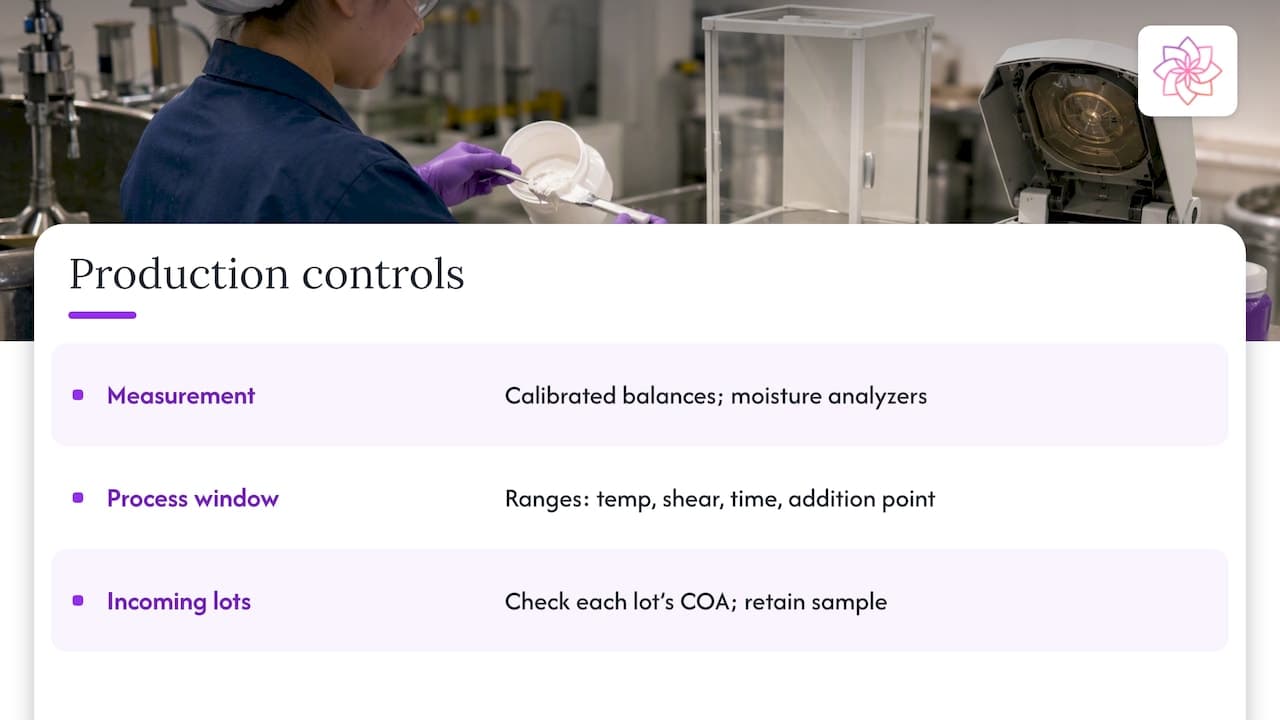
Measurement accuracy. A dosage of 0.2% on a 2,000 kg batch is 4 kg, and a weighing error of several hundred grams moves the dosage outside a narrow optimum. Calibrated balances and, for moisture-sensitive raw materials, calibrated moisture analyzers keep the as-made formulation aligned with the validated one. Moisture in pigments, fillers or carriers also shifts the effective active dosage.
Process window documentation. Record the validated ranges for temperature, shear, mixing time and addition point, based on the designed experiment, and make them part of the batch record.
Incoming-lot verification. Verify each additive lot against its certificate of analysis, and keep a retained sample. Batch-to-batch consistency from the supplier allows a narrower safety margin, which is itself a cost reduction.
A cost-in-use calculation template
The following structure supports a decision between a current additive and a candidate. Figures are illustrative and must be replaced with the formulator's own data.
| Line item | Current additive | Candidate additive |
|---|---|---|
| Price per kg (as supplied) | Enter actual quote | Enter actual quote |
| Active content | Per technical data sheet | Per technical data sheet |
| Minimum effective dosage (as supplied) | From DOE | From DOE |
| Additive cost per 1,000 kg product | Dosage × price | Dosage × price |
| Pigment or resin change allowed | Baseline | Measured change |
| Mill or dispersion time per batch | Baseline | Measured change |
| Rejection and rework rate | Baseline | Measured change |
| Net cost per 1,000 kg | Sum | Sum |
Procurement and technical teams should complete this table jointly. Procurement typically holds price and volume data; technical teams hold dosage, process time and defect data. Either set alone gives an incomplete answer.
Our perspective on cost-in-use
We approach formulation cost from the position of a manufacturer of dispersants, defoamers, rheology modifiers and functional coating additives. In our experience of working with coatings, adhesive, ink, plastics and composite producers, the largest recoverable cost is seldom the additive line on the purchase order. It is the combination of overdosing introduced to cover process variability, additive stacking that accumulated over several reformulations, and qualification time lost when supplier lots vary.
For that reason we position our products around three commitments: comparable performance to premium brands at lower total cost-in-use, optimized dosage support through laboratory-backed qualification, and batch consistency supported by documentation for regulatory and production needs. We encourage customers to qualify on matched active dosage and to share their process conditions, so that recommendations reflect the actual shear, temperature and substrate rather than a catalog default. A candidate that cannot demonstrate a lower net cost per unit of finished product under the customer's own conditions should not be adopted, and the cost template above is built to make that determination plain.
— Astra R&D Team
Where ASTRA additives fit
ASTRA Chemical manufactures and supplies dispersants (ASTRA DISP®), rheology modifiers (ASTRA REO®), silicone and non-silicone defoamers (ASTRA DF® and ASTRA DF NS®), and further functional additive lines for coatings, adhesives, inks, plastics and composites, with technical support and custom formulation guidance. Formulators who want to begin with a dispersant demand study can review the ASTRA F® pigment dispersant page, or see the complete ASTRA product range and request samples and technical consultation for qualification on their own pigments and resins. Pricing is quoted on request.
Common pitfalls that erase savings
- Comparing at equal as-supplied dosage. This penalizes lower-active products and favors diluted ones, as shown in Step 2.
- Validating only at laboratory conditions. Production shear, temperature rise and air entrainment differ from bench scale.
- Ignoring storage stability. A formulation optimized for fresh properties may flocculate, separate or lose defoaming performance after weeks in the warehouse, which creates returns.
- Changing several variables at once. Replacing the dispersant, defoamer and rheology modifier together makes it impossible to attribute savings or failures.
- Overlooking material criteria beyond price. The SpecialChem guide to sustainable and circular coatings lists performance, cost, environmental footprint, supply-chain credibility and end-of-life behavior among the criteria for raw-material selection. A cost project that ignores the others may need to be repeated.
FAQ
What is the fastest way to reduce additive cost without hurting performance?
Determine the minimum effective dosage with a designed experiment, and calculate it on an active basis. Most formulations carry a dosage margin that was set during an earlier reformulation and never revisited. Reducing it to the validated minimum, plus a defined safety margin, typically yields the first and least risky saving.
Is a cheaper additive ever the right choice?
Yes, when it meets specification at a dosage and process time that give a lower net cost per unit of finished product. The comparison must be at matched active content, with defect and rework rates included. A lower price per kilogram alone does not establish a saving.
How often should dispersant demand be re-evaluated?
Re-evaluate whenever the pigment grade, supplier, surface treatment or millbase loading changes. Pigment surface area drives dispersant demand, so a change of pigment source can shift the optimum even when the nominal grade is the same.
Does reducing the number of additives reduce cost?
Often it does. Additives can compete for the same surfaces, so a package assembled over several reformulations may contain components that no longer contribute. Test each component alone and in combination, and remove those that show no measurable effect.
Sources
- Guide to Validating Functional Additives Before Mass Production, SR-FMG
- Using Six Sigma Tools to Evaluate Pigment Dispersant Demand Performance, American Coatings Association
- 2012 Additives Handbook, PCI Magazine
- Evolving Foam-Control Additives, PCI Magazine
- Formulating for Cost Performance
- Sustainable and circular coatings: a formulator's approach to material selection, SpecialChem
Testing additives for this application?
Send us your current formulation challenge and our technical team will recommend an ASTRA product package for lab screening.