Powder Defoamers: Selection, Dosing and Testing Guide
Powder Defoamers: Selection, Dosing and Testing Guide ! Formulator adding powder defoamer to coating A powder defoamer is a foam-control additive supplied as a free-flowing solid, usually an active defoaming phase absorbed on or bonded to a particulate carrier.
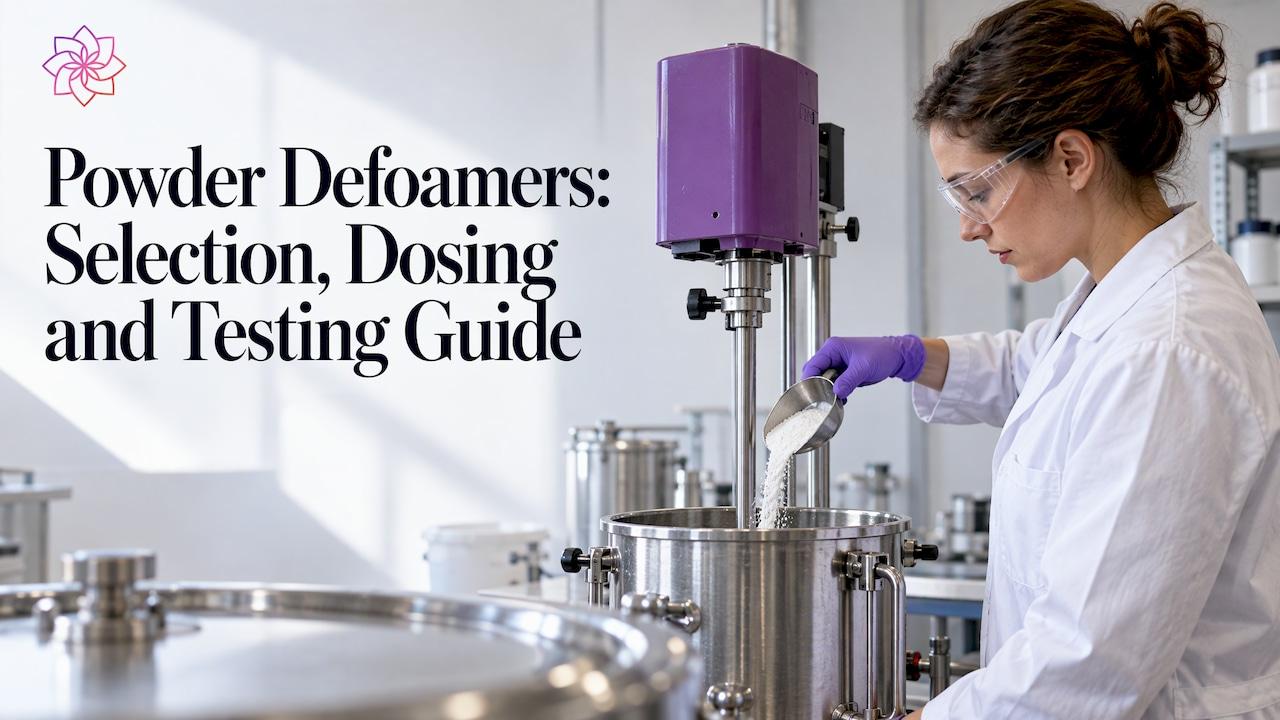
A powder defoamer is a foam-control additive supplied as a free-flowing solid, usually an active defoaming phase absorbed on or bonded to a particulate carrier. It is built for dry-blended and water-redispersible systems, where a liquid defoamer would be difficult to meter, would cause caking, or would separate during storage. Selecting one correctly depends on three variables: the chemistry of the active phase, the carrier, and the way the powder is wetted out and dispersed when the finished product meets water or a resin phase. This guide covers each variable, then a dosing and testing sequence that formulators of coatings, adhesives and related dry-mix products can apply in the laboratory.
TL;DR
- Powder defoamers are generally oil-based active phases, such as silicone or mineral oil, carried on a particulate such as silica, and they are added to dry products like cement, plaster and detergents.
- Selection is a balance: an additive must be incompatible enough to break foam, yet compatible enough to avoid craters, gloss loss and poor wetting in the applied film.
- Dosage is established by a ladder study in the actual formulation, evaluating foam volume, film appearance and aging together, not by a single catalog figure.
- Incorporation method (dry pre-blend, post-addition, or dispersion into the liquid phase) changes droplet size and therefore efficiency.
- Technical support and sample qualification shorten the route from a candidate additive to a validated production grade.
Foam in a coating, adhesive or dry-mix mortar is a dispersion of gas in a liquid stabilized by surfactants, polymeric thickeners, pigments and dispersants. Any defoamer, liquid or powder, works by entering the foam lamella, spreading across the air-liquid interface and destabilizing the film until the bubble ruptures. For that to happen, the active phase must have a lower surface tension than the foaming medium and must be insoluble in it.
Powder defoamers are, in principle, oil-based defoamers on a particulate carrier like silica, and they are added to powdered products such as cement, plaster and detergents (Defoamer, Wikipedia). The carrier performs two functions:
- It converts a liquid active phase into a dry, free-flowing material that can be weighed, blended and stored with other solids.
- On contact with water, it releases the active phase as fine droplets or particles, which then act at the foam lamellae.
The release behavior is the key difference from a liquid defoamer. A liquid grade arrives already emulsified or dispersed, whereas a powder must be wetted, de-agglomerated and distributed by the mixing energy available when the dry product is made down. That is why the same active chemistry can perform differently as a powder and as a liquid.
Silicone and non-silicone active phases
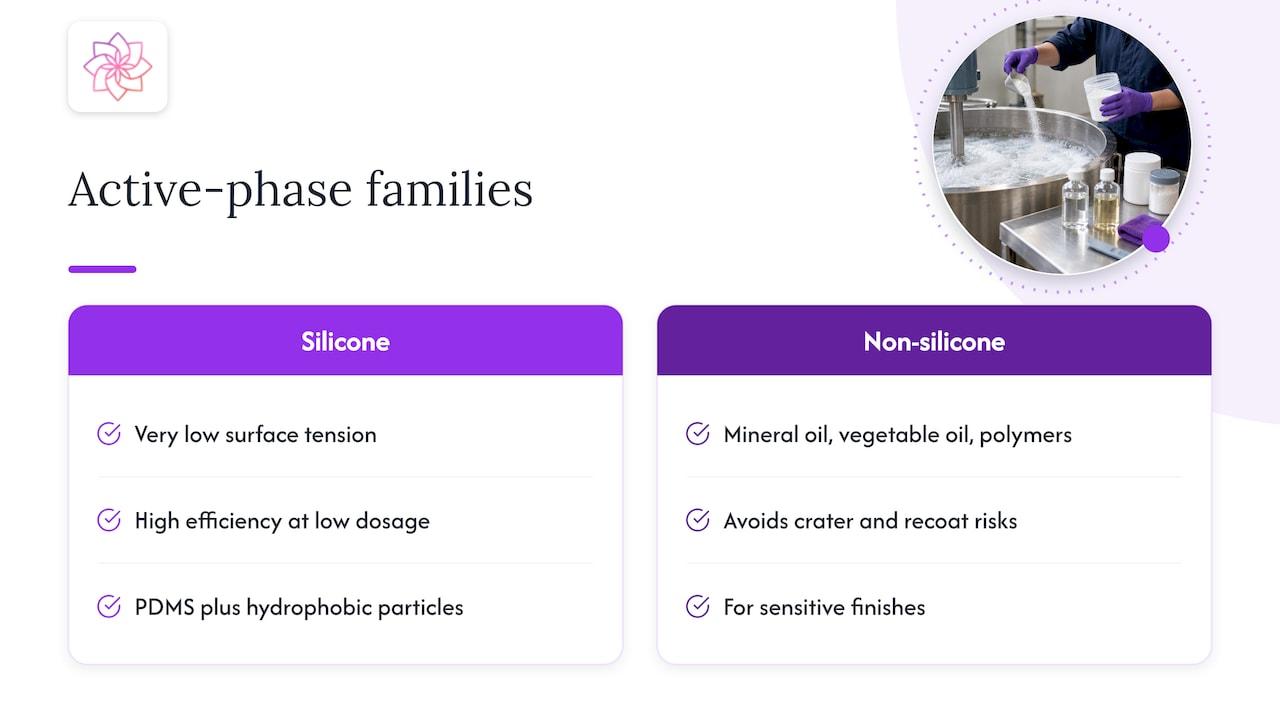
Two families dominate the choice. Silicone-based actives, typically polydimethylsiloxane combined with hydrophobic particles, offer very low surface tension and high efficiency at low dosage. Non-silicone actives, based on mineral oil, vegetable oil derivatives or polymeric surface-active materials, avoid the crater and recoat risks that silicone can introduce in sensitive finishes. The Astra Chemical defoamer range covers both chemistries: ASTRA DF® and ASTRA DF NS® are the starting points for formulators weighing a silicone against a non-silicone approach.
Why powder defoamers are used in coatings and adhesives
The case for a powder format arises wherever the finished product is itself supplied as a dry blend and mixed with water on site, or where moisture sensitivity rules out adding a water-containing liquid additive to a pre-blend. Typical situations include:
- Dry-mix mortars, tile adhesives, skim coats and plasters. Cellulose ethers, redispersible polymer powders and air-entraining effects of surfactants generate foam during mixing. Entrained air can reduce compressive strength, bond strength and surface quality, so it must be controlled.
- Powdered adhesive and sealant bases. Moisture-free storage is needed, and a liquid additive could initiate premature reaction or caking.
- Redispersible and water-reconstituted paints. Dry paint concentrates mixed with water in the field need foam control built into the powder.
- Production simplicity. A single dry pre-blend with the defoamer included removes a separate liquid dosing step and a second raw-material tank.
The defects that foam causes are well recognized. In the applied film they appear as pinholes, craters, fisheyes and micro-foam haze. In production they appear as reduced batch yield, overflow during filling, and inaccurate density readings. In adhesives, trapped air reduces effective bond area and can create weak points in the bond line.
Selection criteria for coating and adhesive formulations
Selection should begin with the binder system, the gloss target and the method of application, because these determine how much incompatibility the film can tolerate.
The compatibility balance
PCI Magazine authors Douglas, Hallack, Heilen, Howard and Semmler explain that defoamers consist of compounds that are not compatible with the coating system. If they are too compatible they become inefficient over time. If they are too incompatible they may be highly efficient bubble busters but cause problems in the applied film. The ideal solution balances compatibility and incompatibility for maximum efficiency (PCI Magazine, 2010). For a powder grade, this balance is set partly by the active phase and partly by the carrier, which controls how finely the active phase is released.
Droplet size and interfacial tension
Adams, writing in the Journal of Coatings Technology, reports that defoamer droplet sizes between 2 and 10 µm are ideal for high performance. The same article notes that oils with low interfacial tension lose efficiency after storage because they break into finer droplets when exposed to new shear, while higher interfacial tensions promise better stability (Adams, JCT, October 1998). For powders, this has a practical consequence. A grade that releases a very fine dispersion under high-shear mixing may behave differently from the same grade in a low-shear blend, and a re-dispersed material that has been stored wet may behave differently again.
Gloss and binder type
Adams also states that a mineral oil-based defoamer is very suitable for flat to medium-gloss acrylic, styrene acrylic and vinyl copolymer emulsions, but that in medium- to high-gloss paints mineral oil can cause loss of gloss definition. In general, the higher the gloss of the coating, the more critical defoamer selection becomes (Adams, JCT, October 1998).
Selection matrix
| Criterion | Question to answer | Typical consequence |
|---|---|---|
| Gloss level | Flat, satin or high gloss? | Higher gloss narrows the acceptable defoamer types |
| Binder system | Acrylic, styrene acrylic, vinyl copolymer, cement-modified, other? | Determines the active-phase polarity required |
| Recoat or overprint | Will further coats or printing follow? | Silicone residues can impair recoat in sensitive lines |
| Mixing energy | Low-shear paddle or high-speed dissolver? | Governs how completely the powder releases its active phase |
| Storage | Dry blend only, or reconstituted and held? | Affects efficiency loss over time |
| Regulatory file | Which documentation does the customer require? | Drives choice of safety data and compliance paperwork |
Incorporation and dosage practice
No single dosage suits every system, and a figure quoted without the formulation behind it should not be carried into production. What can be specified is the method of finding the figure.
Addition methods
- Dry pre-blend. The powder defoamer is mixed with the other solids before water is added. This is the most common route for dry-mix products. Blend time and homogeneity matter, because a poorly distributed defoamer yields foam in some bags and defects in others.
- Post-addition to the liquid phase. The powder is sprinkled into the batch after the main components are wetted. This requires adequate shear to wet out and de-agglomerate the particles.
- Pre-dispersion. The powder is first slurried in a small portion of water or a compatible liquid, then added. This improves distribution for difficult systems, but the slurry should be used within a defined time, since the active phase begins to release and age.
Dosage ladder study
A ladder study evaluates the defoamer at stepped dosage levels in the actual formulation, under the actual mixing and application conditions:
- Prepare a control with no defoamer and record foam volume or wet density after a fixed mixing cycle.
- Prepare three to five dosage steps, starting at the lowest level recommended by the supplier technical data sheet and working upward in small increments.
- Measure foam volume, foam collapse time and wet density at each step.
- Apply films or bond lines at each step and examine them for craters, pinholes, haze, gloss, and adhesion.
- Select the lowest level that gives a stable, defect-free result with a margin, because overdosing can introduce the very defects the additive is meant to prevent.
The lowest effective dosage also serves cost control. A defoamer that works at a lower addition rate reduces total cost-in-use, even when its price per kilogram is similar to that of alternatives.
Testing effectiveness and compatibility
PCI Magazine's Gerald Witucki observes that in coatings, defoamer additives are evaluated not only for foam reduction but also for tendencies to create other problems, such as film defects, loss of adhesion and gloss, and effects on flow and leveling. An additive that removes foam but creates pinholes, craters or poor wetting has merely exchanged one fatal flaw for another (PCI Magazine, 2015). A qualification program for a powder defoamer should therefore test three things together.
Foam performance
- Foam volume and half-life after a standardized mixing or shaking cycle.
- Wet density or air content of the mixed material, which reveals micro-foam that is not visible at the surface.
- Performance at the real process temperature, since viscosity and surface tension shift with it.
Film and bond-line quality
- Visual inspection at magnification for craters, fisheyes, pinholes and haze.
- Gloss at defined angles, compared with the control.
- Adhesion testing appropriate to the substrate, for adhesives and tile-fixing products in particular.
- Flow and leveling on a drawdown or at the intended application thickness.
Stability over time
- Retest after heat aging of the dry blend, since moisture uptake can cake the powder and change release.
- Retest after storage of the reconstituted material, to detect loss of efficiency from droplet size change.
- Batch-to-batch repeatability on at least two lots of the defoamer, because consistency is as important as peak performance.
Limitations and handling precautions
Several practical considerations belong in any procedure that uses a powder defoamer.
- Dust. Fine powders can generate airborne dust during charging. Local exhaust, closed transfer where practical, and respiratory protection as specified in the safety data sheet should be part of the procedure, along with the site's own combustible-dust controls.
- Moisture. Powders can absorb ambient humidity. Containers should be resealed after each use and kept in dry storage, since caking affects both dosing accuracy and release.
- Dispersion quality. Insufficient shear leaves agglomerates that act as defect sites. Observed specks in the film are often undispersed defoamer particles and not a pigment problem.
- Over-incompatibility. As the research on compatibility indicates, a highly efficient defoamer can still cause film defects. The dosage ladder exists to find the point where foam control is achieved before those defects appear.
- Documentation. Safety data sheets, technical data sheets and regulatory statements should be reviewed against the end-use before scale-up, particularly for products that contact food, drinking water or skin.
Our perspective on powder foam control
In our laboratory work, the most frequent cause of a failed defoamer trial is not the additive but the test design. A single dosage, a single mixing speed and an inspection of the foam alone will approve grades that later fail in the film. We therefore treat foam control, film appearance and aging as one qualification.
Our formulation support is organized around this principle. We start from the binder system, the gloss target and the available shear, then match the active chemistry, silicone or non-silicone, to the tolerance of the finished product. Our ASTRA DF® and ASTRA DF NS® lines are designed so that a formulator can compare both approaches within one supplier relationship and one documentation set.
We design our additives to deliver performance comparable to premium brands at a lower total cost-in-use, through optimized dosage, batch consistency and laboratory-backed qualification. Where a customer's process calls for a dry format, our technical team works through the incorporation method and dosage ladder with the customer's own formulation.
Astra R&D Team
Qualifying a defoamer with Astra Chemical
Formulators of coatings, adhesives, inks, plastics and composites can review the full additive portfolio, including dispersants, rheology modifiers and defoamers, on the Astra Chemical products page. The defoamer lines most relevant to foam-control projects are ASTRA DF® and ASTRA DF NS®. Sample requests and technical consultations are available for customers who want to run the ladder study described above on their own formulation. Where a dry format is required, the technical team can advise on how to proceed for the specific system.

Product and pricing details are provided on request through the Astra Chemical website.
FAQ
What is the difference between a powder defoamer and a liquid defoamer?
The difference lies in format and release. A powder defoamer carries an active oil phase on a solid particulate, so it can be blended with dry ingredients and stored without separation. A liquid defoamer is supplied already dispersed or emulsified and is added directly to a liquid system. The active chemistry may be similar, but release depends on wetting and shear in the powder case.
Can a silicone powder defoamer cause surface defects?
It can if dosage is too high or dispersion is poor, because a highly incompatible active phase may produce craters or recoat problems in the film. The remedy is a dosage ladder with film inspection at each step, and a non-silicone alternative where the finish is sensitive. Both options are covered by the ASTRA DF® and ASTRA DF NS® lines.
How is the dosage of a powder defoamer determined?
Dosage is determined experimentally in the actual formulation. A control without defoamer is compared with several stepped additions, evaluating foam volume, wet density, film appearance and aging. The lowest level that gives stable, defect-free results with a safety margin is selected for production.
How should a powder defoamer be stored?
Keep it in its original sealed container in a cool, dry place, and reseal immediately after use, since moisture can cause caking and alter release behavior. The product safety data sheet gives the storage conditions that apply to the specific grade.
Sources
Testing additives for this application?
Send us your current formulation challenge and our technical team will recommend an ASTRA product package for lab screening.