Pinholes in Coatings: Causes, Diagnosis and Formulation Fixes
Pinholes in Coatings: Causes, Diagnosis and Formulation Fixes ! Fine pinholes visible in a cured coating Pinholes in coatings are small, crater-like or through-film voids that form when air, solvent vapor or another gas escapes from a film before it has set.
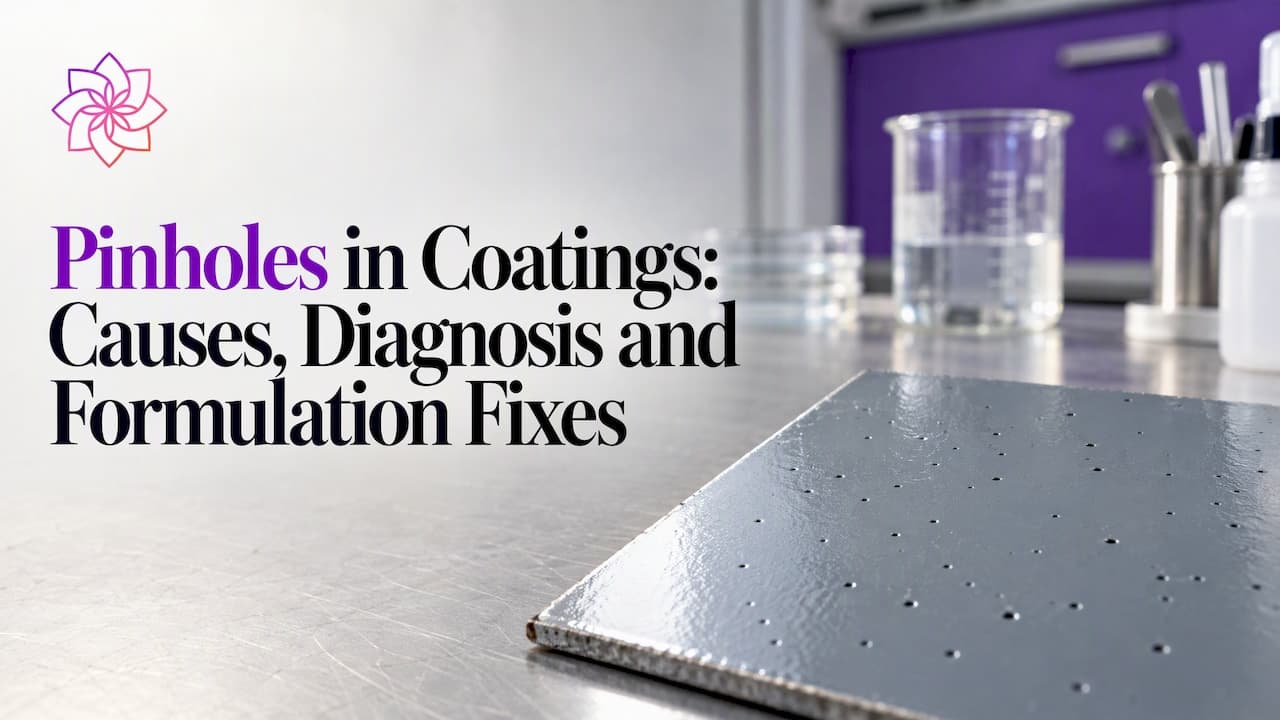
Pinholes in coatings are small, crater-like or through-film voids that form when air, solvent vapor or another gas escapes from a film before it has set. The cause is almost always one of four things: volatiles trapped beneath a prematurely skinned surface, air entrained during mixing or application, contamination on the substrate or in the supply air, or gas released from a porous substrate. Each has a different signature, and each calls for a different correction in the process or the formulation. This guide covers liquid paint and powder coating, and sets out a diagnostic sequence that separates the causes before any remedy is chosen.
TL;DR
- Pinholes form when gas or solvent vapor escapes through a film that has already started to set, or when air is trapped beneath it.
- In liquid coatings, the usual contributors are solvent popping, moisture in atomizing air, excessive film thickness, insufficient flash-off and incompatible solvents.
- In powder coating, the usual contributors are contaminated compressed air, heavy film build, incorrect cure schedules and porous substrates.
- Diagnose in order: air supply, application, film thickness, flash-off and cure, substrate, then formulation. Only then adjust the additive package.
- When the cause is entrained air or unstable foam in the wet film, a well-matched defoamer and dispersant system is the formulation-side correction.
The Powder Coating Institute defines pinholing as the formation of small holes through the entire thickness of a coating, appearing as fine, pimply defects in a cured film, frequently caused by air trapped under the surface. That definition separates pinholes from defects that affect only the upper layer of the film.
In solvent-borne systems, the mechanism is commonly described as solvent popping. Troubleshooting guidance from Sherwin-Williams and the American Coatings Association explains that surface layers skin over too quickly, trapping solvent that later bursts through the surface and leaves pinholes or crater-like openings. Once the film has gelled, it cannot flow back to close the opening. The film does not self-heal, so the void is fixed in place on cure.
Pinholes versus neighboring defects
Several defects look similar at a glance, and misidentifying them leads to the wrong remedy. The table below separates them by origin and by the first thing to check.
| Defect | Typical appearance | Primary origin | First check |
|---|---|---|---|
| Pinholes | Small, deep voids, often through the film | Escaping solvent or gas, trapped air | Flash-off, film thickness, air supply, substrate porosity |
| Craters | Round depressions with a raised rim, often with a visible nucleus | Surface tension gradients from contamination | Oil, silicone, or lubricant contamination; wetting behavior |
| Fisheyes | Larger circular voids exposing the substrate | Low-surface-energy contaminants | Substrate cleanliness, silicone sources in the plant |
| Blisters | Raised domes | Gas, moisture or soluble salts beneath the film | Substrate moisture, osmotic effects, adhesion |
| Orange peel | Regular, undulating texture | Poor leveling and flow | Viscosity, application parameters, cure profile |
| Microfoam | Dense population of tiny bubbles frozen in the film | Air stabilized in the wet film | Mixing energy, surfactant package, defoamer selection |
The distinction between pinholes and craters matters in practice. Craters generally point to contamination and surface tension, which are addressed through cleaning and wetting control. Pinholes generally point to gas movement, which is addressed through drying kinetics, film build, air quality and deaeration.
Causes of pinholes in liquid paint and coatings
A Products Finishing article on pinholes in paint film lists the recurring causes in spray application: moisture in the atomizing air of the spray gun, insufficient atomizing air pressure, unclean surfaces, gases escaping from porous baked castings, trapped solvents, too little flash-off time, incompatible solvents and excessive film thickness. These group into four mechanisms.
Solvent entrapment and popping
When the surface of a film dries faster than the layer beneath it, a skin forms. Solvent remaining below the skin continues to evaporate, builds vapor pressure and eventually ruptures the surface. The conditions that promote this are well known:
- High oven or bake temperatures applied before adequate flash-off.
- Fast, low-boiling solvents in a blend that lacks slower retarder solvents to balance drying.
- Wet film thickness beyond the recommended range, which lengthens the path the solvent must travel.
- High airflow or elevated booth temperature that accelerates surface drying.
The corrective logic is to keep the surface permeable for as long as the underlying film needs to release its volatiles. That means longer flash-off, a more balanced solvent blend, and a controlled temperature ramp into the cure stage.
Air and moisture from the application equipment
Moisture and oil in atomizing air are a recurrent source of pinholes in spray application. Water droplets deposited in the wet film vaporize during bake and leave small voids. The remedy listed in the same Products Finishing source is mechanical: drain moisture from air lines, adjust atomizing pressure, clean the substrate, degas porous castings, allow sufficient solvent flash-off and use the recommended solvents.
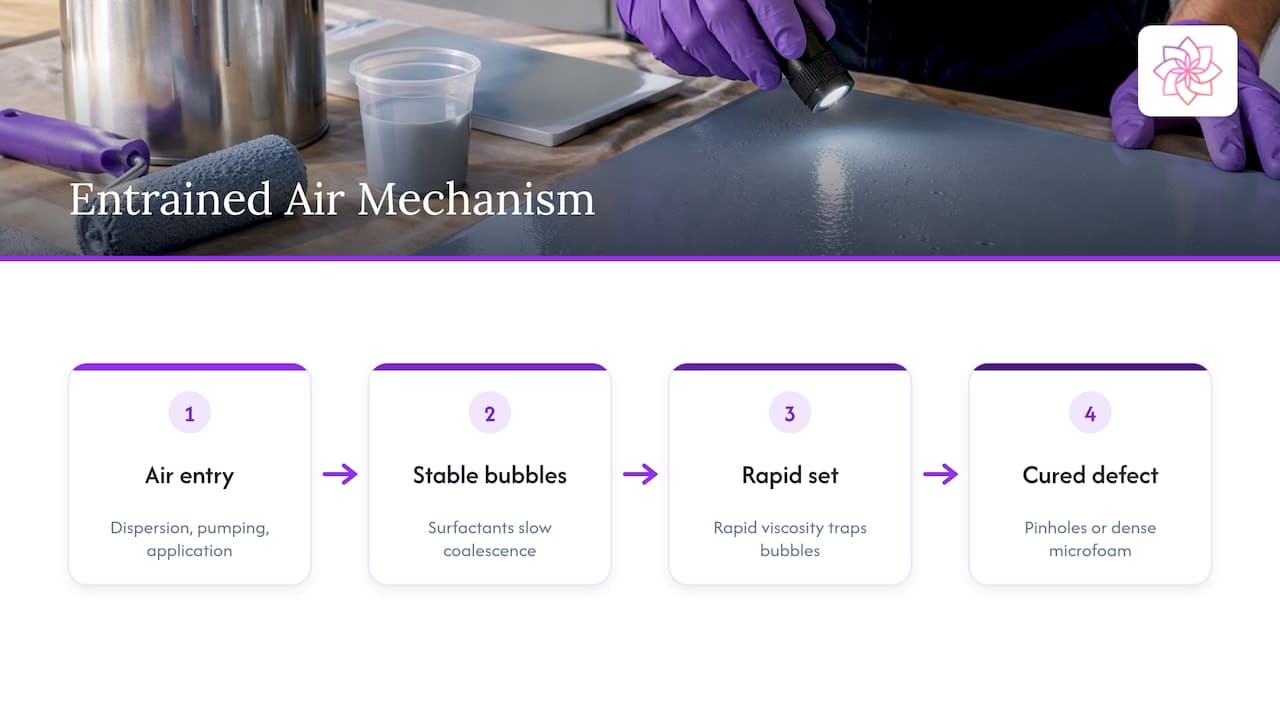
Entrained air and unstable foam in the wet film
Air introduced during dispersion, letdown, pumping or roller and spray application can remain in the wet film if the formulation stabilizes it. Surfactants, wetting agents and some pigment dispersants lower surface tension and slow bubble coalescence. If the viscosity build is rapid, as in high-solids or thixotropic systems, the bubbles cannot rise out before the film sets. Foam traps by design when the interfacial film around a bubble is stabilized, and the bubble then shows up in the cured coating as a pinhole or a dense field of microfoam.
This is the mechanism most directly influenced by the additive package. It is also the one most often misdiagnosed as an application problem, because the defect appears only after the coating has been applied and dried.
Substrate outgassing
Porous substrates such as castings, wood, concrete, masonry and some body fillers hold air and moisture. During bake or cure, heating expands the trapped gas, which then passes through the wet or softening film. Sealing the substrate, pre-baking or degassing it, or applying a primer-sealer that closes the porosity addresses the source directly.
Causes of pinholes in powder coating
Powder coating contains no solvent, so the explanations differ. The TCI Powder troubleshooting guide identifies the common causes of pinholes in powder as contaminants in compressed air, excessive film thickness, improper oven temperatures or cure times, and surface porosity of the substrate.
Compressed air quality
Oil and water in the fluidizing and conveying air reach the powder, alter its charging behavior and leave defects in the melted film. The Powder Coating Institute specifies that compressed air in powder systems should have a minimum 35°F dew point and less than 0.1 ppm of contaminants or oil. Air dryers, coalescing filters and routine drain checks are the standard controls, and the dew point should be verified rather than assumed.
Film thickness and cure schedule
Excess film build traps air between powder particles as the film melts and gels. Because there is no solvent to blame, the entrapped gas is air from the powder bed, adsorbed moisture or volatile by-products of the crosslinking reaction, such as blocking agents or condensation products depending on the chemistry. Thicker films require longer escape paths, and a fast gel at high oven temperature seals the surface before degassing completes. Verifying the actual cure cycle with an oven profiler, rather than relying on the oven set point, shows the metal temperature curve the part truly experiences.
Substrate porosity and pretreatment
Cast aluminum, galvanized steel, and other porous or outgassing metals release gas during cure. Pre-heating the part to drive off gas before powder application, using a lower-gassing or degassing-grade powder, and applying a thinner first coat are widely used methods. Cleanliness also matters: the "water break free" test, in which water sheets over a clean part instead of beading, is a common visual check of surface cleanliness before coating.
Powder formulation factors
Powder manufacturers include degassing agents, typically benzoin or equivalent additives, flow and leveling agents and wax modifiers to allow air to escape before the film gels. The balance matters because a flow additive that improves leveling can also close the surface faster. Where a recurring pinhole pattern persists after process checks, the powder formulation, the grind, and the additive loading belong in the investigation.
A diagnostic sequence for pinholes
The troubleshooting guidance from TCI Powder recommends checking for a contaminated air supply, incorrect application techniques or pressures, inappropriate solvent blends for shop conditions, excessive film thickness, and improper flash-off or oven temperatures. It adds that the substrate should be inspected for porosity or moisture and the bake schedule verified for over-curing or under-curing. A practical order for working through these items is below.
- Characterize the defect. Examine at 10x to 30x magnification. Determine whether the voids penetrate to the substrate, whether they are open or capped, and whether they cluster in particular geometry such as edges, welds or thick areas.
- Map the pattern. Random, uniform distribution tends to indicate air or formulation causes. Clustering on castings, welds or seams tends to indicate substrate outgassing. Distribution that follows the spray pattern tends to indicate application equipment.
- Check the air supply. Drain traps, inspect filters, and measure dew point and oil content at the point of use.
- Verify film thickness. Measure dry film thickness across the part and compare it to the data sheet range. Localized thick areas are common sources of failure even when the average is acceptable.
- Review flash-off and cure. Confirm the flash-off time and temperature in liquid systems, and the real part temperature profile in both liquid and powder systems.
- Test the substrate. Pre-bake a sample, seal it or switch the pretreatment, and observe whether the defect disappears.
- Isolate the formulation. Apply the same coating on a clean glass or sealed metal panel with controlled film build. If pinholes persist there, the formulation, not the process, is the primary cause.
The final step is the most valuable for formulators and manufacturers. A defect that appears on a clean, sealed test panel under controlled application conditions cannot be attributed to the shop floor.
Inspection and detection
Visual inspection finds pinholes that open to the surface, but not discontinuities hidden within a thick film. On conductive substrates, electrical holiday testing is the usual method for locating pinholes and discontinuities. The Association for Materials Protection and Performance publishes NACE SP0188-2024, which covers electrical holiday testing on conductive substrates, and the same standards body maintains visual evaluation guidance for pinholes in concrete and masonry coatings. Which method applies depends on the substrate, the film thickness and the service environment. For tanks, pipelines and immersion service, pinholes are functional defects, because they give electrolyte a direct route to the substrate. For decorative finishes, they are principally an appearance defect, although they can also become initiation sites for corrosion or blistering.
Formulation levers that reduce pinholing
When process checks are clean and the defect persists, the formulation is the remaining variable. Four levers deserve attention.
Defoamer selection
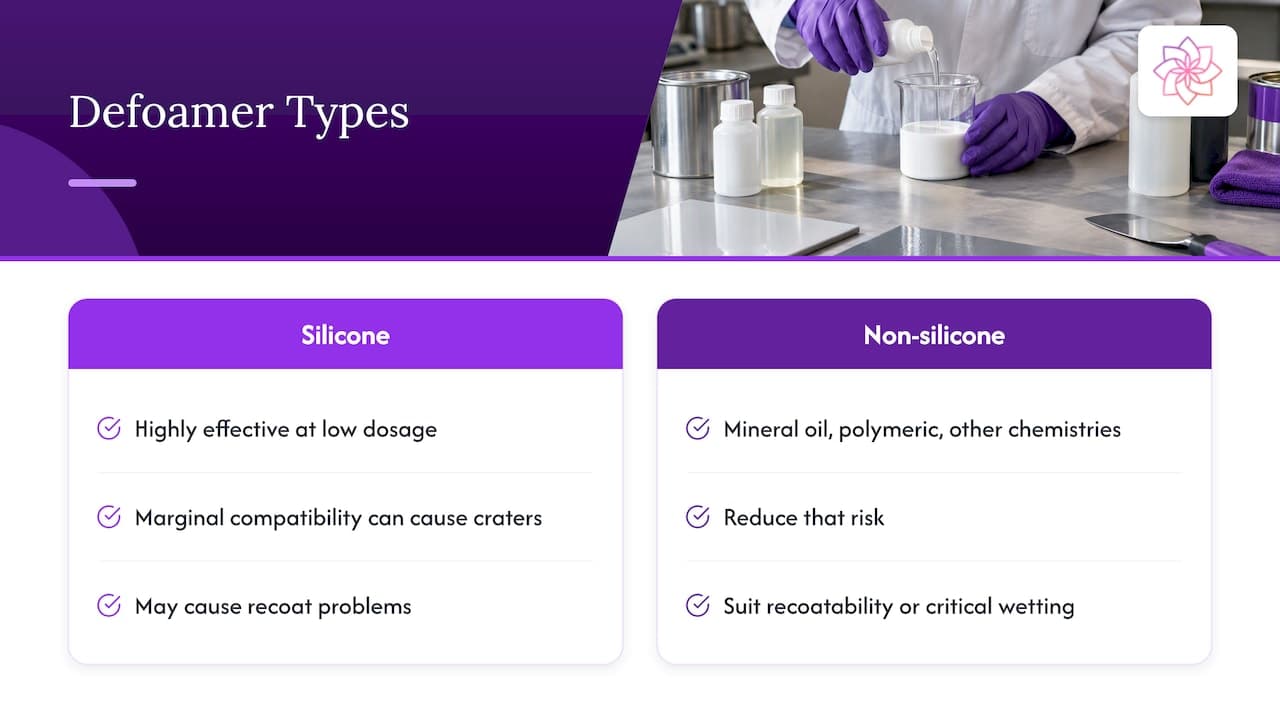
Defoamers work by entering the bubble lamella, bridging it and destabilizing it so that entrained air coalesces and escapes. Silicone defoamers are generally highly effective at low dosage but can contribute to craters or recoat problems where compatibility is marginal. Non-silicone defoamers, based on mineral oil, polymeric or other chemistries, reduce that risk and suit applications where recoatability or critical wetting is a concern. The choice depends on the resin system, the pigment loading, the application method and the cure schedule. The ASTRA DF and ASTRA DF NS lines are part of the ASTRA product range and are intended to cover silicone and non-silicone options.
Dosage and the point of addition both matter. A defoamer added in the grind controls foam during dispersion, while a postadd in the letdown addresses foam generated in filling and application. Overdosing a poorly compatible defoamer can create the surface defects it was meant to prevent, so ladder studies across a dosage range are the sound approach.
Dispersant efficiency and viscosity control
A dispersant that wets and stabilizes pigment efficiently permits lower grind viscosity and higher pigment loading, with less air trapped in agglomerates. Poorly dispersed pigment holds air at the particle surface, and that air is released on application. Efficient deflocculation also improves flow and leveling, giving the film more time to close over small defects. The ASTRA DISP line addresses this stage of the process.
Rheology and leveling window
A rheology profile that recovers too quickly after shear locks bubbles and surface irregularities in place. A profile with sufficient low-shear flow lets the film level and deaerate before structure rebuilds. Rheology modifiers are therefore tuned against the flash-off time and film build of the target application, not chosen in isolation.
Solvent balance and film-formation kinetics
For solvent-borne systems, the evaporation profile of the blend determines how long the surface remains open. Replacing part of a fast solvent with a slower retarder can extend the window for release without changing the resin system. Compatibility of the solvent with the resin matters as well, since incompatible solvents are among the causes listed in the Products Finishing guidance.
Correcting pinholes in existing finishes
For a cured film with pinholes, the correction depends on depth and service. In liquid paint, the established repair is to sand down and refinish after identifying and removing the cause, otherwise the defect will recur. In powder coating, correction typically involves adjusting film build, curing parameters or substrate treatment, then recoating according to the powder supplier's recommendations. Recoating without changing the conditions that produced the defect usually reproduces it, sometimes in greater density.
Tailored additive support from ASTRA Chemical
Astra Chemical manufactures dispersants, silicone and non-silicone defoamers, rheology modifiers and functional coating additives for coatings, adhesives, inks, plastics and composites. The company supports formulators with technical consultation, sample requests and custom formulation guidance, and states that its qualification work is laboratory-backed. Teams working through a persistent pinhole or microfoam problem can review the full ASTRA product range to match chemistry to the resin system and application method, or contact the technical team through the Astra Chemical website to request samples for a ladder study.

Product selection for a specific system benefits from a defined test protocol: the resin and pigment system, the mixing equipment, the application method, the film thickness window and the cure schedule. Supplying these details at the outset shortens the qualification cycle.
Perspective from the formulation laboratory
In our experience with defect investigations, pinholing is frequently addressed at the wrong stage. Process variables such as air quality, flash-off and film build deserve to be verified first, and a clean-panel test is the quickest way to establish whether the root cause sits in the formulation.
When it does, the additive package is rarely a single-component problem. Defoamer, dispersant and rheology modifier interact: a dispersant that lowers grind viscosity changes how air is released, and a rheology profile determines how long that release can continue. For that reason, we recommend evaluating the three together, with dosage ladders and a controlled film-build range, instead of adjusting one additive in isolation.
Our approach is to pair silicone and non-silicone defoamer options with dispersant and rheology selection, supported by laboratory qualification and batch-to-batch consistency. The aim is comparable performance to premium brands at a lower total cost-in-use, achieved through optimized dosage rather than higher loading.
Astra R&D Team
FAQ
What causes pinholes in paint?
The most common causes are solvent trapped beneath a surface that skins over too quickly, moisture in the spray gun's atomizing air, excessive film thickness, too little flash-off time, incompatible solvents and gas escaping from porous substrates. Entrained air stabilized by surfactants in the wet film can also appear as pinholes after drying. Products Finishing lists these causes for spray application.
What causes pinholes in powder coating?
Contaminants in the compressed air, excessive film thickness, improper oven temperatures or cure times, and porous substrates are the usual causes, according to the TCI Powder troubleshooting guide. Checking the air dew point, measuring film build and profiling the oven are the first steps.
How can pinholes be prevented in powder coating?
Use compressed air with a low dew point and no oil, verify the cure cycle with an oven profiler, keep film build within the data sheet range and pre-treat or degas porous parts. The Powder Coating Institute gives a minimum 35°F dew point and under 0.1 ppm of oil or contaminants as the target for compressed air.
How do pinholes differ from craters and fisheyes?
Pinholes are small voids caused mainly by escaping gas, solvent or trapped air. Craters and fisheyes are caused mainly by surface contamination that creates local surface tension differences, so the film pulls away from the contaminated spot. The remedy for pinholes concerns drying and degassing, while the remedy for craters concerns cleanliness and wetting.
Can a defoamer eliminate pinholes?
A defoamer can eliminate pinholes that originate from entrained or stabilized air in the wet film. It cannot correct pinholes caused by substrate outgassing, contaminated air or excessive film build, which require process changes. A clean-panel test shows which situation applies.
Sources
- Glossary of Terms, Powder Coating Institute
- Frequently Asked Questions, Powder Coating Institute
- Troubleshooting Guide, Sherwin-Williams
- Pinholes in Paint Film, Products Finishing
- Guide to the Application and Troubleshooting of Electrostatic Powder Coatings, TCI Powder
- Standard for Visual Evaluation of Pinholes in a Concrete or Masonry Coating, AMPP
Testing additives for this application?
Send us your current formulation challenge and our technical team will recommend an ASTRA product package for lab screening.