Nanoclay Dispersion in Coatings and Adhesives: Methods and Controls
Nanoclay Dispersion in Coatings and Adhesives: Methods and Controls ! High-pressure recirculation equipment in a process room Nanoclay dispersion is the process of separating stacked aluminosilicate platelets and distributing them uniformly through a liquid resin, solvent or coating base, so that th…
Nanoclay dispersion is the process of separating stacked aluminosilicate platelets and distributing them uniformly through a liquid resin, solvent or coating base, so that the clay acts as a network or barrier phase rather than as a population of agglomerates. Success depends on four variables that must be matched to one another: the clay and its surface treatment, the carrier or solvent, the mixing energy and the order of addition. Quality is confirmed by X-ray diffraction, electron microscopy, particle-size measurement and rheology, never by a single indicator.
TL;DR
- Exfoliated platelets, not tactoids, are generally the target morphology, because only separated sheets deliver the barrier, rheology and mechanical effects that justify the clay.
- Organoclay grade must match the polarity of the carrier. Untreated hydrophilic clay is incompatible with hydrophobic matrices.
- Sonication and high-shear processing outperformed manual or conventional batch mixing in the cited epoxy and polyester studies, but shear has to be optimized rather than maximized.
- Disperse the clay first in the thinnest available medium, then add the remaining formulation components under lower shear.
- Confirm dispersion with at least two independent methods, for example X-ray diffraction plus rheology or particle-size data.
Nanoclay particles are built from stacked silicate layers, each roughly one nanometer thick, with interlayer galleries that hold exchangeable cations. A study of nanoclay in vinyl-ester resin from the National Institute of Standards and Technology defines three morphologies that are useful as a working vocabulary:
- Tactoid: largely undisturbed stacks of sheets, with the resin sitting only on the outside of the stack.
- Intercalated: the gallery spacing has increased because polymer or monomer has entered, but the sheets are not fully separated.
- Exfoliated: individual sheets are well dispersed in the matrix. The NIST work identifies this as the generally desired morphology.
In practice, a coating or adhesive batch contains a mixture of all three. Dispersion work is the effort to shift that distribution toward exfoliation and to keep it there through storage, application and cure.
The reason formulators pursue it is functional. Nanoclays are low-cost particles with a high aspect ratio (length divided by thickness), which is the attraction for barrier coatings, as discussed in Practical Coatings Science coverage of polyurethane systems, where nanoclay incorporation was reported to improve dry adhesion and high-pressure hot-water performance. Aggregates forfeit that aspect ratio and also act as defect sites. A review of nanoclay in corrosion-protective coatings identifies poor compatibility and inherent agglomeration as causes of coating defects.
Clay type, surface treatment and carrier: the compatibility triangle
Surface treatment decides whether the clay can wet out
Natural montmorillonite is hydrophilic. The NIST vinyl-ester study states that untreated clay of this kind is incompatible with hydrophobic matrices. Long-chain cation exchange converts the gallery surfaces to organophilic ones and enlarges the gallery spacing, which lets the monomer or resin enter. A second NIST study of functionalized platelets in amine-cured epoxy supports functionalizing the clay with epoxy-compatible groups to promote miscibility and exfoliation. The same work names platelet dispersion and clay-matrix adhesion as the central issues to resolve if property gains are to be realized.
Two organoclay grades can behave very differently under identical processing. A thesis evaluating ultrasonication measured cluster diameters by dynamic light scattering and found 4,969 nm for one commercial organoclay grade against 273 nm for another after two hours of ultrasonic treatment. Process energy cannot fully compensate for a poor chemical match.
The carrier must swell the clay
The NIST work adds that the solvent or monomer should swell the modified clay and be miscible with the polymer. For solvent-based coatings and inks, a practical dispersion guide states a grade-selection rule: low-polarity systems generally call for a high-organic-content clay with a stronger activation step, whereas high-polarity solvents may use a lower-organic-content clay and sometimes need no activator at all.
| Carrier polarity | Typical organoclay approach | Activator |
|---|---|---|
| Low (aliphatic, mineral spirits type) | High organic content | Usually required, with stronger activation |
| Medium | Intermediate organic content | Often required |
| High (polar solvents) | Lower organic content | Sometimes unnecessary |
The table summarizes the grade-matching principle in the guide. Final selections require laboratory confirmation in the actual formulation, since resin, pigment and other additives all shift the polarity balance.
Dispersion methods compared
Published work compares mechanical and ultrasonic routes, and the findings are consistent enough to guide method selection.
| Method | What the evidence shows | Practical consideration |
|---|---|---|
| Manual or low-energy mixing | A comparative polyester study found larger aggregates remaining | Suitable only as a pre-wetting step |
| Intensive batch mixing | In epoxy with 10 wt% organoclay, sonication dispersed the clay more effectively than intensive batch mixing | Scales easily but may leave residual stacks |
| Sonication | Slight shear thinning in the polyester study; increased dynamic properties in epoxy suggested partial intercalation and exfoliation | Energy is delivered to a limited volume, so batch size is a constraint |
| High-shear, high-pressure recirculation | Much stronger shear thinning, associated with a potentially exfoliated structure, in the polyester study | Gap and pass count must be controlled |
| Microfluidization | Evaluated at 5,000 psi (34.5 MPa) in a dispersion thesis alongside ultrasonication, planetary centrifugal mixing and overhead stirring | Equipment-intensive; suited to high-value or small-volume grades |
| Melt blending (thermoplastics) | Solvent-free, which reduces environmental impact and avoids solvent-polymer interactions that can limit dispersion; needs suitable thermal and shear processing, per a 2018 review | Relevant to plastics and hot-melt systems |
| Solution blending | The same review describes a solvent in which the polymer or prepolymer dissolves, allowing the clay to swell and chains to intercalate | Requires solvent handling and recovery |
A 2024 review of epoxy nanocomposites concludes that ultrasonication is generally superior to mechanical mixing in the epoxy studies it covered, and reports partial exfoliation at low clay loading under suitable conditions. The vinyl-ester work at NIST adds a formulation point: styrene combined with high-intensity ultrasonic mixing produced the highest exfoliation in that study, and the authors report that exfoliation depends significantly on both clay composition and processing conditions.
For industrial coating and adhesive production, the comparison reduces to a decision between energy density, batch volume and equipment already on the floor. Rotor-stator or high-speed disperser stages commonly handle pre-wetting and gelation, while ultrasonic or high-pressure stages are added where the measured dispersion quality justifies them.
Mixing sequence and shear control
Order of addition is as important as energy. The solvent-system guide describes a sequence for liquid systems that fits most coating and ink bases:
- Charge the solvent or the lowest-viscosity component first.
- Add the organoclay under moderate agitation so that the powder wets without forming lumps.
- Add the activator, where the grade and carrier require one.
- Apply high shear until the gel structure develops.
- Add the remaining components, including resin, pigment and additives, under lower shear.
The guide also warns that introducing organoclay into an already viscous or fully formulated liquid can prevent wetting and separation of the stacks. The clay should be dispersed first in the thinnest medium available and let down afterward.
Shear is optimized, not maximized
The polyester study quantified how process parameters interact. The high-shear unit used an interaction gap of 50 to 100 micrometres with high-pressure recirculation, and initial viscosity rose with each pass until an apparent maximum exfoliation state was reached after two passes. Beyond that point, additional passes brought no further gain in that system.
A thermoset extrusion study, published in the Journal of Polymer Engineering, reached a similar conclusion from the opposite side. Right-hand kneading elements and three- or four-lobed kneading elements produced uniform dispersion, inadequate shear caused agglomeration, and excessive shear was associated with polymer degradation. For scale-up, the working principle is a defined energy window with a measured response, not the highest speed the equipment can reach.
A practical parameter set to record for each batch:
- Organoclay grade, lot and moisture condition
- Carrier composition and temperature at the start and end of dispersion
- Tip speed or rotor speed, gap and number of passes
- Time to gel structure, with the viscosity reading at that point
- Fineness of grind after dispersion
Temperature deserves particular attention, since high-shear dispersion is exothermic and viscosity, solvent evaporation and activator performance all move with it.
Assessing dispersion quality
No single measurement settles the question, and the literature is explicit about it.
X-ray diffraction (XRD) tracks the basal spacing of the clay. The NIST epoxy study assessed exfoliation with XRD together with transmission electron microscopy. The Australian thesis cautions that the disappearance of an XRD peak can indicate exfoliation but can equally result from very low clay loading, so the result should not be interpreted alone.
Transmission electron microscopy (TEM) shows platelets directly but samples only a tiny volume. Several images from different regions are needed before the picture can be called representative.
Dynamic light scattering reports particle-size distribution in dilute dispersions. The same thesis checked particle-size stability after at least 12 days of stagnation, which is a useful reminder that a dispersion that looks good at the end of mixing may re-agglomerate in storage.
Rheology is the most accessible in-process tool. The polyester study states that high initial viscosity and strong shear thinning are often associated with greater exfoliation, while noting that rheology also depends on clay type, surface treatment and matrix affinity. The Stevens study similarly presents in-process viscoelastic measurements as a practical way to compare dispersion conditions. Rheology is therefore best used comparatively, within a single formulation family.
Fineness of grind is the routine plant check. A polyurethane coating study cited above dispersed its samples until the fineness of grind was below 20 micrometres. A grind gauge cannot see nanometer-scale stacks, so it screens for gross agglomerates and does not confirm exfoliation.
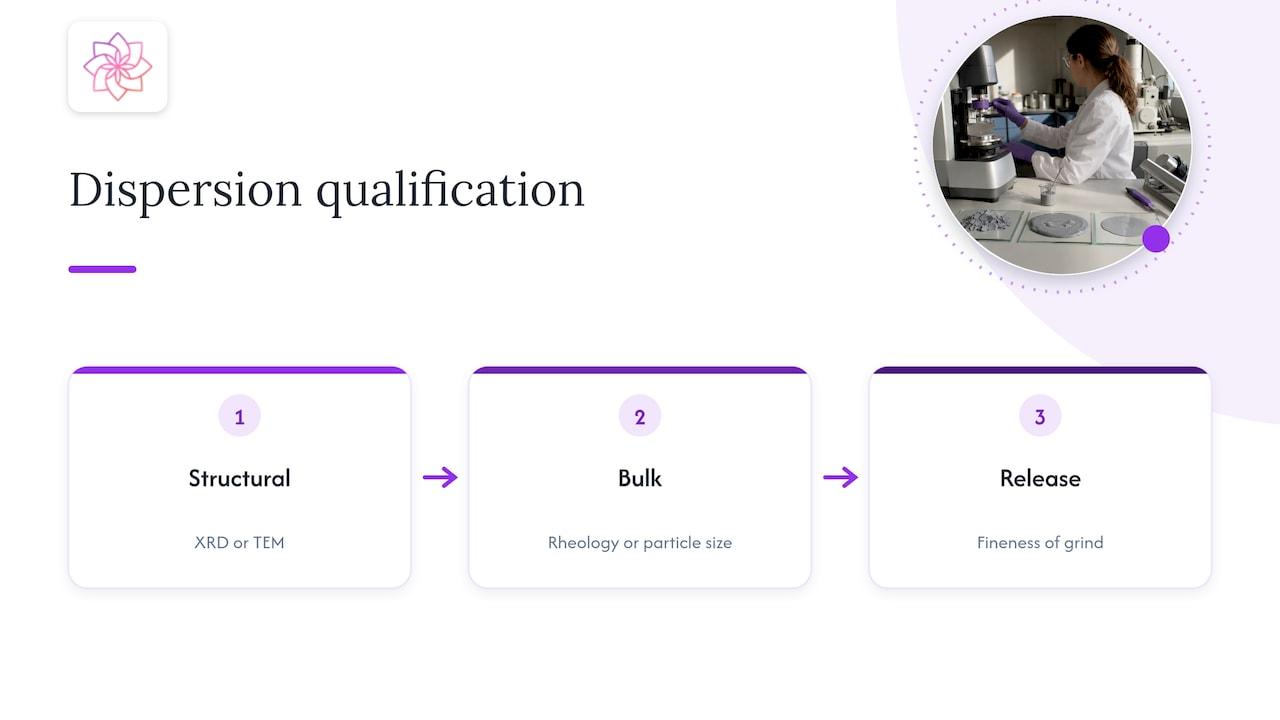
A sound qualification protocol pairs one structural method (XRD or TEM) with one bulk method (rheology or particle size), and then adds the plant-level grind reading as the release check.
Effects on stability, viscosity and film performance
Dispersed organoclay in a liquid system forms a network. According to the solvent-system guide, this network provides viscosity and yield stress at rest and lower viscosity under shear, which is the behavior that supports anti-settling, anti-sag and controlled flow. The polyester study describes the same physics: dispersed layered silicates can form a three-dimensional network that moves the response of the liquid from liquid-like toward solid-like viscoelastic behavior, which can in turn affect processing and polymerization.
The network can also be damaged. The guide identifies water ingress and incompatible downstream surfactants as causes of flocculation or loss of structure. A formulation that thickens correctly in the mill base may therefore lose its rheology after the let-down if a wetting agent or a moisture-carrying raw material is introduced.
On the film side, the polyurethane coating report found improved dry adhesion and better high-pressure hot-water performance after nanoclay incorporation, a slight impact improvement and a negative influence on Erichsen cupping. Dispersion quality governs which of these effects appear, and the trade-off in flexibility is a reminder that loading should be set against the full property profile of the coating.
Common problems and corrective actions
| Symptom | Likely cause | Corrective direction |
|---|---|---|
| Visible lumps or poor wet-out | Clay added to a viscous or complete formulation | Disperse in the thinnest medium first, then let down |
| Low viscosity build despite long mixing | Organoclay grade mismatched to carrier polarity, or no activator | Re-select the grade; add or strengthen the activator |
| Agglomerates after processing | Inadequate shear | Increase energy within the validated window, or add a pass |
| Loss of structure after let-down | Water ingress or incompatible surfactant | Control moisture; review downstream wetting agents |
| Degraded binder or discoloration | Excessive shear or heat | Cap energy input and monitor temperature |
| Film defects such as craters or haze | Residual agglomerates and poor compatibility | Apply coupling agents, polymers or surfactants as compatibilizers, as the corrosion-coating review describes |
Foam is a secondary issue that appears often in high-shear dispersion, because air is entrained as the gel structure builds and the entrained bubbles are stabilized by the same network. Defoamer selection, silicone or non-silicone, should be made on compatibility with the binder and the intended film, and should be evaluated after the dispersion stage, not before it. Reactive diluents and functional additives also change the polarity and viscosity of the carrier, which is covered in the technical guide on reactive diluents and functional additives.
Perspective: an additive supplier's view of nanoclay systems
We approach nanoclay dispersion as one stage in a complete formulation, not as an isolated operation. The clay develops structure only when the carrier, the surface treatment and the energy input are aligned, and the surrounding additives either protect that structure or erode it.
In our experience of supporting coating, adhesive and ink formulators, the most productive step is to define the dispersion stage, the let-down stage and the application behavior together. Dispersants and wetting chemistry influence how pigments and fillers share the mill base with a structuring clay. Defoamers determine whether entrained air from high-shear processing leaves the system. Rheology modifiers determine whether the final flow profile matches the application method.
Our product range of dispersants, silicone and non-silicone defoamers and rheology modifiers is designed to support this approach, backed by laboratory-based qualification and documentation for production and regulatory needs. Our goal is optimized dosage and batch-to-batch consistency, so that a formulation validated in the laboratory behaves identically at production scale and the total cost-in-use stays competitive.
Astra R&D Team
Supporting the dispersion stage with the right additive package
ASTRA Chemical manufactures and supplies dispersants, silicone and non-silicone defoamers, rheology modifiers and functional coating additives for coatings, adhesives, inks, plastics and composites, with technical support and custom formulation guidance. Formulators working on a nanoclay-containing system can review the ASTRA DISP® dispersant range and the full product catalog, or request samples and a technical consultation to match additives to a specific resin system.
The defoamer lines ASTRA DF® and ASTRA DF NS® address foam control after high-shear stages, and the complete line-up is listed on the ASTRA Chemical products page.
FAQ
What is the difference between intercalation and exfoliation?
In intercalation, polymer or monomer enters the clay galleries and increases their spacing, but the layers remain stacked. In exfoliation, the individual sheets are separated and distributed through the matrix. Exfoliation is generally the desired state, according to NIST work on vinyl-ester nanocomposites.
Is sonication better than mechanical mixing for nanoclay?
In the epoxy studies cited here, sonication dispersed the clay more effectively than intensive batch mixing, and a 2024 review found it generally superior. The outcome still depends on clay type and treatment, so each formulation needs its own verification. Many production lines combine a mechanical pre-dispersion with a higher-energy stage.
Which solvent should be used to disperse nanoclay?
The carrier should swell the modified clay and be miscible with the polymer. For organoclays, low-polarity carriers generally need a high-organic-content grade and an activator, while polar solvents may work with a lower-organic-content grade. Untreated hydrophilic montmorillonite is compatible with water but not with hydrophobic resins.
How can dispersion quality be verified?
Combine methods. X-ray diffraction and transmission electron microscopy assess platelet spacing and separation, dynamic light scattering measures particle size, and rheology tracks viscosity and shear thinning in process. A vanishing XRD peak should not be read alone, because very low clay loading can produce the same result.
Why does a nanoclay dispersion lose viscosity after let-down?
The clay network can be disrupted by water ingress or by incompatible surfactants introduced with the remaining components. Controlling moisture and reviewing wetting-agent compatibility before the let-down stage protects the structure.
Sources
- NIST: nanoclay morphology and processing in vinyl-ester resin
- NIST: functionalized nanoclay platelets in amine-cured epoxy
- Stevens Institute: nanoclay dispersion into a thermosetting binder using sonication
- A Comparative Study of Dispersion Techniques for nanoclay composites (Polytechnique Montréal)
- Comparative dispersion study, full abstract (Paperity)
- Victoria University thesis on nanoclay dispersion and durability
- A Review of the Synthesis and Applications of Polymer-Nanoclay Composites (MDPI, 2018)
- Exploring the Impact of Nanoclay on Epoxy Nanocomposites (MDPI, 2024)
- Effect of screw configuration on the dispersion of nanofillers (Journal of Polymer Engineering)
- Dispersing Nanoclay in Solvent-Based Systems: Coatings, Inks
- Influence of Nanoclay on Elastic and Adhesion Properties in Polyurethane Coatings (Paint & Coatings Industry)
- Nanoclay-enabled advanced metal protection (ScienceDirect)
Testing additives for this application?
Send us your current formulation challenge and our technical team will recommend an ASTRA product package for lab screening.