Microfoam in Coatings: Causes, Defects and Control
Microfoam in Coatings: Causes, Defects and Control ! Microbubbles visible in a wet coating drawdown Microfoam in coatings is a population of very fine air bubbles dispersed within the liquid paint or the drying film, as opposed to macrofoam, which collects as visible foam on the surface.
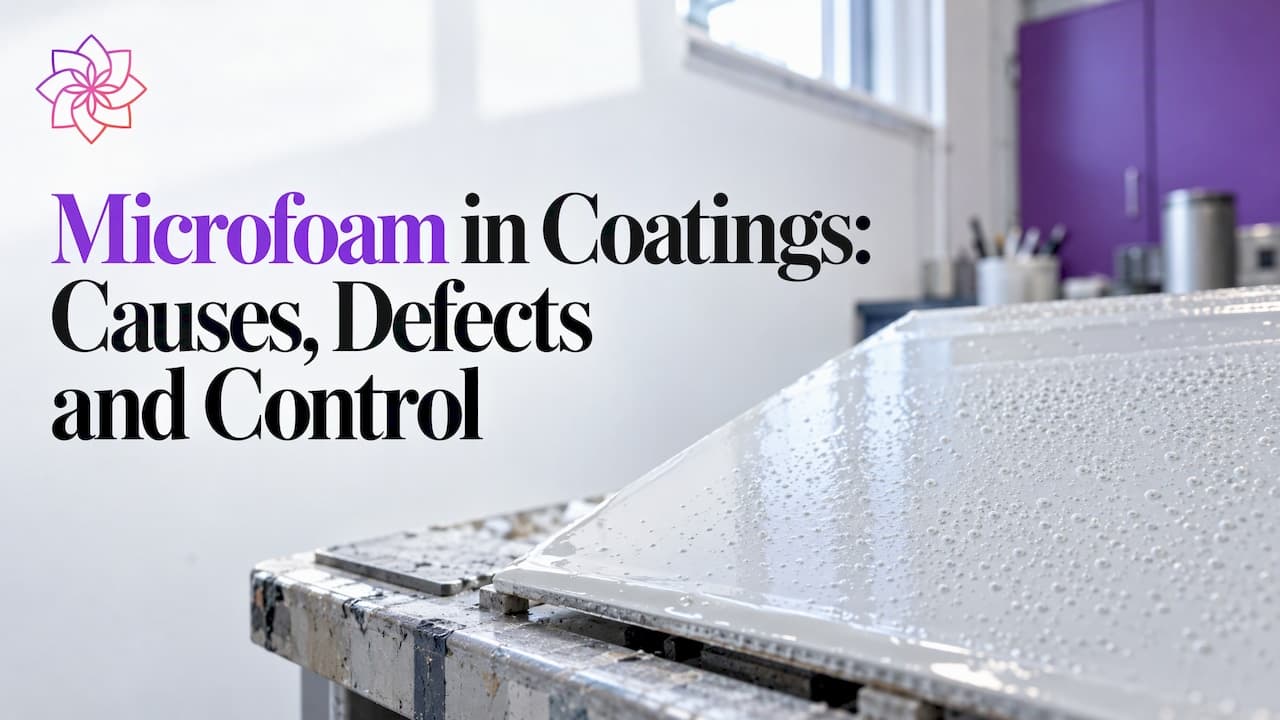
Microfoam in coatings is a population of very fine air bubbles dispersed within the liquid paint or the drying film, as opposed to macrofoam, which collects as visible foam on the surface. Both are forms of entrained air, but they respond to different additive chemistry and different process corrections: macrofoam is generally managed with a defoamer, while finely dispersed microfoam is generally managed with a deaerator. Treating the two as one problem is the most common reason a foam-control program fails to eliminate pinholes, craters and loss of gloss.
This guide sets out how microfoam forms, how to recognize it, what it does to a film, and how formulators select additives and adjust processes to control it.
TL;DR
- Microfoam is fine air stabilized by surfactants inside the coating; macrofoam is foam that sits on the surface and is visible in the can or on the wet film.
- Microfoam is usually a deaeration problem, macrofoam a defoaming problem. The additive type and the dosing logic differ.
- Typical consequences are pinholes, craters, voids, reduced gloss and clarity, and diminished barrier performance.
- Control combines process measures (mixing, pumping, filling, substrate and drying conditions) with a compatible defoamer or deaerator, qualified at the lowest effective dosage.
- Change one variable at a time during troubleshooting, so that the effect of each correction can be attributed.
A foam is a dispersion of gas in a liquid, stabilized by a surfactant layer that surrounds each bubble. In a pure liquid, bubbles rise and burst quickly. A coating is not a pure liquid: it contains wetting agents, dispersants, emulsifiers, polymer latex stabilizers and thickeners, all of which migrate to the air/liquid interface, lower surface tension and slow the drainage of the liquid lamella between bubbles.
The practical distinction between the two forms is one of bubble size and location.
| Property | Macrofoam | Microfoam |
|---|---|---|
| Location | On the surface of the liquid or wet film | Dispersed throughout the bulk liquid and the wet film |
| Visibility | Readily visible during mixing, filling and application | Often invisible as individual bubbles; appears as haze, opacity or later as film defects |
| Rise behavior | Rises and collects rapidly | Rises slowly, or remains suspended in viscous or thixotropic systems |
| Primary additive class | Defoamer | Deaerator |
| Typical defects | Craters, fisheyes, uneven film build | Pinholes, voids, blisters, reduced gloss and clarity |
The rule of thumb is to use a defoamer for macrofoam and a deaerator for microfoam. In real formulations the boundary is not sharp, and many products are designed to give a balance of both actions, which is why selection is ultimately confirmed in the laboratory against the specific system.
How microfoam forms
Air enters a coating at every stage in which energy is imparted to the liquid. The principal entry points are:
- Dispersion and grinding. High-shear dissolvers, bead mills and rotor-stator equipment draw in air through the vortex and incorporate it as fine bubbles, particularly when pigment and extender loading raises viscosity and prevents bubbles from escaping.
- Let-down. Addition of latex, thickener and surfactant-containing additives under agitation introduces air while simultaneously supplying the surface-active species that stabilize it.
- Pumping and transfer. Leaking pump seals, suction-side air leaks, free-fall filling and returns that plunge into the liquid all entrain air.
- Application. Spraying, roll coating and brushing atomize or fold air into the wet film. Roller application in particular entrains air at the nip and in the nap, and it must then escape before the film sets.
- Substrate outgassing. Porous substrates such as concrete, wood and some composites release air as the coating penetrates them. This air emerges through the wet film as bubbles that may not have time to burst before the film gels.
Three formulation factors determine whether that air persists:
- Surfactant concentration and type. Higher levels of wetting agents and dispersants increase foam stability. Adjusting the formulation to reduce surfactant concentration or air entrainment is a recognized corrective route when it is compatible with wetting and pigment stabilization requirements.
- Viscosity and rheology. A high low-shear viscosity or a pronounced yield value slows bubble rise. A rheology profile that gives sag resistance in the wet film also tends to hold microbubbles in place.
- Film thickness and cure speed. A thick film or a fast skin formation shortens the window in which bubbles can migrate to the surface and rupture.
Waterborne systems are especially prone to stable foam because of their high surface tension relative to solventborne systems and their heavy use of surface-active components. Solventborne and high-solids systems are not exempt: high viscosity can trap air that a thinner system would release.
Defects that microfoam causes
Foam can interfere with application, and dried foam leaves defects in the paint film. For microfoam, the consequences are usually seen only after application or after cure:
- Pinholes. Bubbles that reach the surface and burst after the film has begun to set leave craters that do not level out. In protective coatings these may expose the substrate.
- Craters. Surface depressions arising from bubble rupture, or from a defoamer that is not sufficiently compatible with the binder.
- Voids and blisters. Air or solvent vapor retained below a skinned surface expands during forced drying and lifts the film.
- Reduced gloss, clarity and color strength. Dispersed bubbles scatter light. Clear coats look hazy and pigmented coats appear lighter or less saturated than the reference.
- Lower film density and barrier performance. Voids reduce film integrity, with consequences for corrosion protection, chemical resistance and permeability.
- Production losses. Foam raises apparent volume and lowers true fill weight, slows pumping and metering, and creates inconsistent specific gravity between batches.
These are the problems that defoamers and deaerators are specified to prevent, so that the film develops its intended appearance and protective function without surface imperfections.
Identifying microfoam among other film defects
Pinholes, craters, fisheyes and solvent pop can look alike under casual inspection. A structured diagnosis separates them.
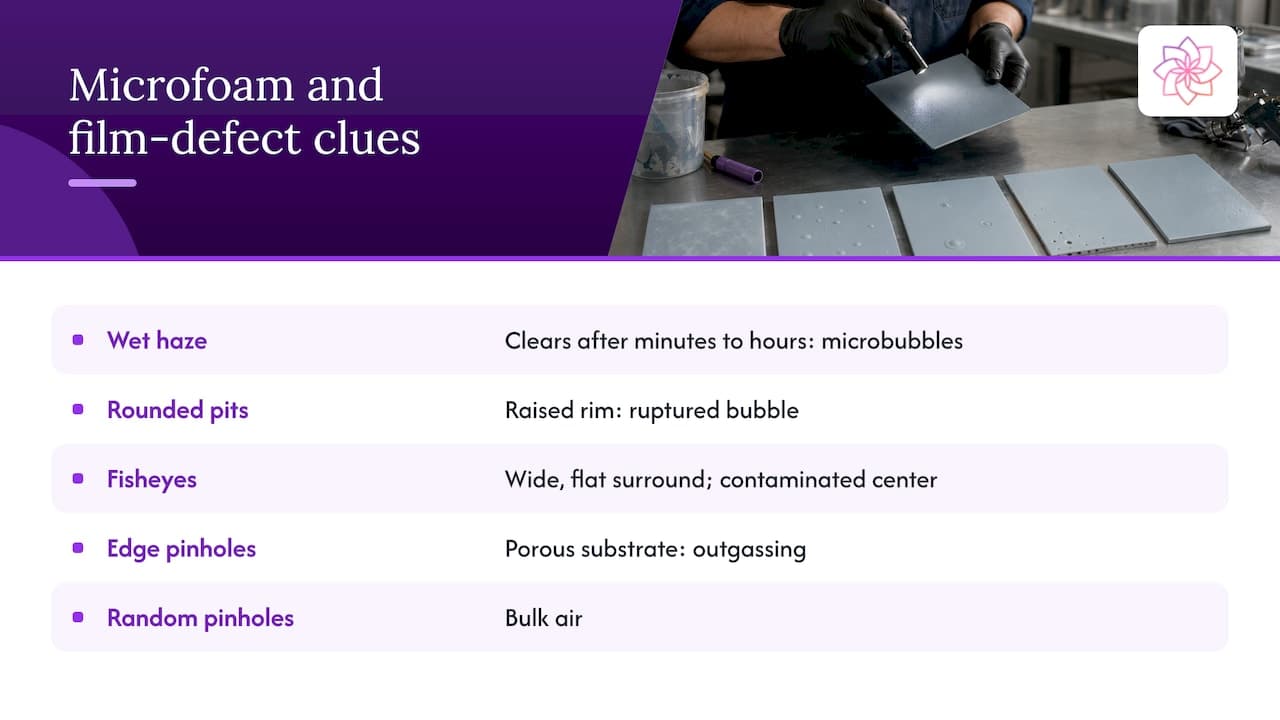
Check the wet material first. Draw a sample into a clear container or a drawdown on a glass panel and observe against light. Haze that clears on standing for minutes to hours indicates entrained microbubbles. A density cup measurement compared with the theoretical density of the batch quantifies the air content, and a falling density value after mixing or pumping points to the step where air is introduced.
Examine the cured film. Rounded pits with a raised rim usually indicate a ruptured bubble, while pits with a clean, wide, flat surround and a contaminated center suggest fisheyes caused by incompatible contamination such as silicone or oil. Pinholes concentrated at the edge of a porous substrate suggest substrate outgassing, whereas randomly distributed pinholes suggest bulk air.
Use inspection data on production lines. On coating lines, defect maps help trace repeating defects to pump frequency or roll circumference and relate them to process variables. The same source notes that bright-field systems detect defects such as pinholes and voids, and that laser systems can resolve defects smaller than 50 microns. A periodic defect pattern points to a mechanical cause, such as a pulsing pump, rather than to the formulation.
Test by controlled comparison. Prepare the same batch with and without a candidate deaerator, apply under identical conditions and compare the film at equal thickness. Keep the substrate, temperature, humidity and application equipment constant.
Process measures that reduce microfoam
Additives are most effective when the process has already been optimized to minimize air introduction. The measures that are most often productive:
- Dissolver geometry. Keep the impeller submerged, avoid a deep vortex, and add powders below the liquid surface or at the vortex edge.
- Staged surfactant addition. Add the most surface-active components late and under low shear where the formulation permits.
- Vacuum or slow-speed finishing. A low-speed stir after dispersion, with or without vacuum, lets bubbles rise before filling.
- Pump and line maintenance. Replace worn seals, tighten suction fittings, submerge return lines and fill from the bottom of the container.
- Resting time. Allow the batch to stand after production. Systems of higher viscosity need longer.
- Substrate preparation. Pre-drying substrates reduces outgassing from absorbed moisture and air.
- Drying profile. Controlling drying-zone temperatures prevents rapid outgassing and skin formation over trapped air. A gradual ramp gives bubbles time to escape.
- Application parameters. Adjust spray pressure, tip size, roller nap and film build to reduce air incorporation.
When several of these corrections are possible, apply them sequentially. Changing the mixing speed, the additive and the oven profile simultaneously makes it impossible to say which action resolved the defect, and a later raw-material change may bring it back. The reasoning behind changing one variable at a time is equally relevant in the selection of a protective system, where multiple simultaneous adjustments obscure the cause of a failure.
Defoamers and deaerators: selection logic
The two additive types act at different points in the foam structure.
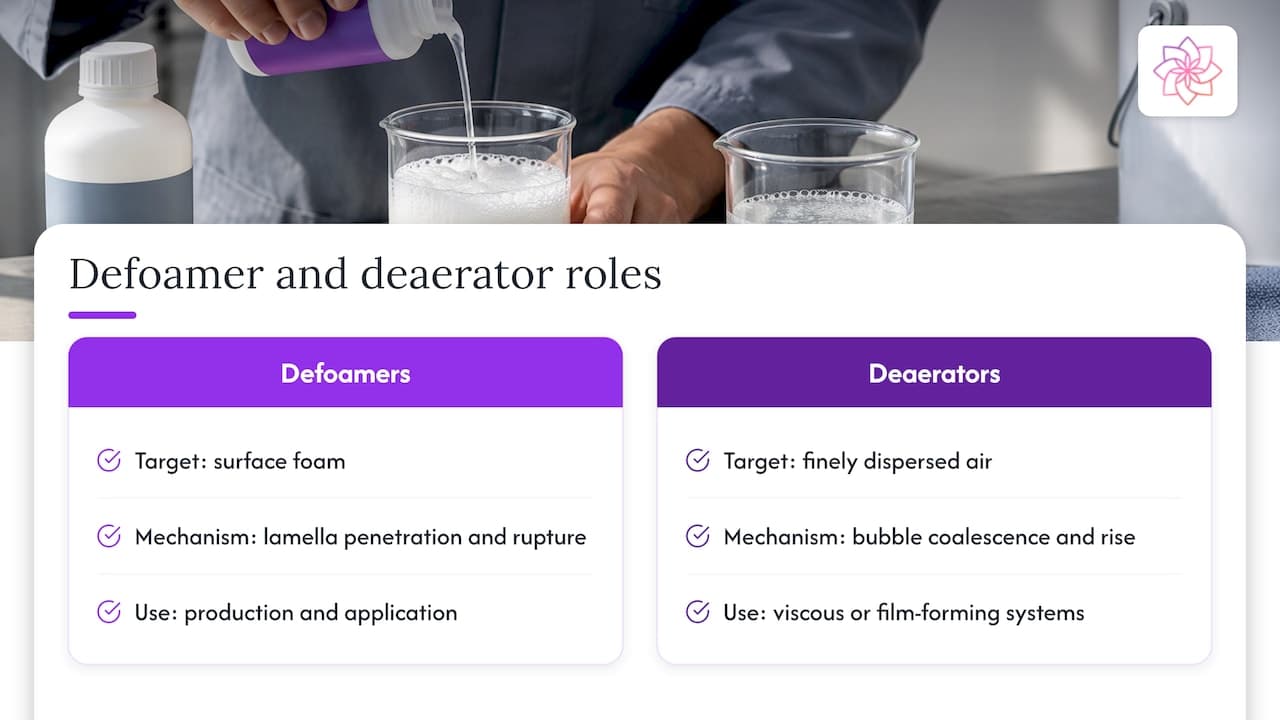
Defoamers are, by design, insoluble or poorly soluble in the medium so that they can move to the interface. They must penetrate the foam lamella, destabilize it and make it burst. They are chosen to collapse surface foam quickly during production and application.
Deaerators are preferred for removing finely dispersed air. They promote the coalescence of small bubbles into larger ones, which then rise faster and escape. They are therefore matched to microfoam in viscous or filmforming systems.
The central constraint is compatibility. Selection is a compromise between defoaming performance and compatibility, since incompatibility can cause craters. A highly efficient additive that is too insoluble leaves its own surface defects, while one that is too compatible fails to reach the interface. The aim is the narrow window between the two.
Criteria for selection
| Criterion | What to evaluate |
|---|---|
| Chemistry | Silicone or non-silicone, depending on recoat, adhesion, printing and cratering requirements |
| Binder system | Waterborne, solventborne, high-solids, 2K, UV-curing, adhesive or ink |
| Foam type | Surface foam, dispersed air, or both |
| Point of addition | Grind stage, let-down, post-addition, or split dosing |
| Dosage | Lowest level that gives the required effect, determined by a dosage ladder |
| Film properties | Gloss, haze, recoatability, adhesion, water resistance, slip |
| Stability | Storage stability of the finished product, since efficiency can decline over time |
| Regulatory | VOC, labeling and documentation for the target market |
Tradeoffs by coating system
- Waterborne architectural paints. Foam is persistent because of the heavy use of surfactants and thickeners. Non-silicone chemistry is frequently preferred where cratering and recoat adhesion are concerns, and silicone-based products may be used where their performance is needed and the system tolerates them.
- Industrial and protective coatings. Pinholes carry a performance cost, so deaeration at high film thickness is prioritized, and defoamer dosage must not compromise intercoat adhesion.
- Clear and high-gloss finishes. Haze and gloss are measured directly, so the additive must be both efficient and highly compatible.
- Adhesives and inks. Entrained air affects bond line continuity or print density, and surface-active additives can interfere with wetting or adhesion on the substrate.
- Plastics and composites. Air trapped in resin during infusion or casting becomes a void, so the viscosity, the vacuum cycle and the additive are tuned together.
A dosage ladder is the standard laboratory method: prepare the base at several additive levels, apply under identical conditions, and record foam height, density, film appearance and gloss. The optimum is where defect-free appearance is reached before side effects appear.
Perspective: foam control as a cost-in-use question
We approach microfoam as a system problem rather than a product problem. In our experience with coatings, adhesives and inks formulators, the same additive can perform well in one binder and fail in another, because the balance between efficiency and compatibility moves with surfactant package, rheology and application method.
For that reason ASTRA Chemical supplies both silicone and non-silicone defoamer lines, together with dispersants, rheology modifiers and functional additives, so that foam control can be matched to the rest of the formulation rather than added after the fact. Our laboratory-backed qualification work is aimed at establishing an optimized dosage, because dosage is where cost-in-use is decided.
Batch consistency and complete documentation matter as much as peak performance. A defoamer that behaves identically from lot to lot allows the process window to be fixed once, which in our view is the practical route to fewer rejected batches and lower total cost.
Astra R&D Team
Selecting a defoamer line for your system
ASTRA Chemical manufactures defoamers in silicone and non-silicone chemistries, supported by technical consultation, sample requests and custom formulation guidance for coatings, adhesives, inks, plastics and composites. The ASTRA DF® and ASTRA DF NS® lines address foam control, while ASTRA DISP® dispersants support pigment stabilization in the same formulation. Because the dispersant package influences foam stability, evaluating them together shortens qualification.

Formulators and procurement teams can review the full range on the ASTRA Chemical products page and request samples and technical support for a specific system. Those working from an existing specification can also consult the additive cross-reference. Further technical guides are collected on the ASTRA Chemical blog.
A practical troubleshooting sequence
- Define the defect. Confirm by wet-material and cured-film examination whether the cause is bulk air, substrate outgassing or contamination.
- Quantify air content. Measure density of the batch at each stage to locate the step where air enters.
- Correct mechanical causes. Repair pump seals, lower vortex depth, change filling method.
- Adjust the drying profile and substrate conditions if defects concentrate at specific zones or edges.
- Select the additive type according to foam type: deaerator for dispersed air, defoamer for surface foam, or a balanced product for both.
- Run a dosage ladder and compare gloss, haze, adhesion and recoat behavior.
- Confirm on scale. Repeat on a production-size batch, with the planned storage period, before releasing the formulation.
Between steps, change only one parameter and record the result, so that the final specification is traceable.
FAQ
Is microfoam the same as microbubbles?
In coating practice the terms describe the same phenomenon: very fine air bubbles held in the liquid or film. Microfoam is the usual term when the bubbles are stabilized by surfactants and persist after mixing, whereas macrofoam collects on the surface.
Can a defoamer remove microfoam?
A defoamer acts mainly on the lamellae of surface foam, so its effect on finely dispersed air can be limited. Deaerators are generally preferred for dispersed air, and many formulations use a balanced additive or a combination, confirmed by a dosage ladder.
Why do pinholes appear even when the batch looks foam-free?
Microbubbles may be invisible in the wet material, and air can also be released from a porous substrate during application and drying. Measuring batch density, pre-drying the substrate and moderating the drying profile help to separate these causes.
Does adding more defoamer eliminate the problem faster?
Not reliably. Excess additive can exceed its compatibility limit and cause craters, haze or recoat problems. The recommended approach is to determine the lowest effective dosage with a dosage ladder.
Sources
Testing additives for this application?
Send us your current formulation challenge and our technical team will recommend an ASTRA product package for lab screening.