High pH Defoamers: Selection and Use in Alkaline Systems
High pH Defoamers: Selection and Use in Alkaline Systems ! Foam in an alkaline coating vessel A high pH defoamer is a foam control additive that keeps its knockdown and persistence in alkaline media, typically in waterborne coatings, adhesives and inks neutralized with amines or inorganic bases, or…
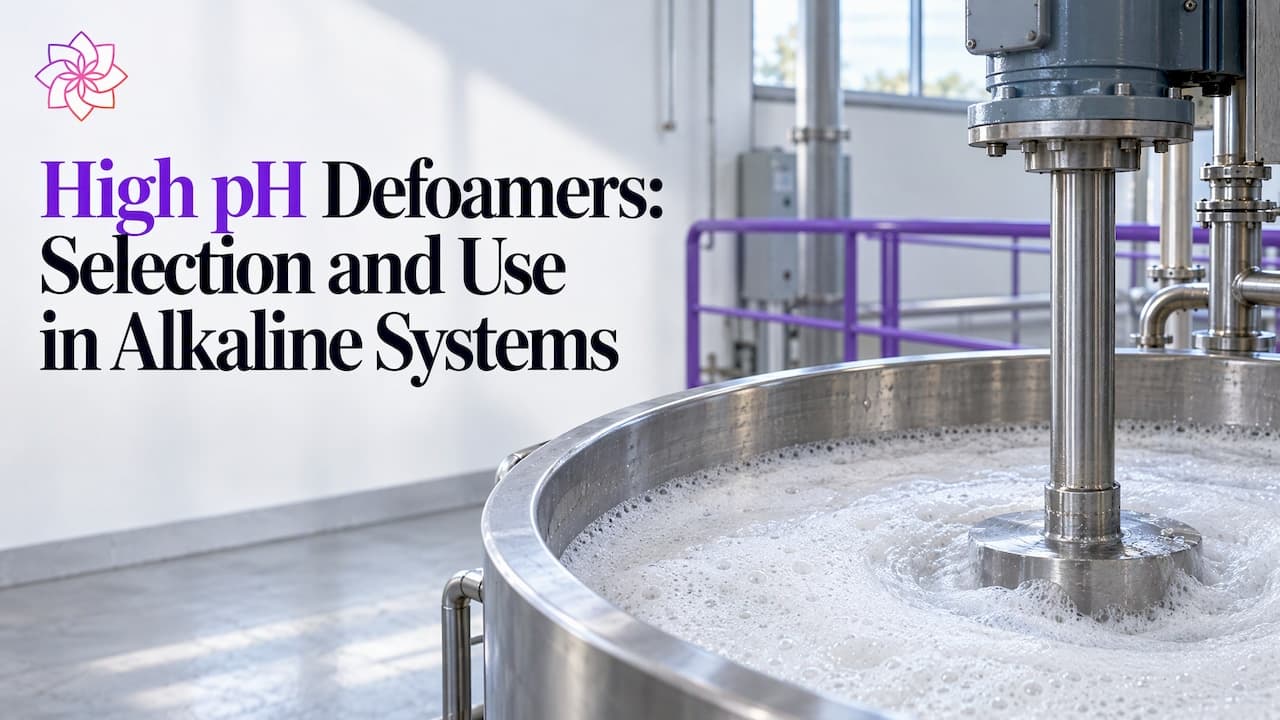
A high pH defoamer is a foam control additive that keeps its knockdown and persistence in alkaline media, typically in waterborne coatings, adhesives and inks neutralized with amines or inorganic bases, or in process streams that run above pH 10. Selection depends on four variables: the chemical stability of the defoamer's active phase at the system pH, its compatibility with the surfactants and dispersants already present, the temperature of processing, and the surface quality required in the cured film or bond line. Each of these is addressed below, together with a dosing method, a validation protocol and a troubleshooting table.
TL;DR
- Alkaline waterborne systems foam because the surfactants, dispersants and wetting agents that stabilize them also stabilize air in the liquid; the defoamer must out-compete them without destabilizing the formulation.
- Above pH 10 and at elevated temperature, hydrophobic silica-based actives have performed best in published comparative testing, so the hydrophobic particle and its carrier are the first items to specify.
- Silicone and non-silicone defoamers both have a place; the choice is governed by recoat, adhesion and cratering risk as much as by pH tolerance.
- Dose from a low starting level, add at the correct stage, and validate under production-like shear, temperature and aging before scale-up.
- Foam control, air release and surface defects are separate measurements and should be tested separately.
In aqueous coatings, pH describes the acid-base balance of the continuous phase. For acrylic and other carboxyl-functional resins, the neutralizing amine or base solubilizes or stabilizes the polymer, so the resin itself sets much of the pH. Waterborne architectural and industrial coatings commonly sit in a mildly alkaline window, while many adhesives, cleaners, pulp and paper streams, and metalworking or saponification processes run considerably higher.
For defoamer selection, three working ranges are useful:
| pH range | Typical systems | Main concern for the defoamer |
|---|---|---|
| 7 to 9 | Acrylic latex paints, water-reducible industrial coatings, most waterborne adhesives | Compatibility with surfactants and avoidance of craters and haze |
| 9 to 10.5 | Amine-neutralized alkali-soluble resin systems, some inks, alkaline primers | Hydrolytic stability of the active phase during shelf storage |
| Above 10.5 | Strongly alkaline cleaners, cementitious and mineral-based systems, process liquors | Retention of knockdown and persistence under alkali and heat |
These ranges are practical groupings used for screening, not formal standards. The actual limit of any defoamer must be established on the target formulation.
Why alkaline waterborne systems foam
Waterborne formulations are prone to foam because they contain stabilizers by design. Dispersants, wetting agents and emulsifiers lower surface tension and form elastic films at the air-liquid interface, which is the mechanism that keeps a lamella from draining and rupturing. Published application guidance for waterborne resins notes that these ingredients make foaming likely, and that incorrect defoamer choice or dosage can in turn cause pinholes, craters and gloss reduction.
Three process conditions aggravate the problem:
- Entrainment during dispersion and letdown. High-speed dispersers draw air into a low-viscosity, mid-solids liquid. The pigment grind stage usually generates the greatest volume of foam, and the letdown stage generates the most stable micro-foam.
- Application shear. Spray, roller, curtain and pump circulation reintroduce air after the product has left the mixing vessel.
- pH drift. If the amine volatilizes or is consumed, the system pH and the resin's solubilization change. An improperly balanced pH can contribute to foam, and it can also alter how a defoamer partitions between phases.
Two distinct problems are often conflated. Macro-foam sits on the surface and collapses readily with a suitable defoamer. Micro-foam and entrained air remain dispersed in the bulk and require a defoamer with air-release (deaerating) character. A product that excels at one may be mediocre at the other, which is why the test plan below measures both.
How high pH affects defoamer stability and performance
A defoamer works by entering the foam lamella, spreading, and creating a bridge or a thin spot that ruptures the film. This requires a hydrophobic, insoluble active that remains finely and stably dispersed in the carrier. High pH challenges that arrangement in several ways.
- Chemical attack on the active phase. Strong alkali, particularly in combination with heat, can degrade components that are stable at neutral pH. Ester-containing carriers and certain emulsifier types are susceptible to saponification, and the siloxane backbone and silica surface treatment can be affected over long exposure at extreme pH.
- Emulsion instability. Many defoamers are supplied as emulsions. Electrolyte load and high ionic strength in alkaline systems can break or coarsen the defoamer emulsion, which first produces craters and later loss of effect.
- Surface chemistry of the particles. Hydrophilic silica dissolves slowly in strong alkali, whereas hydrophobically modified silica resists wetting by the aqueous phase and retains its activity longer.
The published technical evidence on this point is consistent. In comparative testing of silica-based defoamer actives, high-pH and high-temperature conditions were identified as challenging, and polydimethylsiloxane-modified fumed and precipitated silica grades gave the best results, with one precipitated grade performing best in the series. For applications above pH 10 and at high temperatures, such as paper production, that precipitated, strongly hydrophobic silica was named the product of choice, with a hydrophobic fumed grade also recommended for high-pH use. The practical lesson is that the degree of hydrophobization of the particle, and not only the silicone fluid, determines alkaline durability.
Defoamer chemistries for alkaline coatings and adhesives
No single chemistry is best across every alkaline system. The comparison below summarizes general behavior and typical tradeoffs for screening purposes.
| Chemistry | Strengths at high pH | Tradeoffs and risks |
|---|---|---|
| Silicone emulsion with hydrophobic silica | Strong knockdown, low use level, good persistence when the silica is highly hydrophobic | Cratering and recoat problems if poorly compatible; gloss reduction at overdose |
| Silicone oil or compound (non-aqueous carrier) | High efficiency in concentrated or solvent-containing phases | Needs good dispersion; can separate in low-viscosity alkaline systems |
| Polyether-modified siloxane | Balanced foam control and compatibility; tends toward lower defect risk | Lower knockdown than conventional silicone; temperature-dependent solubility (cloud point) |
| Mineral oil based with hydrophobic particles | Economical, robust at moderate alkalinity | Can affect gloss, water resistance and VOC or labeling status |
| Non-silicone polymeric (polyether, fatty alcohol, organic polymer) | Low crater risk, favorable recoatability and adhesion | Typically less persistent in highly foamy, surfactant-rich systems; requires careful dose optimization |
Silicone-free options are frequently specified where adhesion, overprinting or recoating is critical, such as pressure-sensitive adhesives, laminating adhesives, printing inks and multilayer industrial coatings. Silicone-based options are specified where knockdown strength and long-term persistence dominate, such as high-shear processing and heavily surfactant-loaded systems. The ASTRA Chemical defoamer range covers both silicone and non-silicone types, with detail on the ASTRA DF® line and the ASTRA DF NS® line.
Selection criteria for a high pH defoamer
A structured screening procedure avoids repeated trial and error. The following criteria are applied in order.
- System pH and its variation. Record the pH at manufacture, at storage end and at application. A defoamer qualified at pH 8.5 may fail in a system that rises to 10.5 after neutralizer addition.
- Temperature profile. Include grind temperature, hot filling, and storage or transport extremes. Alkali and heat act together.
- Foam type. Decide whether surface foam, micro-foam or entrained air is the dominant defect.
- Surfactant and dispersant package. High loadings of anionic or non-ionic wetting agents call for a more hydrophobic, higher-efficiency defoamer or an additional air-release component.
- Surface quality requirement. High-gloss and clear films tolerate far less defoamer than matte or pigmented systems.
- Downstream operations. Recoating, printing, laminating, bonding and powder or film overcoating all raise the bar for silicone compatibility.
- Regulatory and documentation needs. Confirm that safety data sheets, technical data sheets and regulatory declarations match the end-use of the product.
Dosing and incorporation
The usual error with a defoamer is treating dose as a lever that always improves results. Defoamers are intentionally incompatible to a controlled degree, and excess concentration is a direct route to craters, fish-eyes and haze.
Starting dose. Begin at the low end of the supplier's recommended range, in practice often a fraction of one percent on total formulation weight, and run a ladder study with three to five levels. Select the lowest level that gives acceptable foam control after aging, not the one that performs best on day one.
Stage of addition. A common approach is a split addition:
- A portion in the grind stage, to control foam created by high-shear dispersion of pigments and fillers.
- The remainder in the letdown, added under moderate agitation, to control foam during mixing, filling and application.
Adding all of the defoamer at the end gives poor control in the grind, while adding all of it at the start allows the active phase to be consumed or over-sheared before application.
Incorporation. Add the defoamer into the vortex at moderate speed, so that it is dispersed to the intended droplet size without being broken down into droplets too small to enter the foam lamella. Ensure the product is homogeneous before sampling.
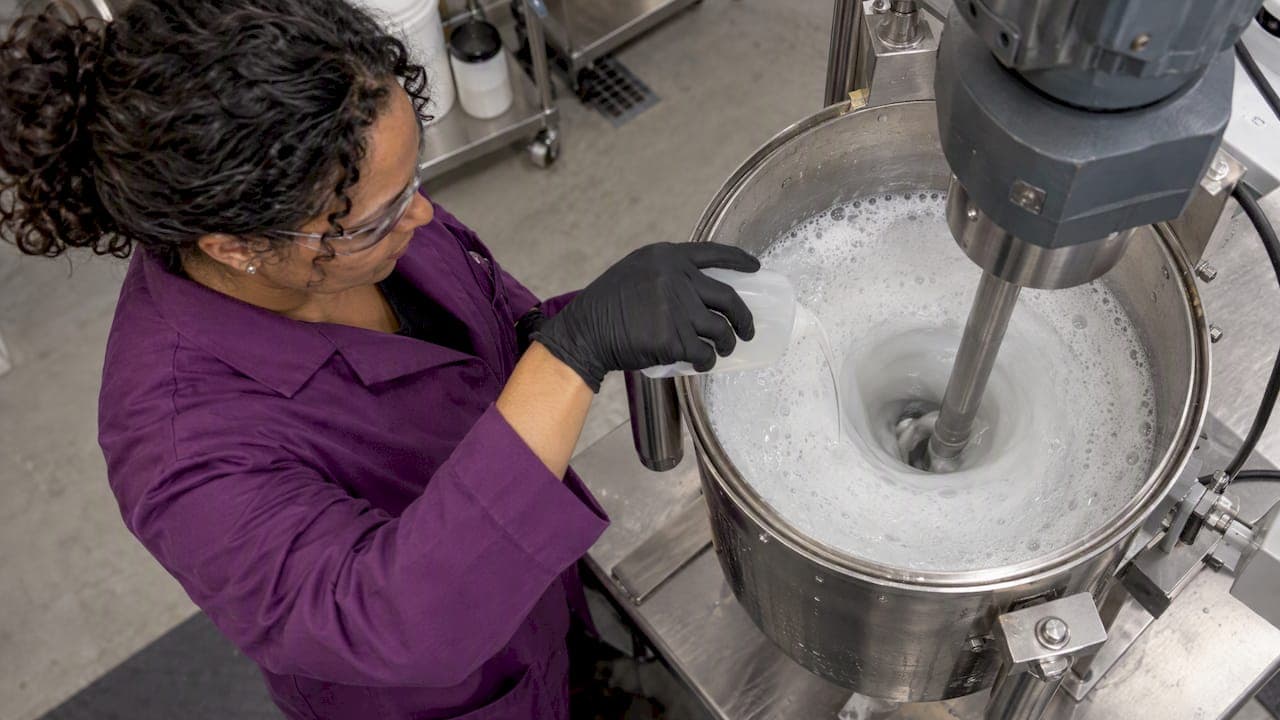
pH order of operations. Where the neutralizing base is added late, evaluate whether the defoamer should precede or follow neutralization. Some emulsions are more stable at the lower pH of an acidic resin dispersion, and a late addition after pH adjustment avoids long hold times under strong alkali.
Compatibility and validation protocol
Laboratory success does not guarantee production success. Industry guidance for adhesives and sealants in OEM assembly recommends that a rigorous test and validation plan be developed with material suppliers and executed in conditions that approximate production as closely as possible. The same source stresses evaluating compatibility with all substrates, cleaning materials and other process components to avoid harmful interactions before cure. For defoamers in alkaline coatings and adhesives, this translates into the following sequence.
- Define pass and fail criteria in advance. Examples include maximum foam volume after a fixed agitation time, density after mixing as an air-content proxy, the absence of craters on a defined substrate, gloss within tolerance, and adhesion or bond strength within specification.
- Foam test. Shake or recirculation tests, or high-speed stirring for a fixed time, with measurement of foam height initially and after several intervals. Run at the real process temperature.
- Air-release test. Measure density of the formulation after agitation, or the time for bubbles to rise and disappear in a drawdown or cup.
- Film or bond-line test. Draw down on the actual substrates used, including pre-treated or contaminated surfaces if these occur in production, and inspect for craters, pinholes, haze and orange peel. For adhesives, evaluate wet-out, open time and bond strength.
- Accelerated aging. Hold samples at elevated temperature for a set period and repeat the foam and surface tests. This reveals hydrolytic or emulsion failure that does not appear in a fresh sample.
- Freeze-thaw and shelf stability. Observe separation, viscosity drift, pH drift and syneresis.
- Pilot scale. Confirm in a batch large enough to reproduce real shear, pumping and filling conditions.
Troubleshooting foam and surface defects in alkaline systems
The table matches typical observations to probable causes and corrective directions.
| Observation | Probable cause | Corrective direction |
|---|---|---|
| Foam returns after several days of storage | Active phase degraded or emulsion destabilized by alkali | Move to a more hydrophobic, alkali-stable active; verify with accelerated aging |
| Craters or fish-eyes on the film | Overdose or incompatibility of the defoamer | Reduce dose, change carrier type, or switch to a polyether-modified or non-silicone option |
| Good surface foam control, but pinholes and micro-bubbles in the film | Insufficient air-release performance | Add or substitute a deaerating component; optimize viscosity and film build |
| Gloss or haze loss | Particles of defoamer too large or too much of it | Lower dose, improve dispersion, test a finer emulsion |
| Foam only appears in the grind | Defoamer added too late | Include a portion of the dose in the grind stage |
| Poor recoat or adhesion | Silicone migration to the surface | Evaluate non-silicone chemistry and run recoat or peel testing |
| Variable results between batches | Inconsistent pH, temperature or addition procedure | Standardize pH specification and addition point; require batch documentation from the supplier |
When a problem persists after these steps, record the pH, temperature, mixing energy, and the composition of the surfactant package, and review the data with the additive supplier's technical staff. Foam problems in alkaline systems are nearly always multifactorial.
Perspective: cost-in-use, not unit cost
Our experience in formulation support is that defoamer decisions are made too often on price per kilogram and too rarely on cost-in-use. A product that needs a higher dose, produces a rework batch, or fails after aging in an alkaline system is expensive regardless of its invoice price.
We design the ASTRA Chemical additive range around performance comparable to premium brands at a lower total cost-in-use, supported by optimized dosage guidance, batch consistency and full technical support. For high pH systems, that means qualifying a defoamer under laboratory conditions that include aging, temperature and the customer's own surfactant package, and documenting the result so that production and regulatory teams work from the same data.
Silicone and non-silicone defoamers are both part of our portfolio because no single chemistry resolves every defect. We prefer to define the foam type, the surface requirement and the downstream process first, and then recommend the product and the dose ladder that fit them.
Astra R&D Team
Qualifying a defoamer with ASTRA Chemical
Formulators running alkaline waterborne coatings, adhesives, inks, plastics or composites can request technical consultation and samples for a defoamer evaluation. ASTRA Chemical supplies silicone and non-silicone defoamers together with dispersants, rheology modifiers and functional coating additives, so that foam control can be matched to the rest of the additive package. The full range is listed on the ASTRA Chemical products page.
Provide the system pH range, processing temperature, resin type and target surface quality with the request, so that a first screening set can be selected on relevant criteria.
FAQ
What makes a defoamer suitable for high pH?
It needs an active phase and carrier that do not degrade in alkali, and an emulsion that stays stable at high ionic strength. Strongly hydrophobic silica-based actives have performed well in comparative testing above pH 10, particularly at elevated temperature. Suitability must still be confirmed on the actual formulation by aging tests.
Is a silicone or non-silicone defoamer better for alkaline coatings?
Neither is universally better. Silicone types generally give stronger knockdown and longer persistence, while non-silicone types reduce the risk of craters and recoat or adhesion problems. The decision follows the foam type, surface requirement and downstream operations.
Why does foam return after a defoamer worked at first?
The usual cause is loss of the active phase through alkaline degradation, emulsion breakdown, or consumption of the defoamer by shear and adsorption onto pigments. Accelerated aging of a sample before approval reveals this failure mode. A split addition, with part of the dose in the letdown, can also restore control.
How much defoamer should be added?
The correct level is the lowest one that meets the foam and surface criteria after aging. Start at the low end of the supplier's range, evaluate a ladder of three to five levels, and avoid overdosing, which is a common source of craters, haze and gloss loss.
Does the defoamer affect adhesion or recoating?
It can, especially with silicone-containing products that migrate to the surface. Confirm compatibility with substrates, cleaning agents and any subsequent coating or bonding step through peel, adhesion and recoat tests before approving the defoamer for production.
Sources
Testing additives for this application?
Send us your current formulation challenge and our technical team will recommend an ASTRA product package for lab screening.